
An Illustrated Proof of the CAP Theorem
An Illustrated Proof of the CAP Theorem
The CAP Theorem is a fundamental theorem in distributed systems that states any distributed system can have at most two of the following three properties.
- Consistency
- Availability
- Partition tolerance
This guide will summarize Gilbert and Lynch's specification and proof of the CAP Theorem with pictures!
What is the CAP Theorem?
The CAP theorem states that a distributed system cannot simultaneously be consistent, available, and partition tolerant. Sounds simple enough, but what does it mean to be consistent? available? partition tolerant? Heck, what exactly do you even mean by a distributed system?
In this section, we'll introduce a simple distributed system and explain what it means for that system to be available, consistent, and partition tolerant. For a formal description of the system and the three properties, please refer to Gilbert and Lynch's paper.
A Distributed System
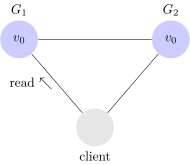
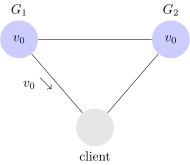
Let's consider a very simple distributed system. Our system is composed of two servers, G1G1 and G2G2. Both of these servers are keeping track of the same variable, vv, whose value is initially v0v0. G1G1 and G2G2 can communicate with each other and can also communicate with external clients. Here's what our system looks like.
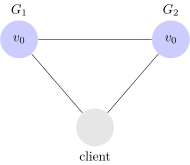
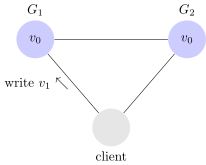
A client can request to write and read from any server. When a server receives a request, it performs any computations it wants and then responds to the client. For example, here is what a write looks like.
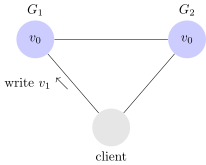
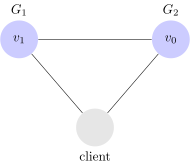
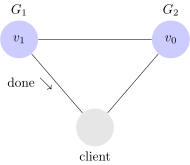
And here is what a read looks like.
Now that we've gotten our system established, let's go over what it means for the system to be consistent, available, and partition tolerant.
Consistency
Here's how Gilbert and Lynch describe consistency.
any read operation that begins after a write operation completes must return that value, or the result of a later write operation
In a consistent system, once a client writes a value to any server and gets a response, it expects to get that value (or a fresher value) back from any server it reads from.
Here is an example of an inconsistent system.
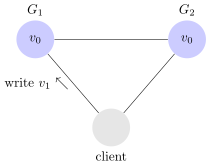
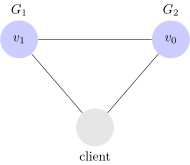
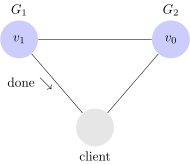
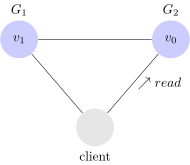
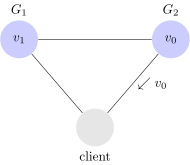
Our client writes v1v1 to G1G1 and G1G1 acknowledges, but when it reads from G2G2, it gets stale data: v0v0.
On the other hand, here is an example of a consistent system.
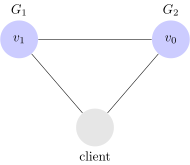
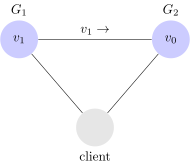
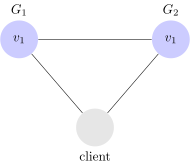
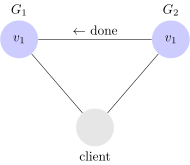
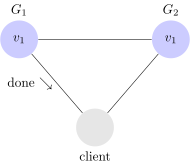
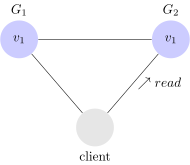
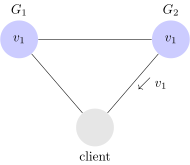
In this system, G1G1 replicates its value to G2G2 before sending an acknowledgement to the client. Thus, when the client reads from G2G2, it gets the most up to date value of vv: v1v1.
Availability
Here's how Gilbert and Lynch describe availability.
every request received by a non-failing node in the system must result in a response
In an available system, if our client sends a request to a server and the server has not crashed, then the server must eventually respond to the client. The server is not allowed to ignore the client's requests.
Partition Tolerance
Here's how Gilbert and Lynch describe partitions.
the network will be allowed to lose arbitrarily many messages sent from one node to another
This means that any messages G1G1 and G2G2 send to one another can be dropped. If all the messages were being dropped, then our system would look like this.
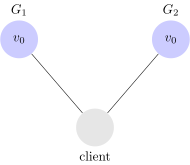
Our system has to be able to function correctly despite arbitrary network partitions in order to be partition tolerant.
The Proof
Now that we've acquainted ourselves with the notion of consistency, availability, and partition tolerance, we can prove that a system cannot simultaneously have all three.
Assume for contradiction that there does exist a system that is consistent, available, and partition tolerant. The first thing we do is partition our system. It looks like this.
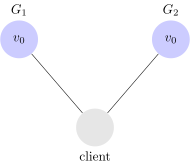
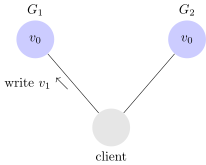
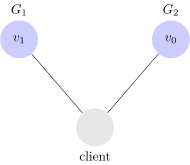
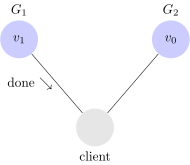
Next, we have our client request that v1v1 be written to G1G1. Since our system is available, G1G1 must respond. Since the network is partitioned, however, G1G1 cannot replicate its data to G2G2. Gilbert and Lynch call this phase of execution α1α1.
Next, we have our client issue a read request to G2G2. Again, since our system is available, G2G2 must respond. And since the network is partitioned, G2G2 cannot update its value from G1G1. It returns v0v0. Gilbert and Lynch call this phase of execution α2α2.
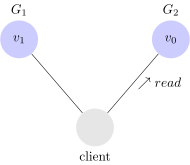
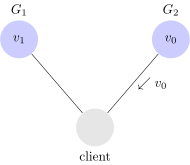
G2G2 returns v0v0 to our client after the client had already written v1v1 to G1G1. This is inconsistent.
We assumed a consistent, available, partition tolerant system existed, but we just showed that there exists an execution for any such system in which the system acts inconsistently. Thus, no such system exists.
An Illustrated Proof of the CAP Theorem的更多相关文章
- 【翻译】Brewer's CAP Theorem CAP定理
Brewer's CAP Theorem 原文地址:http://www.julianbrowne.com/article/brewers-cap-theorem Brewer’s (CAP) The ...
- [转]A plain english introduction to cap theorem
Kaushik Sathupadi Programmer. Creator. Co-Founder. Dad. See all my projects and blogs → A plain engl ...
- CAP theorem
https://en.wikipedia.org/wiki/CAP_theorem
- CAP Confusion: Problems with ‘partition tolerance’
by Henry Robinson, April 26, 2010 The 'CAP' theorem is a hot topic in the design of distributed data ...
- CAP理论中, P(partition tolerance, 分区容错性)的合理解释
在CAP理论中, 对partition tolerance分区容错性的解释一般指的是分布式网络中部分网络不可用时, 系统依然正常对外提供服务, 而传统的系统设计中往往将这个放在最后一位. 这篇文章对这 ...
- 分布式系统的一致性级别划分及Zookeeper一致性级别分析
最近在研究分布式系统的一些理论概念,例如关于分布式系统一致性的讨论,看了一些文章我有一些不解.大多数对分布式系统一致性的划分是将其分为三类:强一致性,顺序一致性以及弱一致性.强一致性(Strict C ...
- Tychonov Theorem
(Remark: The proof presented in this post is a reorganization and interpretation of that given by Ja ...
- CAP Twelve Years Later: How the "Rules" Have Changed
The CAP theorem asserts that any networked shared-data system can have only two of three desirable ...
- 分布式系统理论基础 - CAP
引言 CAP是分布式系统.特别是分布式存储领域中被讨论最多的理论,“什么是CAP定理?”在Quora 分布式系统分类下排名 FAQ 的 No.1.CAP在程序员中也有较广的普及,它不仅仅是“C.A.P ...
随机推荐
- java 中类初始化,构造方法,静态成员变量,静态块的加载顺序
1.编译和运行概念要搞清:编译即javac的过程,负责将.java文件compile成.class文件,主要是类型.格式检查与编译成字节码文件,而加载是指java *的过程,将.class文件加载到内 ...
- 【cf比赛记录】Codeforces Round #601 (Div. 2)
Codeforces Round #601 (Div. 2) ---- 比赛传送门 周二晚因为身体不适鸽了,补题补题 A // http://codeforces.com/contest/1255/p ...
- linux 上使用yum 安装openjdk1.8
使用yum查找jdk: yum search java|grep jdk # yum search java|grep jdk ldapjdk-javadoc.noarch : Javadoc for ...
- 【Dubbo】带着问题看源码:什么是SPI机制?Dubbo是如何实现的?
什么是SPI? 在Java中,SPI全称为 Service Provider Interface,是一种典型的面向接口编程机制.定义通用接口,然后具体实现可以动态替换,和 IoC 有异曲同工之妙. ...
- Mesa: GeoReplicated, Near RealTime, Scalable Data Warehousing
Mesa的定义并没有反映出他的特点,因为分布式,副本,高可用,他都是依赖google的其他基础设施完成的 他最大的特点是,和传统数仓比,可以做到near real-time的返回聚合的查询结果 算入实 ...
- Vue 与 动态组件 import 的尝试
<template> <component :is='fuck' :data='data'></component> </template> <s ...
- 从ASP.NET到ASP.NET Core差异变化
MSDN原文:链接 ASP.NET Core项目为开发人员提供了针对.NET Core,.NET Framework2种实现方式,根据官网通告NETCORE3.0后将取消对.NET Framework ...
- 【转】【Centos】Linux(Centos7)下搭建SVN服务器
系统环境:centos7.2 第一步:通过yum命令安装svnserve,命令如下: yum -y install subversion 此命令会全自动安装svn服务器相关服务和依赖,安装完成会自动停 ...
- 【mybatis】子查询
networkResource的 resultMap <resultMap id="NetworkResultMap" type="com.chinamobile. ...
- J-CUBE Appears at AVATAR Xprize at Geneva 2019
2019年5月27日,瑞士日内瓦,Avatar Xprize发布会隆重举行.非常荣幸的是,J-CUBE也受邀参加此次大会. 关于Avatar Xprize项目的介绍 https://avatar.xp ...