
Translation Lookaside Buffer
COMPUTER ORGANIZATION AND ARCHITECTURE DESIGNING FOR PERFORMANCE NINTH EDITION
In principle, then, every virtual memory reference can cause two physical mem-
ory accesses: one to fetch the appropriate page table entry, and one to fetch the
desired data. Thus, a straightforward virtual memory scheme would have the effect
of doubling the memory access time. To overcome this problem, most virtual
memory schemes make use of a special cache for page table entries, usually called
a translation lookaside buffer (TLB). This cache functions in the same way as a
memory cache and contains those page table entries that have been most recently
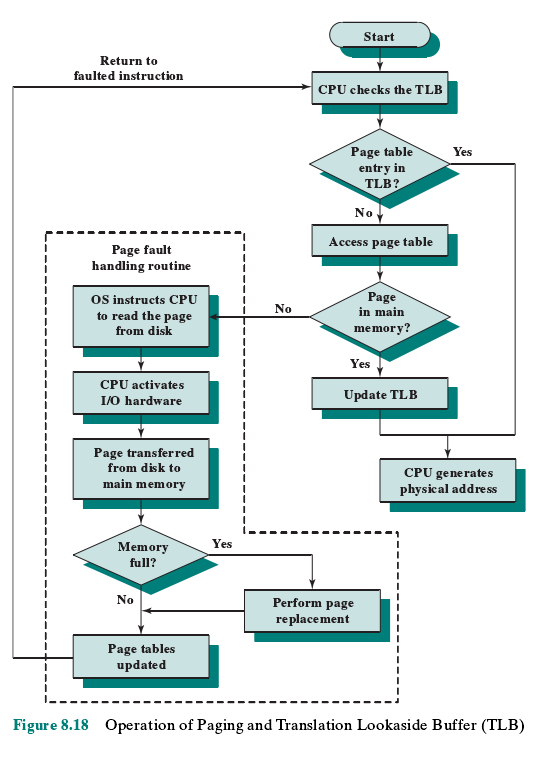
used. Figure 8.18 is a flowchart that shows the use of the TLB. By the principle of
locality, most virtual memory references will be to locations in recently used pages.
Therefore, most references will involve page table entries in the cache. Studies of
the VAX TLB have shown that this scheme can significantly improve performance
[CLAR85, SATY81].
Note that the virtual memory mechanism must interact with the cache system
(not the TLB cache, but the main memory cache). This is illustrated in Figure 8.19.
A virtual address will generally be in the form of a page number, offset. First, the
memory system consults the TLB to see if the matching page table entry is present.
If it is, the real (physical) address is generated by combining the frame number with
the offset. If not, the entry is accessed from a page table. Once the real address is
generated, which is in the form of a tag and a remainder, the cache is consulted to
see if the block containing that word is present (see Figure 4.5). If so, it is returned
to the processor. If not, the word is retrieved from main memory.

The reader should be able to appreciate the complexity of the processor hard-
ware involved in a single memory reference. The virtual address is translated into
a real address. This involves reference to a page table, which may be in the TLB, in
main memory, or on disk. The referenced word may be in cache, in main memory,
or on disk. In the latter case, the page containing the word must be loaded into main
memory and its block loaded into the cache. In addition, the page table entry for
that page must be updated.
Translation Lookaside Buffer的更多相关文章
- 全面学习理解TLB(Translation Look-aside Buffer)地址变换高速缓存
全面学习理解TLB(Translation Look-aside Buffer)地址变换高速缓存 前言: 本文学习思路是:存在缘由 --> 存在好处 --> 定义性质 --> 具 ...
- PatentTips - Virtual translation lookaside buffer
BACKGROUND OF THE INVENTION A conventional virtual-machine monitor (VM monitor) typically runs on a ...
- 【转】TLB(Translation Lookaside Buffers,TLB)的作用
原文网址:http://sdnydubing.blog.163.com/blog/static/137470570201122810503396/ 从虚拟地址到物理地址的转换过程可知:使用一级页表进行 ...
- Linux中Buffer和Cache的区别
1. Cache:缓存区,是高速缓存,是位于CPU和主内存之间的容量较小但速度很快的存储器,因为CPU的速度远远高于主内存的速度,CPU从内存中读取数据需等待很长的时间,而 Cache保存着CPU刚 ...
- armv8 memory translation
AArch32,arm的32bit架构: AArch64,arm的64bit架构: ARMv8.2-LPA,是armv8.2中的新feature,扩大了IPA和PA的支持范围,从48bit扩展到52b ...
- Cache 和 Buffer 都是缓存,主要区别是什么?【转】
作者:Towser 链接:https://www.zhihu.com/question/26190832/answer/32387918 来源:知乎 著作权归作者所有.商业转载请联系作者获得授权,非商 ...
- 【学习笔记】cache/buffer
cache 是为了弥补高速设备和低速设备的鸿沟而引入的中间层,最终起到**加快访问速度**的作用.buffer 的主要目的进行流量整形,把突发的大数量较小规模的 I/O 整理成平稳的小数量较大规模的 ...
- cache和buffer区别探讨
一. 1.Buffer(缓冲区)是系统两端处理速度平衡(从长时间尺度上看)时使用的.它的引入是为了减小短期内突发I/O的影响,起到流量整形的作用.比如生产者——消费者问题,他们产生和消耗资源的速度大体 ...
- PatentTips - Supporting address translation in a virtual machine environment
BACKGROUND A conventional virtual-machine monitor (VMM) typically runs on a computer and presents to ...
随机推荐
- vijos p1002 dp ***
链接:点我 一开始的方程式很好写的,但是数据太大,考虑到石子数目很小,我们对其进行离散化,若相邻两点距离超过ya的值,则后面所有点都往前移动,这里ya的值是可以调整的 #include <ios ...
- stack+DFS ZOJ 1004 Anagrams by Stack
题目传送门 /* stack 容器的应用: 要求字典序升序输出,所以先搜索入栈的 然后逐个判断是否满足答案,若不满足,回溯继续搜索,输出所有符合的结果 */ #include <cstdio&g ...
- DP VK Cup 2012 Qualification Round D. Palindrome pairs
题目地址:http://blog.csdn.net/shiyuankongbu/article/details/10004443 /* 题意:在i前面找回文子串,在i后面找回文子串相互配对,问有几对 ...
- iOS 初步单元测试
- (void)testExample { // This is an example of a functional test case. // Use XCTAssert and related ...
- HDU1576 A/B(乘法逆元)
题目的代数系统可以看作整数模9973乘法群?然后存在乘法逆元. 于是题目要求$A \div B \pmod {9973} $其实就相当于求$A \times B^{-1}\pmod {9973} $. ...
- HDU4081 Qin Shi Huang's National Road System(次小生成树)
枚举作为magic road的边,然后求出A/B. A/B得在大概O(1)的时间复杂度求出,关键是B,B是包含magic road的最小生成树. 这么求得: 先在原图求MST,边总和记为s,顺便求出M ...
- CodeForces 450B (矩阵快速幂模板题+负数取模)
题目链接:http://acm.hust.edu.cn/vjudge/problem/viewProblem.action?id=51919 题目大意:斐波那契数列推导.给定前f1,f2,推出指定第N ...
- 用iftop监控流量
1.下载iftop http://pan.baidu.com/share/link?shareid=387372457&uk=1829018343 或 wget http://www.ex-p ...
- CC150 - 11.5
Question: Given a sorted array of strings which is interspersed with empty strings, write a method t ...
- Redis中7种集合类型应用场景
StringsStrings 数据结构是简单的key-value类型,value其实不仅是String,也可以是数字.使用Strings类型,你可以完全实现目前 Memcached 的功能,并且效率更 ...