
Determining if a point lies on the interior of a polygon
Determining if a point lies on the interior of a polygon
Written by Paul Bourke November 1987
Solution 1 (2D)
The following is a simple solution to the problem often encountered in computer graphics, determining whether or not a point (x,y) lies inside or outside a 2D polygonally bounded plane. This is necessary for example in applications such as polygon filling on raster devices, hatching in drafting software, and determining the intersection of multiple polygons.
Consider a polygon made up of N vertices (xi,yi) where i ranges from 0 to N-1. The last vertex (xN,yN) is assumed to be the same as the first vertex (x0,y0), that is, the polygon is closed. To determine the status of a point (xp,yp) consider a horizontal ray emanating from (xp,yp) and to the right. If the number of times this ray intersects the line segments making up the polygon is even then the point is outside the polygon. Whereas if the number of intersections is odd then the point (xp,yp) lies inside the polygon. The following shows the ray for some sample points and should make the technique clear.
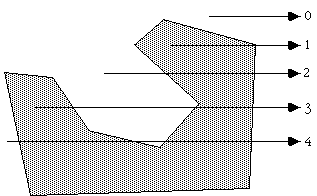
Note: for the purposes of this discussion 0 will be considered even, the test for even or odd will be based on modulus 2, that is, if the number of intersections modulus 2 is 0 then the number is even, if it is 1 then it is odd.
The only trick is what happens in the special cases when an edge or vertex of the polygon lies on the ray from (xp,yp). The possible situations are illustrated below.
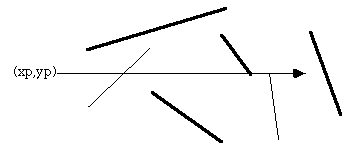
The thick lines above are not considered as valid intersections, the thin lines do count as intersections. Ignoring the case of an edge lying along the ray or an edge ending on the ray ensures that the endpoints are only counted once.
Note that this algorithm also works for polygons with holes as illustrated below
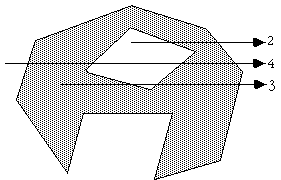
The following C function returns INSIDE or OUTSIDE indicating the status of a point P with respect to a polygon with N points.
#define MIN(x,y) (x < y ? x : y)

#define MAX(x,y) (x > y ? x : y)

#define INSIDE 0

#define OUTSIDE 1

typedef struct {

   double x,y;

} Point;

int InsidePolygon(Point *polygon,int N,Point p)

{

  int counter = 0;

  int i;

  double xinters;

  Point p1,p2;

  p1 = polygon[0];

  for (i=1;i<=N;i++) {

    p2 = polygon[i % N];

    if (p.y > MIN(p1.y,p2.y)) {

      if (p.y <= MAX(p1.y,p2.y)) {

        if (p.x <= MAX(p1.x,p2.x)) {

          if (p1.y != p2.y) {

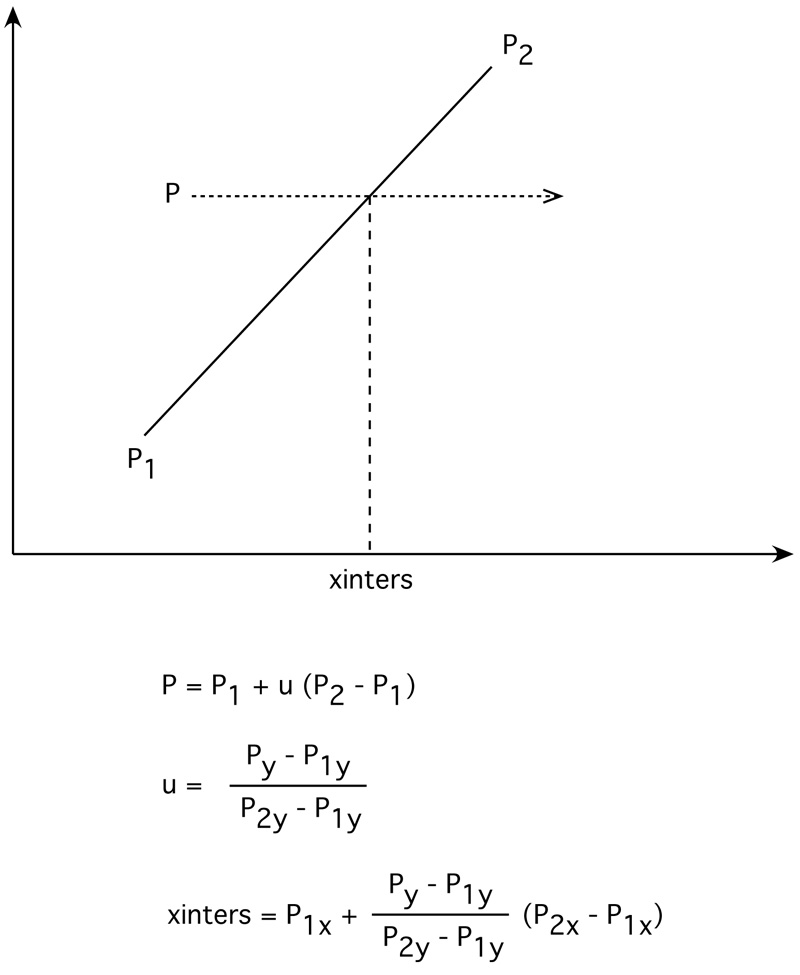
            xinters = (p.y-p1.y)*(p2.x-p1.x)/(p2.y-p1.y)+p1.x;

            if (p1.x == p2.x || p.x <= xinters)

              counter++;

          }

        }

      }

    }

    p1 = p2;

  }

  if (counter % 2 == 0)

    return(OUTSIDE);

  else

    return(INSIDE);

}
The following code is by Randolph Franklin, it returns 1 for interior points and 0 for exterior points.
    int pnpoly(int npol, float *xp, float *yp, float x, float y)

    {

      int i, j, c = 0;

      for (i = 0, j = npol-1; i < npol; j = i++) {

        if ((((yp[i] <= y) && (y < yp[j])) ||

             ((yp[j] <= y) && (y < yp[i]))) &&

            (x < (xp[j] - xp[i]) * (y - yp[i]) / (yp[j] - yp[i]) + xp[i]))

          c = !c;

      }

      return c;

    }
Contribution by Alexander Motrichuk:
//SOLUTION #1 (2D) - Redesigned

#define MIN(x,y) (x < y ? x : y)

#define MAX(x,y) (x > y ? x : y)

#define INSIDE    1

#define OUTSIDE   0

struct Point

{

    Point() : x(.), y(.) {};

    Point(double x1, double y1) : x(x1), y(y1) {};

    bool operator==(const Point& _right)

    {

        return x == _right.x && y == _right.y;

    };

    double x, y;

};

//horizintal left cross over direction algorithm

//-----------------------------------------------

//  bound   |   value that will be returned only if (p) lies on the bound or vertex

int InsidePolygon(Point* polygon, int N, Point p, int bound)

{

    //cross points count of x

    int __count = ;

    //neighbour bound vertices

    Point p1, p2;

    //left vertex

    p1 = polygon[];

    //check all rays

    for(int i = ; i <= N; ++i)

    {

        //point is an vertex

        if(p == p1) return bound;

        //right vertex

        p2 = polygon[i % N];

        //ray is outside of our interests

        if(p.y < MIN(p1.y, p2.y) || p.y > MAX(p1.y, p2.y))

        {

            //next ray left point

            p1 = p2; continue;

        }

        //ray is crossing over by the algorithm (common part of)

        if(p.y > MIN(p1.y, p2.y) && p.y < MAX(p1.y, p2.y))

        {

            //x is before of ray

            if(p.x <= MAX(p1.x, p2.x))

            {

                //overlies on a horizontal ray

                if(p1.y == p2.y && p.x >= MIN(p1.x, p2.x)) return bound;

                //ray is vertical

                if(p1.x == p2.x)

                {

                    //overlies on a ray

                    if(p1.x == p.x) return bound;

                    //before ray

                    else ++__count;

                }

                //cross point on the left side

                else

                {

                    //cross point of x

                    double xinters = (p.y - p1.y) * (p2.x - p1.x) / (p2.y - p1.y) + p1.x;

                    //overlies on a ray

                    if(fabs(p.x - xinters) < __DBL_EPSILON__) return bound;

                    //before ray

                    if(p.x < xinters) ++__count;

                }

            }

        }

        //special case when ray is crossing through the vertex

        else

        {

            //p crossing over p2

            if(p.y == p2.y && p.x <= p2.x)

            {

                //next vertex

                const Point& p3 = polygon[(i+) % N];

                //p.y lies between p1.y & p3.y

                if(p.y >= MIN(p1.y, p3.y) && p.y <= MAX(p1.y, p3.y))

                {

                    ++__count;

                }

                else

                {

                    __count += ;

                }

            }

        }

        //next ray left point

        p1 = p2;

    }

    //EVEN

    if(__count %  == ) return(OUTSIDE);

    //ODD

    else return(INSIDE);

}
Quote: "For most of the algorithms above there is a pathological case if the point being queried lies exactly on a vertex. The easiest way to cope with this is to test that as a separate process and make your own decision as to whether you want to consider them inside or outside."
Contribution in VBA by Giuseppe Iaria:
'---------------------------------------------------------------------------------------------------------

'************************************ Function InsidePolygon *************************************

'---------------------------------------------------------------------------------------------------------

'VBA implementation of the theory provided by Paul Bourke (http://paulbourke.net/geometry/polygonmesh/)

'author: ing. Giuseppe Iaria - rev. 20/08/2014

'---------------------------------------------------------------------------------------------------------

'The function is based on Solution 1 (2D)

'The function determines if a point P lies inside or outside a Polygon, returning "True" or "False"

'The points are defined through the user-defined type "Point"

'The Polygon is an array of points, each being a user-defined type "Point"

'The Polygon is implemented assuming a "Base 1" condition, so the "Option Base 1" statement is required

'The optional argument "OnPolygonBorder" deals with these special cases:

' - P lies on a vertex of the Polygon

' - P lies on a line segment of the Polygon

'If omitted or passed as "False", and a special case occurs, then the function returns "False"

'If passed as "True", and a special case occurs, then the function returns "True"

'Auxiliary functions used:

' - DistancePointSegment: determines the distance between a point and a line segment

' - Distance2Point: determines the distance between two points

'Both the auxiliary functions have been developed on:

' - the theory by Paul Bourke (http://paulbourke.net/geometry/pointlineplane/)

' - an original VBA code by Brandon Crosby (http://paulbourke.net/geometry/pointlineplane/source.vba)

'---------------------------------------------------------------------------------------------------------

Option Base

Public Type Point

    x As Double

    y As Double

End Type

Public Function InsidePolygon(Polygon() As Point, P As Point, Optional ByVal OnPolygonBorder As Boolean) As Boolean

Dim counter As Integer, i As Integer, ip1 As Integer

Dim xInters As Double, dist As Double

Const EPS As Single = 0.0001

'Check if the point lies on a polygon's vertex or line segment

For i =  To UBound(Polygon)

    ip1 = i Mod UBound(Polygon) +

    dist = DistancePointSegment(P, Polygon(i), Polygon(ip1))

    If dist < EPS Then

        If OnPolygonBorder Then

            InsidePolygon = True

            Else

            InsidePolygon = False

        End If

        Exit Function

    End If

    Next i

'Determine the numbers of intersection between the orizzontal ray from point and polygon

For i =  To UBound(Polygon)

    ip1 = i Mod UBound(Polygon) +

    If P.y > IIf(Polygon(i).y < Polygon(ip1).y, Polygon(i).y, Polygon(ip1).y) Then

        If P.y <= IIf(Polygon(i).y > Polygon(ip1).y, Polygon(i).y, Polygon(ip1).y) Then

            If P.x <= IIf(Polygon(i).x > Polygon(ip1).x, Polygon(i).x, Polygon(ip1).x) Then

                If Polygon(i).y <> Polygon(ip1).y Then

                    xInters = Polygon(i).x + (Polygon(ip1).x - Polygon(i).x) * (P.y - Polygon(i).y) / (Polygon(ip1).y - Polygon(i).y)

                    If (Polygon(i).x = Polygon(ip1).x) Or (P.x <= xInters) Then counter = counter +

                End If

            End If

        End If

    End If

    Next i

If counter Mod  =  Then InsidePolygon = False Else InsidePolygon = True

End Function

Private Function DistancePointSegment(P As Point, P1 As Point, P2 As Point) As Double

Dim LineMag As Double, u As Double

Dim d1 As Double, d2 As Double

Dim Pint As Point

Const EPS As Single = 0.0001

LineMag = Distance2Point(P1, P2)

If LineMag < EPS Then Exit Function

u = (((P.x - P1.x) * (P2.x - P1.x)) + ((P.y - P1.y) * (P2.y - P1.y))) / LineMag ^

If u <  Or u >  Then

    d1 = Distance2Point(P, P1)

    d2 = Distance2Point(P, P2)

    If d1 > d2 Then DistancePointSegment = d2 Else DistancePointSegment = d1

    Else

    Pint.x = P1.x + u * (P2.x - P1.x)

    Pint.y = P1.y + u * (P2.y - P1.y)

    DistancePointSegment = Distance2Point(P, Pint)

End If

End Function

Private Function Distance2Point(P1 As Point, P2 As Point) As Double

Distance2Point = Sqr((P2.x - P1.x) ^  + (P2.y - P1.y) ^ )

End Function
Contribution written in c# by Jerry Knauss:
public static bool Contains( Point[] points, Point p )

{

   bool result = false;

   for( int i = ; i < points.Length - ; i++ )

   {

      if( ( ( ( points[ i +  ].Y <= p.Y ) && ( p.Y < points[ i ].Y ) ) || ( ( points[ i ].Y <= p.Y ) && ( p.Y < points[ i +  ].Y ) ) ) && ( p.X < ( points[ i ].X - points[ i +  ].X ) * ( p.Y - points[ i +  ].Y ) / ( points[ i ].Y - points[ i +  ].Y ) + points[ i +  ].X ) )

      {

         result = !result;

      }

   }

   return result;

}
Solution 2 (2D)
Another solution forwarded by Philippe Reverdy is to compute the sum of the angles made between the test point and each pair of points making up the polygon. If this sum is 2pi then the point is an interior point, if 0 then the point is an exterior point. This also works for polygons with holes given the polygon is defined with a path made up of coincident edges into and out of the hole as is common practice in many CAD packages.
The inside/outside test might then be defined in C as
typedef struct {

   int h,v;

} Point;

int InsidePolygon(Point *polygon,int n,Point p)

{

   int i;

   double angle=0;

   Point p1,p2;

   for (i=0;i<n;i++) {

      p1.h = polygon[i].h - p.h;

      p1.v = polygon[i].v - p.v;

      p2.h = polygon[(i+1)%n].h - p.h;

      p2.v = polygon[(i+1)%n].v - p.v;

      angle += Angle2D(p1.h,p1.v,p2.h,p2.v);

   }

   if (ABS(angle) < PI)

      return(FALSE);

   else

      return(TRUE);

}

/*

   Return the angle between two vectors on a plane

   The angle is from vector 1 to vector 2, positive anticlockwise

   The result is between -pi -> pi

*/

double Angle2D(double x1, double y1, double x2, double y2)

{

   double dtheta,theta1,theta2;

   theta1 = atan2(y1,x1);

   theta2 = atan2(y2,x2);

   dtheta = theta2 - theta1;

   while (dtheta > PI)

      dtheta -= TWOPI;

   while (dtheta < -PI)

      dtheta += TWOPI;

   return(dtheta);

}
Solution 3 (2D)
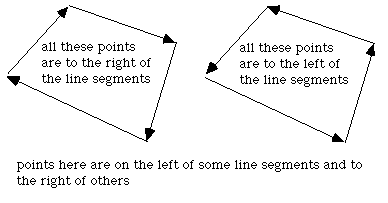
There are other solutions to this problem for polygons with special attributes. If the polygon is convex then one can consider the polygon as a "path" from the first vertex. A point is on the interior of this polygons if it is always on the same side of all the line segments making up the path.
Given a line segment between P0 (x0,y0) and P1 (x1,y1), another point P (x,y) has the following relationship to the line segment.
Compute
(y - y0) (x1 - x0) - (x - x0) (y1 - y0)
if it is less than 0 then P is to the right of the line segment, if greater than 0 it is to the left, if equal to 0 then it lies on the line segment.
Solution 4 (3D)
|
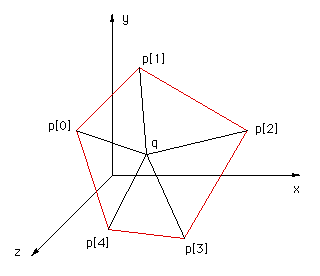
This solution was motivated by solution 2 and correspondence with Reinier van Vliet and Remco Lam. To determine whether a point is on the interior of a convex polygon in 3D one might be tempted to first determine whether the point is on the plane, then determine it's interior status. Both of these can be accomplished at once by computing the sum of the angles between the test point (q below) and every pair of edge points p[i]->p[i+1]. This sum will only be 2pi if both the point is on the plane of the polygon AND on the interior. The angle sum will tend to 0 the further away from the polygon point q becomes. |
 |
The following code snippet returns the angle sum between the test point q and all the vertex pairs. Note that the angle sum is returned in radians.
typedef struct {

   double x,y,z;

} XYZ;

#define EPSILON  0.0000001

#define MODULUS(p) (sqrt(p.x*p.x + p.y*p.y + p.z*p.z))

#define TWOPI 6.283185307179586476925287

#define RTOD 57.2957795

double CalcAngleSum(XYZ q,XYZ *p,int n)

{

   int i;

   double m1,m2;

   double anglesum=0,costheta;

   XYZ p1,p2;

   for (i=0;i<n;i++) {

      p1.x = p[i].x - q.x;

      p1.y = p[i].y - q.y;

      p1.z = p[i].z - q.z;

      p2.x = p[(i+1)%n].x - q.x;

      p2.y = p[(i+1)%n].y - q.y;

      p2.z = p[(i+1)%n].z - q.z;

      m1 = MODULUS(p1);

      m2 = MODULUS(p2);

      if (m1*m2 <= EPSILON)

         return(TWOPI); /* We are on a node, consider this inside */

      else

         costheta = (p1.x*p2.x + p1.y*p2.y + p1.z*p2.z) / (m1*m2);

      anglesum += acos(costheta);

   }

   return(anglesum);

}
Note
For most of the algorithms above there is a pathological case if the point being queries lies exactly on a vertex. The easiest way to cope with this is to test that as a separate process and make your own decision as to whether you want to consider them inside or outside.
Determining if a point lies on the interior of a polygon的更多相关文章
- [算法]A General Polygon Clipping Library
A General Polygon Clipping Library Version 2.32 http://www.cs.man.ac.uk/~toby/alan/software/gpc.h ...
- postgis几何操作函数集
管理操作函数 AddGeometryColumn - Adds a geometry column to an existing table of attributes. By default use ...
- linux tcp调优
Linux TCP Performance Tuning News Linux Performance Tuning Recommended Books Recommended Links Linux ...
- simplestyle
simplestyle-spec A simple specification for styling GeoJSON data. Versions 1.1.0 Adds properties to ...
- MySQL所有函数及操作符
参考:Function and Operator Reference Name Description ABS() Return the absolute value ACOS() Return th ...
- OpenGL ES 正反面设置指令
在OpenGL ES 中,仅有一种表面网格表示方式,那就是三角形. 三角形的三个顶点,可以组几个面?有答 1 的没有?有!那就是还不懂OpenGL ES 的我. 事实上,一张纸是有正反面的,那么一个三 ...
- GDI+ Tutorial for Beginners
原文 GDI+ Tutorial for Beginners GDI+ is next evolution of GDI. Using GDI objects in earlier versions ...
- Extensions for Spatial Data
http://dev.mysql.com/worklog/task/?spm=5176.100239.blogcont4270.8.j3asa7&id=6609 前文: 这两天因为项目原因看了 ...
- mysql 函数表
Name Description ABS() Return the absolute value ACOS() Return the arc cosine ADDDATE() Add time val ...
随机推荐
- (Python)list的内建函数 filter(), map(), 和 reduce()
这一节,我们将主要学习用于list的三个内建函数: filter(), map(), 和 reduce(). 1.filter(function, sequence) 逐个从sequence中取一个 ...
- JS-字符串操作,查找显示高亮
<!DOCTYPE HTML><html><head><meta http-equiv="Content-Type" content=&q ...
- js时间 字符串相互转化
js的时间和字符串的转化的讲解是有很多文章的,基本的都是一致的原理.不过曾经碰到过一个比较坑爹的需求,看到网上很少有相关的总结,所以自己简单的记录一下,给后来的同学们点思路. 当时的需求是这样子的,某 ...
- 用SQL语句,删除掉重复项只保留一条
用SQL语句,删除掉重复项只保留一条 在几千条记录里,存在着些相同的记录,如何能用SQL语句,删除掉重复的呢1.查找表中多余的重复记录,重复记录是根据单个字段(peopleId)来判断 select ...
- Windows Phone 8.1商店启动协议
最近开发wp8.1已经两个月了,感觉坑不少,原来8时代的商店api多明了,微软不给封装就算了,至少你要在msdn上明显的地方标注下啊...................顺便在吐槽下bing,找了一个 ...
- UART的CTS与RTS
在RS232中本来CTS 与RTS 有明确的意义,但自从贺氏(HAYES) 推出了聪明猫(SmartModem)后就有点混淆了.在RS232中RTS 与CTS 是用来半双工模式下的方向切换:HAYES ...
- 5.7 NDK开发
JNI开发流程主要分为以下6步: 编写Java源代码 将Java源代码编译成class字节码文件 用javah -jni命令生成.h头文件(-jni参数表示将class中用native声明的函数生成j ...
- swoole 安装
swoole 安装: 1. 下载源代码,我下载的是1.8.6版本wget https://github.com/swoole/swoole-src/archive/1.8.6-stable.tar.g ...
- python+图像分割seg
好痛苦 1.目前思路为HOG+SVM 提取HOG时候发现,包装的lib cv2 里有hog算子,但是函数是指针形式.不会用了.. 现在改用推荐的scikits.image , from skimage ...
- Css3图标库
最近在研究icon font图标字库,觉得很有意思,于是找了一些比较好的在线字库.大都是开源的,而且各有特色,推荐给大家! 阿里icon font字库 http://www.iconfont.cn/ ...