
Mybatis中的collection、association来处理结果映射
最近几天闲下来,主动把之前的代码优化了一下:)
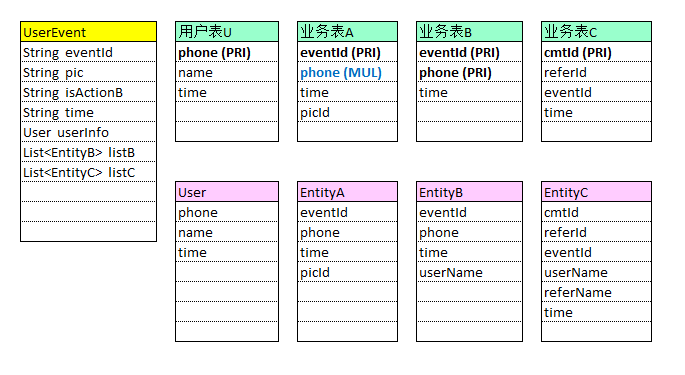
原处理

 1  String eventId = "";

 2  String aTime = "";

 3  for (UserEvent event : userEventList) {

 4       eventId = event.getEventId();

 5

 6       // 获取业务B信息

 7       List<EntityB> listB = mapperB.selectBInfoByEventId(eventId);

 8       event.setListB(listB);

 9

10      // 获取业务C信息

11      List<EntityC> listC = mapperC.selectCInfoByEventId(eventId);

12      event.setListC(listC);

13

14      // 查看是否有业务B处理

15      EntityB entityB = mapperB.selectBInfoByPrimary(phone, eventId);

16      event.setIsActionB(null == entityB ? "false" : "true");

17

18      // 获取业务A和用户信息

19      User userInfo = mapperA.selectEventUserInfoByEventId(eventId);

20      if(null != userInfo){

21          aTime = userInfo.getTime();

22          event.setTime(aTime == null ? "" : sdfMd.format(sdfYmd.parse(aTime)));

23                      event.setUserInfo(userInfo);

24       }

25  }
 1   <select id="selectBInfoByEventId" parameterType="String" resultType="EntityA">

 2     SELECT

 3       B.phone     AS phone,

 4       B.time      AS time,

 5       U.name      AS userName

 6     FROM table_b B

 7     LEFT JOIN user U ON U.phone = B.phone

 8     WHERE B.event_id = #{eventId}

 9     ORDER BY B.time ASC

10   </select>

11   <select id="selectCInfoByEventId" parameterType="String" resultType="EntityC">

12     SELECT

13       C.cmtId,

14       C.referId,

15       C.time,

16       U.name   AS userName

17       ( SELECT TU.name FROM table_c TC

18         LEFT JOIN user TU ON TU.phone = TC.phone

19         WHERE TC.cmt_id = TC.refer_id

20        ) AS referName

21     FROM table_c C

22       LEFT JOIN user U ON C.phone = U.phone

23     WHERE C.event_id = #{eventId}

24     ORDER BY C.time ASC

25   <select id="selectEventUserInfoByEventId" parameterType="java.lang.String" resultType="User">

26       SELECT

27           U.name,

28           U.picId,

29           A.time

30        FROM table_a A

31        LEFT JOIN user U ON U.phone = A.phone

32       WHERE A.event_id = #{eventId}

33   </select>
优化分析
- 在代码结构上,要避免在for循环中作查询处理。考虑将查询参数evenId从for循环中提取出来,做批量查询,然后再将查询结果设定到对应的实体类中。
- 在业务上,对于每一个UserEvent中的eventId,业务表A中必定对应有一条记录,而在业务表B和业务表C中则未必有与这个eventId关联的数据。因此,可以将业务表A作为主表,通过eventId与另外几个表关联查询。查询次数也由原来的至少四次减少为一次查询。
- 对于联合查询的结果,以UserEvent作为查询结果的实体类,使用Mybatis中的collection、association来处理结果映射。
- 另外,各业务表的查询中都有与用户表User的关联,考虑将各业务信息的查询处理创建为视图。这样不仅能简化联合查询中SQL语句,也可以隔离基础表的数据。
优化后的代码
  int eventSize = userEventList.size();

  List<String> eventIds = new ArrayList<String>();

  // 如果考虑去掉重复数据,可以使用集合Set,但是作为Mybatis的输入参数,最后还是需要将Set转化为List。
   // 此处直接使用List,因为在业务上排除了重复数据的可能性。

  for (int i = 0; i < eventSize; i++) {

     eventIds.add(userEventList.get(i).getEventId());

  }

  Map<String, Object> paramsMap = new HashMap<String, Object>();

  paramsMap.put("eventIds", eventIds);

  paramsMap.put("phone", phone);

  List<UserEvent> eventInfoList = eventMapper.selectUserEventInfo(paramsMap);

  // 将查询结果转化为Map存储,方便调用

  Map<String, UserEvent> eventInfoMap = new HashMap<String, UserEvent>();

  for(UserEvent event : eventInfoList){

     eventInfoMap.put(event.getEventId(), event);

  }

  UserEvent newEvent = null;

  String aTime = null;

  for(UserEvent event : roadEventList){ // 从查询结果Map中取出补充信息,保存到原UserEvent对象中

     newEvent =eventInfoMap.get(event.getEventId());

     if(null != newEvent ){

         aTime = newEvent.getTime();

         event.setTime(aTime == null ? "" : sdfMd.format(sdfYmd.parse(aTime )));

         event.setIsActionB(newEvent.getIsActionB() == null ? "false" : newEvent.getIsActionB());

         event.setUserInfo(newEvent.getUserInfo());

         event.setListB(newEvent.getListB());

         event.setListC(newEvent.getListC());

     }

 }
    <resultMap id="UserMap" type="User">

        <result column="name" property="name" />

        <result column="picId" property="picId" />

        <result column="time" property="time" />

    </resultMap>

    <resultMap id="BMap" type="EntityB">

        <id column="bPhone" property="phone" />

        <result column="bUserName" property="userName" />

         <result column="bTime" property="time" />

     </resultMap>

     <resultMap id="CMap" type="EntityC">

         <id column="cmtId" property="cmtId" />

         <result column="referId" property="referId" />

         <result column="cUserName" property="userName" />

         <result column="referName" property="referName" />

         <result column="cTime" property="time" />

     </resultMap>

     <resultMap id="EventResultMap" type="com.xxxx.bean.UserEvent">

         <id column="eventId" property="eventId" />

         <result column="time" property="time" />

         <result column="isActionB" property="isActionB" />

         <association property="userInfo" resultMap="UserMap" />

         <collection property="listB" resultMap="BMap" />

         <collection property="listC" resultMap="CMap" />

     </resultMap>

     <select id="selectUserEventInfo" resultMap="EventResultMap">

       SELECT

           A.eventId,

           A.time,

           A.name,

           A.picId,

           CASE WHEN B.phone = #{phone} THEN "true" ELSE "false" END AS isActionB,

           B.phone          AS bPhone,

           B.userName       AS bUserName,

           B.time           AS bTime,

           C.cmtId,

           C.referId,

           C.userName       AS cUserName,

           C.referName      AS referName,

           C.time           AS cTime

        FROM v_table_a A

        LEFT JOIN v_table_b B ON B.eventId = A.eventId

        LEFT JOIN v_table_c C ON C.eventId = A.eventId

       <where>

           A.event_id in

           <foreach collection="eventIds" index="" item="eventId"
            open="(" separator="," close=")">

                 #{eventId}

           </foreach>

       </where>;

   </select>
编码时需要注意的几个地方
1. 复杂对象的映射解析
  <!-- spring-mybatis.xml文件 -->

  <!-- 配置sqlSessionFactory -->

  <bean id="sqlSessionFactory" class="org.mybatis.spring.SqlSessionFactoryBean">

      <property name="dataSource" ref="dataSource" />
    <!-- 将各Java类的简写别名单独放到文件mybatis.xml中,方便修改和管理 -->

      <property name="configLocation" value="classpath:xml/mybatis.xml" />
      <property name="mapperLocations" value="classpath:sql/*.xml" />

  </bean>
  <!-- mybatis.xml文件 -->

  <configuration>

      <typeAliases>

          <typeAlias alias="EntityA" type="com.xxxx.model.EntityA" />

          <typeAlias alias="EntityB" type="com.xxxx.model.EntityB" />

          <typeAlias alias="EntityC" type="com.xxxx.model.EntityC" />

          <typeAlias alias="User" type="com.xxxx.model.User" />

      </typeAliases>

  </configuration>
2. foreach标签的使用
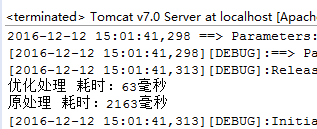
处理时间对比
http://www.cnblogs.com/quiet-snowy-day/p/6166340.html
Mybatis中的collection、association来处理结果映射的更多相关文章
- Mybatis中使用collection进行多对多双向关联示例(含XML版与注解版)
Mybatis中使用collection进行多对多双向关联示例(含XML版与注解版) XML版本: 实体类: @Data @NoArgsConstructor public class Course ...
- 谈一下思考,关于mybatis中<foreach collection="list">中list得来的原因 没看到官方说明
<foreach> 是在sql语句中进行多个id查询 时用到的,因为mybatis代替jdbc和hibernate, 使用 在xml文件中编写sql语句,这是一个标签文件.然后在 dao层 ...
- Mybatis中的collection和association一关系
collection 一对多和association的多对一关系 学生和班级的一对多的例子 班级类: package com.glj.pojo; import java.io.Serializable ...
- mybatis 中 foreach collection的三种用法(转)
文章转自 https://blog.csdn.net/qq_24084925/article/details/53790287 oreach的主要用在构建in条件中,它可以在SQL语句中进行迭代一个集 ...
- mybatis 中 foreach collection的三种用法
foreach的主要用在构建in条件中,它可以在SQL语句中进行迭代一个集合. foreach元素的属性主要有 item,index,collection,open,separator,close. ...
- Mybatis 中 foreach collection 的三种用法
foreach的主要用在构建in条件中,它可以在SQL语句中进行迭代一个集合. foreach元素的属性主要有 item,index,collection,open,separator,close. ...
- mybatis中foreach collection的三种用法
foreach的主要用在构建in条件中,它可以在SQL语句中进行迭代一个集合. foreach元素的属性主要有 item,index,collection,open,separator,close. ...
- MyBatis 中 resultMap 详解
resultMap 是 Mybatis 最强大的元素之一,它可以将查询到的复杂数据(比如查询到几个表中数据)映射到一个结果集当中.如在实际应用中,有一个表为(用户角色表),通过查询用户表信息展示页面, ...
- mybatis中常见的问题总结
如下所有举例基于springboot+mybatis项目中,SSH使用mybatis的写法也一样,只是形式不同而已 问题1.org.apache.ibatis.binding.BindingExcep ...
随机推荐
- Antialiasing with Transparency
Antialiasing with Transparency This sample demonstrates the GeForce 7 Series per-primitive super-sam ...
- 浏览器 user-agent 字符串的故事
你是否好奇标识浏览器身份的User-Agent,为什么每个浏览器都有Mozilla字样? 故事还得从头说起,最初的主角叫NCSA Mosaic,简称Mosaic(马赛克),是1992年末位于伊利诺伊大 ...
- IMP-00009: 导出文件异常结束
今天准备从生产库向测试库进行数据导入,结果在imp导入的时候遇到" IMP-00009: 导出文件异常结束" 错误,google一下,发现可能有如下原因导致 imp的数据太大,没有 ...
- Java多态与C++中多态的实现
大牛的文章,值得拜读http://www.ibm.com/developerworks/cn/java/j-lo-polymorph/ 粘贴过来好多图片丢失了 /(ㄒoㄒ)/~~ 众所周知,多态是面向 ...
- css伪元素before/after和画三角形的搭配应用
想要实现的效果如下: 第一步:如何用css画出三角形? /* css画三角形 */ .sanjiao{ ; border-top:40px solid red; border-bottom:40px ...
- href="#"和javasrcript:void(0)的区别
当我们需要一个空链接时,通常有两种方法: <a href="#">这个一个空链接</a> 和 <a href="javascript:voi ...
- java TimeUnit synchronized demo
import java.util.concurrent.TimeUnit; public class TestCalc { private static boolean stopRequested=f ...
- ssi服务器端指令
SSI使用详解 你是否曾经或正在为如何能够在最短的时间内完成对一个包含上千个页面的网站的修改而苦恼?那么可以看一下本文的介绍,或许能够对你有所帮助.什么是SSI?SSI是英文Server Side I ...
- c/c++编译时,指定程序运行时查找的动态链接库路径
http://blog.csdn.net/tsxw24/article/details/10220735 c/c++编译时,指定程序运行时查找的动态链接库路径 分类: c/c++ linux 2013 ...
- docker debug diagnose
$ sudo systemctl stop docker $ sudo docker -d -D DEBU[0282] Error contacting registry https://regist ...