
Mybatis中的collection、association来处理结果映射
最近几天闲下来,主动把之前的代码优化了一下:)
原处理

 1  String eventId = "";

 2  String aTime = "";

 3  for (UserEvent event : userEventList) {

 4       eventId = event.getEventId();

 5

 6       // 获取业务B信息

 7       List<EntityB> listB = mapperB.selectBInfoByEventId(eventId);

 8       event.setListB(listB);

 9

10      // 获取业务C信息

11      List<EntityC> listC = mapperC.selectCInfoByEventId(eventId);

12      event.setListC(listC);

13

14      // 查看是否有业务B处理

15      EntityB entityB = mapperB.selectBInfoByPrimary(phone, eventId);

16      event.setIsActionB(null == entityB ? "false" : "true");

17

18      // 获取业务A和用户信息

19      User userInfo = mapperA.selectEventUserInfoByEventId(eventId);

20      if(null != userInfo){

21          aTime = userInfo.getTime();

22          event.setTime(aTime == null ? "" : sdfMd.format(sdfYmd.parse(aTime)));

23                      event.setUserInfo(userInfo);

24       }

25  }
 1   <select id="selectBInfoByEventId" parameterType="String" resultType="EntityA">

 2     SELECT

 3       B.phone     AS phone,

 4       B.time      AS time,

 5       U.name      AS userName

 6     FROM table_b B

 7     LEFT JOIN user U ON U.phone = B.phone

 8     WHERE B.event_id = #{eventId}

 9     ORDER BY B.time ASC

10   </select>

11   <select id="selectCInfoByEventId" parameterType="String" resultType="EntityC">

12     SELECT

13       C.cmtId,

14       C.referId,

15       C.time,

16       U.name   AS userName

17       ( SELECT TU.name FROM table_c TC

18         LEFT JOIN user TU ON TU.phone = TC.phone

19         WHERE TC.cmt_id = TC.refer_id

20        ) AS referName

21     FROM table_c C

22       LEFT JOIN user U ON C.phone = U.phone

23     WHERE C.event_id = #{eventId}

24     ORDER BY C.time ASC

25   <select id="selectEventUserInfoByEventId" parameterType="java.lang.String" resultType="User">

26       SELECT

27           U.name,

28           U.picId,

29           A.time

30        FROM table_a A

31        LEFT JOIN user U ON U.phone = A.phone

32       WHERE A.event_id = #{eventId}

33   </select>
优化分析
- 在代码结构上,要避免在for循环中作查询处理。考虑将查询参数evenId从for循环中提取出来,做批量查询,然后再将查询结果设定到对应的实体类中。
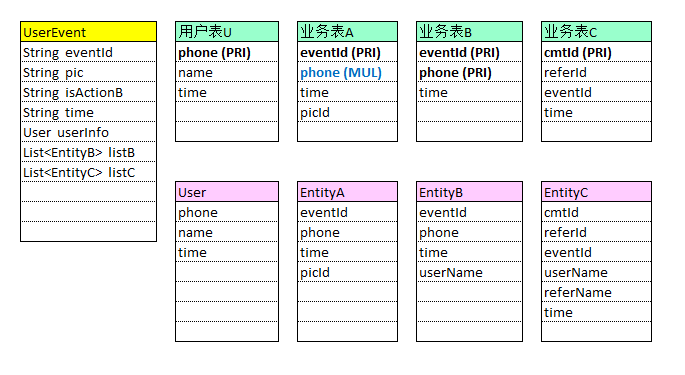
- 在业务上,对于每一个UserEvent中的eventId,业务表A中必定对应有一条记录,而在业务表B和业务表C中则未必有与这个eventId关联的数据。因此,可以将业务表A作为主表,通过eventId与另外几个表关联查询。查询次数也由原来的至少四次减少为一次查询。
- 对于联合查询的结果,以UserEvent作为查询结果的实体类,使用Mybatis中的collection、association来处理结果映射。
- 另外,各业务表的查询中都有与用户表User的关联,考虑将各业务信息的查询处理创建为视图。这样不仅能简化联合查询中SQL语句,也可以隔离基础表的数据。
优化后的代码
  int eventSize = userEventList.size();

  List<String> eventIds = new ArrayList<String>();

  // 如果考虑去掉重复数据,可以使用集合Set,但是作为Mybatis的输入参数,最后还是需要将Set转化为List。
   // 此处直接使用List,因为在业务上排除了重复数据的可能性。

  for (int i = 0; i < eventSize; i++) {

     eventIds.add(userEventList.get(i).getEventId());

  }

  Map<String, Object> paramsMap = new HashMap<String, Object>();

  paramsMap.put("eventIds", eventIds);

  paramsMap.put("phone", phone);

  List<UserEvent> eventInfoList = eventMapper.selectUserEventInfo(paramsMap);

  // 将查询结果转化为Map存储,方便调用

  Map<String, UserEvent> eventInfoMap = new HashMap<String, UserEvent>();

  for(UserEvent event : eventInfoList){

     eventInfoMap.put(event.getEventId(), event);

  }

  UserEvent newEvent = null;

  String aTime = null;

  for(UserEvent event : roadEventList){ // 从查询结果Map中取出补充信息,保存到原UserEvent对象中

     newEvent =eventInfoMap.get(event.getEventId());

     if(null != newEvent ){

         aTime = newEvent.getTime();

         event.setTime(aTime == null ? "" : sdfMd.format(sdfYmd.parse(aTime )));

         event.setIsActionB(newEvent.getIsActionB() == null ? "false" : newEvent.getIsActionB());

         event.setUserInfo(newEvent.getUserInfo());

         event.setListB(newEvent.getListB());

         event.setListC(newEvent.getListC());

     }

 }
    <resultMap id="UserMap" type="User">

        <result column="name" property="name" />

        <result column="picId" property="picId" />

        <result column="time" property="time" />

    </resultMap>

    <resultMap id="BMap" type="EntityB">

        <id column="bPhone" property="phone" />

        <result column="bUserName" property="userName" />

         <result column="bTime" property="time" />

     </resultMap>

     <resultMap id="CMap" type="EntityC">

         <id column="cmtId" property="cmtId" />

         <result column="referId" property="referId" />

         <result column="cUserName" property="userName" />

         <result column="referName" property="referName" />

         <result column="cTime" property="time" />

     </resultMap>

     <resultMap id="EventResultMap" type="com.xxxx.bean.UserEvent">

         <id column="eventId" property="eventId" />

         <result column="time" property="time" />

         <result column="isActionB" property="isActionB" />

         <association property="userInfo" resultMap="UserMap" />

         <collection property="listB" resultMap="BMap" />

         <collection property="listC" resultMap="CMap" />

     </resultMap>

     <select id="selectUserEventInfo" resultMap="EventResultMap">

       SELECT

           A.eventId,

           A.time,

           A.name,

           A.picId,

           CASE WHEN B.phone = #{phone} THEN "true" ELSE "false" END AS isActionB,

           B.phone          AS bPhone,

           B.userName       AS bUserName,

           B.time           AS bTime,

           C.cmtId,

           C.referId,

           C.userName       AS cUserName,

           C.referName      AS referName,

           C.time           AS cTime

        FROM v_table_a A

        LEFT JOIN v_table_b B ON B.eventId = A.eventId

        LEFT JOIN v_table_c C ON C.eventId = A.eventId

       <where>

           A.event_id in

           <foreach collection="eventIds" index="" item="eventId"
            open="(" separator="," close=")">

                 #{eventId}

           </foreach>

       </where>;

   </select>
编码时需要注意的几个地方
1. 复杂对象的映射解析
  <!-- spring-mybatis.xml文件 -->

  <!-- 配置sqlSessionFactory -->

  <bean id="sqlSessionFactory" class="org.mybatis.spring.SqlSessionFactoryBean">

      <property name="dataSource" ref="dataSource" />
    <!-- 将各Java类的简写别名单独放到文件mybatis.xml中,方便修改和管理 -->

      <property name="configLocation" value="classpath:xml/mybatis.xml" />
      <property name="mapperLocations" value="classpath:sql/*.xml" />

  </bean>
  <!-- mybatis.xml文件 -->

  <configuration>

      <typeAliases>

          <typeAlias alias="EntityA" type="com.xxxx.model.EntityA" />

          <typeAlias alias="EntityB" type="com.xxxx.model.EntityB" />

          <typeAlias alias="EntityC" type="com.xxxx.model.EntityC" />

          <typeAlias alias="User" type="com.xxxx.model.User" />

      </typeAliases>

  </configuration>
2. foreach标签的使用
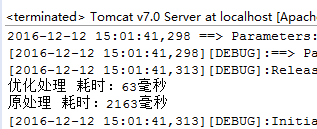
处理时间对比
http://www.cnblogs.com/quiet-snowy-day/p/6166340.html
Mybatis中的collection、association来处理结果映射的更多相关文章
- Mybatis中使用collection进行多对多双向关联示例(含XML版与注解版)
Mybatis中使用collection进行多对多双向关联示例(含XML版与注解版) XML版本: 实体类: @Data @NoArgsConstructor public class Course ...
- 谈一下思考,关于mybatis中<foreach collection="list">中list得来的原因 没看到官方说明
<foreach> 是在sql语句中进行多个id查询 时用到的,因为mybatis代替jdbc和hibernate, 使用 在xml文件中编写sql语句,这是一个标签文件.然后在 dao层 ...
- Mybatis中的collection和association一关系
collection 一对多和association的多对一关系 学生和班级的一对多的例子 班级类: package com.glj.pojo; import java.io.Serializable ...
- mybatis 中 foreach collection的三种用法(转)
文章转自 https://blog.csdn.net/qq_24084925/article/details/53790287 oreach的主要用在构建in条件中,它可以在SQL语句中进行迭代一个集 ...
- mybatis 中 foreach collection的三种用法
foreach的主要用在构建in条件中,它可以在SQL语句中进行迭代一个集合. foreach元素的属性主要有 item,index,collection,open,separator,close. ...
- Mybatis 中 foreach collection 的三种用法
foreach的主要用在构建in条件中,它可以在SQL语句中进行迭代一个集合. foreach元素的属性主要有 item,index,collection,open,separator,close. ...
- mybatis中foreach collection的三种用法
foreach的主要用在构建in条件中,它可以在SQL语句中进行迭代一个集合. foreach元素的属性主要有 item,index,collection,open,separator,close. ...
- MyBatis 中 resultMap 详解
resultMap 是 Mybatis 最强大的元素之一,它可以将查询到的复杂数据(比如查询到几个表中数据)映射到一个结果集当中.如在实际应用中,有一个表为(用户角色表),通过查询用户表信息展示页面, ...
- mybatis中常见的问题总结
如下所有举例基于springboot+mybatis项目中,SSH使用mybatis的写法也一样,只是形式不同而已 问题1.org.apache.ibatis.binding.BindingExcep ...
随机推荐
- MySQL 使用explain查看执行计划
使用explain查看执行计划, 下面是针对这两条语句进行分析,其查询结果是一样的. EXPLAIN select n.id,n.title from info n inner join info_t ...
- 推荐25款php中非常有用的类库
推荐25款php中非常有用的类库 投稿:hebedich 字体:[增加 减小] 类型:转载 时间:2014-09-29 作为一个PHP开发者,现在是一个令人激动的时刻.每天有许许多多有用的库分发出 ...
- 使用无限生命期Session的方法
使用无限生命期Session的方法 [来源] 达内 [编辑] 达内 [时间]2013-03-28 Session储存在服务器端,根据客户端提供的SessionID来得到这个用户的文件,然后读 ...
- DCDC(4.5V to 23V -3.3V)
这里的电感应该用体积10*12的
- Bootstrap页面布局24 - BS旋转木马功能
代码: <div class='container-fluid'> <h3 class='page-header'>Bootstrap 旋转木马</h3> < ...
- 依赖注入Bean属性
一.Bean属性依赖注入 对于类成员变量,注入方式有三种 •构造函数注入 •属性setter方法注入 •接口注入 Spring支持前两种 1.构造函数 属性注入 使用构造方法注入,在Spring配置文 ...
- nginx 反向代理 取得真实IP和域名
nginx反向代理后,在应用中取得的ip都是反向代理服务器的ip,取得的域名也是反向代理配置的url的域名,解决该问题,需要在nginx反向代理配置中添加一些配置信息,目的将客户端的真实ip和域名传递 ...
- java Channel filp compact
import java.nio.ByteBuffer; //Listing 7-1. Copying Bytes from an Input Channel to an Output Channel ...
- phpcms v9 模板调用代码大全
另:每个栏目会对应当前所选模型的三个模板文件: 这些模板文件所在位置:phpcms/templates/default/content/ 目录下,如果想修改模板文件,只需要到此目录下找到对应的模板文 ...
- C/C++ 获取汉字拼音首字母
#include <stdint.h> #include <stdio.h> #include <ctype.h> #include <string.h> ...