
poj1872A Dicey Problem
| Home | Problems | Status | Contest |
A
B
C
D
E
F
G
H
I
J
K
L
M
N
O
Time Limit:1000MS Memory Limit:65536KB 64bit IO Format:%I64d & %I64u
Status
Description
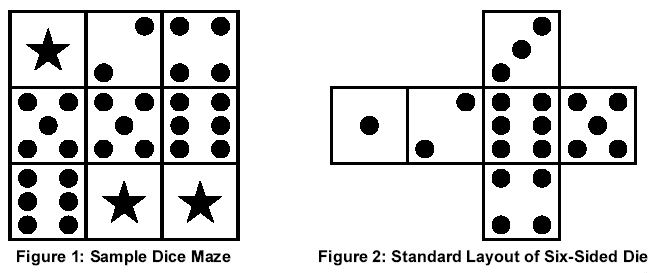
To move through the maze you must tip the die over on an edge to land on an adjacent square, effecting horizontal or vertical movement from one square to another. However, you can only move onto a square that contains the same number as the number displayed on the top of the die before the move, or onto a "wild" square which contains a star. Movement onto a wild square is always allowed regardless of the number currently displayed on the top of the die. The goal of the maze is to move the die off the starting square and to then find a way back to that same square.
For example, at the beginning of the maze there are two possible moves. Since the 5 is on top of the die, it is possible to move down one square, and since the square to the left of the starting position is wild it is also possible to move left. If the first move chosen is to move down, this brings the 6 to the top of the die and moves are now possible both to the right and down. If the first move chosen is instead to the left, this brings the 3 to the top of the die and no further moves are possible.
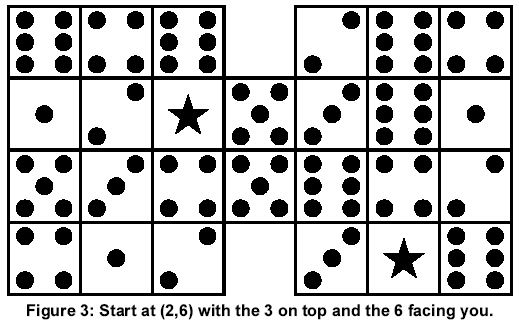
If we consider maze locations as ordered pairs of row and column numbers (row, column) with row indexes starting at 1 for the top row and increasing toward the bottom, and column indexes starting at 1 for the left column and increasing to the right, the solution to this simple example maze can be specified as: (1,2), (2,2), (2,3), (3,3), (3,2), (3,1), (2,1), (1,1), (1,2). A bit more challenging example maze is shown in Figure 3.
The goal of this problem is to write a program to solve dice mazes. The input file will contain several mazes for which the program should search for solutions. Each maze will have either a unique solution or no solution at all. That is, each maze in the input may or may not have a solution, but those with a solution are guaranteed to have only one unique solution. For each input maze, either a solution or a message indicating no solution is possible will be sent to the output.
Input
Output
Sample Input
DICEMAZE1

3 3 1 2 5 1

-1 2 4

5 5 6

6 -1 -1

DICEMAZE2

4 7 2 6 3 6

6 4 6 0 2 6 4

1 2 -1 5 3 6 1

5 3 4 5 6 4 2

4 1 2 0 3 -1 6

DICEMAZE3

3 3 1 1 2 4

2 2 3

4 5 6

-1 -1 -1

END
Sample Output
DICEMAZE1

  (1,2),(2,2),(2,3),(3,3),(3,2),(3,1),(2,1),(1,1),(1,2)

DICEMAZE2

  (2,6),(2,5),(2,4),(2,3),(2,2),(3,2),(4,2),(4,1),(3,1),

  (2,1),(2,2),(2,3),(2,4),(2,5),(1,5),(1,6),(1,7),(2,7),

  (3,7),(4,7),(4,6),(3,6),(2,6)

DICEMAZE3

  No Solution Possible
用了个bfs就过了,水题,在最后格式输出的时候错了几次,做题的时候,不防做个小正方形,这样省去了大量的想象,速度也快的多!
#include <iostream>

#include  <stdio.h>

#include<string.h>

#include<string>

#include <queue>

using namespace std;

int row,column,up,down,n,m,left,right,front,back,startx,starty;

struct mazntree{int x[7];string re;int row,colomn;};

mazntree start,p,temp;

int visit[7][7][50][50];

int map[100][100];

int dir[4][2]={{0,-1},{1,0},{0,1},{-1,0}};

int init()

{

    scanf("%d%d%d%d%d%d",&n,&m,&startx,&starty,&up,&front);

    if(up==1)

    {

        if(front==2)

        {

            start.x[1]=1,start.x[2]=6,start.x[3]=4,start.x[4]=3,start.x[5]=2,start.x[6]=5;

        }

        else if(front==3)

        {

             start.x[1]=1,start.x[2]=6,start.x[3]=2,start.x[4]=5,start.x[5]=3,start.x[6]=4;

        }

        else if(front==4)

        {

             start.x[1]=1,start.x[2]=6,start.x[3]=5,start.x[4]=2,start.x[5]=4,start.x[6]=3;

        }

        else if( front==5)

        {

             start.x[1]=1,start.x[2]=6,start.x[3]=3,start.x[4]=4,start.x[5]=5,start.x[6]=2;

        }

    }

	else if(up==2)

    {

        if(front==1)

        {

            start.x[1]=2,start.x[2]=5,start.x[3]=3,start.x[4]=4,start.x[5]=1,start.x[6]=6;

        }

        else if(front==3)

        {

             start.x[1]=2,start.x[2]=5,start.x[3]=6,start.x[4]=1,start.x[5]=3,start.x[6]=4;

        }

        else if(front==4)

        {

             start.x[1]=2,start.x[2]=5,start.x[3]=1,start.x[4]=6,start.x[5]=4,start.x[6]=3;

        }

        else if( front==6)

        {

             start.x[1]=2,start.x[2]=5,start.x[3]=4,start.x[4]=3,start.x[5]=6,start.x[6]=1;

        }

    }

	else if(up==3)

    {

        if(front==1)

        {

            start.x[1]=3,start.x[2]=4,start.x[3]=5,start.x[4]=2,start.x[5]=1,start.x[6]=6;

        }

        else if(front==2)

        {

             start.x[1]=3,start.x[2]=4,start.x[3]=1,start.x[4]=6,start.x[5]=2,start.x[6]=5;

        }

        else if(front==5)

        {

             start.x[1]=3,start.x[2]=4,start.x[3]=6,start.x[4]=1,start.x[5]=5,start.x[6]=2;

        }

        else if( front==6)

        {

             start.x[1]=3,start.x[2]=4,start.x[3]=2,start.x[4]=5,start.x[5]=6,start.x[6]=1;

        }

    }

	else if(up==4)

    {

        if(front==1)

        {

            start.x[1]=4,start.x[2]=3,start.x[3]=2,start.x[4]=5,start.x[5]=1,start.x[6]=6;

        }

        else if(front==2)

        {

             start.x[1]=4,start.x[2]=3,start.x[3]=6,start.x[4]=1,start.x[5]=2,start.x[6]=5;

        }

        else if(front==5)

        {

             start.x[1]=4,start.x[2]=3,start.x[3]=1,start.x[4]=6,start.x[5]=5,start.x[6]=2;

        }

        else if( front==6)

        {

             start.x[1]=4,start.x[2]=3,start.x[3]=5,start.x[4]=2,start.x[5]=6,start.x[6]=1;

        }

    }

     else if(up==5)

    {

        if(front==1)

        {

            start.x[1]=5,start.x[2]=2,start.x[3]=4,start.x[4]=3,start.x[5]=1,start.x[6]=6;

        }

        else if(front==3)

        {

             start.x[1]=5,start.x[2]=2,start.x[3]=1,start.x[4]=6,start.x[5]=3,start.x[6]=4;

        }

        else if(front==4)

        {

             start.x[1]=5,start.x[2]=2,start.x[3]=6,start.x[4]=1,start.x[5]=4,start.x[6]=3;

        }

        else if( front==6)

        {

             start.x[1]=5,start.x[2]=2,start.x[3]=3,start.x[4]=4,start.x[5]=6,start.x[6]=1;

        }

    }

	else if(up==6)

    {

        if(front==2)

        {

            start.x[1]=6,start.x[2]=1,start.x[3]=3,start.x[4]=4,start.x[5]=2,start.x[6]=5;

        }

        else if(front==3)

        {

             start.x[1]=6,start.x[2]=1,start.x[3]=5,start.x[4]=2,start.x[5]=3,start.x[6]=4;

        }

        else if(front==4)

        {

             start.x[1]=6,start.x[2]=1,start.x[3]=2,start.x[4]=5,start.x[5]=4,start.x[6]=3;

        }

        else if( front==5)

        {

             start.x[1]=6,start.x[2]=1,start.x[3]=4,start.x[4]=3,start.x[5]=5,start.x[6]=2;

        }

    }

    int i,j;

    for(i=1;i<=n;i++)

    {

        for(j=1;j<=m;j++)

        {

            scanf("%d",&map[i][j]);

        }

    }

	return 1;

}

bool changecan(int i)//判定能否走

{

    int x[7];

    for( int j=1;j<7;j++)

    {

        x[j]=p.x[j];

    }

    p.row=p.row+dir[i][0];

    p.colomn=p.colomn+dir[i][1];

    if((map[p.row][p.colomn]!=0)&&p.row>=1&&p.row<=n&&p.colomn>=1&&p.colomn<=m&&((p.x[1]==map[p.row][p.colomn])||(map[p.row][p.colomn]==-1)))//不越界

    {

       if( i==0)//左移

       {

           p.x[3]=x[1];

           p.x[4]=x[2];

           p.x[2]=x[3];

           p.x[1]=x[4];

           p.re=temp.re+'0';

       }

       else if(i==1)//下称

       {

           p.x[5]=x[1];

           p.x[6]=x[2];

           p.x[2]=x[5];

           p.x[1]=x[6];

           p.re=temp.re+'1';

       }

       else if ( i==2)//右移

       {

           p.x[4]=x[1];

           p.x[3]=x[2];

           p.x[1]=x[3];

           p.x[2]=x[4];

           p.re=temp.re+'2';

       }

       else if (i==3)//上移

       {

           p.x[6]=x[1];

           p.x[5]=x[2];

           p.x[1]=x[5];

           p.x[2]=x[6];

           p.re=temp.re+'3';

        }

       if(visit[p.x[1]][p.x[5]][p.row][p.colomn]==0)//没有访问过-1能走,0不能走

        {

            visit[p.x[1]][p.x[5]][p.row][p.colomn]=1;//标记为已访问

             return true;

        }

       else

         return false;

    }

    else

    {

        return false;

    }

	return false;

}

int bfs()

{

    queue<mazntree> q;

    int i,xx,yy;

    memset(visit ,0,sizeof(visit));

	while(!q.empty())//先清空

	{

		q.pop();

    }

    start.re="";

    start.colomn=starty;

    start.row=startx;

    q.push(start);

    while(!q.empty())

    {

        temp=q.front();

        q.pop();

        for( i=0;i<4;i++)

        {

            p=temp;

           if(changecan(i))

           {

                q.push(p);

			if(visit[p.x[1]][p.x[5]][p.row][p.colomn]&&(p.row==startx)&&(p.colomn==starty))//找到

			  {

            int count=0;

            xx=startx,yy=starty;

			count=1;

			printf("  (%d,%d),",startx,starty);

            for( i=0;i<p.re.length()-1;i++,count++)

            {

                xx=xx+dir[p.re[i]-'0'][0];

                yy=yy+dir[p.re[i]-'0'][1];

                if(count==0)

                printf("  ");

                printf("(%d,%d),",xx,yy);

                if(count==8)

                {

                    printf("\n");

                    count=-1;

                }

            }

			 xx=xx+dir[p.re[i]-'0'][0];

                yy=yy+dir[p.re[i]-'0'][1];

				printf("(%d,%d)\n",xx,yy);

            return 1;

        }

           }

        }

}

    printf("  No Solution Possible\n");

    return -1;

}

int main()

{

    char str[200];

    while(1)

    {

        gets(str);

        if(str[0]=='E'&&str[1]=='N'&&str[2]=='D')

            break;

      init();

        printf("%s\n",str);

       gets(str);//把最后的回车吸收

       bfs();

    }

    return 0;

}
FAQ | About Virtual Judge | Forum | Discuss | Open Source Project
All Copyright Reserved ©2010-2012
HUST ACM/ICPC TEAM
Anything about the OJ, please ask in the
forum, or contact author:
Isun
Server Time:
poj1872A Dicey Problem的更多相关文章
- poj 1872 A Dicey Problem WA的代码,望各位指教!!!
A Dicey Problem Time Limit: 1000MS Memory Limit: 65536K Total Submissions: 832 Accepted: 278 Des ...
- UVA 810 - A Dicey Problem(BFS)
UVA 810 - A Dicey Problem 题目链接 题意:一个骰子,给你顶面和前面.在一个起点,每次能移动到周围4格,为-1,或顶面和该位置数字一样,那么问题来了,骰子能不能走一圈回到原地, ...
- UVA-810 A Dicey Problem (BFS)
题目大意:滚骰子游戏,骰子的上面的点数跟方格中的数相同时或格子中的数是-1时能把格子滚过去,找一条从起点滚到起点的路径. 题目大意:简单BFS,状态转移时细心一些即可. 代码如下; # include ...
- A Dicey Problem 骰子难题(Uva 810)
题目描述:https://uva.onlinejudge.org/external/8/810.pdf 把一个骰子放在一个M x N的地图上,让他按照规定滚动,求滚回原点的最短路径. 思路: 记忆化 ...
- Uva - 810 - A Dicey Problem
根据状态进行bfs,手动打表维护骰子滚动. AC代码: #include <iostream> #include <cstdio> #include <cstdlib&g ...
- BFS广搜题目(转载)
BFS广搜题目有时间一个个做下来 2009-12-29 15:09 1574人阅读 评论(1) 收藏 举报 图形graphc优化存储游戏 有时间要去做做这些题目,所以从他人空间copy过来了,谢谢那位 ...
- 1199 Problem B: 大小关系
求有限集传递闭包的 Floyd Warshall 算法(矩阵实现) 其实就三重循环.zzuoj 1199 题 链接 http://acm.zzu.edu.cn:8000/problem.php?id= ...
- No-args constructor for class X does not exist. Register an InstanceCreator with Gson for this type to fix this problem.
Gson解析JSON字符串时出现了下面的错误: No-args constructor for class X does not exist. Register an InstanceCreator ...
- C - NP-Hard Problem(二分图判定-染色法)
C - NP-Hard Problem Crawling in process... Crawling failed Time Limit:2000MS Memory Limit:262144 ...
随机推荐
- 微信应用号开发知识贮备之Webpack实战
天地会珠海分舵注:随着微信应用号的呼之欲出,相信新一轮的APP变革即将发生.作为行业内人士,我们很应该去拥抱这个趋势.这段时间在忙完工作之余准备储备一下这方面的知识点,以免将来被微信应用号的浪潮所淹没 ...
- PHP: 判断是否是JSON数据
原文:PHP: 判断是否是JSON数据 首先要记住json_encode返回的是字符串, 而json_decode返回的是对象. 判断数据不是JSON格式: function is_not_json( ...
- VC++.Net CAD编程架构
1.每个对应的菜单项的图形抽象的, 图形抽象基类, 取决于改变来自子(如矩形.椭圆形) 2.在Doc对象管理列表管理,图形对象,当图形需要重绘或序列存储,通过遍历该列表的对象可以是 3. 每个类的职责 ...
- EA强大的绘图工具---设计数据库表格
关于EA这个优秀的软件是从师哥哪里听来的,自己瞎点了点,感觉也没什么.近期和和智福加上一个师哥合作敲机房收费系统时,想到之前听人说EA非常强大,便随便找了找关于EA使用的帮助手冊.果然惊喜-- 如题, ...
- Bundle压缩JS和CSS
ASP.NET MVC之Bundle压缩JS和CSS 介绍Bundle之前先引用<淘宝技术这十年>中一段话,对Web前端稍微有点常识的人都应该知道,浏览器下一步会加载页面中用到的CSS.J ...
- jQuery Easy UI LinkButton(button)包
LinkButton(button)包,easyui其中一个基本组成部分 演示样例: <!DOCTYPE html> <html> <head> <title ...
- Android多画面幻灯片:ViewPager基础上,利用与PagerTabStrip出生缺陷(源代码)
近期使用ViewPager.读了几个人说是不是很清晰的信息,干脆自己写demo总结下. 样例非常easy.Activity里有三个界面能够滑动.每个界面都有一个button并设置好了监听.PagerT ...
- Eclipse在SVN安装步骤(两种)和使用方法
一.至Eclipse安装SVN,最常见的两种方式:手动模式,使用安装向导.具体操作步骤如下: 单程:手动安装 1.官方网站下载,从site-1.6.9.zip文件,网址是:subclipse.tigr ...
- REST 测试工具
两款 REST 测试工具 用CURL命令行测试REST API 无疑是低效率的,这里把最近使用的两款 Chrome 插件总结下 POSTMAN 简单易用 REST Console 功能强大 使用的话用 ...
- webapp 开发调试测试方法总结
好久都没有发表过日志了,反正近期项目也已经接近尾声了,那么是时候该总结一下在项目中用到的技术了,请看:这里先废话几句,我们现在的开发模式是这样子的:先把本地的网页上传到远程服务器(因为好多设备都要去访 ...