
OLAP vs OLTP: what makes the difference
OLAP vs OLTP: what makes the difference
OLPT and OLAP are complementingtechnologies. You can't live without OLTP: it runs your business dayby day. So, using getting strategic information from OLTP is usuallyfirst “quick and dirty” approach, but can become limiting later.
This post explores keydifferences between two technologies.
OLTPstands for On LineTransaction Processing and is a datamodeling approach typically used to facilitate and manage usual business applications.
Most of applications you see and use areOLTP based.
OLAPstands for On LineAnalytic Processing and is an approach to answer multi-dimensional queries. OLAP was conceived forManagement Information Systems and Decision
Support Systems but isstillwidely underused: every day I see too much people makingout business intelligence from OLTP data!
With the constant growth of dataanalysis and business intelligence applications (now even in smallbusiness) understanding OLAP nuances and benefits is a must if youwant provide valid and useful analytics to management.
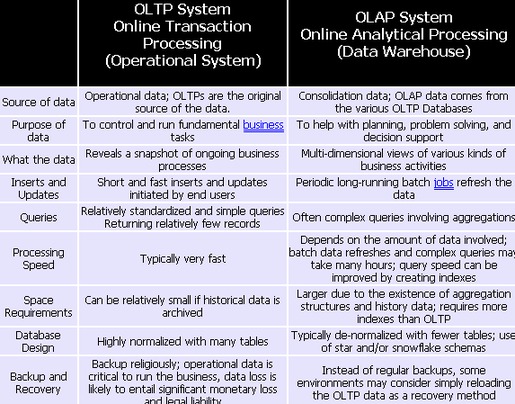
The following table summarized maindifferences between OLPT and OLAP:
|
OLTP |
OLAP |
|
|
Application |
Operational: ERP, CRM, legacy apps, ... |
Management Information System, Decision Support System |
|
Typical users |
Staff |
Managers, Executives |
|
Horizon |
Weeks, Months |
Years |
|
Refresh |
Immediate |
Periodic |
|
Data model |
Entity-relationship |
Multi-dimensional |
|
Schema |
Normalized |
Star |
|
Emphasis |
Update |
Retrieval |
Let's go straight to each key points.
Horizon
OLTP databases store “live”operational information. An invoice, for example, once paid, ispossibly moved to some sort of backup store, maybe upon period closing. On the other side5-10 strategic analysis are usual to identify trends. Extending
life of operational data, would not be enough (in addition to possibly impacting performance).
Even keeping that data indexedand online for years, you would surely face compatibility problems.It is quite improbable that your current invoice fields andreferences are the same of 10 years ago!
But neither performance norcompatibility are the biggest concern under large horizon. Realproblem is business dynamics. Today business constantly change andthe traditional entity-relationship approach is too vulnerable tochanges. I will better explore this
point in next post with apractical example.
Refresh
OLPT requires instant update. When youcash some money from an ATM you balance shall be immediately updated.OLAP has not such requirement. Nobody needs instant information tomake strategic business decision.
This allows OLAP data to be refresheddaily. This means extra timing and resources for cleansing andaccruing data. If, for example, an invoice was canceled, we wouldn'tlike to see its value first inflating sales figures and later reverted.
More time and more resources would alsoallow better indexing to address huge tables covering the extendedhorizon.
Data Model & Schema
This is possibly the most evidentdifference between two approaches. OLTP perfectly fits traditionalentity-relationship or object-oriented models. We usually refer toinformation as attributes related to entities, objects or classes,like product price, invoice
amount or client name. Mapping can bewith a simple, one argument function:
product » price
invoice » amount
client » name
Such functions can be implementedthough classic tables, one row per instance, whereeach attribute ismapped to one column.
Now, if you listen to typical businessquestions you perceive a different requirement:
What is gross margin by product category in Europe and Asia?
What's our current inventory by product and warehouse?
Which was the evolution of return rate of different products acquired by different suppliers?
Are mapped as functions of multiplearguments (left side):
Product category × Region » Grossmargin
Product × Warehouse » Inventory
Supplier × Time × Product » Returnrate
Mapping attributes to columns do not work any more in this case: a multi-dimensionalapproach is required.
Tables do not naturally support multi-dimensional approachbut relational databases are still the most widely used, proven andreliable approach today available. Reliability and performance is amust if we think in storing terabytes of data along years.
The solution is use an hybridapproach based sitting on conventional relational technology. Thismodel employs so calledstar-schema instead of traditionalnormalization.
Emphasis
OLPT emphasis is on update. Transactionlevel isolation assures that database is always in a consistentstate. This can imply in some overhead to coordinate concurrentupdates but is necessary even in small applications.
On the other side OLAP can be updatedby periodic (daily) processes that work in standalone mode thusconsistency can be assured through update process.
But OLAP faces another challenge:retrieval. Suppose a telecom executive asking how much was billedlast year in communications from USA to Japan. Can you figure howmuch time would it take to go ever each individual call to get theresult?
OLTP emphasis is on retrieval andit organizes data to return result of ad hoc inquiries in a reasonableamount of time.
Two worlds, two obstacles
So, in practice you need two differentdatabases, one for OLAP and another one for OLTP. The second one isusually called a Data Warehouse and is a must if you want to makeserious business intelligence.
But, if this is best solution why itisn't widely adopted? Why so many people are still trying to use BItools on traditional OLTP database? These are the most common reasons I have seen in practice:
Doctrine. For years data modelers have been educated to normalize data and for years they have been told that data redundancy is first deadly sin.Habit is worst enemy of OLAP approach. Even when a star schema was officially
adopted for BI applications, I have seen an irresistible attraction tosnowflaking (I'll explain this term in next posts).
Ingenuity. “Let's buy a good tool that will do the magic with little effort!”. This seems quite a better alternative to creating and feeding a second database. It doesn't work, still can be a valid solution if, as IT manager, you
have just opened your second envelope. In next post I will illustrate with practical example what will probably go wrong.
Building a relational data warehouse isactually not so difficult, neither exclusively applicable tomulti-billion corporations or terabytes of data and, infuture
posts,I pretend to show a pragmatic and agile approach.
For further detail on OLAP technology Isuggest to read: OlapSolutions - 2nded.
By Erik Tomsen, also available at Amazon.
原文地址:http://www.cbsolution.net/techniques/ontarget/olap_vs_oltp_what_makes
下图引自另外一个网页,点击图片跳转
OLAP vs OLTP: what makes the difference的更多相关文章
- OLAP、OLTP的介绍和比较 via csdn
OLAP.OLTP的介绍和比较 数据处理大致可以分成两大类: OLTP(On-Line Transaction Processing)联机事务处理 也称为面向交易的处理系统,其基本特征是顾客的原始数据 ...
- OLAP和OLTP的区别(基础知识) 【转】
联机分析处理 (OLAP) 的概念最早是由关系数据库之父E.F.Codd于1993年提出的,他同时提出了关于OLAP的12条准则.OLAP的提出引起了很大的反响,OLAP作为一类产品同联机事务处理 ( ...
- OLAP和OLTP的区别
OLAP(On-Line Analytical Processing)联机分析处理,也称为面向交易的处理过程,其基本特征是前台接收的用户数据可以立即传送到计算中心进行处理,并在很短的时间内给出处理结果 ...
- day 59 MySQL之锁、事务、优化、OLAP、OLTP
MySQL之锁.事务.优化.OLAP.OLTP 本节目录 一 锁的分类及特性 二 表级锁定(MyISAM举例) 三 行级锁定 四 查看死锁.解除锁 五 事务 六 慢日志.执行计划.sql优化 七 ...
- olap和Oltp(转)
OLAP和OLTP的区别(基础知识) 联机分析处理 (OLAP) 的概念最早是由关系数据库之父E.F.Codd于1993年提出的,他同时提出了关于OLAP的12条准则.OLAP的提出引起了很大的反响, ...
- OLAP、OLTP的介绍和比较
OLTP与OLAP的介绍 数据处理大致可以分成两大类:联机事务处理OLTP(on-line transaction processing).联机分析处理OLAP(On-Line Analytical ...
- Oracle OLAP 与 OLTP 介绍
文章出处:http://blog.csdn.net/tianlesoftware/article/details/5794844 感谢原作者的分享. 数据处理大致可以分成两大类:联机事务处理OLTP( ...
- OLAP和OLTP基础知识
数据处理大致可以分成两大类:联机事务处理OLTP(on-line transaction processing).联机分析处理OLAP(On-Line Analytical Processing).O ...
- OLAP和OLTP的区别(基础知识)
联机分析处理 (OLAP) 的概念最早是由关系数据库之父E.F.Codd于1993年提出的,他同时提出了关于OLAP的12条准则.OLAP的提出引起了很大的反响,OLAP作为一类产品同联机事务处理 ( ...
随机推荐
- 初学CDQ分治-NEU1702
关于CDQ分治,首先需要明白分治的复杂度. T(n) = 2T(n/2)+O(kn), T(n) = O(knlogn) T(n) = 2T(n/2)+O(knlogn), T(n) = O(knlo ...
- Jmeter使用之常用函数介绍
“_csvRead”函数 CsvRead函数是从外部读取参数,CsvRead函数可以从一个文件中读取多个参数. 下面具体讲一下如何使用csvread函数: 1. 新建一个csv或者text文件 ...
- maven Connection refused: connect
现象: 本地可以访问错误提示中的地址.但使用maven无法下载jar包. 环境: 浏览器上网需要使用代理 解决方法: 设置成正常代理可以.具体方法可以下载一个代理工具.只要IE配置成能直接访问http ...
- SenchaTouch介绍和Sencha Architect介绍以及安装
一.SenchaTouch介绍 Sencha Touch框架是世界上第一个基于HTML 5的Mobile App框架. 在Sencha Touch这个名词中,包括了两个组成部分,其中Sencha的前身 ...
- 项目开发中遇到的extjs常见问题
事件触发机制 l 给某一个控件添加事件. obj.addEvents( {search : true }); l 给某一个事件添加处理函数 n 给一个对象或变量添加监听及对应得处理,可以在创建时,通过 ...
- 20160816_Redis一些资料
1.官网 http://redis.io/ 2.一个教程 http://www.yiibai.com/redis/redis_quick_guide.html 3.快速开始指南(Quick Start ...
- a、b交换与比较
1.有两个变量a,b,不用if.?: .switch 或其他判断语句,找出两个数中 较大的: int max = ((a+b)+abs(a-b))/2 较小的: int min = ((a+b)-ab ...
- Nemo Documents – 给文件添加标签 以日历的形式将文件呈现出来,很像 Outlook,你可以根据年、月、日来查看不同类型的文档
Nemo Documents – 给文件添加标签 scavin(Google+) on 2012.03.28. Nemo Documents 是款文件组织管理工具(文档管理器),不是街道大妈胜似大 ...
- WebDriver - 添加失败截图
WebDriver失败截图可以通过两种方式实现: 1. Use WebdriverEventListener 第一步:创建自己的WebDriverEventListener 创建自己的WebDrive ...
- Now直播应用的后台服务器性能测试实践
版权声明:本文由Oliver原创文章,转载请注明出处: 文章原文链接:https://www.qcloud.com/community/article/208 来源:腾云阁 https://www.q ...