
Booksort POJ - 3460 (IDA*)
Description
The Leiden University Library has millions of books. When a student wants to borrow a certain book, he usually submits an online loan form. If the book is available, then the next day the student can go and get it at the loan counter. This is the modern way of borrowing books at the library.
There is one department in the library, full of bookcases, where still the old way of borrowing is in use. Students can simply walk around there, pick out the books they like and, after registration, take them home for at most three weeks.
Quite often, however, it happens that a student takes a book from the shelf, takes a closer look at it, decides that he does not want to read it, and puts it back. Unfortunately, not all students are very careful with this last step. Although each book has a unique identification code, by which the books are sorted in the bookcase, some students put back the books they have considered at the wrong place. They do put it back onto the right shelf. However, not at the right position on the shelf.
Other students use the unique identification code (which they can find in an online catalogue) to find the books they want to borrow. For them, it is important that the books are really sorted on this code. Also for the librarian, it is important that the books are sorted. It makes it much easier to check if perhaps some books are stolen: not borrowed, but yet missing.
Therefore, every week, the librarian makes a round through the department and sorts the books on every shelf. Sorting one shelf is doable, but still quite some work. The librarian has considered several algorithms for it, and decided that the easiest way for him to sort the books on a shelf, is by sorting by transpositions: as long as the books are not sorted,
- take out a block of books (a number of books standing next to each other),
- shift another block of books from the left or the right of the resulting ‘hole’, into this hole,
- and put back the first block of books into the hole left open by the second block.
One such sequence of steps is called a transposition.
The following picture may clarify the steps of the algorithm, where X denotes the first block of books, and Y denotes the second block.
| Original situation: |  |
| After step 1: |  |
| After step 2: |  |
| After step 3: |  |
Of course, the librarian wants to minimize the work he has to do. That is, for every bookshelf, he wants to minimize the number of transpositions he must carry out to sort the books. In particular, he wants to know if the books on the shelf can be sorted by at most 4 transpositions. Can you tell him?
Input
The first line of the input file contains a single number: the number of test cases to follow. Each test case has the following format:
- One line with one integer n with 1 ≤ n ≤ 15: the number of books on a certain shelf.
- One line with the n integers 1, 2, …, n in some order, separated by single spaces: the unique identification codes of the n books in their current order on the shelf.
Output
For every test case in the input file, the output should contain a single line, containing:
- if the minimal number of transpositions to sort the books on their unique identification codes (in increasing order) is T ≤ 4, then this minimal number T;
- if at least 5 transpositions are needed to sort the books, then the message "5 or more".
Sample Input
3

6

1 3 4 6 2 5

5

5 4 3 2 1

10

6 8 5 3 4 7 2 9 1 10
Sample Output
2

3

5 or more
题意:给n本书,每次可以选取其中一段移动到另外的位置,使得书的编号变成1~n,如果步数超过4,就输出5 or more,反则输出步数。
思路:抽取书同一长度的书,有n-len+1种选择,有n-len个位置可以插入,并且因为一位置len长度后移等于后面位置前移
Σ(n-len)*(n-len+1)/2 <= (15*14+14*13+...+2*1)/2 == 560 ,因为只用判断是否步数<=4,不同搜索(560)4,时间复杂度过大。
通过IDA*(迭代加深+A*)
迭代加深:因为我们确定答案会在5之前收到
A*:评估函数,因为一次移动,最多可以使得3本书后面的书籍编号改变,所以该状态到达终态的至少步数f = ⌈错误后继/3⌉
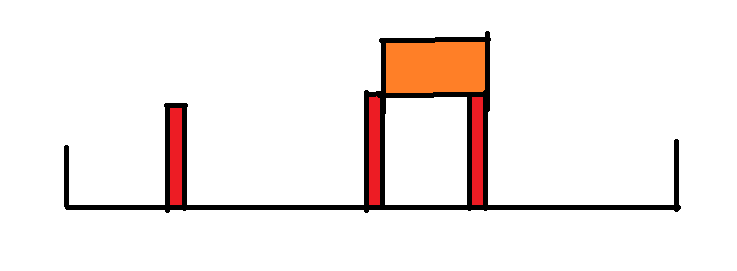
(红色为三本书,是一次移动种最多改变的三本,橙色区域代表移动的区域,移动至第一个红色书的后面,那么第二个和第三个红色书的后继都改变了)
#include<iostream>

#include<cstdio>

#include<cmath>

using namespace std;

const int maxn = ;

int t;

int n;

struct Node

{

    int s[maxn];

};

bool check(int s[])

{

    for(int i=; i<n; i++)

        if(s[i] +  != s[i+])

            return ;

    return ;

}

Node change(Node x,int l,int r,int len)

{

    Node tmp = x;

    for(int i=l; i<l+len; i++)

        x.s[r-len-l+i+] = tmp.s[i];

    for(int i=l+len; i<=r; i++)

        x.s[i-len] = tmp.s[i];

    return x;

}

int cal(int s[])

{

    int ans = ;

    for(int i=; i<n; i++)

        if(s[i] +  != s[i+])

            ans++;

    return ceil(ans/3.0);

}

bool dfs(Node x,int now,int lim)

{

    if(now + cal(x.s) > lim)

        return ;

    if(check(x.s))return ;

    for(int len=; len<n; len++)

    {

        for(int i=; i+len- <=n; i++)

        {

            for(int j=i+len; j<=n; j++)

            {

                if(dfs(change(x,i,j,len),now+,lim))return ;

            }

        }

    }

    return ;

}

int main()

{

    scanf("%d",&t);

    Node start;

    while(t--)

    {

        scanf("%d",&n);

        for(int i=; i<=n; i++)

            scanf("%d",&start.s[i]);

        for(int i=; i<; i++)

        {

            if(dfs(start,,i))

            {

                printf("%d\n",i);

                break;

            }

            else if(i == )printf("5 or more\n");

        }

    }

}
Booksort POJ - 3460 (IDA*)的更多相关文章
- POJ题目(转)
http://www.cnblogs.com/kuangbin/archive/2011/07/29/2120667.html 初期:一.基本算法: (1)枚举. (poj1753,poj29 ...
- Repeater POJ - 3768 (分形)
Repeater POJ - 3768 Harmony is indispensible in our daily life and no one can live without it----may ...
- UVA - 10384 The Wall Pusher(推门游戏)(IDA*)
题意:从起点出发,可向东南西北4个方向走,如果前面没有墙则可走:如果前面只有一堵墙,则可将墙向前推一格,其余情况不可推动,且不能推动游戏区域边界上的墙.问走出迷宫的最少步数,输出任意一个移动序列. 分 ...
- Radar Installation POJ - 1328(贪心)
Assume the coasting is an infinite straight line. Land is in one side of coasting, sea in the other. ...
- Best Cow Fences POJ - 2018 (二分)
Farmer John's farm consists of a long row of N (1 <= N <= 100,000)fields. Each field contains ...
- E - The Balance POJ - 2142 (欧几里德)
题意:有两种砝码m1, m2和一个物体G,m1的个数x1, m2的个数为x2, 问令x1+x2最小,并且将天平保持平衡 !输出 x1 和 x2 题解:这是欧几里德拓展的一个应用,欧几里德求不定方程 ...
- 人类即将进入互联网梦境时代(IDA)
在电影<盗梦空间>中,男主角科布和妻子在梦境中生活了50年,从楼宇.商铺.到河流浅滩.一草一木.这两位造梦师用意念建造了属于自己的梦境空间.你或许并不会想到,在不久未来,这看似科幻的情节将 ...
- POJ - 2286 - The Rotation Game (IDA*)
IDA*算法,即迭代加深的A*算法.实际上就是迭代加深+DFS+估价函数 题目传送:The Rotation Game AC代码: #include <map> #include < ...
- POJ3460 Booksort(IDA*)
POJ3460 Booksort 题意:给定一个长度为n的序列,每次可以取出其中的一段数,插入任意一个位置,问最少需要几次操作才能使整个序列变为1~n 思路:IDA*+迭代加深搜索 小技巧:将一段数插 ...
随机推荐
- org.apache.catalina.core.DefaultInstanceManager cannot be cast to org.apache.tomcat.InstanceManager
1.控制台报错信息 严重: Servlet.service() for servlet [jsp] in context with path [/Resource] threw exception [ ...
- Java的两个实验程序
日期:2018.10.07 星期五 博客期:015 Part1:----------------第一个是二柱子出30道小学数学题: 一.程序设计思想 本程序设计由三部分构成,第一部分因为循环30次的需 ...
- SpringMVC拦截器与异常处理
点击查看上一章 在我们SpringMVC中也可以使用拦截器对用户的请求进行拦截,用户可以自定义拦截器来实现特定的功能.自定义拦截器必须要实现HandlerInterceptor接口 package c ...
- cf219d 基础换根法
/*树形dp换根法*/ #include<bits/stdc++.h> using namespace std; #define maxn 200005 ]; int root,n,s,t ...
- git使用diff----git-pull之后如何查看拉下来的文件有那些修改
git pull拉取 git pull对于拉下来的修改文件自动对其进行git add /rm 及git commit 操作.所以拉下来的文件有那些修改,查看的方式可把它们归结于上一次提交的比较. gi ...
- Java 产生一个大于等于200,小于300的随机数,且是10的整数倍
public class Random200_300 { public static void main(String[] args) { int r1 = 0; while (true) { r1 ...
- 使用7zip批量压缩文件夹到不同压缩包
for /d %%X in (*) do "c:\Program Files\7-Zip\7z.exe" a "%%X.7z" "%%X\" ...
- Unet 项目部分代码学习
github地址:https://github.com/orobix/retina-unet 主程序: ################################################ ...
- 饮冰三年-人工智能-Python-10之C#与Python的对比
1:注释 C# 中 单行注释:// 多行注释:/**/ python 中 单行注释:# 多行注释:“““内容””” 2:字符串 C#中 "" 用双引号如("我是字符串&q ...
- 012-Python-paramiko和IO多路复用
1.IO 多路复用 1.监听多个socket变化 2.socket服务端 IO多路复用+socket 来实现web服务器: a.服务端优先运行 b.浏览器:http://.......com 浏览器连 ...