
Spark之Task原理分析
override def receive: PartialFunction[Any, Unit]
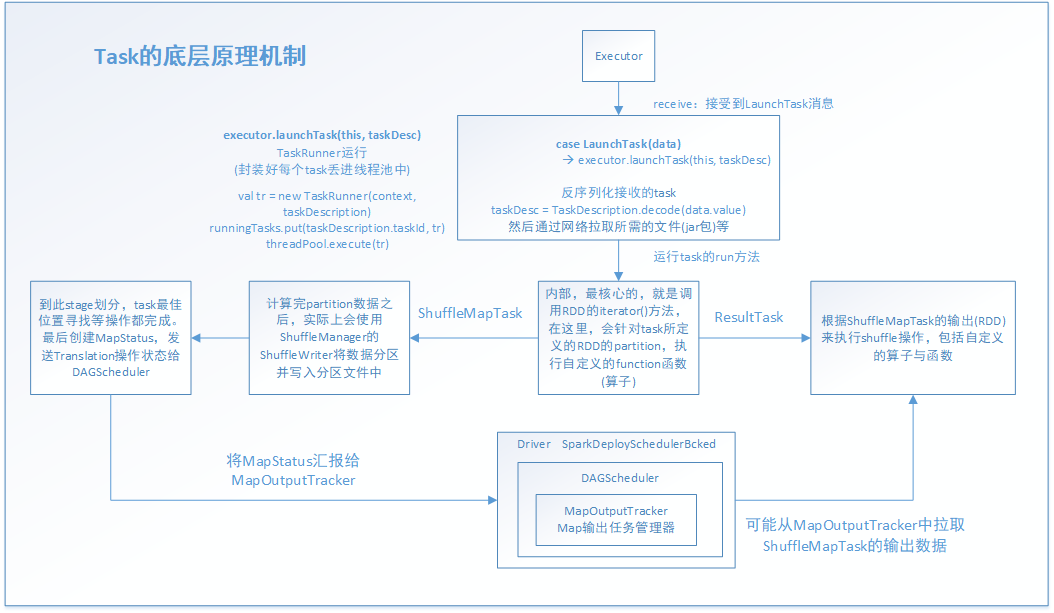
executor接受到这个事件消息后,task才真正开始工作。其中的executor.launchTask(this, taskDesc)就是主要的实现函数体
case LaunchTask(data) =>

      if (executor == null) {

        exitExecutor(, "Received LaunchTask command but executor was null")

      } else {

        val taskDesc = TaskDescription.decode(data.value)

        logInfo("Got assigned task " + taskDesc.taskId)

        executor.launchTask(this, taskDesc)

      }
launchTask方法,主要是new出一个TaskRunner线程,并把它放进java的线程池中运行。通过这里也知道其实Spark的底层是依赖Java和Scala共同实现的。
def launchTask(context: ExecutorBackend, taskDescription: TaskDescription): Unit = {

    val tr = new TaskRunner(context, taskDescription)

    runningTasks.put(taskDescription.taskId, tr)

    threadPool.execute(tr)

  }
通过看TaskRunner的实现,知道它是继承Runnable的,因此,就知道线程真正的运行体是run()方法。
class TaskRunner(

      execBackend: ExecutorBackend,

      private val taskDescription: TaskDescription)

    extends Runnable

    下面是run( )方法的主要部分源码。

override def run(): Unit = {

      threadId = Thread.currentThread.getId

      Thread.currentThread.setName(threadName)

      val threadMXBean = ManagementFactory.getThreadMXBean

      val taskMemoryManager = new TaskMemoryManager(env.memoryManager, taskId)

      val deserializeStartTime = System.currentTimeMillis()

      val deserializeStartCpuTime = if (threadMXBean.isCurrentThreadCpuTimeSupported) {

        threadMXBean.getCurrentThreadCpuTime

      } else 0L

      Thread.currentThread.setContextClassLoader(replClassLoader)

      val ser = env.closureSerializer.newInstance()

      logInfo(s"Running $taskName (TID $taskId)")

      execBackend.statusUpdate(taskId, TaskState.RUNNING, EMPTY_BYTE_BUFFER)

      var taskStart: Long =

      var taskStartCpu: Long =

      startGCTime = computeTotalGcTime()

      try {

        // Must be set before updateDependencies() is called, in case fetching dependencies

        // requires access to properties contained within (e.g. for access control).

        //对序列化的数据,进行反序列化

        Executor.taskDeserializationProps.set(taskDescription.properties)

        //通过网络通信的方法,把task运行所需要的文件、资源、jar等拉取过来

        updateDependencies(taskDescription.addedFiles, taskDescription.addedJars)

        //最后,通过正式的反序列化操作,将整个task的数据集拉取过来

        //这里用ClassLoader的原因是通过指定的上下文资源,进行加载和读取。(当然,反射还有另外的功能:通过反射放射动态加载一个类,创建类的对象)

        task = ser.deserialize[Task[Any]](

          taskDescription.serializedTask, Thread.currentThread.getContextClassLoader)

        task.localProperties = taskDescription.properties

        task.setTaskMemoryManager(taskMemoryManager)

        // If this task has been killed before we deserialized it, let's quit now. Otherwise,

        // continue executing the task.

        val killReason = reasonIfKilled

        if (killReason.isDefined) {

          // Throw an exception rather than returning, because returning within a try{} block

          // causes a NonLocalReturnControl exception to be thrown. The NonLocalReturnControl

          // exception will be caught by the catch block, leading to an incorrect ExceptionFailure

          // for the task.

          throw new TaskKilledException(killReason.get)

        }

        logDebug("Task " + taskId + "'s epoch is " + task.epoch)

        env.mapOutputTracker.updateEpoch(task.epoch)

        // Run the actual task and measure its runtime.

        //计算task开始的时间

        taskStart = System.currentTimeMillis()

        taskStartCpu = if (threadMXBean.isCurrentThreadCpuTimeSupported) {

          threadMXBean.getCurrentThreadCpuTime

        } else 0L

        var threwException = true

        /**

          * value 对于ShuffleMapTask来说,就是MapStatus

          * 封装了ShuffleMapTask计算的数据,输出的位置

          * 后面的ShuffleMapTask会去联系MapOutputTracker来获取一个ShuffleMapTask的输出位置,通过网络网络拉取数据

          * ResultTask也是这样的,只不过是查询ShuffleMapTask的结果MapStatus的位置

                    *  总的来说 MapOutputTracker(Map输出任务管理器),把map和action联系起来了。

          */

        val value = try {

            //真正的task的线程执行方法,下面会详细分析

          val res = task.run(

            taskAttemptId = taskId,

            attemptNumber = taskDescription.attemptNumber,

            metricsSystem = env.metricsSystem)

          threwException = false

          res

        } finally {

          val releasedLocks = env.blockManager.releaseAllLocksForTask(taskId)

          val freedMemory = taskMemoryManager.cleanUpAllAllocatedMemory()

          if (freedMemory >  && !threwException) {

            val errMsg = s"Managed memory leak detected; size = $freedMemory bytes, TID = $taskId"

            if (conf.getBoolean("spark.unsafe.exceptionOnMemoryLeak", false)) {

              throw new SparkException(errMsg)

            } else {

              logWarning(errMsg)

            }

          }

          if (releasedLocks.nonEmpty && !threwException) {

            val errMsg =

              s"${releasedLocks.size} block locks were not released by TID = $taskId:\n" +

                releasedLocks.mkString("[", ", ", "]")

            if (conf.getBoolean("spark.storage.exceptionOnPinLeak", false)) {

              throw new SparkException(errMsg)

            } else {

              logInfo(errMsg)

            }

          }

        }

        task.context.fetchFailed.foreach { fetchFailure =>

          // uh-oh.  it appears the user code has caught the fetch-failure without throwing any

          // other exceptions.  Its *possible* this is what the user meant to do (though highly

          // unlikely).  So we will log an error and keep going.

          logError(s"TID ${taskId} completed successfully though internally it encountered " +

            s"unrecoverable fetch failures!  Most likely this means user code is incorrectly " +

            s"swallowing Spark's internal ${classOf[FetchFailedException]}", fetchFailure)

        }

        //task结束的时间

        val taskFinish = System.currentTimeMillis()

        val taskFinishCpu = if (threadMXBean.isCurrentThreadCpuTimeSupported) {

          threadMXBean.getCurrentThreadCpuTime

        } else 0L

        // If the task has been killed, let's fail it.

        task.context.killTaskIfInterrupted()

        //对MapStatus进行各种序列化和封装,后面要发送给MapOutputTracker

        val resultSer = env.serializer.newInstance()

        val beforeSerialization = System.currentTimeMillis()

        val valueBytes = resultSer.serialize(value)

        val afterSerialization = System.currentTimeMillis()

        // Deserialization happens in two parts: first, we deserialize a Task object, which

        // includes the Partition. Second, Task.run() deserializes the RDD and function to be run.

        /**

          * 计算出task的一些统计信息,运行时间/反序列化消耗的时间/Java虚拟机 GC消耗的时间/反序列化消耗的时间

          */

        task.metrics.setExecutorDeserializeTime(

          (taskStart - deserializeStartTime) + task.executorDeserializeTime)

        task.metrics.setExecutorDeserializeCpuTime(

          (taskStartCpu - deserializeStartCpuTime) + task.executorDeserializeCpuTime)

        // We need to subtract Task.run()'s deserialization time to avoid double-counting

        task.metrics.setExecutorRunTime((taskFinish - taskStart) - task.executorDeserializeTime)

        task.metrics.setExecutorCpuTime(

          (taskFinishCpu - taskStartCpu) - task.executorDeserializeCpuTime)

        task.metrics.setJvmGCTime(computeTotalGcTime() - startGCTime)

        task.metrics.setResultSerializationTime(afterSerialization - beforeSerialization)

        // Note: accumulator updates must be collected after TaskMetrics is updated

        val accumUpdates = task.collectAccumulatorUpdates()

        // TODO: do not serialize value twice

        val directResult = new DirectTaskResult(valueBytes, accumUpdates)

        val serializedDirectResult = ser.serialize(directResult)

        val resultSize = serializedDirectResult.limit

        // directSend = sending directly back to the driver

        //下面是对map结果做序列化和对其做位置等信息的封装,方便网络传输和位置查找。注意,BlockManager 是Spark底层的内存,数据,磁盘数据管理的组件

        val serializedResult: ByteBuffer = {

          if (maxResultSize >  && resultSize > maxResultSize) {

            logWarning(s"Finished $taskName (TID $taskId). Result is larger than maxResultSize " +

              s"(${Utils.bytesToString(resultSize)} > ${Utils.bytesToString(maxResultSize)}), " +

              s"dropping it.")

            ser.serialize(new IndirectTaskResult[Any](TaskResultBlockId(taskId), resultSize))

          } else if (resultSize > maxDirectResultSize) {

            val blockId = TaskResultBlockId(taskId)

            env.blockManager.putBytes(

              blockId,

              new ChunkedByteBuffer(serializedDirectResult.duplicate()),

              StorageLevel.MEMORY_AND_DISK_SER)

            logInfo(

              s"Finished $taskName (TID $taskId). $resultSize bytes result sent via BlockManager)")

            ser.serialize(new IndirectTaskResult[Any](blockId, resultSize))

          } else {

            logInfo(s"Finished $taskName (TID $taskId). $resultSize bytes result sent to driver")

            serializedDirectResult

          }

        }

        //调用executor所在的ScoresGrainedExecutorBackend的statusUpdate,更新状态信息

        setTaskFinishedAndClearInterruptStatus()

        execBackend.statusUpdate(taskId, TaskState.FINISHED, serializedResult)

      } catch {

        case t: Throwable if hasFetchFailure && !Utils.isFatalError(t) =>

          val reason = task.context.fetchFailed.get.toTaskFailedReason

          if (!t.isInstanceOf[FetchFailedException]) {

            // there was a fetch failure in the task, but some user code wrapped that exception

            // and threw something else.  Regardless, we treat it as a fetch failure.

            val fetchFailedCls = classOf[FetchFailedException].getName

            logWarning(s"TID ${taskId} encountered a ${fetchFailedCls} and " +

              s"failed, but the ${fetchFailedCls} was hidden by another " +

              s"exception.  Spark is handling this like a fetch failure and ignoring the " +

              s"other exception: $t")

          }

          setTaskFinishedAndClearInterruptStatus()

          execBackend.statusUpdate(taskId, TaskState.FAILED, ser.serialize(reason))
executor的task.run,底层主要是task的run方法,很明显看出来,主要工作是创建一个context,把task运行过程中的上下文记录下来。其中关键的是调用抽象方法,runTask。
final def run(

    taskAttemptId: Long,

    attemptNumber: Int,

    metricsSystem: MetricsSystem): T = {

  SparkEnv.get.blockManager.registerTask(taskAttemptId)

  //创建 context ,task的执行上下文,里面记录task执行的全局性的数据

  //重试次数,task属于哪个stage,task要处理的是哪个rdd,哪个partition等

  context = new TaskContextImpl(

    stageId,

    partitionId,

    taskAttemptId,

    attemptNumber,

    taskMemoryManager,

    localProperties,

    metricsSystem,

    metrics)

  TaskContext.setTaskContext(context)

  taskThread = Thread.currentThread()

  if (_reasonIfKilled != null) {

    kill(interruptThread = false, _reasonIfKilled)

  }

  new CallerContext(

    "TASK",

    SparkEnv.get.conf.get(APP_CALLER_CONTEXT),

    appId,

    appAttemptId,

    jobId,

    Option(stageId),

    Option(stageAttemptId),

    Option(taskAttemptId),

    Option(attemptNumber)).setCurrentContext()

  try {

    //调用抽象方法,runTask

    runTask(context)

  } catch {

    case e: Throwable =>

      // Catch all errors; run task failure callbacks, and rethrow the exception.

      try {

        context.markTaskFailed(e)

      } catch {

        case t: Throwable =>

          e.addSuppressed(t)

      }

      context.markTaskCompleted(Some(e))

      throw e

  } finally {

    try {

      // Call the task completion callbacks. If "markTaskCompleted" is called twice, the second

      // one is no-op.

      context.markTaskCompleted(None)

    } finally {

      try {

        Utils.tryLogNonFatalError {

          // Release memory used by this thread for unrolling blocks

          SparkEnv.get.blockManager.memoryStore.releaseUnrollMemoryForThisTask(MemoryMode.ON_HEAP)

          SparkEnv.get.blockManager.memoryStore.releaseUnrollMemoryForThisTask(

            MemoryMode.OFF_HEAP)

          // Notify any tasks waiting for execution memory to be freed to wake up and try to

          // acquire memory again. This makes impossible the scenario where a task sleeps forever

          // because there are no other tasks left to notify it. Since this is safe to do but may

          // not be strictly necessary, we should revisit whether we can remove this in the

          // future.

          val memoryManager = SparkEnv.get.memoryManager

          memoryManager.synchronized { memoryManager.notifyAll() }

        }

      } finally {

        // Though we unset the ThreadLocal here, the context member variable itself is still

        // queried directly in the TaskRunner to check for FetchFailedExceptions.

        TaskContext.unset()

      }

    }

  }

}
task是抽象方法,意味着这个类只是模板类,仅仅封装了一些子类通用的属性和方法,依赖于子类实现它们,来确定具体的功能。 前面说过task的有两个子类ShuffleMapTask和ResultTask。有了它们,才能运行定义的算子和逻辑
def runTask(context: TaskContext): T

def preferredLocations: Seq[TaskLocation] = Nil

// Map output tracker epoch. Will be set by TaskSetManager.

var epoch: Long = -

// Task context, to be initialized in run().

@transient var context: TaskContextImpl = _

// The actual Thread on which the task is running, if any. Initialized in run().

@volatile @transient private var taskThread: Thread = _

// If non-null, this task has been killed and the reason is as specified. This is used in case

// context is not yet initialized when kill() is invoked.

@volatile @transient private var _reasonIfKilled: String = null

protected var _executorDeserializeTime: Long =

protected var _executorDeserializeCpuTime: Long =

/**

* If defined, this task has been killed and this option contains the reason.

*/

def reasonIfKilled: Option[String] = Option(_reasonIfKilled)

/**

* Returns the amount of time spent deserializing the RDD and function to be run.

*/

def executorDeserializeTime: Long = _executorDeserializeTime

def executorDeserializeCpuTime: Long = _executorDeserializeCpuTime

/**

* Collect the latest values of accumulators used in this task. If the task failed,

* filter out the accumulators whose values should not be included on failures.

*/

def collectAccumulatorUpdates(taskFailed: Boolean = false): Seq[AccumulatorV2[_, _]] = {

  if (context != null) {

    // Note: internal accumulators representing task metrics always count failed values

    context.taskMetrics.nonZeroInternalAccums() ++

      // zero value external accumulators may still be useful, e.g. SQLMetrics, we should not

      // filter them out.

      context.taskMetrics.externalAccums.filter(a => !taskFailed || a.countFailedValues)

  } else {

    Seq.empty

  }

}
到此,task整个运行流程已分析一遍,最后,调用下面的函数来更新状态信息
setTaskFinishedAndClearInterruptStatus()

execBackend.statusUpdate(taskId, TaskState.FINISHED, serializedResult)
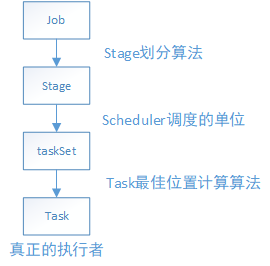
最后来总结一下,task的运行一开始不是直接调用底层的task的run方法直接处理job-->stage-->taskSet-->task这条路线的task任务的,它是通过分层和分工的思想来完成。task会派生出两个子类ShuffleMapTask和ResultTask分别完成对应的工作,ShuffleMapTask主要是对task所拥有的的RDD的partition做对应的RDD转换工作,ResultTask主要是根据action动作触发,并拉取ShuffleMapTask阶段的结果做进一步的算子和逻辑函数对数据的进一步处理。这两个阶段是通过MapOutputTracker来连接起来的。
Spark之Task原理分析的更多相关文章
- 小记--------spark的worker原理分析及源码分析
- 小记--------spark内核架构原理分析
首先会将jar包上传到机器(服务器上) 1.在这台机器上会产生一个Application(也就是自己的spark程序) 2.然后通过spark-submit(shell) 提交程序 ...
- [Spark性能调优] 第一章:性能调优的本质、Spark资源使用原理和调优要点分析
本課主題 大数据性能调优的本质 Spark 性能调优要点分析 Spark 资源使用原理流程 Spark 资源调优最佳实战 Spark 更高性能的算子 引言 我们谈大数据性能调优,到底在谈什么,它的本质 ...
- spark 性能调优(一) 性能调优的本质、spark资源使用原理、调优要点分析
转载:http://www.cnblogs.com/jcchoiling/p/6440709.html 一.大数据性能调优的本质 编程的时候发现一个惊人的规律,软件是不存在的!所有编程高手级别的人无论 ...
- 性能调优的本质、Spark资源使用原理和调优要点分析
本课主题 大数据性能调优的本质 Spark 性能调优要点分析 Spark 资源使用原理流程 Spark 资源调优最佳实战 Spark 更高性能的算子 引言 我们谈大数据性能调优,到底在谈什么,它的本质 ...
- Spark原理分析目录
1 Spark原理分析 -- RDD的Partitioner原理分析 2 Spark原理分析 -- RDD的shuffle简介 3 Spark原理分析 -- RDD的shuffle框架的实现概要分析 ...
- 20、Task原理剖析与源码分析
一.Task原理 1.图解 二.源码分析 1. ###org.apache.spark.executor/Executor.scala /** * 从TaskRunner开始,来看Task的运行的工作 ...
- Spark中Task数量的分析
本文主要说一下Spark中Task相关概念.RDD计算时Task的数量.Spark Streaming计算时Task的数量. Task作为Spark作业执行的最小单位,Task的数量及运行快慢间接决定 ...
- 深度剖析Spark分布式执行原理
让代码分布式运行是所有分布式计算框架需要解决的最基本的问题. Spark是大数据领域中相当火热的计算框架,在大数据分析领域有一统江湖的趋势,网上对于Spark源码分析的文章有很多,但是介绍Spark如 ...
随机推荐
- 如何用MathType快速输入公式
我们在写论文的时候,如果涉及到数学公式的话,我们一般都会使用MathType软件,但同时对于一些新手来说不太用使用此款软件,输入公式时就会很慢,今天教大家如何利用MathType快速输入公式. 具体方 ...
- Java精选笔记_EL表达式
EL表达式 初始EL EL是一种可以简化JSP页面的表达式,EL表达式的语法非常简单都是以"${"符号开始,以"}"符号结束的 EL表达式是一种简单的数据&qu ...
- swift swift学习笔记--函数和闭包
使用 func来声明一个函数.通过在名字之后在圆括号内添加一系列参数来调用这个方法.使用 ->来分隔形式参数名字类型和函数返回的类型 func greet(person: String, day ...
- Redis(二)-- 发布订阅、事务、安全、持久化
一.Redis发布订阅 Redis 发布订阅(pub/sub)是一种消息通信模式:发送者(pub)发送消息,订阅者(sub)接收消息. 打开两个窗口:session1 和 session2 在sess ...
- Tomcat优化详细教程
Tomcat是我们经常使用的 servlet容器之一,甚至很多线上产品都使用 Tomcat充当服务器.而且优化后的Tomcat性能提升显著,本文从以下几方面进行分析优化. 一.内存优化 默认情况下To ...
- call和apply方法
/* * @ call和apply方法 * @ 当一个object没有某个方法,但是其他的有,我们可以借助call或apply用其它对象的方法来操作. * @ (有方法的)对象.call(" ...
- 实用的IOS应用程序框架
实用的IOS应用程序框架 目录 概述 概述
- android选择图片或拍照图片上传到服务器(包括上传参数)
From:http://blog.csdn.net/springsky_/article/details/8213898具体上传代码: 1.选择图片和上传界面,包括上传完成和异常的回调监听 [java ...
- This function has none of DETERMINISTIC, NO SQL
错误信息: [Err] 1418 - This function has none of DETERMINISTIC, NO SQL, or READS SQL DATA in its declara ...
- linux注意的一些地方
assert宏的原型定义在<assert.h>中,其作用是如果它的条件返回错误,则终止程序执行 #include <assert.h>void assert( int expr ...