
Course Selection CodeChef - RIN
All submissions for this problem are available.
Read problems statements in Mandarin Chineseand Russian.
Rin is attending a university.
She has M semesters to finish her program, and that program has N required courses. Each course must be taken in exactly one of the semesters.
Some courses have prerequisites: for each i from 1 to K, she must take course A[i]before course B[i].
The same course may be taught by different professors in different semesters, and how well she does will depend on which professor teaches her. Additionally, some courses may not be taught every semester.
We are given an array X representing this information. For each course i and each semester j, X[i][j] = -1 if course i is not taught in semester j. Otherwise, X[i][j] will be an integer between 0 and 100: the expected score Rin will get if she takes course i in semester j.
Rin may take any number of courses per semester, including none, as long as they are taught that semester and she has already taken any required prerequisite courses.
Help Rin to find the maximal average score she can get over her whole program.
Input
The first line contain 3 integers: N, M and K.
This is followed by N lines, each containing M integers. The jth integer on the ith line represents the value of X[i][j].
This is followed by K lines, each containing two integers: A[i] and B[i].
Output
Output one real number: the maximal average score, rounded to 2 digits after the decimal point.
Constraints
- 1 ≤ M, N ≤ 100
- 0 ≤ K ≤ 100
- -1 ≤ X[i][j] ≤ 100
- 1 ≤ A[i], B[i] ≤ N
- For each i, A[i] ≠ B[i].
- For different i and j, (A[i], B[i]) ≠ (A[j], B[j]).
- We guarantee there exists a way to take these N courses in M semesters.
Subtasks
Subtask 1: (20 Points) A course can have at most 1 pre request course.
Subtask 2: (80 Points) Refer to constraints above
Example
Input 1:

3 2 2

70 100

100 80

100 90

1 2

1 3

Output 1:

80.00

Input 2:

4 5 4

20 -1 100 -1 -1

100 30 -1 -1 -1

100 -1 30 20 40

100 30 40 50 20

1 2

1 3

2 4

3 4

Output 2:

32.50
Explanation
Example case 1
The only way she can finish these 3 courses is: take course 1 in the first semester, then take courses 2 and 3 in the second semester. The average score is (70 + 80 + 90) / 3 = 80.00.
Example case 2
The optimal solution is: take course 1 in semester 1, course 2 in semester 2, course 3 in semester 3 and course 4 in semester 4.
EXPLANATION:
First, let's ignore the dependencies. The answer is just the maximum grade per course in any of the semesters, which is trivial to compute but let's put this in another perspective:
For each course, the best grade is 100 - (minimum grade we lose by picking one of the semesters).
To model this as a network flow graph, we do 4 things:
- Create a vertex for each pair (course i, semester j).
- Create a source vertex which is connected to the first semester of each course i by an edge with capacity 100 - grade(i, 1).
- For every semester j from 2 to M, connect the vertices of each course i from semester j-1 to j with capacity 100 - grade(i, j) or 100 if the course is not available (it's the same as having grade 0, recall that it's guaranteed there is a solution).
- Create a sink vertex and connect the last semester of each course to it, with infinite capacity.
Consider the following example with 3 courses and 3 semesters:
3 3

10 70 100

80 50 40

80 20 40
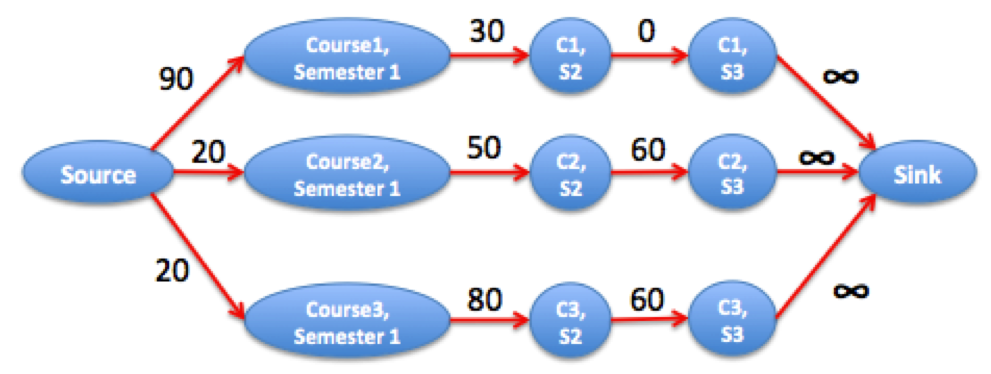
The corresponding graph is depicted in the above picture. The maximum flow is equal to the combined grade loss for all courses. We pick semester 3 for course 1 (zero loss), and semester 1 for courses 2 and 3 (loss 20+20). The maximum grade average we can get is (N * 100 - maxflow) / N. In this case: (3*100 - 40) / 3 ~= 86.67.
- Returning to the problem, why does this help?
If we model the problem this way, we can also include the course dependencies. Suppose there are dependencies 1->2 and 1->3. The best we can do is course 1 in semester 2 and courses 2 and 3 in semester 3 for (70+40+40)/3 average.
- If there are dependencies 1->2 and 1->3, then courses 2 and 3 can never be done in the first semester.
This implies that the minimum grade loss for courses 2 and 3 is not bounded by its grades in semester 1. This is the same as changing the capacities associated to semester 1 of courses 2 and 3 to infinity.
- Why do we pick semester j for course 1?
The combined grade loss of doing course 1 in semester 2 + courses 2 and 3 in semester 3 is less than doing course 1 in semester 1 + courses 2 and 3 in semesters 2 or 3.
In terms of network flow, this means that
- if we pick semester j = 1, then courses 2 and 3 are not bounded by grade loss in semester 1. To combine the grade loss by picking semester 1, we connect vertex (course 1, semester 1) to (course 2, semester 2) and (course 3, semester 2) with infinite capacity.
- if we pick semester j = 2, then courses 2 and 3 are not bounded by grade loss in semesters 1 and 2. Same as above but connecting (course 1, semester 2) to courses 2 and 3, semester 3.
- picking semester j = 3 is not possible.
The resulting network is the following
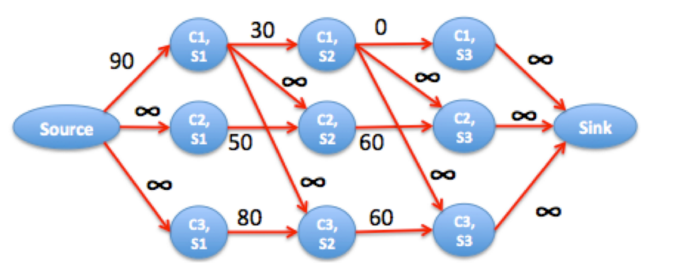
We can see that the maximum flow is 150. The best is to distribute the grade loss of course 1 in semester 2, flow 3, among courses 2 and 3 in semester 3. In fact, 70+40+40 = 300 - 150.
To give you another example, consider the input
3 3 2

10 50 100

80 90 40

80 40 70

1 2

1 3
The best we can do course 1 at semester 1 (10) + course 2 at semester 2 (90) and course 3 at semester 3 (70) = 10+90+70. The resulting graph is
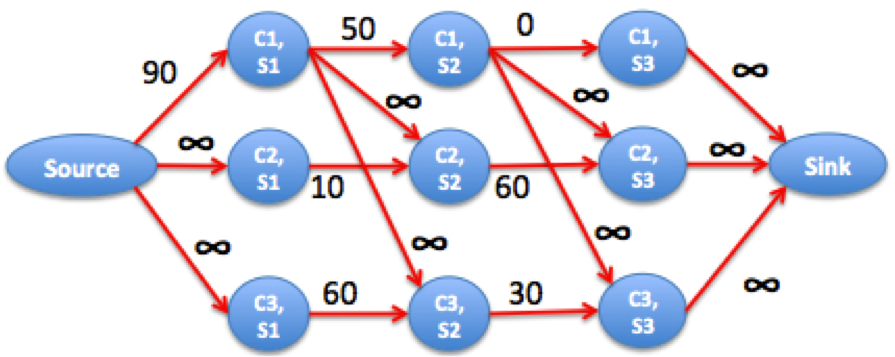
We can see that the maximum flow is 130 because in this case, it is better to distribute the grade loss of course 1 at semester 1, the flow 90, among the grade loss of courses 2 and 3 over semesters 2 and 3, respectively.
In a nutshell, we create a graph with N*M+2 vertices and use a standard maximum flow algorithm. The hard part was to realize how to build the network correctly.
Proof sketch:
Since max-flow equals min-cut, we can think of our problem as of finding a minimum cut in the above graph. Let Pi be a path corresponding to i-th course, i.e. the path formed of edges corresponding to i-th course in all semesters. In order to prove the correction of the above construction, we can show two properties of the graph:
- For every 1 <= i <= N, min-cut contains exactly one edge from Pi.
- For every constraint (i, j), if min-cut contains the k-th edge of Pi, then it contains the x-th edge of Pj, where x > k i.e. j-th course is taken in later semester than i-th course.
These two fact can be shown quite easily, but we will omit exact proofs here. Intuitively, if you pick any edge from Pi, then Pi is disconnected and there is no need for taking any other edge from it. Moreover, an edge (i, j) corresponding to a constraint, prevent us of taking course j before course i, because if you did it, then in order to make the graph disconnected, you would have to add the second edge of Pj to min-cut which contradicts the first fact.
#include<cstdio>

#include<cstring>

#include<iostream>

#define inf 2e9

using namespace std;

const int Z=101;

const int N=Z*Z;

const int M=2e6+5;

struct edge{int v,next,cap;}e[M];int tot=1,head[N];

int n,m,k,cnt,ans,S,T,id[Z][Z],X[Z][Z],dis[N],q[M];

inline int read(){

	int x=0,f=1;char ch=getchar();

	while(ch<'0'||ch>'9'){if(ch=='-')f=-1;ch=getchar();}

	while(ch>='0'&&ch<='9'){x=x*10+ch-'0';ch=getchar();}

	return x*f;

}

inline void add(int x,int y,int z){

	e[++tot].v=y;e[tot].cap=z;e[tot].next=head[x];head[x]=tot;

	e[++tot].v=x;e[tot].cap=0;e[tot].next=head[y];head[y]=tot;

}

inline bool bfs(){

	for(int i=S;i<=T;i++) dis[i]=-1;

	int h=0,t=1;q[t]=S;dis[S]=0;

	while(h!=t){

		int x=q[++h];

		for(int i=head[x];i;i=e[i].next){

			if(e[i].cap&&dis[e[i].v]==-1){

				dis[e[i].v]=dis[x]+1;

				if(e[i].v==T) return 1;

				q[++t]=e[i].v;

			}

		}

	}

	return 0;

}

int dfs(int x,int f){

	if(x==T) return f;

	int used=0,t;

	for(int i=head[x];i;i=e[i].next){

		if(e[i].cap&&dis[e[i].v]==dis[x]+1){

			t=dfs(e[i].v,min(e[i].cap,f));

			e[i].cap-=t;e[i^1].cap+=t;

			used+=t;f-=t;

			if(!f) return used;

		}

	}

	if(!used) dis[x]=-1;

	return used;

}

inline void dinic(){

	while(bfs()) ans-=dfs(S,inf);

}

inline int getY(int x){

	if(~x) return 100-x;

	return inf;

}

int main(){

	n=read();m=read();k=read();

	for(int i=1;i<=n;i++){

		for(int j=1;j<=m;j++){

			X[i][j]=read();

		}

	}

	for(int i=1;i<=n;i++){

		for(int j=1;j<=m;j++){

			id[i][j]=++cnt;

		}

	}

	S=0,T=n*m+1;

	for(int i=1;i<=n;i++){

		add(S,id[i][1],getY(X[i][1]));

		for(int j=2;j<=m;j++) add(id[i][j-1],id[i][j],getY(X[i][j]));

		add(id[i][m],T,inf);

	}

	for(int i=1,a,b;i<=k;i++){

		a=read();b=read();

		add(S,id[b][1],inf);

		for(int j=2;j<=m;j++) add(id[a][j-1],id[b][j],inf);

	}

	ans=100*n;

	dinic();

	printf("%.2lf",1.0*ans/n);

	return 0;

}
Course Selection CodeChef - RIN的更多相关文章
- CodeChef - RIN Course Selection
Read problems statements in Mandarin Chineseand Russian. Rin is attending a university. She has M se ...
- Codechef RIN 「Codechef14DEC」Course Selection 最小割离散变量模型
问题描述 提供中文版本好评,一直以为 Rin 是题目名字... pdf submit 题解 参考了 东营市胜利第一中学姜志豪 的<网络流的一些建模方法>(2016年信息学奥林匹克中国国家队 ...
- [CODECHEF]RIN
题意:一个人要在$m$个学期上$n$节课,在第$j$学期上$i$课有$X_{i,j}$的收益,有些课$B_i$有前置课程$A_i$,问最大得分 这个题我都做不出来还去看题解...我退役吧== 考虑每种 ...
- CodeChef - RIN 最小割应用 规划问题
题意:给定\(n\)门课和\(m\)个学期,每门课在每个学期有不同的得分,需要选定一个学期去完成,但存在约束条件,共有\(k\)对课程需要\(a\)在\(b\)开始学前学会,求最大得分(原问题是求最高 ...
- [CodeChef]RIN(最小割)
Description 有m门课可以在n个学期内学习,第i门课在第j个学期的收益是\(X_{i,j}\),一个学期可以学多门课,有的课之间有依赖关系,即必须先学a再学b,求最大收益.n,m<= ...
- Codechef Course Selection
Home » Practice(Hard) » Course Selection Course Selection Problem Code: RINSubmit https://www.codech ...
- codechef营养题 第三弹
第三弾が始まる! codechef problems 第三弹 一.Motorbike Racing 题面 It's time for the annual exciting Motorbike Rac ...
- codechef营养题 第二弹
第二弾が始まる! codechef problems 第二弹 一.Backup Functions 题面 One unavoidable problem with running a restaura ...
- codechef 营养题 第一弹
第一弾が始まる! 定期更新しない! 来源:http://wenku.baidu.com/link?url=XOJLwfgMsZp_9nhAK15591XFRgZl7f7_x7wtZ5_3T2peHh5 ...
随机推荐
- 基于CentOS的MySQL学习补充四--使用Shell批量从CSV文件里插入数据到数据表
本文出处:http://blog.csdn.net/u012377333/article/details/47022699 从上面的几篇文章中,能够知道怎样使用Shell创建数据库.使用Shell创建 ...
- js获取当前域名的方法
一.获取当前域名 1.方法一 var domain = document.domain; 2.方法二 var domain = window.location.host; 但是获取到的domain在线 ...
- python __path__ 变量
今天在读django源码的时候遇到了一个问题!它就是__path__这个系统变量 一.__path__变更初见: 由__path__这个变量的名字就知道,这个是一个系统变量,不是用户自定义的变量,于是 ...
- 如何在IIS7或IIS7.5中导入导出站点及应用程序池. -摘自网络
为实现负载平衡,我们可能会使用多个WEB服务器,也就会需要给多个IIS配置同样的站点和应用程序池.那么我们需要一个一个的重新建吗?当然不用,我们只需要一些简单的命令就可以在IIS7(Windows S ...
- Object-C中的字符串对象2-可变字符串
// // main.m // 字符串-可变字符串 // // Created by zhangqs008 on 14-2-13. // Copyright (c) 2014年 zhangqs008. ...
- Spring加载xml配置文件的方式(BeanFactory和ApplicationContext区别)
描述 大家都知道Java读普通文件是通过Basic I/O 中的InputStream.OutStream.Reader.Writer 等实现的.在spring 框架中,它是怎样识别xml这个配置文件 ...
- jQuery操作CheckBox的方法(选中,取消,取值)
jQuery操作CheckBox的方法(选中,取消,取值). 代码: <!DOCTYPE HTML PUBLIC "-//W3C//DTD HTML 4.0 Transitional/ ...
- Atitit.软件仪表盘(4)--db数据库子系统-监测
Atitit.软件仪表盘(4)--db数据库子系统-监测 连接数::: 死锁表列表:死锁基础列表(最近几条记录,时间,sql等) 3.对服务器进行监控,获取CUP,I/O使用情况 4.对数据库进行 ...
- poj 1611 The Suspects 并查集变形题目
The Suspects Time Limit: 1000MS Memory Limit: 20000K Total Submissions: 20596 Accepted: 9998 D ...
- 在windows中使用Navicat连接Linux虚拟机中的mysql数据库
今天想用navicat远程连接虚拟机中的MySQL数据库,一直连不上,在网上搜索了一下,发现原因是MySQL对远程用户登陆的授权问题.这里说一下我的解决方法.(本人小白) 首先,我用navicat去远 ...