
SciTech-Mathmatics-Sinusoids正弦波/Harmonics(谐波) + FrequenciesSynthesis(频率合成) + Fourier Series(傅里叶级数):PeriodicalFunctions + (Discrete)FourierTransform:AllFunctions + Spectral Analysis
几何角度看,Fourier Series(傅立叶级数) 其实非常容易理解:
每一组\((\cos(2\pi n f t),\ \sin(2\pi n f t))\)三角函数都可看作决定一“谐波空间”的 \(x\) 轴与 \(y\) 轴;
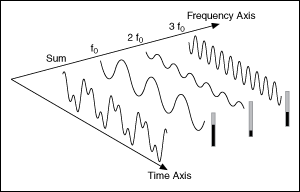
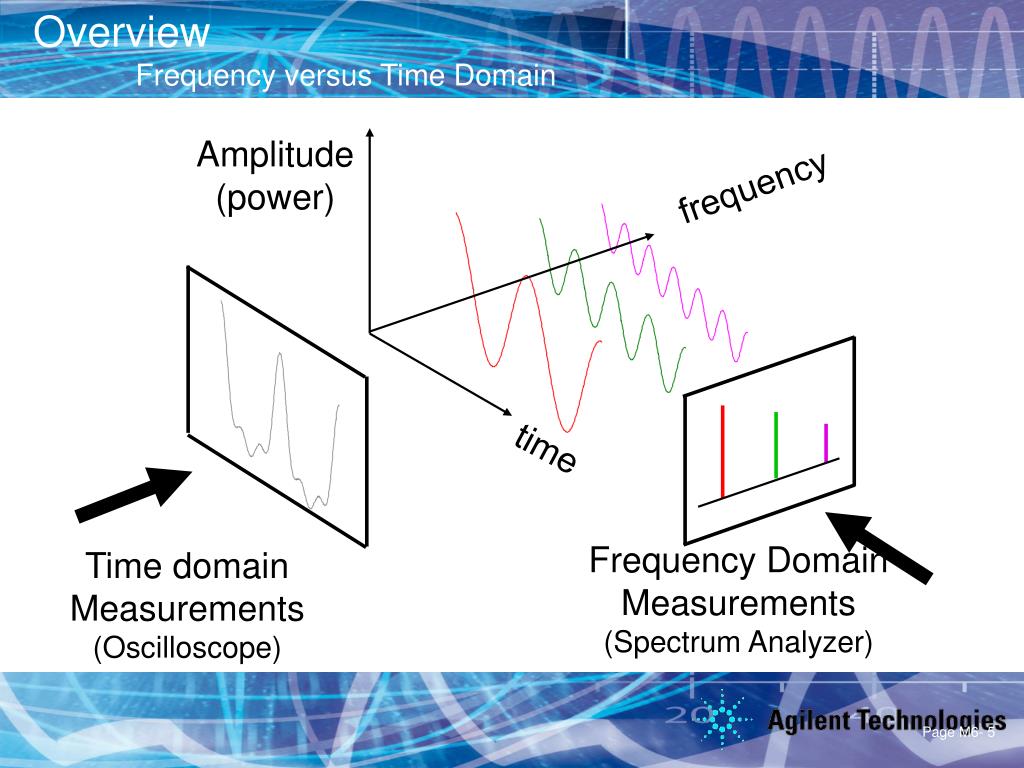
Time-domain 的信号, 是用 Freq.-domain 的 N 个独立空间的谐波合成;
每一个“谐波空间”, 都是一对可配置\(( freq.,\ magnitude,\ phase)\)的三角函数(cos/sin);
每一个“谐波空间”, 都有三个坐标轴: \((1, \cos(2\pi n f t), \sin(2\pi n f t))\):
\(\large \begin{array}{ll} \\ x(t) &= \frac{a_0}{2} + \sum_{n=1}^{\infty} {[\ a_{n} \cos(2\pi n f t) + b_{n}\sin(2\pi n f t) \ ]} \\
& \frac{a_0}{2} \longrightarrow 分解到基函数1(常数函数)对应的坐标轴上的坐标 \\
& a_n \longrightarrow 分解到 基函数 \cos(2\pi n f t) 对应的坐标轴上的坐标 \\
& b_n \longrightarrow 分解到 基函数 \sin(2\pi n f t) 对应的坐标轴上的坐标 \\
\end{array}\)\(\large \begin{array}{ll} \\ x(t) &= \int_{n=-\infty}^{+\infty}{S_n \cdot e^{i\frac{2\pi n t}{T}}} dt \\
S_n &= \frac{1}{T} \int_{t_0}^{t_0+T}{ x(t) \cdot e^{-i\frac{2\pi n t}{T}}} dt \\
& S_n: 分解到 正交基函数(复函数)\ e^{i 2\pi n f t}\ 坐标轴上的坐标 \\
\\
when & T \rightarrow \infty, \bf{即频域 谐波组频点 无穷多, 就变成“连续的频带”} \\
F(\omega) &= \frac{1}{2\pi} \int_{-\infty}^{+\infty}{x(t) \cdot e^{-i \omega t}} dt \\
& \omega: 代表频率 \\
\\ \end{array}\)合成的 \(\large X(t)\) 周期为 \(T = \frac{1}{f}\),
是因为其 \(k\) 个Frequency Components(频率成分) 的 周期的最小公倍数为 T;
这些 Harmonics(Frequency Components) 谐波任意“加减”组合, 周期最小公倍数为 T.
下文 “Preliminaries.3. Frequency Components) for Synthesis” 有述;内积(inner product of vectors) 与 分解;
向量的内积, 在有限维向量空间, 两个向量的内积:
\(\large \begin{array}{rl} \overrightarrow{u} \cdot \overrightarrow{v} &= x_1 x_2 + y_1 y_2 \\
where & \overrightarrow{u} = (x_1, y_1),\ \overrightarrow{v} = (x_2, y_2) \\
\end{array}\)函数的内积, 在无限维函数空间, 两个函数(连续)的内积(内积要重新定义,用到积分):
\(\large \begin{array}{rl} <f, g> &= \int_{t_0}^{t_0 + T}{f(t)g(t)} dt \end{array}\)离散向量分解:
将向量 \(\overrightarrow{u}\) 分解到 两个"正交向量" \(\overrightarrow{v_1}\) 与 \(\overrightarrow{v_2}\)上:
假设在(\(\overrightarrow{v_1}\), \(\overrightarrow{v_2}\))两坐标轴上坐标为(\(c_1\), \(c_2\)), 则有:
\(\large \begin{array}{ll} \ & \\
& \overrightarrow{u} = c_1 \overrightarrow{v_1} + c_2 \overrightarrow{v_2} \\
& 分解出的坐标(c_1, c_2)分别为: \\
& c_1 = \frac{\overrightarrow{u} \cdot \overrightarrow{v_1}}{\overrightarrow{v_1} \cdot \overrightarrow{v_1}},\ c_2 = \frac{\overrightarrow{u} \cdot \overrightarrow{v_2}}{\overrightarrow{v_2} \cdot \overrightarrow{v_2}} \\
\\ \end{array}\)连续向量分解:
将连续向量函数 \(\overrightarrow{x(t)}\) 分解到 两个"正交基函数" \(\overrightarrow{\cos(2\pi n f t)}\) 与 \(\overrightarrow{\sin(2\pi n f t)}\)上:
要将以上向量分解公式,由 有限维的向量空间 扩展到 无限维的函数空间;
要将内积由 有限维的向量空间 扩展到 无限维的函数空间,
并且, 要将每个三角函数(cos/sin)都看作一个“独立的坐标轴”,
用到 上文的 “函数的内积” 积分公式.
但是为方便高效, 最好用 \(Euler's\ Equation\) 将$cos/sin转换为:
\(\large \begin{array}{ll} \because & s_n &= \frac{1}{T} \int_{t_0}^{t_0 + T}{x(t) \cdot e^{-i2\pi n f t}} dt \\
& T &= \infty \\
\therefore & F(\omega) &= \frac{1}{2\pi} \int_{-\infty}^{+\infty}{x(t) \cdot e^{-i \omega t}} dt \\
\\ \end{array}\)
向量的正交与分解: 投影到正交的一堆向量为基的空间;
之所以选择分解到 \(f(\theta) = \cos \theta\) 与 \(f(\theta) = \sin \theta\), 是因为这是“一对正交基函数”,
而且在任意时刻 \(t_0\) 开始, 时长 \(2\pi\) 的 \(\sin{x} \cos{x}\) 信号的积分都是\(0\):
\(\large \begin{array}{rl} <sin, cos> &= \int_{ t_0}^{t_0 + 2\pi}{\sin{x} \cos{x}} dx = 0 \end{array}\)类比: 就像\(XOY\)平面的\(X轴\) 与 \(Y轴\) 是正交的,
因此\(XOY\)平面上任何一点, 可用其分别在\(X轴\) 与 \(Y轴\)上的投影作为(x,y)坐标;向量正交: 对于 \(XOY\)平面上两个向量 \(\overrightarrow{u} = (x_1, y_1),\ \overrightarrow{v} = (x_2, y_2)\),
如果它们的内积为0, 夹角为\(90^{\circ}\), 则称这两个向量点是“正交的”, 即 :
\(\large \begin{array}{rl} \overrightarrow{u} \cdot \overrightarrow{v} = x_1 x_2 + y_1 y_2 = 0 \\ \end{array}\)函数正交: 余弦函数$ \cos \theta $ 与 正弦函数$ \sin \theta $,
可看作 无限维的 Hilbert 空间 的 无限维向量, 向量的各个“元”是连续区间的“函数值”;
无限维空间的向量内积需要用到积分重新定义为“两个连续函数的函数值先相乘后积分”:
\(\large \begin{array}{rl} <f, g> &= \int_{x_0}^{x_0 + T}{f(x)g(x)} dx \\
<sin, cos> &= \int_{t_0}^{t_0 + 2\pi}{\sin{t} \cos{t}} dt = 0
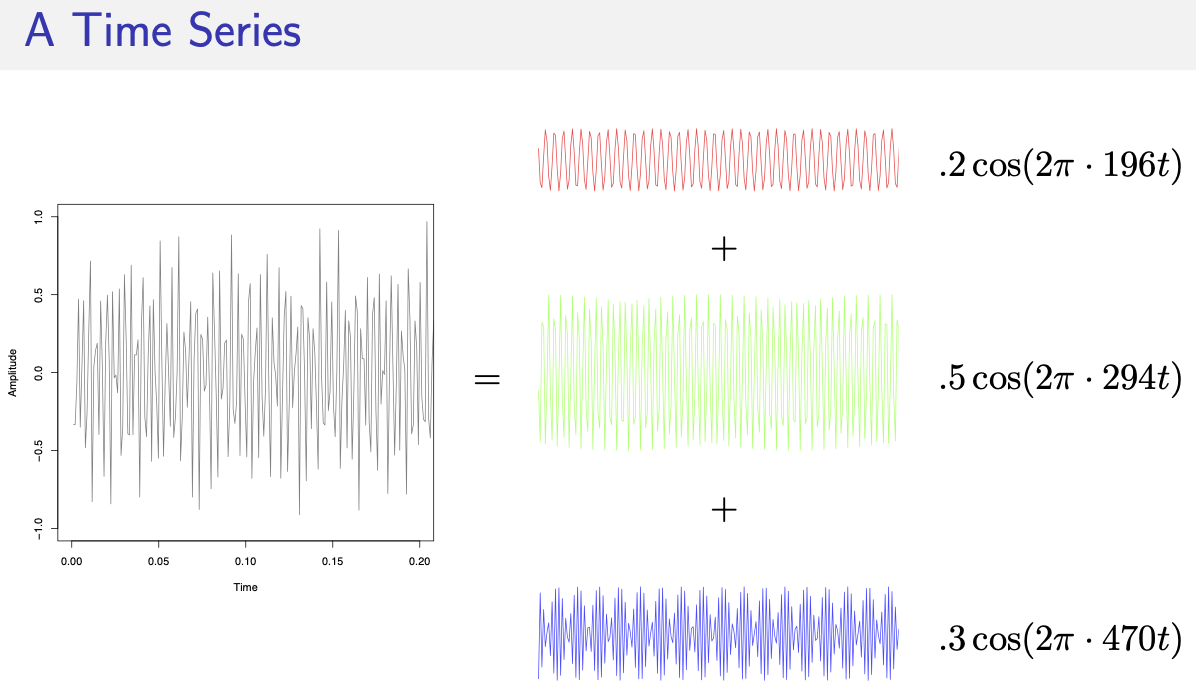
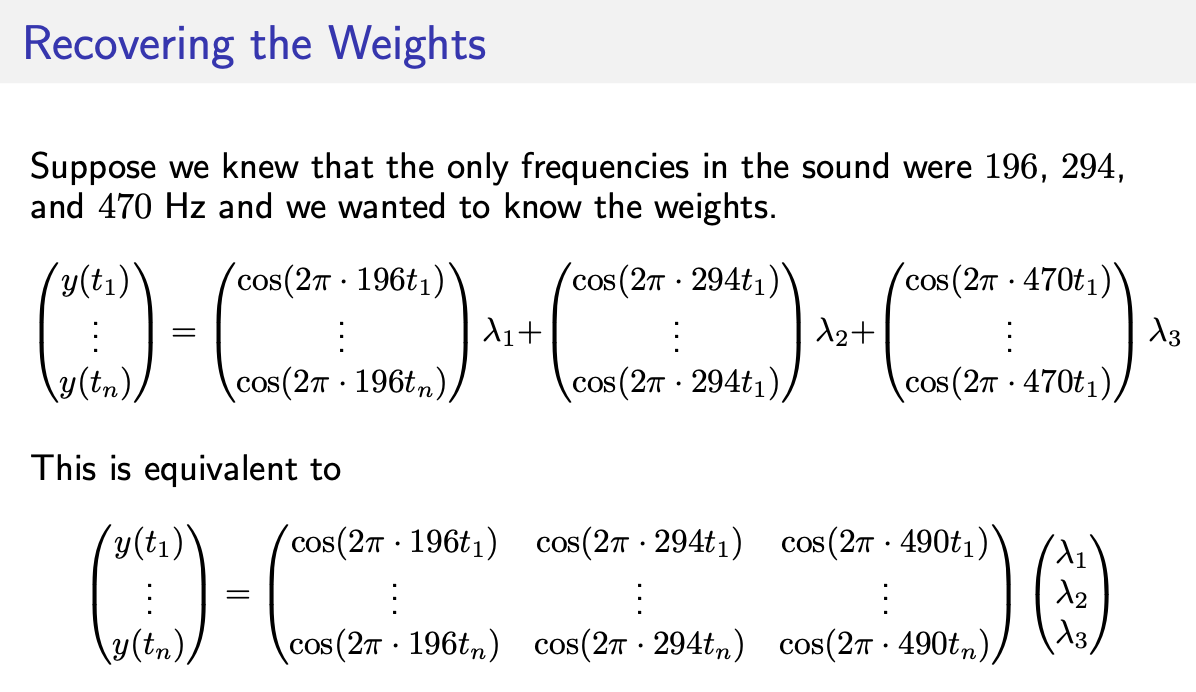
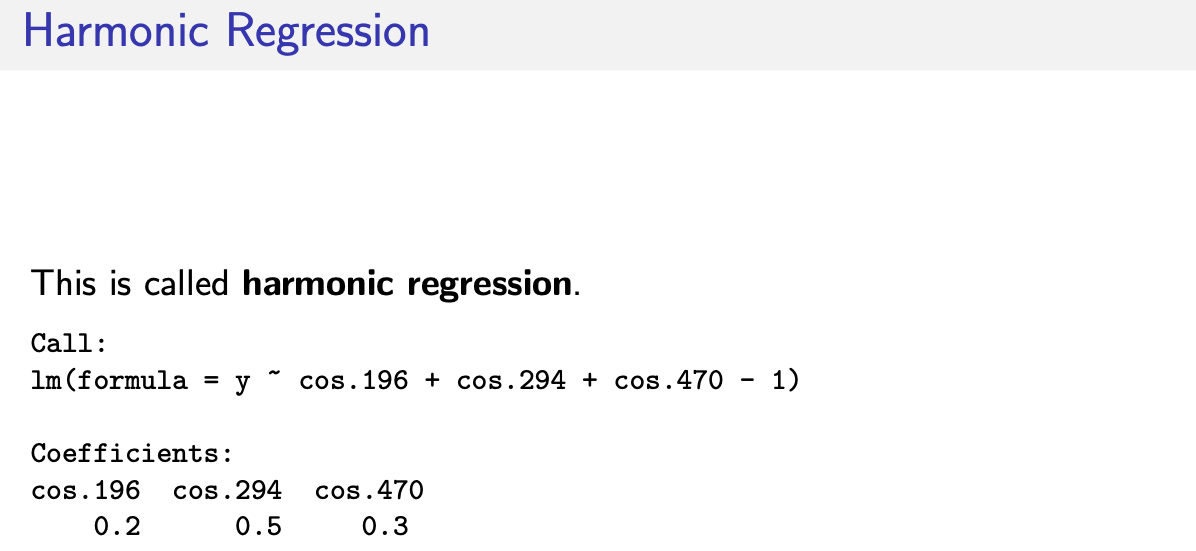
\end{array}\)分解 Time-domain 信号到 Frequency-domain,
总体思路上, 与“Taylor Series(泰勒级数)拟合任意N阶可导函数”类似:Taylor Series 是以无限项 $\large a_j (x-x_0)^j $(带可调参数的幂函数) 合成任意的 \(\large f(x)\);
确定系数 \(\large a_j\) 与 \(\large x_0\) 是用 \(\large f'(x),\ f''(x), f^{3}(x),\ ...\ ,\ , f^{n}(x)\) 无限高阶导数进行拟合与误差估计;Fourier Series 是以无限项 \(\large [\ a_{n} \cos(2\pi n f t) + b_{n}\sin(2\pi n f t) \ ]\)(可配置系数的sin正弦信号发生器);
确定系数 \(a_n\) 与 \(b_n\) 是用 积分/复数 运算 进行拟合与误差估计;
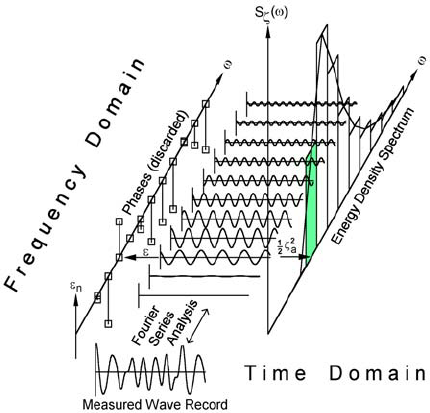
实际上, 把 Time-domain 的 Signal 函数 \(X(t)\) 分解/投影到 Frequency-domain 的多个“平面”(sin信号发生器):
每个“平面”有 一对“正交基函数”(cos/sin), 实现上是一组(\(N\)个)“可配置系数”的sin信号发生器(谐波信号轮);
每个“sin正弦信号轮”的用:- 半径(Radius)表示\(magnitude\)系数,
- 用起始的距0弧度的bias量表示\(phase\)系数,
- 以配置的常数的转动频率周期转动(产生信号)表示 Harmonic(\(\large nf_0\)) 固定的谐波频率;
通过这一组(\(N\)个)“sin信号轮”以配置好的\((magnitude,\ phase,\ harmonic)\)同时转动(产生信号),
可以合成任意的周期函数; 谐波信号轮个数越多(\(N\)越大)越精准;参数 \((a_j, b_j)\) 可以导出\((magnitude,\ phase)\), 因为 \(frequency\)这个系数,
总是 Harmonic(谐波频点, “基频\(\large f\)”的自然数倍), 所以可视为可变的常数;
因此实际最需要确定的系数\((magnitude,\ phase)\)用 \((a_j, b_j)\) 导出就足够;
Sampling在任意时刻\(\large t_0\), 最短采集(\(\bf{T_0 = \frac{1}{f_0}}\)(the fundamental period)$时长就足够;
既可以选用 sin 系列的正弦函数, 也可以选用 cos系列的余弦函数;
之所以选用 cos 与 sin 两个函数作为“基函数”:- 因为 cos 与 sin 这一对“基函数”正交.
- cos 与 sin 可以非常好的与 Complex Space 转换;
- cos 与 sin 可以用 Euler's Equation $\large e^{i\theta} = \cos\theta + i \sin\theta $ 进行变换计算;
- cos 与 sin 在 实现、转换、变换 以及 实际应用 时非常方便实现.
\(\large cos\theta\) 可用 \(\large sin{(\theta - \frac{\pi}{2})}\) 合成(即phase左移\(\large \frac{\pi}{2}\));
实现上, 只要做好一种可配置(freq., magnitude, phase)的 sin正弦信号发生器就可规模化量产; - 总之优点众多.
Preliminaries
Periodic signals:
At least to begin, we’ll mainly be concerned with signals that are periodic.
Informally, a periodic signal is one that repeats, over and over, forever. To be more precise:
A signal \(x(t)\) is said to be periodic if there exists some number \(T\),
\(\large \begin{array}{lll} \text{such that} & \\
x(t) &=& x(t+T) \text{ , for all } t \\
& & \ T:\ \mathbf{\text{the period of the signal} } \\
& & \ \mathbf{smallest\ } T:\ \mathbf{\text{the fundamental period}} \\
\end{array}\).Sinusoids:
Precisely what do we mean by a sinusoid? The term “sinusoid” means a sine wave,
but we don’t just mean the standard \(\sin(t)\). To enable our analysis,
we want to be able to work sine waves of different \(heights\), \(widths\) and \(phases\).
So, to us, a single sinusoid means a function of the form
\(\large \begin{array}{lll} \\
\ \ \ \ & x(t) &= A& \sin(2\pi f t + \phi) \\
\text{for some} & & \\
& & A &its\ amplitude \\
& & f &its\ frequency,\ period\ T = \frac{1}{f} \\
& & \phi &its\ phase \\
\end{array}\),Frequency Components for Synthesis:
\(\begin{array}{rlll} GIVING& &&& \\
x_{1}(t) &=& A_1 \sin (1 \times (2\pi f t + \phi ) ) \ ,\ \text{ freq.: } \ f\ ,\ \text{ amplitude:} A_1\ ,\ \text{ phase:} \ \phi \\
x_{2}(t) &=& A_2 \sin (2 \times (2\pi f t + \phi) ) \ ,\ \text{ freq.: } 2f\ ,\ \text{ amplitude:} A_2\ ,\ \text{ phase:} 2\phi \\
x_{3}(t) &=& A_3 \sin (3 \times (2\pi f t + \phi) ) \ ,\ \text{ freq.: } 3f\ ,\ \text{ amplitude:} A_3\ ,\ \text{ phase:} 3\phi \\
...& & \\
x_{k}(t) &=& A_k \sin (k \times (2\pi f t + \phi) ) \ ,\ \text{ freq.: } nf\ ,\ \text{ amplitude:} A_k\ ,\ \text{ phase:} k\phi \\
\\
X(t) &=& \sum_{n=1}^{k} x_{n}(t) & \\
&=& \sum_{n=1}^{k} { A_{n} \sin[\ n(2\pi f t + \phi)\ ] } & \\
\\ \end{array}\)
\(\text{ THEN the }\mathbf{period}\ of\ X(t)\text{ is } T = \frac{1}{f}, \text{SINCE}\)
\(\begin{array}{rlll} \\
\ \ period(x_{1}) &= T &= \frac{1}{f}, \\
\ \ period(x_{2}) &= \frac{T}{2} &= \frac{1}{2f}, \\
\ \ period(x_{3}) &= \frac{T}{3} &= \frac{1}{3f}, \\
\ \ &... & \\
\ \ period(x_{k}) &= \frac{T}{k} &= \frac{1}{kf}, \\
\\ \end{array}\)Harmonics/Sinusoids:
The sinusoidal terms are often called \(\mathbf{harmonics}\), a term borrowed from music.
The harmonics will have frequencies \(f\ ,\ 2f\ ,\ 3f\ ,\ 4f\) and so on.
We also call each \(harmonic\), \(A_n \sin(2\pi n f t + \phi n)\), the \(\mathbf{frequency\ component}\) of \(x(t)\) at frequency \(n f\).
For example, if \(f = 10Hz\), we call the \(harmonic\) for which
\(n = 3\) the “\(30Hz\ component\)”, reflecting that
in this case \(\sin(2\pi n f t+\phi n)\) is a sinusoid of frequency \(30Hz\)Frequency-domain and Time-domain Representation:
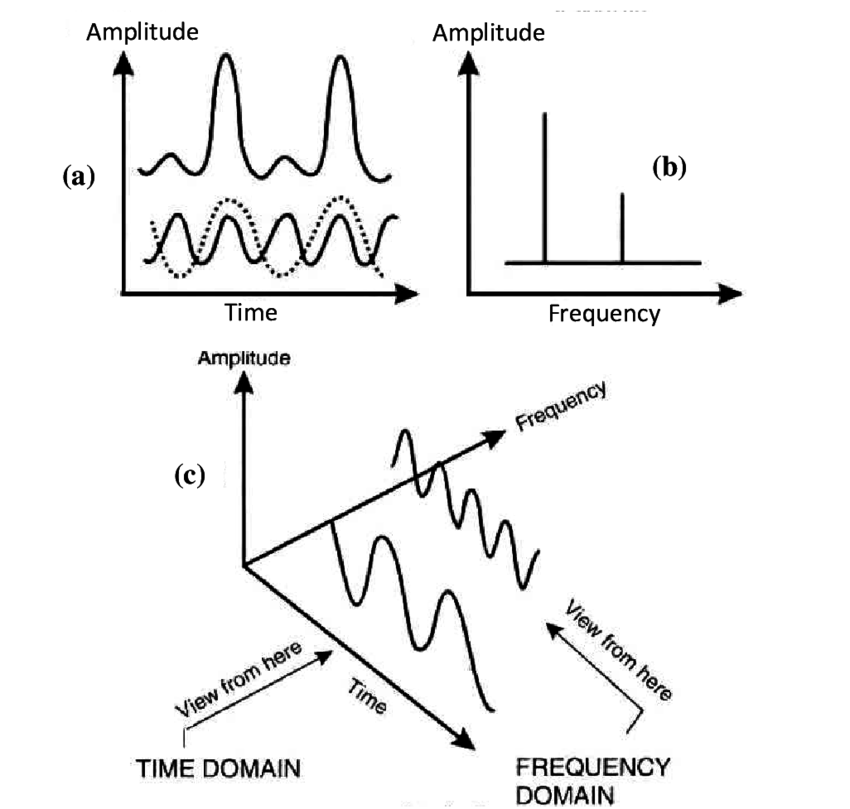
- the frequency-domain representation of the periodic signal:
represent a signal using the magnitudes and phases in its Fourier series.
We often plot the magnitudes in the Fourier series,
using a stem graph and labeling the frequency axis by frequency.
In this sense, this representation is a function of frequency. - the time-domain representation of the signal:
represent a periodic signal as a function of time in its Fourier series. - Example:
![]()
- the frequency-domain representation of the periodic signal:

The Fourier Series:
- Joseph Fourier’s idea was to express periodic signals as a sum of sinusoids.
- Theorem.
If \(\mathbf{ x(t) }\) is a \(\text{ well-behaved periodic signal }\) with \(\large \mathbf{ period\ T}\),
$\large \text{ We call }\mathbf{\ following\ sum } \ the\ \mathbf{\ Fourier\ series\ of\ }x(t) $
\(\large \begin{array}{ll} x(t) &= \begin{equation} A_0 + \sum_{n=1}^{\infty} { A_{n} \sin(2\pi n f t + n\phi) } \tag{1F} \end{equation} \\
& \mathbf{ frequency }: f = 1/T, \\
& \mathbf{ magnitudes }: A_i\ ,\ i \in [\ 1, +\infty\ ] \\
& \mathbf{ phases } \phi_i\ ,\ i \in [\ 1, +\infty\ ] \\
\\ \end{array}\)
Another fact relating to Fourier series is that:
the $magnitudes\ A_0\ ,\ A_1\ ,\ A_2\ ,\ ... $ and $phases\ \phi_1\ ,\ \phi_2\ ,\ ... $
in above equation uniquely determine \(x(t)\). That is, if we can find these
$ magnitudes $ and \(phases\) corresponding to a periodic signal \(x(t)\),
then, in effect, we have another way of describing \(x(t)\).\(\large \text{ Another useful form of Fourier series of }x(t)\)
\(\large \begin{array}{ll} x(t) &= \begin{equation} \frac{a_0}{2} + \sum_{n=1}^{\infty} {[\ a_{n} \cos(2\pi n f t) + b_{n}\sin(2\pi n f t) \ ]} \tag{2F} \end{equation} \\
& a_{0} = 2 A_0\ , \\
& a_{n} = A_{n}\cos{(n\phi)}\ ,\ b_{n} = A_{n}\sin{(n\phi)}\ , \\
& (a_{n})^{2} + (b_{n})^{2} = (A_{n})^{2}\ \\
& \text{ above } \mathbf{coefficients}\text{ can then be found, } \\
& \text{ using the following integrals, where }T = \frac{1}{f}: \\
& a_n = \frac{2}{T} \int_{0}^{T}{x(t)\cos(2\pi n f t)} dt \, \\
& b_n = \frac{2}{T} \int_{0}^{T}{x(t)\sin(2\pi n f t)} dt \\
&\text{ and }a_0,\ a_1,\ a_2,\ . . .\text{ and }b_1,\ b_2,\ . . .\ \\
&\text{ can be converted to }magnitudes\text{ and }phases,\ \\
&\text{ to fit above form (1F) }. \\
\\ \end{array}\)\(\large \text{ Proof of form (1F) and form (2F) are the same }\)
\(\large \begin{array}{lll} \\
& \because & \sin(X + Y) = \sin{X} \cos{Y} + \cos{X} sin{Y} \\
& \therefore & \sin(2\pi n f t + n\phi) = \sin{(2\pi n f t)} \cos{(n\phi)} + \cos{(2\pi n f t)} sin{(n\phi)} \\
& x(t) &= A_0 + \sum_{n=1}^{\infty} { A_{n} \sin(2\pi n f t + n\phi) } \\
& &= A_0 + \sum_{n=1}^{\infty} { (A_{n}\cos{(n\phi)}) \sin{(2\pi n f t)} + (A_{n}\sin{(n\phi)}) \cos{(2\pi n f t)}\ ] } \\
& & = \frac{a_0}{2} + \sum_{n=1}^{\infty} {[\ a_{n} \cos(2\pi n f t) + b_{n}\sin(2\pi n f t) \ ]} \\
\\ \end{array}\)\(\large \text{ Complex form of Fourier series of }x(t)\)
\(\large \begin{array}{lll} \because e^{i\theta} &= \cos\theta + i\sin\theta ,\text{ the Euler's Equation}\\
\therefore e^{i2 \pi n f t} &= \cos{(2 \pi n f t)} + i\sin{(2 \pi n f t)} \\
x(t) &= \frac{a_0}{2} + \sum_{n=1}^{\infty} {[\ a_{n} \cos(2\pi n f t) + b_{n}\sin(2\pi n f t) \ ]} \\
&= \frac{1}{T} \int_{t_0}^{t_0 + T}{x(t) \cdot e^{-i2\pi n f t}} dt \\
\\ \end{array}\)\(\large \begin{array}{ll} \because & S_n &= \frac{1}{T} \int_{t_0}^{t_0 + T}{x(t) \cdot e^{-i2\pi n f t}} dt \\
& T &= \infty \\
\therefore & F(\omega) &= \frac{1}{2\pi} \int_{-\infty}^{+\infty}{x(t) \cdot e^{-i \omega t}} dt \\
\\ \end{array}\)
Time Domain + Frequency Domain
and Fourier Transforms @ Princeton University:
Fourier Series: Periodical Functions
Fourier Transform: All Functions
Frequency Domain and Fourier Transforms @ Princeton University:
https://www.princeton.edu/~cuff/ele201/kulkarni_text/frequency.pdf
Signals and the frequency domain
ENGR 40M lecture notes — July 31, 2017 Chuan-Zheng Lee, Stanford University
https://web.stanford.edu/class/archive/engr/engr40m.1178/slides/signals.pdf
https://www.mathworks.com/help/signal/ug/extract-regions-of-interest-from-whale-song.html
https://web.stanford.edu/class/stats253/lectures_2014/lect7.pdf
https://web.stanford.edu/class/stats253/lectures_2014/
https://resources.pcb.cadence.com/blog/2020-time-domain-analysis-vs-frequency-domain-analysis-a-guide-and-comparison
- Time Domain and Frequency Domain:
- Illustrations:
| | | |
| ---- | ---- | ---- |
|![]() |
| ![]() |
| ![]() |
|
- Illustrations:
 |
|  |
|  |
|
- Application: The role of ECoG magnitude and phase in decoding position, velocity, and acceleration during continuous motor behavior
![]()

Frequency Domain and Fourier Transforms @ Princeton University:
https://www.princeton.edu/~cuff/ele201/kulkarni_text/frequency.pdf
![]()
Signals @ WEB.stanford.edu
https://web.stanford.edu/class/archive/engr/engr40m.1178/slides/signals.pdfhttps://web.stanford.edu/class/stats253/lectures_2014/lect7.pdf

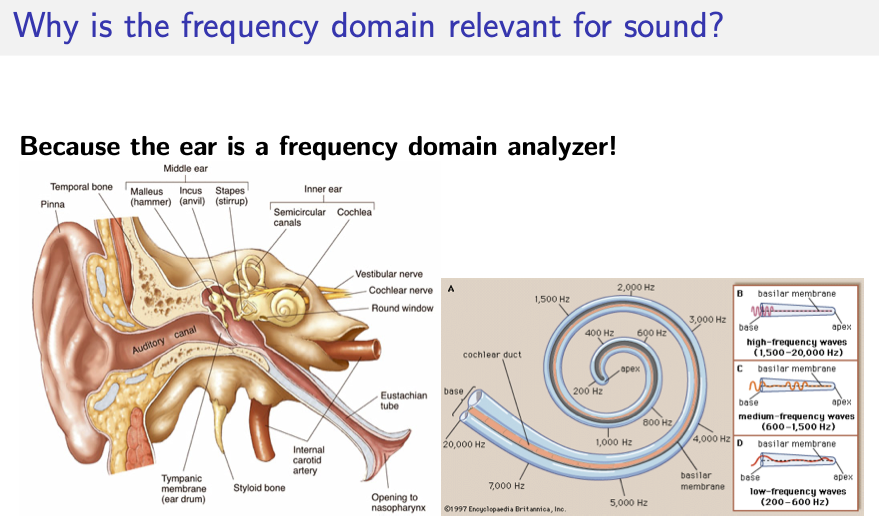
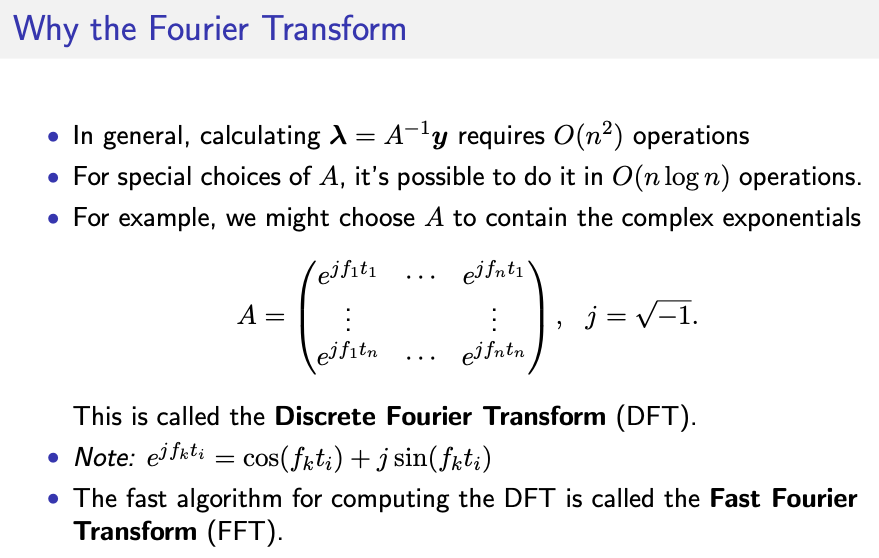
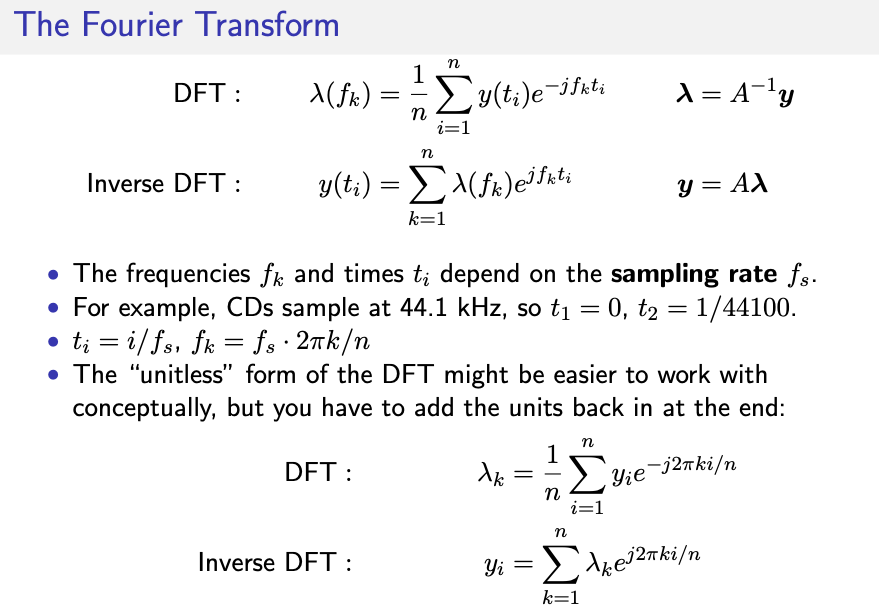
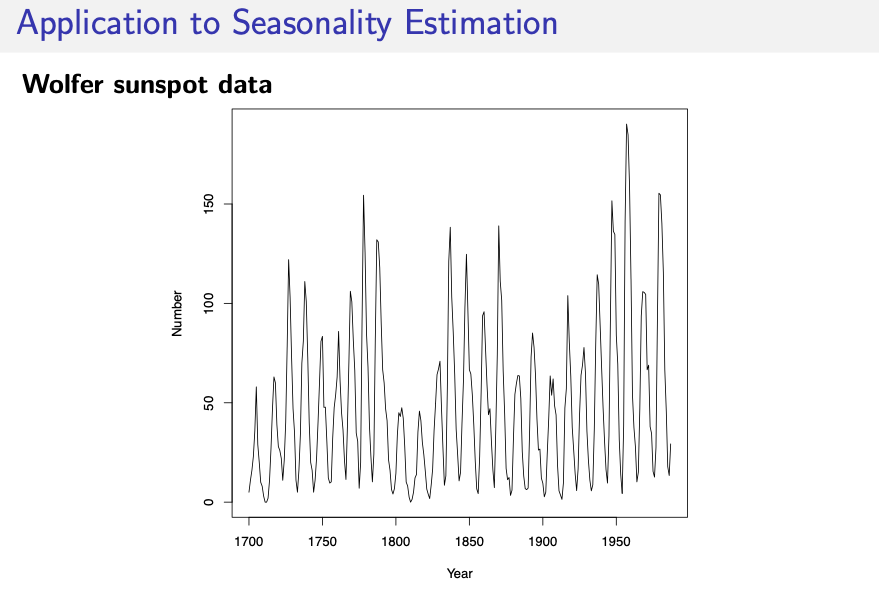
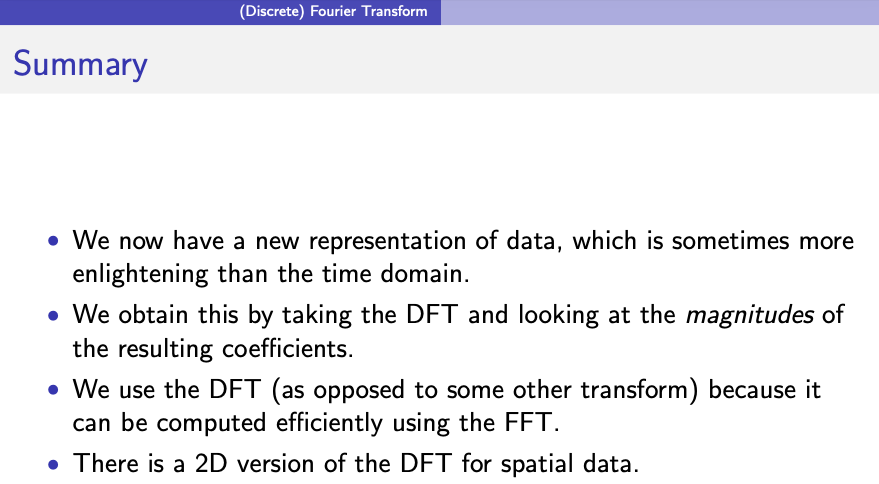
The Frequency Domain
(Discrete) Fourier Transform
Spectral Analysis
This is a new course.
• The material that we will be covering has not really been synthesized—because it is at the frontiers of statistics!
• We will be loosely following the books
• Shumway and Stoffer. Time Series Analysis and Applications (with R
Applications).
• Sherman. Spatial Statistics and Spatio-Temporal Data.
• You don’t have to purchase these books: they are available for free for Stanford students. (Link on course website.)
• Other useful references:
• Bivand et al. Applied Spatial Data Analysis with R. (also available free) • Cressie and Wikle. Statistics for Spatio-Temporal Data.



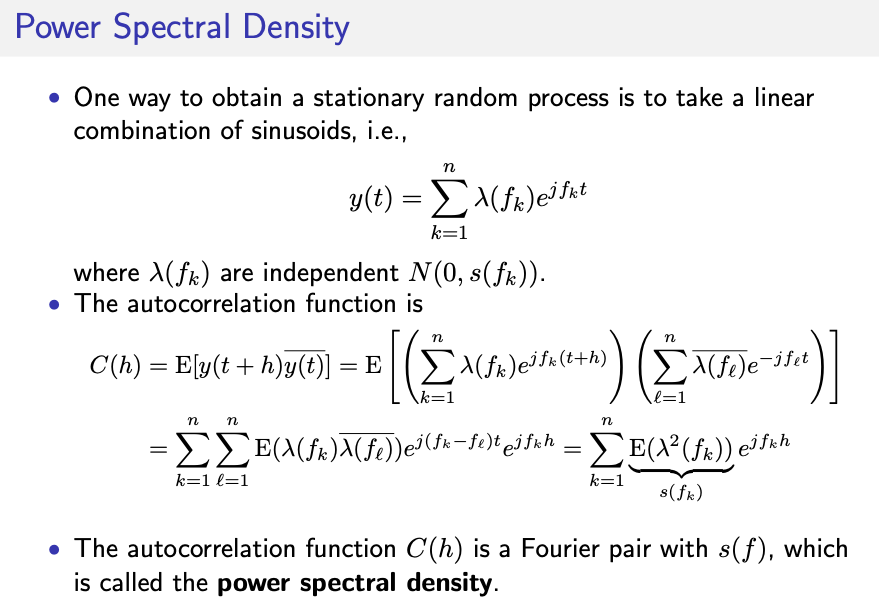
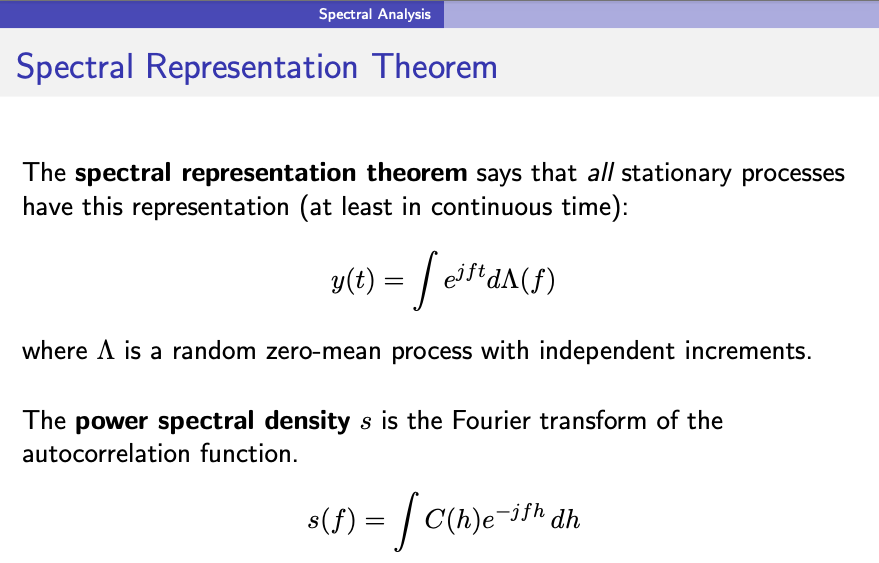
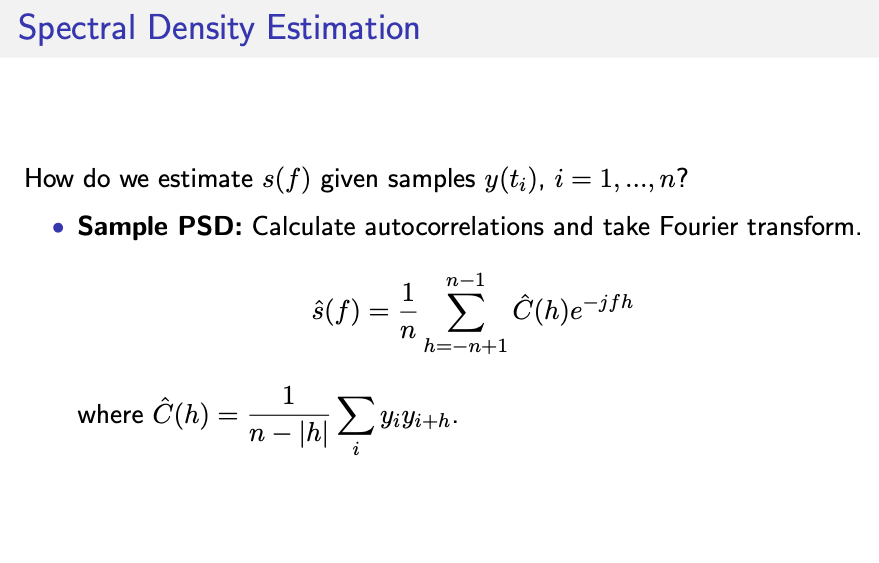
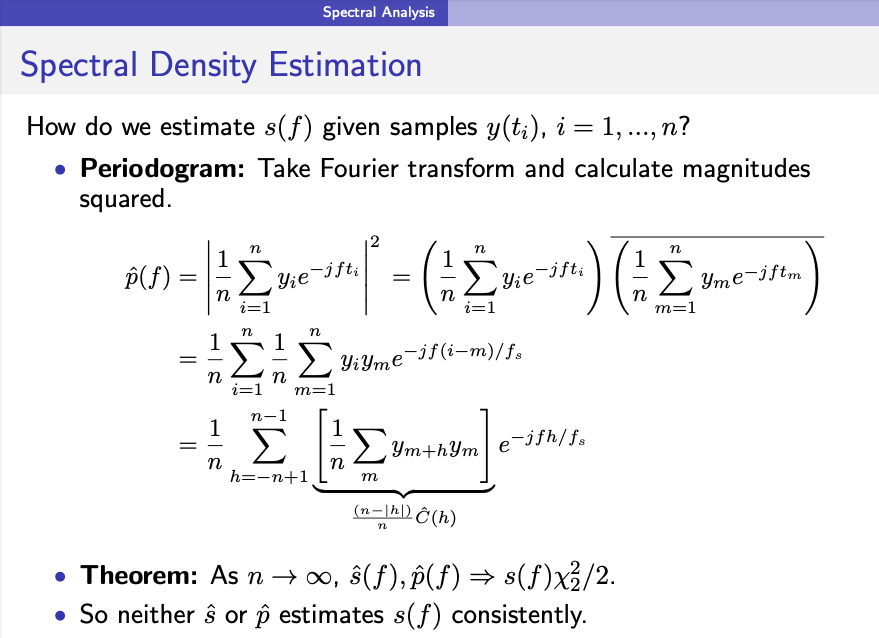
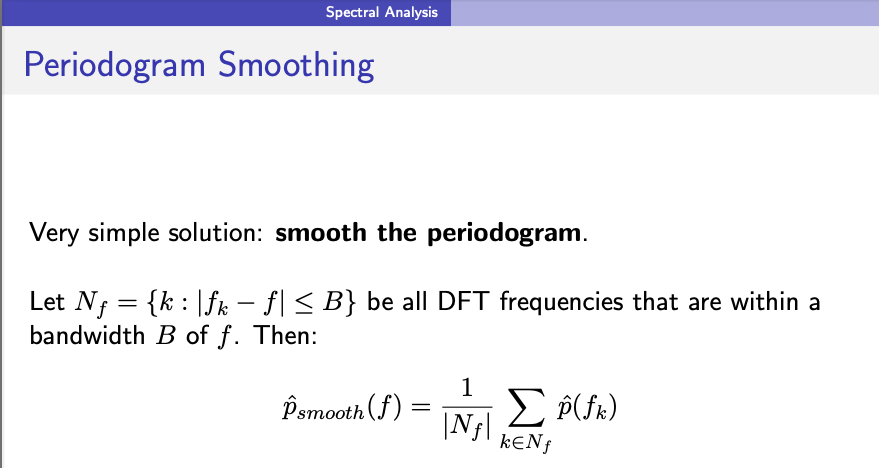
点击查看代码
SciTech-Mathmatics-Sinusoids正弦波/Harmonics(谐波) + FrequenciesSynthesis(频率合成) + Fourier Series(傅里叶级数):PeriodicalFunctions + (Discrete)FourierTransform:AllFunctions + Spectral Analysis的更多相关文章
- 每天进步一点点------直接数字频率合成DDS
- python做语音信号处理
音频信号的读写.播放及录音 标准的python已经支持WAV格式的书写,而实时的声音输入输出需要安装pyAudio(http://people.csail.mit.edu/hubert/pyaudio ...
- SciPy fftpack(傅里叶变换)
章节 SciPy 介绍 SciPy 安装 SciPy 基础功能 SciPy 特殊函数 SciPy k均值聚类 SciPy 常量 SciPy fftpack(傅里叶变换) SciPy 积分 SciPy ...
- 扯一扯基于4046系IC的锁相电路设计
4046系IC(下简称4046),包括最常见的CD4046(HEF4046),可以工作在更高频的74(V)HC4046,以及冷门而且巨难买到的74HC(T)7046和74HCT904 ...
- LOTO虚拟示波器软件功能演示之——FIR数字滤波
本文章介绍一下LOTO示波器新出的功能--FIR数字滤波的功能. 在此之前我们先来了解一下带通滤波和带阻滤波.我们都知道每个信号是不同频率不同幅值正弦波的线性叠加,为了方便直接得观察到这种现象,就有了 ...
- ENGG1310 Electricity and electronics P1.2 Electronic Communication
课程内容笔记,自用,不涉及任何 assignment,exam 答案 Notes for self use, not included any assignments or exams 一个 3h 的 ...
- 算法系列:FFT 003
转载自https://zhuanlan.zhihu.com/p/19763358 作者:Heinrich 链接:https://zhuanlan.zhihu.com/p/19763358 来源:知乎 ...
- FFT的物理意义
来源:学步园 FFT(Fast Fourier Transform,快速傅立叶变换)是离散傅立叶变换的快速算法,也是我们在数字信号处理技术中经常会提到的一个概念.在大学的理工科课程中,在完成高等数学的 ...
- 基于DDS的任意波形发生器
实验原理 DDS的原理 DDS(Direct Digital Frequency Synthesizer)直接数字频率合成器,也可叫DDFS. DDS是从相位的概念直接合成所需波形的一种频率合成技术. ...
- 10条现代EQ技术基础贴士(转)
前言: 无论是追求复古的模拟音色还是高精度的透明音质,现代电脑音乐制作中层出不断的新EQ插件以其超强的频率塑形和个性化功能为音色的润色和重塑提供了无限可能. 虽然EQ并不是音频工程工具中最复杂的,但是 ...
随机推荐
- Quartz.Net定时任务
参照: [项目升级]集成Quartz.Net Job实现(一) - 腾讯云开发者社区-腾讯云 (tencent.com) Quartz分布式任务调度 - 掘金 (juejin.cn) 基本概念: Qu ...
- GoView:Start14.6k,上车啦上车啦,Vue3低代码平台GoView,零代码+全栈框架
GoView:Start14.6k,上车啦上车啦,Vue3低代码平台GoView,零代码+全栈框架 项目介绍 GoView 是一个Vue3搭建的低代码数据可视化开发平台,将图表或页面元素封装为基础组件 ...
- VMware 17 Pro 虚拟机从下载到安装的超详细教程,解决你的所有疑问
VMware 17 Pro介绍 VMware 17 Pro是一款功能强大的虚拟机软件,适用于开发人员.测试人员.系统管理员和教育机构.它可以在一台计算机上模拟运行多台虚拟机,支持Windows.Lin ...
- 【记录】Python爬虫|爬取空间PC版日志模板
目录 效果 运行结果 模板中免费的部分 损坏的模板 小彩蛋 代码 问题及解决方式 1. 返回数据_callback({})而非json 2. 获取封面图链接 注:2021/7/30做 效果 运行结果 ...
- 痞子衡嵌入式:聊聊i.MXRT1024/1064片内4MB Flash的SFDP表易丢失导致的烧录异常
大家好,我是痞子衡,是正经搞技术的痞子.今天痞子衡给大家介绍的是i.MXRT1024/1064片内4MB Flash的SFDP表易丢失导致的烧录异常. 我们知道 i.MXRT 系列本身并没有片内非易失 ...
- vue3 基础-动态组件 & 异步组件
之前学习的都是父子组件传值的话题, 一句话总结就是, 常规数据通过属性传, dom 结构通过插槽 slot 来传. 而本篇则关注如何通过数据去控制组件的显示问题, 如咱经常用到的页面切换呀, Tab ...
- mcp~客户端与服务端的通讯技术
mcp通讯协议 stdio sse streamable http JSON_RPC MCP 的传输层负责将 MCP 协议消息转换为 JSON-RPC 格式进行传输,并将接收到的 JSON-RPC 消 ...
- synchronized 锁是可重入锁吗?如何验证?
摘要:举例证明 synchronized锁 是可重入锁,并描述可重入锁的实现原理. 综述 先给大家一个结论:synchronized锁 是可重入锁! 关于什么是可重入锁,通俗来说,当线程请求一 ...
- GC-QA-RAG 智能问答系统的向量检索
本章节介绍 GC-QA-RAG 智能问答系统的核心检索技术原理,包括向量化策略.混合检索机制.RRF 融合排序等关键实现细节. 1. 检索流程概述 系统采用典型的 RAG(Retrieval-Augm ...
- 稀疏数组(Golang版本)
稀疏数组 基本介绍 当一个数组中大部分元素为0,或者为同一个值的数组时,可以使用稀疏数组来保存该数组. 稀疏数组的处理方法: 记录数组一共有几行几列,有多少个不同的数值: 把具有不同值的元素的行数列数 ...