
201871010104-陈园园 《面向对象程序设计(java)》第十一周学习总结
201871010104-陈园园 《面向对象程序设计(java)》第十一周学习总结
| 项目 | 内容 |
| 这个作业属于哪个课程 | https://www.cnblogs.com/nwnu-daizh/ |
| 这个作业要求在哪里 | https://www.cnblogs.com/lily-2018/p/11441372.html |
| 作业学习目标 |
(1) 理解泛型概念; (2) 掌握泛型类的定义与使用; (3) 了解泛型方法的声明与使用; (4) 掌握泛型接口的定义与实现; (5) 理解泛型程序设计,理解其用途。 |
第一部分:总结理论知识
1.泛型:也称参数化类型(parameterized type),就是在定义类、接口和方法时,通过类型参数指示将要处理的对象类型。(如ArrayList类)。
2.泛型程序设计(Generic programming):编写代码可以被很多不同类型的对象所重用。
3.Pair类引入了一个类型变量T,用尖括号(<>)括起来,并放在类名的后面。
4.泛型类可以有多个类型变量。例如:
public class Pair<T, U> { … }
5.类定义中的类型变量用于指定方法的返回类型以及域、局部变量的类型。
6.泛型方法的声明:泛型方法(1)除了泛型类外,还可以只单独定义一个方法作为泛型方法,用于指定方法参数或者返回值为泛型类型,留待方法调用时确定。
(2)泛型方法可以声明在泛型类中,也可以声明在普通类中。
7.泛型接口的定义:
public interface IPool <T>
{
T get();
int add(T t);
}
8.泛型变量的限定:(1)定义泛型变量的上界:public class NumberGeneric< T extends Number>
上述声明规定了NumberGeneric类所能处理的泛型变量类型,需和Number有继承关系。
extends关键字所声明的上界既可以是一个类,也可以是一个接口。
(2)定义泛型变量的下界:List<? super CashCard> cards = new ArrayList<T>();
下界说明:通过super关键字可以固定泛型参数的类型为某种类型或者其超类。
档程序希望为一个方法的参数限定时,通常可以使用下限通配符。
9.通配符类型:“?”符号标明参数的类型可以是任何一种类型,他和参数T的含义是有区别的,T表示一种未知类型,而?标明任何一种类型。
这种通配符一般有以下三种用法:(1)单独的?:用于表示任何类型。
(2)?extends type:表示带有上界
(3)?super type:表示带有下界
10.pair与pair<?>de区别在于:可以用任意object对象调用原始的pair类的setobject方法。
第二部分:实验部分
实验1: 导入第8章示例程序,测试程序并进行代码注释。
测试程序1:
1)编辑、调试、运行教材311、312页代码,结合程序运行结果理解程序;
2) 在泛型类定义及使用代码处添加注释;
3)掌握泛型类的定义及使用。
代码如下:
package pair1;

/**

 * @version 1.00 2004-05-10

 * @author Cay Horstmann

 */

public class Pair<T> //Pair类引入了一个类型变量T

{

   private T first;//构造方法的调用

   private T second;

   public Pair() { first = null; second = null; }

   public Pair(T first, T second) { this.first = first;  this.second = second; }

   public T getFirst() { return first; }//返回值

   public T getSecond() { return second; }

   public void setFirst(T newValue) { first = newValue; }//入口参数

   public void setSecond(T newValue) { second = newValue; }

}
package pair1;

/**

 * @version 1.01 2012-01-26

 * @author Cay Horstmann

 */

public class PairTest1

{

   public static void main(String[] args)

   {

      String[] words = { "Mary", "had", "a", "little", "lamb" };//定义常量

      Pair<String> mm = ArrayAlg.minmax(words);//类名调用方法名

      System.out.println("min = " + mm.getFirst());

      System.out.println("max = " + mm.getSecond());//输出最大值、最小值

   }

}

class ArrayAlg

{

   /**

    * Gets the minimum and maximum of an array of strings.

    * @param a an array of strings

    * @return a pair with the min and max values, or null if a is null or empty

    */

   public static Pair<String> minmax(String[] a)//泛型类实例化

   {

      if (a == null || a.length == 0) return null;

      String min = a[0];

      String max = a[0];

      for (int i = 1; i < a.length; i++)

      {

         if (min.compareTo(a[i]) > 0) min = a[i];//compareTo比较方法

         if (max.compareTo(a[i]) < 0) max = a[i];

      }

      return new Pair<>(min, max);//实例化后的调用对象

   }

}
运行结果如下:

测试程序2:
1)编辑、调试运行教材315页 PairTest2,结合程序运行结果理解程序;
2)在泛型程序设计代码处添加相关注释;
3)了解泛型方法、泛型变量限定的定义及用途。
代码如下:
package pair2;

/**

 * @version 1.00 2004-05-10

 * @author Cay Horstmann

 */

public class Pair<T> //Pair类引入了一个类型变量T

{

   private T first;

   private T second;

   public Pair() { first = null; second = null; }

   public Pair(T first, T second) { this.first = first;  this.second = second; }//构造方法的调用

   public T getFirst() { return first; }//返回值

   public T getSecond() { return second; }

   public void setFirst(T newValue) { first = newValue; }//入口参数

   public void setSecond(T newValue) { second = newValue; }

}
package pair2;

import java.time.*;

/**

 * @version 1.02 2015-06-21

 * @author Cay Horstmann

 */

public class PairTest2

{

   public static void main(String[] args)

   {

      LocalDate[] birthdays =

         {

            LocalDate.of(1906, 12, 9), // G. Hopper

            LocalDate.of(1815, 12, 10), // A. Lovelace

            LocalDate.of(1903, 12, 3), // J. von Neumann

            LocalDate.of(1910, 6, 22), // K. Zuse

         };

      Pair<LocalDate> mm = ArrayAlg.minmax(birthdays);//实例化一个LocalDat类

      System.out.println("min = " + mm.getFirst());

      System.out.println("max = " + mm.getSecond());//得到min、max

   }

}

class ArrayAlg

{

   /**

      Gets the minimum and maximum of an array of objects of type T.

      @param a an array of objects of type T

      @return a pair with the min and max values, or null if a is null or empty

   */

   public static <T extends Comparable> Pair<T> minmax(T[] a) //将T限制为实现Comparable接口的类

   {

      if (a == null || a.length == 0) return null;

      T min = a[0];

      T max = a[0];

      for (int i = 1; i < a.length; i++)//compareTo方法

      {

         if (min.compareTo(a[i]) > 0) min = a[i];

         if (max.compareTo(a[i]) < 0) max = a[i];

      }

      return new Pair<>(min, max);//返回新的pair类

   }

}
运行结果如下:

测试程序3:
1) 用调试运行教材335页 PairTest3,结合程序运行结果理解程序;
2) 了解通配符类型的定义及用途。
代码如下:
package pair3;

/**

 * @version 1.00 2004-05-10

 * @author Cay Horstmann

 */

public class Pair<T> //Pair类引入了一个类型变量T

{

   private T first;

   private T second;

   public Pair() { first = null; second = null; }

   public Pair(T first, T second) { this.first = first;  this.second = second; }//构造方法的调用

   public T getFirst() { return first; }//返回值

   public T getSecond() { return second; }

   public void setFirst(T newValue) { first = newValue; }//入口参数

   public void setSecond(T newValue) { second = newValue; }

}
package pair3;

/**

 * @version 1.01 2012-01-26

 * @author Cay Horstmann

 */

public class PairTest3

{

   public static void main(String[] args)

   {//定义Manager类

      var ceo = new Manager("Gus Greedy", 800000, 2003, 12, 15);

      var cfo = new Manager("Sid Sneaky", 600000, 2003, 12, 15);

      var buddies = new Pair<Manager>(ceo, cfo);

      printBuddies(buddies);

      ceo.setBonus(1000000);

      cfo.setBonus(500000);

      Manager[] managers = { ceo, cfo };

      var result = new Pair<Employee>();//程序调用泛型方法

      minmaxBonus(managers, result);//泛型方法

      System.out.println("first: " + result.getFirst().getName()

         + ", second: " + result.getSecond().getName());

      maxminBonus(managers, result);

      System.out.println("first: " + result.getFirst().getName()

         + ", second: " + result.getSecond().getName());

   }

   public static void printBuddies(Pair<? extends Employee> p)

   {

      Employee first = p.getFirst();

      Employee second = p.getSecond();

      System.out.println(first.getName() + " and " + second.getName() + " are buddies.");

   }

   public static void minmaxBonus(Manager[] a, Pair<? super Manager> result)

   { //任何泛型Pair类型,它的类型参数是Manager的子类

      if (a.length == 0) return;

      Manager min = a[0];

      Manager max = a[0];

      for (int i = 1; i < a.length; i++)

      {

         if (min.getBonus() > a[i].getBonus()) min = a[i];

         if (max.getBonus() < a[i].getBonus()) max = a[i];

      }

      result.setFirst(min);

      result.setSecond(max);

   }

   public static void maxminBonus(Manager[] a, Pair<? super Manager> result)

   {//统配符限制为Manager的所有超类型

      minmaxBonus(a, result);

      PairAlg.swapHelper(result); // OK--swapHelper captures wildcard type

   }

   // can't write public static <T super manager> . . .

}

class PairAlg

{

   public static boolean hasNulls(Pair<?> p)//泛型类;类型变量的通配符“?”

   {

      return p.getFirst() == null || p.getSecond() == null;

   }

   public static void swap(Pair<?> p) { swapHelper(p); }

 //swap调用swapHelper

   public static <T> void swapHelper(Pair<T> p)

   {

      T t = p.getFirst();

      p.setFirst(p.getSecond());

      p.setSecond(t);

   }

}
package pair3;

public class Manager extends Employee//Manager类的父类是Employee类

{

   private double bonus;

   /**

      @param name the employee's name

      @param salary the salary

      @param year the hire year

      @param month the hire month

      @param day the hire day

   */

   public Manager(String name, double salary, int year, int month, int day)

   {

      super(name, salary, year, month, day);

      bonus = 0;

   }

   public double getSalary()

   {

      double baseSalary = super.getSalary();

      return baseSalary + bonus;

   }

   public void setBonus(double b)

   {

      bonus = b;

   }

   public double getBonus()

   {

      return bonus;

   }

}
package pair3;

import java.time.*;

public class Employee

{  //构造一个Employee类

   private String name;

   private double salary;

   private LocalDate hireDay;

   public Employee(String name, double salary, int year, int month, int day)

   {

      this.name = name;//this直接引用

      this.salary = salary;

      hireDay = LocalDate.of(year, month, day);

   }

   //访问器方法

   public String getName()

   {

      return name;

   }

   public double getSalary()

   {

      return salary;

   }

   public LocalDate getHireDay()

   {

      return hireDay;

   }

   public void raiseSalary(double byPercent)

   {

      double raise = salary * byPercent / 100;

      salary += raise;

   }

}
运行结果如下:

实验2:结对编程练习,将程序提交到PTA(2019面向对象程序设计基础知识测试题(2))
(1) 编写一个泛型接口GeneralStack,要求类中方法对任何引用类型数据都适用。GeneralStack接口中方法如下:
push(item); //如item为null,则不入栈直接返回null。
pop(); //出栈,如为栈为空,则返回null。
peek(); //获得栈顶元素,如为空,则返回null.
public boolean empty();//如为空返回true
public int size(); //返回栈中元素数量
(2)定义GeneralStack的子类ArrayListGeneralStack,要求:
ü 类内使用ArrayList对象存储堆栈数据,名为list;
ü 方法: public String toString()//代码为return list.toString();
ü 代码中不要出现类型不安全的强制转换。
(3)定义Car类,类的属性有:
private int id;
private String name;
方法:Eclipse自动生成setter/getter,toString方法。
(4)main方法要求
ü 输入选项,有quit, Integer, Double, Car 4个选项。如果输入quit,程序直接退出。否则,输入整数m与n。m代表入栈个数,n代表出栈个数。然后声明栈变量stack。
ü 输入Integer,打印Integer Test。建立可以存放Integer类型的ArrayListGeneralStack。入栈m次,出栈n次。打印栈的toString方法。最后将栈中剩余元素出栈并累加输出。
ü 输入Double ,打印Double Test。剩下的与输入Integer一样。
ü 输入Car,打印Car Test。其他操作与Integer、Double基本一样。只不过最后将栈中元素出栈,并将其name依次输出。
特别注意:如果栈为空,继续出栈,返回null
输入样例
Integer

5

2

1 2 3 4 5

Double

5

3

1.1 2.0 4.9 5.7 7.2

Car

3

2

1 Ford

2 Cherry

3 BYD

quit
输出样例
Integer Test

push:1

push:2

push:3

push:4

push:5

pop:5

pop:4

[1, 2, 3]

sum=6

interface GeneralStack

Double Test

push:1.1

push:2.0

push:4.9

push:5.7

push:7.2

pop:7.2

pop:5.7

pop:4.9

[1.1, 2.0]

sum=3.1

interface GeneralStack

Car Test

push:Car [id=1, name=Ford]

push:Car [id=2, name=Cherry]

push:Car [id=3, name=BYD]

pop:Car [id=3, name=BYD]

pop:Car [id=2, name=Cherry]

[Car [id=1, name=Ford]]

Ford

interface GeneralStack
代码如下:
import java.util.ArrayList;

import java.util.Scanner;

interface GeneralStack<T>{

    public T push(T item);            //如item为null,则不入栈直接返回null。

    public T pop();                 //出栈,如为栈为空,则返回null。

    public T peek();                //获得栈顶元素,如为空,则返回null.

    public boolean empty();//如为空返回true

    public int size();     //返回栈中元素数量

}

//定义GeneralStack的子类ArrayListGeneralStack

class ArrayListGeneralStack implements GeneralStack{

    ArrayList list=new ArrayList();

    @Override

    public String toString() {

        return  list.toString();

    }

    @Override

    public Object pop() {

        if (list.size()==0){

            return null;

        }

        return list.remove(list.size()-1);

    }

    @Override

    public Object push(Object item) {

        if (list.add(item)){

            return item;

        }else {

            return false;

        }

    }

    @Override

    public Object peek() {

        return list.get(list.size()-1);

    }

    @Override

    public boolean empty() {

        if (list.size()==0){

            return true;

        }else {

            return false;

        }

    }

    @Override

    public int size() {

        return list.size();

    }

}

//定义Car类

class Car{

    private int id;

    private String name;

    @Override

    public String toString() {

        return "Car [" +

                "id=" + id +

                ", name=" + name  +

                ']';

    }

    public int getId() {

        return id;

    }

    public void setId(int id) {

        this.id = id;

    }

    public String getName() {

        return name;

    }

    public void setName(String name) {

        this.name = name;

    }

    public Car(int id, String name) {

        this.id = id;

        this.name = name;

    }

}

public class Main {

    public static void main(String[] args) {

        Scanner sc=new Scanner(System.in);

        while (true){

            String s=sc.nextLine();

            if (s.equals("Double")){

                System.out.println("Double Test");

                int count=sc.nextInt();

                int pop_time=sc.nextInt();

                ArrayListGeneralStack arrayListGeneralStack = new ArrayListGeneralStack();//建立可以存放Double类型的ArrayListGeneralStack

                for (int i=0;i<count;i++){

                    System.out.println("push:"+arrayListGeneralStack.push(sc.nextDouble()));

                }

                for (int i=0;i<pop_time;i++){

                    System.out.println("pop:"+arrayListGeneralStack.pop());

                }

                System.out.println(arrayListGeneralStack.toString());

                double sum=0;

                int size=arrayListGeneralStack.size();

                for (int i=0;i<size;i++){

                    sum+=(double)arrayListGeneralStack.pop();

                }

                System.out.println("sum="+sum);

                System.out.println("interface GeneralStack");

            }

            else if (s.equals("Integer")){

                System.out.println("Integer Test");

                int count=sc.nextInt();

                int pop_time=sc.nextInt();

                ArrayListGeneralStack arrayListGeneralStack = new ArrayListGeneralStack();//建立可以存放Integer类型的ArrayListGeneralStack

                for (int i=0;i<count;i++){

                    System.out.println("push:"+arrayListGeneralStack.push(sc.nextInt()));

                }

                for (int i=0;i<pop_time;i++){

                    System.out.println("pop:"+arrayListGeneralStack.pop());

                }

                System.out.println(arrayListGeneralStack.toString());

                int sum=0;

                int size=arrayListGeneralStack.size();

                for (int i=0;i<size;i++){

                    sum+=(int)arrayListGeneralStack.pop();

                }

                System.out.println("sum="+sum);

                System.out.println("interface GeneralStack");

            }

            else if (s.equals("Car")){

                System.out.println("Car Test");

                int count=sc.nextInt();

                int pop_time=sc.nextInt();

                ArrayListGeneralStack arrayListGeneralStack = new ArrayListGeneralStack();//创建可以存放Car类型的ArrayListGeneralStack

                for (int i=0;i<count;i++){

                    int id=sc.nextInt();

                    String name=sc.next();

                    Car car = new Car(id,name);

                    System.out.println("push:"+arrayListGeneralStack.push(car));

                }

                for (int i=0;i<pop_time;i++){

                    System.out.println("pop:"+arrayListGeneralStack.pop());

                }

                System.out.println(arrayListGeneralStack.toString());

                if (arrayListGeneralStack.size()>0){

                    int size=arrayListGeneralStack.size();

                    for (int i=0;i<size;i++){

                        Car car=(Car) arrayListGeneralStack.pop();

                        System.out.println(car.getName());

                    }

                }

                System.out.println("interface GeneralStack");

            }

            else if (s.equals("quit")){

                break;

            }

        }

    }

}
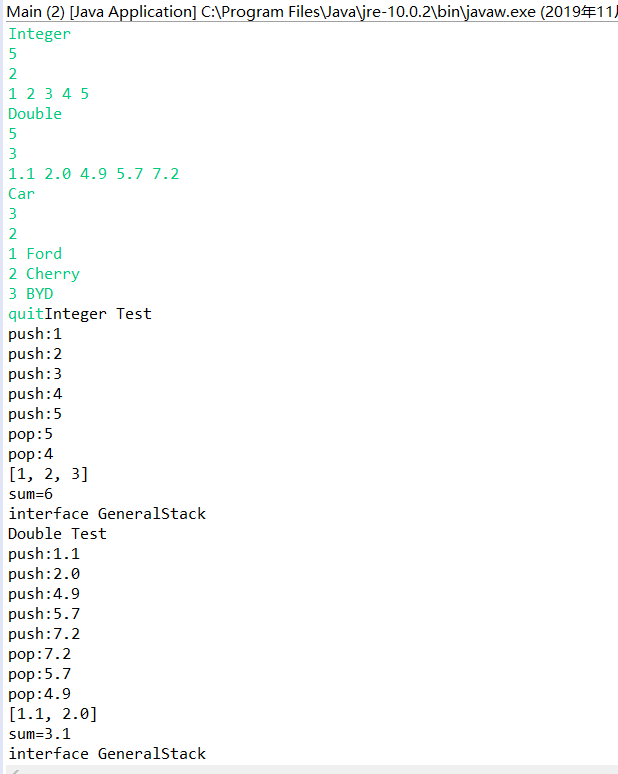
运行结果如下:
三、实验心得
通过本周的学习,掌握了泛型类的定义,以及泛型方法的声明,还有泛型接口的定义,以及对泛型变量的限定。但在用泛型类写程序时还是有一点点的困难。本次实验除了导入程序学习之外,就是首次结对编程练习,编程练习对我来说,很难。学习编程的过程也很难,但是在老师和学长的慢慢引导之下,可以渐渐地掌握一些基本技能。总之,收获还是有的,就是进步不太大。
201871010104-陈园园 《面向对象程序设计(java)》第十一周学习总结的更多相关文章
- 201771010134杨其菊《面向对象程序设计java》第九周学习总结
第九周学习总结 第一部分:理论知识 异常.断言和调试.日志 1.捕获 ...
- 201871010132-张潇潇《面向对象程序设计(java)》第一周学习总结
面向对象程序设计(Java) 博文正文开头 项目 内容 这个作业属于哪个课程 https://www.cnblogs.com/nwnu-daizh/ 这个作业的要求在哪里 https://www.cn ...
- 扎西平措 201571030332《面向对象程序设计 Java 》第一周学习总结
<面向对象程序设计(java)>第一周学习总结 正文开头: 项目 内容 这个作业属于哪个课程 https://www.cnblogs.com/nwnu-daizh/ 这个作业的要求在哪里 ...
- 201871010124 王生涛《面向对象程序设计JAVA》第一周学习总结
项目 内容 这个作业属于哪个课程 https://www.cnblogs.com/nwnu-daizh/ 这个作业的要求在哪里 https://edu.cnblogs.com/campus/xbsf/ ...
- 杨其菊201771010134《面向对象程序设计Java》第二周学习总结
第三章 Java基本程序设计结构 第一部分:(理论知识部分) 本章主要学习:基本内容:数据类型:变量:运算符:类型转换,字符串,输入输出,控制流程,大数值以及数组. 1.基本概念: 1)标识符:由字母 ...
- 201871010115——马北《面向对象程序设计JAVA》第二周学习总结
项目 内容 这个作业属于哪个课程 https://www.cnblogs.com/nwnu-daizh/ 这个作业的要求在哪里 https://www.cnblogs.com/nwnu-daizh/p ...
- 201777010217-金云馨《面向对象程序设计(Java)》第二周学习总结
项目 内容 这个作业属于哪个课程 https://www.cnblogs.com/nwnu-daizh/ 这个作业的要求在哪里 https://www.cnblogs.com/nwnu-daizh/p ...
- 201871010132——张潇潇《面向对象程序设计JAVA》第二周学习总结
项目 内容 这个作业属于哪个课程 https://www.cnblogs.com/nwnu-daizh/ 这个作业的要求在哪里 https://www.cnblogs.com/nwnu-daizh/p ...
- 201771010123汪慧和《面向对象程序设计Java》第二周学习总结
一.理论知识部分 1.标识符由字母.下划线.美元符号和数字组成, 且第一个符号不能为数字.标识符可用作: 类名.变量名.方法名.数组名.文件名等.第二部分:理论知识学习部分 2.关键字就是Java语言 ...
- 《Java程序设计》第十一周学习总结
20175334 <Java程序设计>第十一周学习总结 教材学习内容总结 第十三章 URL类 一个URL对象通常包含最基本的三部分信息:协议.地址.资源. URL对象调用 InputStr ...
随机推荐
- pycharm 设置django server
- vmvare虚拟机篇
新建虚拟机-典型-稍后安装-Linux-管理-从磁盘删除-虚拟机名称-位置- 安装Tools-用于虚拟机和本地文件共享和传送 网络适配器桥接模式-桥接本地网卡 NAT模式-再重新连接本地网卡 仅主机模 ...
- jQuery中的属性(四)
1. attr(name|properties|key,value|fn), 设置或返回被选元素的属性值 参数说明: name:属性名称 properties:作为属性的“名/值对”对象 key,va ...
- x3
#include<stdio.h> int main() { char ch; printf("输入一个字符:\n"); scanf("%c",&a ...
- Spring Boot(十二):LocalDateTime格式化处理
Java 8之后,日期类的处理建议使用java.time包中对应的LocalDateTime, LocalDate, LocalTime类.(参考Java8新特性) 在Spring Boot中(验证版 ...
- HTML+CSS基础 border css属性 Div块 盒子
border css属性 边框颜色 border-color:red/#ffffff/rgb()默认为黑色 边框样式 border-style:solid (实线) dashed (虚线).默认为n ...
- 博客中新浪图床 迁移至 阿里云的OSS
前言 因为之前有个新浪的图床,还挺好用,而且免费,自己博客的图片上传到其上面也挺方便的,但是,前几周吧,突然图片就不能访问了,之前本来是想通过添加 meta 头来解决的,但是发现没有效果.于是就自己搞 ...
- 2019-11-29-WPF-模拟触摸设备
原文:2019-11-29-WPF-模拟触摸设备 title author date CreateTime categories WPF 模拟触摸设备 lindexi 2019-11-29 08:47 ...
- qt 界面去掉系统边框2.0版
之前的一版存在bug.如果将鼠标放移动到界面内某个可点击的widget上(如:QPushButton)上,按住鼠标左键不放,界面可能会出现界面非预期移动的问题. 那是因为当鼠标移动到可点击的widge ...
- Android App自动化测试实战(基于Python)(三)
1.Native App自动化测试及Appuim框架介绍 android平台提供了一个基于java语言的测试框架uiautomator,它一个测试的Java库,包含了创建UI测试的各种API和执行自动 ...