
IdentityServer4之Jwt身份验证方案分析
一,准备内容
在之前讲过的asp.net core 实现OAuth2.0四种模式系列中的IdentityApi客户端用到了以下配置代码
  public void ConfigureServices(IServiceCollection services)

        {

            services.AddMvc().SetCompatibilityVersion(CompatibilityVersion.Version_2_2);

            services.AddAuthentication("Bearer").AddJwtBearer(r => {

                //认证地址

                r.Authority = "http://localhost:5000";

                //权限标识

                r.Audience = "secretapi";

                //是否必需HTTPS

                r.RequireHttpsMetadata = false;

            });

        }
app.UseAuthentication();
AddJwtBearer到底起到什么作用呢。首先熟习两个概念
1,中间件(Middleware)
中间件是组装到Asp.net core应用程序管道中以处理请求和响应的软件。可以这样理解:一根管道从水源(用户)连接到家庭(资源)。水源的水是不能直接饮用的,需要重重过滤,这些过滤手段就是中间件,在处理过程中决定是否往下继续传送,可能丢弃,也可能转到其它地方。请参考我之前写的《Asp.net core之中间件》
2,身份认证执行方案(AuthenticationSchemes)
在一个启用身份认证的Asp.net core应用中可以有几个执行方案,分工不同,功能也不同。可以指定由那个方案进行身份认证,如以下代码
      [HttpGet]

        [Route("api/identity")]

        [Microsoft.AspNetCore.Authorization.Authorize(Roles ="admin",AuthenticationSchemes ="Bearer")]

        public object GetUserClaims()
指定了方案名为“Bearer”的方案来做这个Api接口的认证。这个"Bearer"是怎么来的呢,看一下services.AddAuthentication方法有几个重载,我们上面用的重载是传递一个字符串指定默认方案为“Bearer”,那么程序是如果根据"Bearer"这个方案名找到对应的执行方案的呢?
二,AddJwtBearer添加Jwt证书验证执行方案
AddJwtBearer是Microsoft.AspNetCore.Authentication.JwtBearer对AuthenticationBuilder的一个扩写方法,看一下源码
  public static class JwtBearerExtensions

    {

        public static AuthenticationBuilder AddJwtBearer(this AuthenticationBuilder builder)

            => builder.AddJwtBearer(JwtBearerDefaults.AuthenticationScheme, _ => { });

        public static AuthenticationBuilder AddJwtBearer(this AuthenticationBuilder builder, Action<JwtBearerOptions> configureOptions)

            => builder.AddJwtBearer(JwtBearerDefaults.AuthenticationScheme, configureOptions);

        public static AuthenticationBuilder AddJwtBearer(this AuthenticationBuilder builder, string authenticationScheme, Action<JwtBearerOptions> configureOptions)

            => builder.AddJwtBearer(authenticationScheme, displayName: null, configureOptions: configureOptions);

        public static AuthenticationBuilder AddJwtBearer(this AuthenticationBuilder builder, string authenticationScheme, string displayName, Action<JwtBearerOptions> configureOptions)

        {

            builder.Services.TryAddEnumerable(ServiceDescriptor.Singleton<IPostConfigureOptions<JwtBearerOptions>, JwtBearerPostConfigureOptions>());

            return builder.AddScheme<JwtBearerOptions, JwtBearerHandler>(authenticationScheme, displayName, configureOptions);

        }

    }
有四个方法重载,但最后运行的是最后一个重载,最后一个重载用了builder.AddScheme方法添加方案,所以,AddJwtBearer本质上就是添加验证方案。前二个方法重载没有传“authenticationScheme"参数,使用的是JwtBearerDefaults.AuthenticationScheme这个值,我们上边用的代码是第二个重载,传了configOptions,没传authenticationScheme,JwtBearerDefaults.AuthenticationScheme这个值预设为Bearer(见以下源码),所以根据Bearer这个方案名找到的方案就是我们运行AddJwtBearer所添加的方案。
 public static class JwtBearerDefaults

    {

        /// <summary>

        /// Default value for AuthenticationScheme property in the JwtBearerAuthenticationOptions

        /// </summary>

        public const string AuthenticationScheme = "Bearer";

    }
三,JwtBearer执行方案具体做了什么工作
上面说过AddJwtBearer本质上就是添加一个执行方案。先看下添加执行方案的关键源码
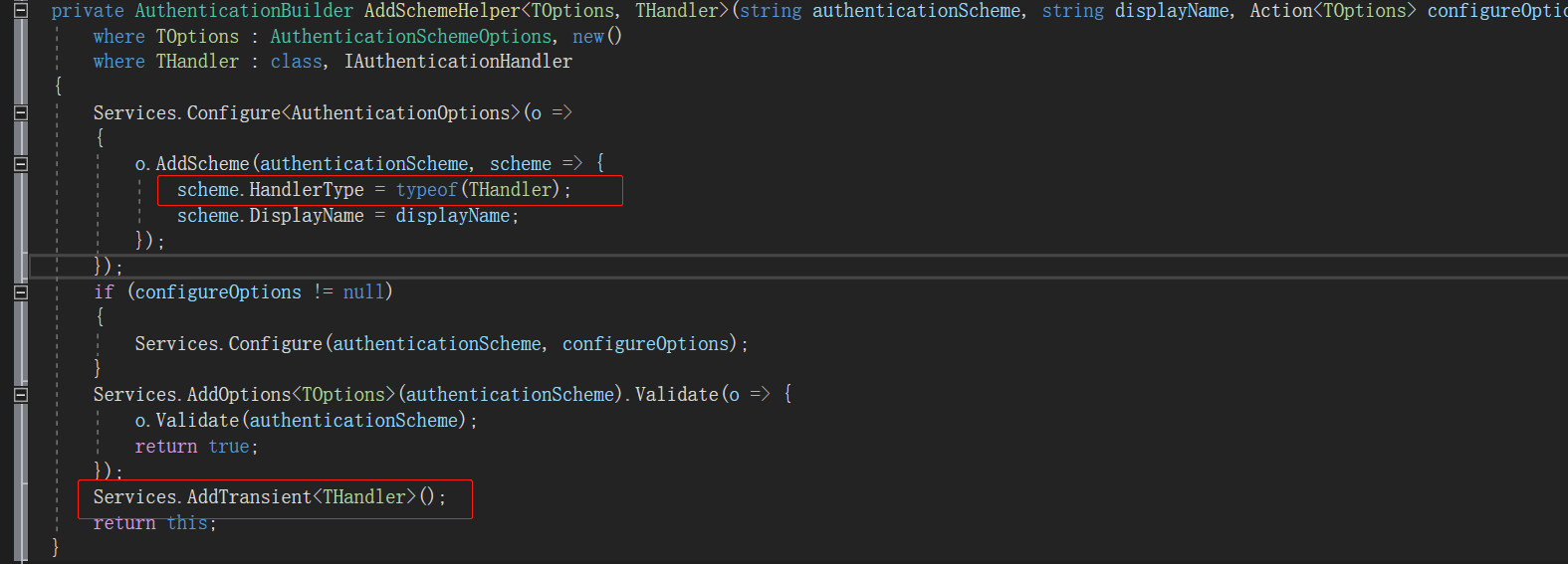
把方案的HandlerType指定为方法的第二个泛型,方便从根据方案实例化Hndler,并将这个泛型添加进了服务依赖。从AddJwtBearer源码可看到出这个泛型为:JwtBearerHandler
  public static AuthenticationBuilder AddJwtBearer(this AuthenticationBuilder builder, string authenticationScheme, string displayName, Action<JwtBearerOptions> configureOptions)

        {

            builder.Services.TryAddEnumerable(ServiceDescriptor.Singleton<IPostConfigureOptions<JwtBearerOptions>, JwtBearerPostConfigureOptions>());

            return builder.AddScheme<JwtBearerOptions, JwtBearerHandler>(authenticationScheme, displayName, configureOptions);

        }
分析JwtBearerHandler源码,JwtBearerHandler主要是能干三件事
1,HandleAuthenticateAsync:获取HTTP请求头里的Authorization头。先验证是不是Bearer格式,再用JwtSecurityTokenHandler这个工具类验证Jwt数据,包括长度,格式,是否过期,签发地址等。
触发事件:1),MessageReceived:接收到请时触发。
2),TokenValidated:验证Jwt数据成功时触发。
3),AuthenticationFailed:验证Jwt数据失败时触发。
附源码
  protected override async Task<AuthenticateResult> HandleAuthenticateAsync()

        {

            string token = null;

            try

            {

                // Give application opportunity to find from a different location, adjust, or reject token

                var messageReceivedContext = new MessageReceivedContext(Context, Scheme, Options);

                // event can set the token

                await Events.MessageReceived(messageReceivedContext);

                if (messageReceivedContext.Result != null)

                {

                    return messageReceivedContext.Result;

                }

                // If application retrieved token from somewhere else, use that.

                token = messageReceivedContext.Token;

                if (string.IsNullOrEmpty(token))

                {

                    string authorization = Request.Headers[HeaderNames.Authorization];

                    // If no authorization header found, nothing to process further

                    if (string.IsNullOrEmpty(authorization))

                    {

                        return AuthenticateResult.NoResult();

                    }

                    if (authorization.StartsWith("Bearer ", StringComparison.OrdinalIgnoreCase))

                    {

                        token = authorization.Substring("Bearer ".Length).Trim();

                    }

                    // If no token found, no further work possible

                    if (string.IsNullOrEmpty(token))

                    {

                        return AuthenticateResult.NoResult();

                    }

                }

                if (_configuration == null && Options.ConfigurationManager != null)

                {

                    _configuration = await Options.ConfigurationManager.GetConfigurationAsync(Context.RequestAborted);

                }

                var validationParameters = Options.TokenValidationParameters.Clone();

                if (_configuration != null)

                {

                    var issuers = new[] { _configuration.Issuer };

                    validationParameters.ValidIssuers = validationParameters.ValidIssuers?.Concat(issuers) ?? issuers;

                    validationParameters.IssuerSigningKeys = validationParameters.IssuerSigningKeys?.Concat(_configuration.SigningKeys)

                        ?? _configuration.SigningKeys;

                }

                List<Exception> validationFailures = null;

                SecurityToken validatedToken;

                foreach (var validator in Options.SecurityTokenValidators)

                {

                    if (validator.CanReadToken(token))

                    {

                        ClaimsPrincipal principal;

                        try

                        {

                            principal = validator.ValidateToken(token, validationParameters, out validatedToken);

                        }

                        catch (Exception ex)

                        {

                            Logger.TokenValidationFailed(ex);

                            // Refresh the configuration for exceptions that may be caused by key rollovers. The user can also request a refresh in the event.

                            if (Options.RefreshOnIssuerKeyNotFound && Options.ConfigurationManager != null

                                && ex is SecurityTokenSignatureKeyNotFoundException)

                            {

                                Options.ConfigurationManager.RequestRefresh();

                            }

                            if (validationFailures == null)

                            {

                                validationFailures = new List<Exception>(1);

                            }

                            validationFailures.Add(ex);

                            continue;

                        }

                        Logger.TokenValidationSucceeded();

                        var tokenValidatedContext = new TokenValidatedContext(Context, Scheme, Options)

                        {

                            Principal = principal,

                            SecurityToken = validatedToken

                        };

                        await Events.TokenValidated(tokenValidatedContext);

                        if (tokenValidatedContext.Result != null)

                        {

                            return tokenValidatedContext.Result;

                        }

                        if (Options.SaveToken)

                        {

                            tokenValidatedContext.Properties.StoreTokens(new[]

                            {

                                new AuthenticationToken { Name = "access_token", Value = token }

                            });

                        }

                        tokenValidatedContext.Success();

                        return tokenValidatedContext.Result;

                    }

                }

                if (validationFailures != null)

                {

                    var authenticationFailedContext = new AuthenticationFailedContext(Context, Scheme, Options)

                    {

                        Exception = (validationFailures.Count == 1) ? validationFailures[0] : new AggregateException(validationFailures)

                    };

                    await Events.AuthenticationFailed(authenticationFailedContext);

                    if (authenticationFailedContext.Result != null)

                    {

                        return authenticationFailedContext.Result;

                    }

                    return AuthenticateResult.Fail(authenticationFailedContext.Exception);

                }

                return AuthenticateResult.Fail("No SecurityTokenValidator available for token: " + token ?? "[null]");

            }

            catch (Exception ex)

            {

                Logger.ErrorProcessingMessage(ex);

                var authenticationFailedContext = new AuthenticationFailedContext(Context, Scheme, Options)

                {

                    Exception = ex

                };

                await Events.AuthenticationFailed(authenticationFailedContext);

                if (authenticationFailedContext.Result != null)

                {

                    return authenticationFailedContext.Result;

                }

                throw;

            }

        }
2,HandleChallengeAsync:验证失败时挑战验证结果,有点像网球比赛的挑战鹰眼功能。但Jwt的挑战验证极其简单,就是重新调用了一次HandleAuthenticateAsync,然后就是挑战失败后设置请求上下文的状态码为:401,也就是我们在前端访问的Response状态码,再往Http回应的Http Header上加上一个名为WWWAuthenticate的头。触发Challenge事件表示挑战失败。
附源码
 protected override async Task HandleChallengeAsync(AuthenticationProperties properties)

        {

            var authResult = await HandleAuthenticateOnceSafeAsync();

            var eventContext = new JwtBearerChallengeContext(Context, Scheme, Options, properties)

            {

                AuthenticateFailure = authResult?.Failure

            };

            // Avoid returning error=invalid_token if the error is not caused by an authentication failure (e.g missing token).

            if (Options.IncludeErrorDetails && eventContext.AuthenticateFailure != null)

            {

                eventContext.Error = "invalid_token";

                eventContext.ErrorDescription = CreateErrorDescription(eventContext.AuthenticateFailure);

            }

            await Events.Challenge(eventContext);

            if (eventContext.Handled)

            {

                return;

            }

            Response.StatusCode = 401;

            if (string.IsNullOrEmpty(eventContext.Error) &&

                string.IsNullOrEmpty(eventContext.ErrorDescription) &&

                string.IsNullOrEmpty(eventContext.ErrorUri))

            {

                Response.Headers.Append(HeaderNames.WWWAuthenticate, Options.Challenge);

            }

            else

            {

                // https://tools.ietf.org/html/rfc6750#section-3.1

                // WWW-Authenticate: Bearer realm="example", error="invalid_token", error_description="The access token expired"

                var builder = new StringBuilder(Options.Challenge);

                if (Options.Challenge.IndexOf(' ') > 0)

                {

                    // Only add a comma after the first param, if any

                    builder.Append(',');

                }

                if (!string.IsNullOrEmpty(eventContext.Error))

                {

                    builder.Append(" error=\"");

                    builder.Append(eventContext.Error);

                    builder.Append("\"");

                }

                if (!string.IsNullOrEmpty(eventContext.ErrorDescription))

                {

                    if (!string.IsNullOrEmpty(eventContext.Error))

                    {

                        builder.Append(",");

                    }

                    builder.Append(" error_description=\"");

                    builder.Append(eventContext.ErrorDescription);

                    builder.Append('\"');

                }

                if (!string.IsNullOrEmpty(eventContext.ErrorUri))

                {

                    if (!string.IsNullOrEmpty(eventContext.Error) ||

                        !string.IsNullOrEmpty(eventContext.ErrorDescription))

                    {

                        builder.Append(",");

                    }

                    builder.Append(" error_uri=\"");

                    builder.Append(eventContext.ErrorUri);

                    builder.Append('\"');

                }

                Response.Headers.Append(HeaderNames.WWWAuthenticate, builder.ToString());

            }

        }
3,HandleForbiddenAsync,验证Jwt数据成功,但授权失败时会调用这个方法,设置Response状态码为403,直接返回不再继续往下。触发Forbidden事件。
附源码
 protected override Task HandleForbiddenAsync(AuthenticationProperties properties)

        {

            var forbiddenContext = new ForbiddenContext(Context, Scheme, Options);

            Response.StatusCode = 403;

            return Events.Forbidden(forbiddenContext);

        }
三,JwtBearer执行方案工作流程
上边说了JwtBearerHandler的三个功能,这一小节来讲讲这三个功能在什么时候开始工作的。
上面我们使用AddAuthentication,AddJwtBearer只是把这个身份验证这个功能加入到服务,好比你买了台冰箱放在家里,还没有上电使用,占了个地方而已,怎么使用呢,这里就要用到中间件,中间件就像一个即插即用的插头。启用身份验证的中间件用UseAuthentication方法。看一下这个方法的源码,看它又做了什么事。
// Copyright (c) .NET Foundation. All rights reserved.

// Licensed under the Apache License, Version 2.0. See License.txt in the project root for license information.

using System;

using System.Threading.Tasks;

using Microsoft.AspNetCore.Http;

using Microsoft.Extensions.DependencyInjection;

namespace Microsoft.AspNetCore.Authentication

{

    public class AuthenticationMiddleware

    {

        private readonly RequestDelegate _next;

        public AuthenticationMiddleware(RequestDelegate next, IAuthenticationSchemeProvider schemes)

        {

            if (next == null)

            {

                throw new ArgumentNullException(nameof(next));

            }

            if (schemes == null)

            {

                throw new ArgumentNullException(nameof(schemes));

            }

            _next = next;

            Schemes = schemes;

        }

        public IAuthenticationSchemeProvider Schemes { get; set; }

        public async Task Invoke(HttpContext context)

        {

            context.Features.Set<IAuthenticationFeature>(new AuthenticationFeature

            {

                OriginalPath = context.Request.Path,

                OriginalPathBase = context.Request.PathBase

            });

            // Give any IAuthenticationRequestHandler schemes a chance to handle the request

            var handlers = context.RequestServices.GetRequiredService<IAuthenticationHandlerProvider>();

            foreach (var scheme in await Schemes.GetRequestHandlerSchemesAsync())

            {

                var handler = await handlers.GetHandlerAsync(context, scheme.Name) as IAuthenticationRequestHandler;

                if (handler != null && await handler.HandleRequestAsync())

                {

                    return;

                }

            }

            var defaultAuthenticate = await Schemes.GetDefaultAuthenticateSchemeAsync();

            if (defaultAuthenticate != null)

            {

                var result = await context.AuthenticateAsync(defaultAuthenticate.Name);

                if (result?.Principal != null)

                {

                    context.User = result.Principal;

                }

            }

            await _next(context);

        }

    }

}
重点是Invoke方法,看来就做了二件事
1,从当前方案集合里(可添加多个方案,目前我们只用了一个Bearer)筛选出IAuthenticationRequestHandler的实现类,执行他的HandleRequestAsync方法。
2,找到默认执行方案,执行他的AuthenticateAsync方法。
第1件事,当前我添加的Bearer方案所用的JwtBearerHandler并没有继承自IAuthenticationRequestHandler,所以这一步在当前验证方案就没起作用,我们在以后讲AddOpenIdConnect时会讲到这一步,使用OpenidConnect做身份验证时,OpenidConnect所用的OpenIdConnectHandler是RemoteAuthenticationHandler的实现,而RemoteAuthenticationHandler继承了IAuthenticationRequestHandler
public class JwtBearerHandler : AuthenticationHandler<JwtBearerOptions>
public abstract class RemoteAuthenticationHandler<TOptions> : AuthenticationHandler<TOptions>, IAuthenticationRequestHandler
第2件事,执行AuthenticateAsync方法,在JwtBearerHandler中没有这个方法,但他的父类 AuthenticationHandler<JwtBearerOptions>中是有的。在父类中执行AuthenticateAsync时如果没有设置ForwardAuthenticate(验证方案跳转),会执行HandleAuthenticateOnceAsync方法,这个方法要注意:他是一个类似于单例的调用方式,在生命周期内只会触发一次子类的HandleAuthenticateAsync方法。也就是JwtBearerHandler的HandleAuthenticateAsync方法。理解这个对后续的工作流很重要。
附源码
public async Task<AuthenticateResult> AuthenticateAsync()

        {

            var target = ResolveTarget(Options.ForwardAuthenticate);

            if (target != null)

            {

                return await Context.AuthenticateAsync(target);

            }

            // Calling Authenticate more than once should always return the original value.

            var result = await HandleAuthenticateOnceAsync();

            if (result?.Failure == null)

            {

                var ticket = result?.Ticket;

                if (ticket?.Principal != null)

                {

                    Logger.AuthenticationSchemeAuthenticated(Scheme.Name);

                }

                else

                {

                    Logger.AuthenticationSchemeNotAuthenticated(Scheme.Name);

                }

            }

            else

            {

                Logger.AuthenticationSchemeNotAuthenticatedWithFailure(Scheme.Name, result.Failure.Message);

            }

            return result;

        }

        /// <summary>

        /// Used to ensure HandleAuthenticateAsync is only invoked once. The subsequent calls

        /// will return the same authenticate result.

        /// </summary>

        protected Task<AuthenticateResult> HandleAuthenticateOnceAsync()

        {

            if (_authenticateTask == null)

            {

                _authenticateTask = HandleAuthenticateAsync();

            }

            return _authenticateTask;

        }
好了,JwtBearerHandler的三个功能,我们已经搞清一个了,他的验证功能在请求伊始就会能过身份验证中间件触发。那另二个呢,另外二个功能的触发点需要用到另一个中间件,身份授权中间件(UseAuthorization)。这个中间件不用手动Use,AddMvc和UseMvc已经把这部份工作做了。这个中间件干了什么,看下他的中间件实现源码
// Copyright (c) .NET Foundation. All rights reserved.

// Licensed under the Apache License, Version 2.0. See License.txt in the project root for license information.

using System;

using System.Linq;

using System.Threading.Tasks;

using Microsoft.AspNetCore.Authentication;

using Microsoft.AspNetCore.Authorization.Policy;

using Microsoft.AspNetCore.Http;

using Microsoft.Extensions.DependencyInjection;

namespace Microsoft.AspNetCore.Authorization

{

    public class AuthorizationMiddleware

    {

        // Property key is used by other systems, e.g. MVC, to check if authorization middleware has run

        private const string AuthorizationMiddlewareInvokedKey = "__AuthorizationMiddlewareInvoked";

        private static readonly object AuthorizationMiddlewareInvokedValue = new object();

        private readonly RequestDelegate _next;

        private readonly IAuthorizationPolicyProvider _policyProvider;

        public AuthorizationMiddleware(RequestDelegate next, IAuthorizationPolicyProvider policyProvider)

        {

            _next = next ?? throw new ArgumentNullException(nameof(next));

            _policyProvider = policyProvider ?? throw new ArgumentNullException(nameof(policyProvider));

        }

        public async Task Invoke(HttpContext context)

        {

            if (context == null)

            {

                throw new ArgumentNullException(nameof(context));

            }

            var endpoint = context.GetEndpoint();

            // Flag to indicate to other systems, e.g. MVC, that authorization middleware was run for this request

            context.Items[AuthorizationMiddlewareInvokedKey] = AuthorizationMiddlewareInvokedValue;

            // IMPORTANT: Changes to authorization logic should be mirrored in MVC's AuthorizeFilter

            var authorizeData = endpoint?.Metadata.GetOrderedMetadata<IAuthorizeData>() ?? Array.Empty<IAuthorizeData>();

            var policy = await AuthorizationPolicy.CombineAsync(_policyProvider, authorizeData);

            if (policy == null)

            {

                await _next(context);

                return;

            }

            // Policy evaluator has transient lifetime so it fetched from request services instead of injecting in constructor

            var policyEvaluator = context.RequestServices.GetRequiredService<IPolicyEvaluator>();

            var authenticateResult = await policyEvaluator.AuthenticateAsync(policy, context);

            // Allow Anonymous skips all authorization

            if (endpoint?.Metadata.GetMetadata<IAllowAnonymous>() != null)

            {

                await _next(context);

                return;

            }

            // Note that the resource will be null if there is no matched endpoint

            var authorizeResult = await policyEvaluator.AuthorizeAsync(policy, authenticateResult, context, resource: endpoint);

            if (authorizeResult.Challenged)

            {

                if (policy.AuthenticationSchemes.Any())

                {

                    foreach (var scheme in policy.AuthenticationSchemes)

                    {

                        await context.ChallengeAsync(scheme);

                    }

                }

                else

                {

                    await context.ChallengeAsync();

                }

                return;

            }

            else if (authorizeResult.Forbidden)

            {

                if (policy.AuthenticationSchemes.Any())

                {

                    foreach (var scheme in policy.AuthenticationSchemes)

                    {

                        await context.ForbidAsync(scheme);

                    }

                }

                else

                {

                    await context.ForbidAsync();

                }

                return;

            }

            await _next(context);

        }

    }

}
1,先进行策略验证,是不是该请求不需要授权,是的话就往下传递请求,不再执行后边的代码
2,该请求需要授权访问,请调用policyEvaluator.AuthorizeAsync进行身份及授权验证
附源码
 public virtual async Task<PolicyAuthorizationResult> AuthorizeAsync(AuthorizationPolicy policy, AuthenticateResult authenticationResult, HttpContext context, object resource)

        {

            if (policy == null)

            {

                throw new ArgumentNullException(nameof(policy));

            }

            var result = await _authorization.AuthorizeAsync(context.User, resource, policy);

            if (result.Succeeded)

            {

                return PolicyAuthorizationResult.Success();

            }

            // If authentication was successful, return forbidden, otherwise challenge

            return (authenticationResult.Succeeded)

                ? PolicyAuthorizationResult.Forbid()

                : PolicyAuthorizationResult.Challenge();

        }
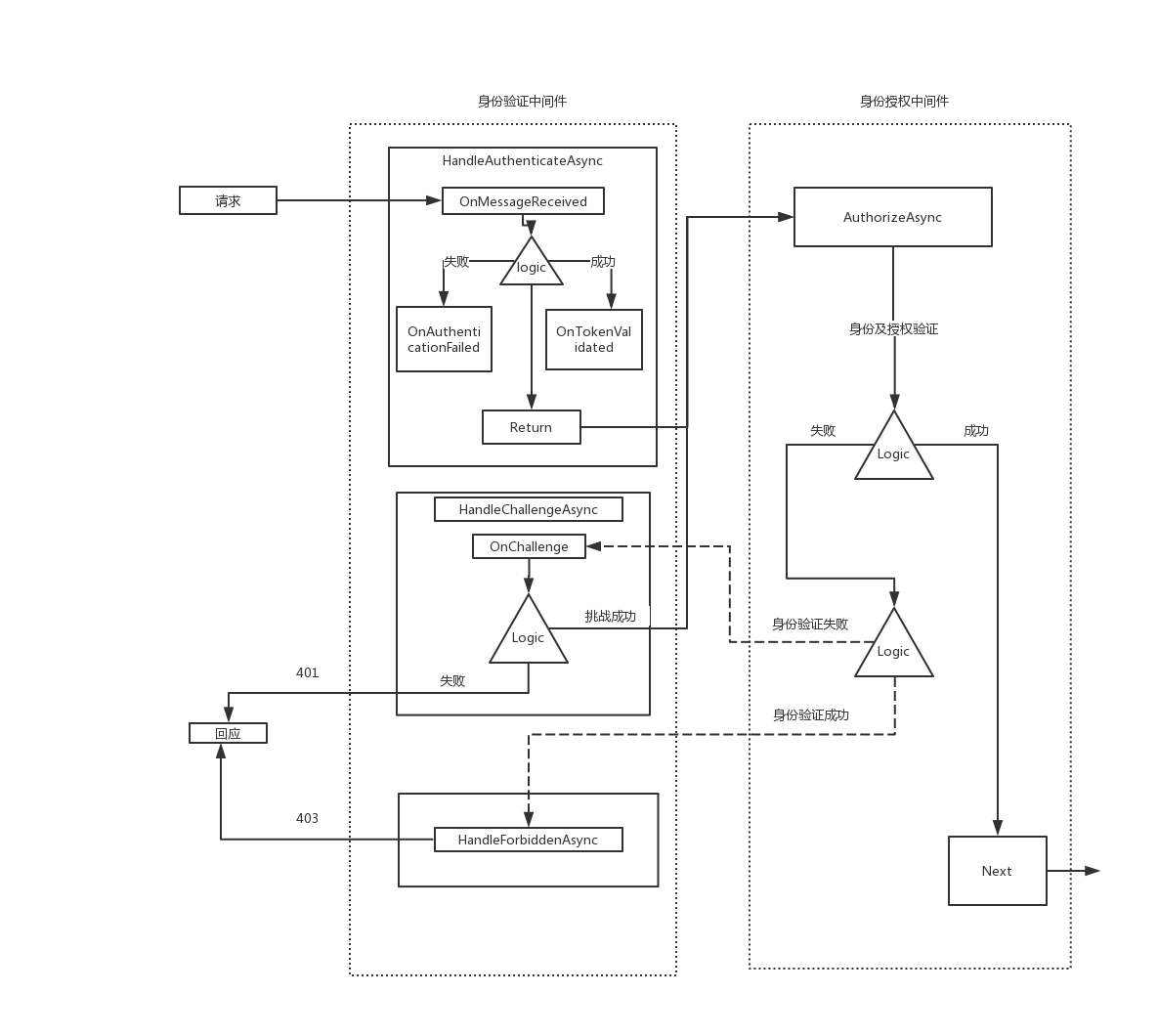
如果身份和授权都验证成功,则成功,如果身份验证能过,授权没通过则禁止访问,直接回应,如果身份验证没通过就去挑战验证结果,挑战成功继续来一次来,挑战失败就直接回应了。源码中的PolicyAuthorizationResult.Forbid() 和PolicyAuthorizationResult.Challenge()具体执行的是什么方法呢?看以下源码
   public virtual Task<AuthenticationScheme> GetDefaultChallengeSchemeAsync()

            => _options.DefaultChallengeScheme != null

            ? GetSchemeAsync(_options.DefaultChallengeScheme)

            : GetDefaultSchemeAsync();

        public virtual Task<AuthenticationScheme> GetDefaultForbidSchemeAsync()

            => _options.DefaultForbidScheme != null

            ? GetSchemeAsync(_options.DefaultForbidScheme)

            : GetDefaultChallengeSchemeAsync();
然来如果没有指定特定的方案,就返回默认的方案。指定特定的Challenge方案和Forbid方案我们讲OpenIdConnect时再详细说。目前我们所用的只有一个默认方案:Bearer,所以会执行JwtBearerHandler的Challenge和Forbid方法。
如此一来,JwtBearerHandler的三种功能触发时机,作用都已经搞清楚了,我画了个图方便大家理理解
IdentityServer4之Jwt身份验证方案分析的更多相关文章
- asp.net core 3.1多种身份验证方案,cookie和jwt混合认证授权
开发了一个公司内部系统,使用asp.net core 3.1.在开发用户认证授权使用的是简单的cookie认证方式,然后开发好了要写几个接口给其它系统调用数据.并且只是几个简单的接口不准备再重新部署一 ...
- JWT 身份认证优缺点分析以及常见问题解决方案
本文转载自:JWT 身份认证优缺点分析以及常见问题解决方案 Token 认证的优势 相比于 Session 认证的方式来说,使用 token 进行身份认证主要有下面三个优势: 1.无状态 token ...
- Asp.Net Core 5 REST API 使用 JWT 身份验证 - Step by Step
翻译自 Mohamad Lawand 2021年1月22日的文章 <Asp Net Core 5 Rest API Authentication with JWT Step by Step> ...
- HTTP 请求未经客户端身份验证方案“Anonymous”授权。从服务器收到的身份验证标头为“Negotiate,NTLM”
转自:http://www.cnblogs.com/geqinggao/p/3270499.html 近来项目需要Web Service验证授权,一般有两种解决方案: 1.通过通过SOAP Heade ...
- 发布Restful服务时出现IIS 指定了身份验证方案错误时的解决方案(IIS specified authentication schemes)
发布RESTful服务,当访问.svc文件时出现如下错误时: IIS 指定了身份验证方案“IntegratedWindowsAuthentication, Anonymous”,但绑定仅支持一种身份验 ...
- HTTP 请求未经客户端身份验证方案“Anonymous”授权。
今天调取WebService的时候报: HTTP 请求未经客户端身份验证方案“Anonymous”授权. 解决办法: 配置文件里改: <basicHttpBinding> <bind ...
- Spring Cloud系列-Zuul网关集成JWT身份验证
前言 这两三年项目中一直在使用比较流行的spring cloud框架,也算有一定积累,打算有时间就整理一些干货与大家分享. 本次分享zuul网关集成jwt身份验证 业务背景 项目开发少不了身份认证,j ...
- ASP.NET Core Web API中带有刷新令牌的JWT身份验证流程
ASP.NET Core Web API中带有刷新令牌的JWT身份验证流程 翻译自:地址 在今年年初,我整理了有关将JWT身份验证与ASP.NET Core Web API和Angular一起使用的详 ...
- .netcore实现jwt身份验证
前言 http协议本身是一种无状态的协议.所以客户端的每次请求,服务端是不清楚其身份的,需要客户端每次都要将身份信息传入,服务进行验证,才能达到安全验证的目的. 传统的Web用户验证:1.客户端传入用 ...
随机推荐
- 深度讨论i++问题
例题1:下列程序的输出结果是多少? public class Test { static { int x = 5; } static int x, y; public static void main ...
- 使用深度学习的超分辨率介绍 An Introduction to Super Resolution using Deep Learning
使用深度学习的超分辨率介绍 关于使用深度学习进行超分辨率的各种组件,损失函数和度量的详细讨论. 介绍 超分辨率是从给定的低分辨率(LR)图像恢复高分辨率(HR)图像的过程.由于较小的空间分辨率(即尺寸 ...
- chown与chmod的区别
chown 修改文件和文件夹的用户和用户组属性 1.要修改文件hh.c的所有者.修改为sakia的这个用户所有 chown sakia hh.c 这样就把hh.c的用户访问权限应用到sakia作为所有 ...
- 下载根目录下的pdf文件, 浏览器下载
public void outPut(HttpServletRequest request, HttpServletResponse response, Integer type) { ClassPa ...
- 京津冀大学生竞赛:babyphp
京津冀大学生竞赛:babyphp 比赛的时候没做出来,回来以后一会就做出来了,难受...还是基本功不扎实,都不记得__invoke怎么触发的了 放上源码 <?php error_reportin ...
- TCP的拥塞窗口和快速恢复机制的一些备忘及一点想法
rwnd(窗口,代表接收端的处理能力).cwnd(拥塞窗口,从发送端看当前网络整体承载能力).ssthresh(快速增长切换成慢速增长的界限值) 1.慢启动,是指数增长(对面确认多少个包,就增加多少) ...
- sci会议和sci期刊区别是什么
sci会议和sci期刊区别是什么?从名称上来看就很明显了,一个是学术会议,一个是学术期刊,是不同的学术研究载体,不论是会议论文还是期刊论文,都是受认可的,就目前来看,发表期刊论文的作者要偏多一些,主要 ...
- Python使用偏函数与类实现装饰器
# -*- coding: utf-8 -*- # author:baoshan # python对某个对象是否能通过装饰器形式使用只有一个要求:decorator必须是一个可被调用的对象. # 我们 ...
- CentOS7 安装特定版本的Docker
先卸载旧版本 sudo yum remove docker \ docker-client \ docker-client-latest \ docker-common \ docker-late ...
- [LeetCode] 349. Intersection of Two Arrays 两个数组相交
Given two arrays, write a function to compute their intersection. Example 1: Input: nums1 = [1,2,2,1 ...