
theano中的concolutional_mlp.py学习
(1) evaluate _lenet5中的导入数据部分
     # 导入数据集,该函数定义在logistic_sgd中,返回的是一个list

     datasets = load_data(dataset)

     # 从list中提取三个元素,每个元素都是一个tuple(每个tuple含有2个元素,分别为images数据和label数据)

     train_set_x, train_set_y = datasets[0] #训练集

     valid_set_x, valid_set_y = datasets[1] #校验集

     test_set_x, test_set_y = datasets[2]   #测试集

     # 训练集、校验集、测试集分别含有的样本个数

     n_train_batches = train_set_x.get_value(borrow=True).shape[0]

     n_valid_batches = valid_set_x.get_value(borrow=True).shape[0]

     n_test_batches = test_set_x.get_value(borrow=True).shape[0]

     # 训练集、校验集、测试集中包含的minibatch个数(每个iter,只给一个minibatch,而不是整个数据集)

     n_train_batches /= batch_size

     n_valid_batches /= batch_size

     n_test_batches /= batch_size

(2)evaluate _lenet5中的building model部分
     # 首先,定义一些building model用到的符号变量

     index = T.lscalar()  # 用于指定具体哪个minibatch的指标

     # start-snippet-1

     x = T.matrix('x')   # 存储图像的像素数据

     y = T.ivector('y')  # 存储每幅图像对应的label

     # 开始build model

     print '... building the model'

     # 将输入的数据(batch_size, 28 * 28)reshape为4D tensor(batch_size是每个mini-batch包含的image个数)

     layer0_input = x.reshape((batch_size, 1, 28, 28))

     # 构造第一个卷积层

     # (1)卷积核大小为5*5、个数为nkerns[0]、striding =1,padding=0

     #     输出的feature map大小为:(28-5+1 , 28-5+1) = (24, 24)

     # (2)含有max-pooling,pooling的大小为2*2、striding =1,padding=0

     #     输出的map大小为:(24/2, 24/2) = (12, 12)

     # (3)综上,第一个卷积层输出的feature map为一个4D tensor,形状为:(batch_size, nkerns[0], 12, 12)

     layer0 = LeNetConvPoolLayer(

         rng,

         input=layer0_input,

         image_shape=(batch_size, 1, 28, 28),

         filter_shape=(nkerns[0], 1, 5, 5),

         poolsize=(2, 2)

     )

     # 构造第二个卷积层,卷积核大小为5*5

     # (1)卷积核大小为5*5、个数为nkerns[0]、striding =1,padding=0

     #     输出的feature map大小为:(12-5+1, 12-5+1) = (8, 8)

     # (2)含有max-pooling,pooling的大小为2*2、striding =1,padding=0

     #     输出的map大小为:(8/2, 8/2) = (4, 4)

     # (3)综上,第二个卷积层输出的feature map为一个4D tensor,形状为:(batch_size, nkerns[1], 4, 4)

     layer1 = LeNetConvPoolLayer(

         rng,

         input=layer0.output,

         image_shape=(batch_size, nkerns[0], 12, 12),

         filter_shape=(nkerns[1], nkerns[0], 5, 5),

         poolsize=(2, 2)

     )

     # 将第二个卷积层的输出map(形状为(batch_size, nkerns[1], 4, 4))转化为一个matrix的形式

     # 该矩阵的形状为:(batch_size, nkerns[1] * 4 * 4),每一行为一个图形对应的feature map

     layer2_input = layer1.output.flatten(2)

     # 第一个全链接层

     # (1)输入的大小固定,即第二个卷积层的输出

     # (2)输出大小自己选的,这里选定为500

     # (3)sigmoid函数为tan函数

     layer2 = HiddenLayer(

         rng,

         input=layer2_input,

         n_in=nkerns[1] * 4 * 4,

         n_out=500,

         activation=T.tanh

     )

     # 输出层,即逻辑回归层

     layer3 = LogisticRegression(input=layer2.output, n_in=500, n_out=10)

     # 代价函数的计算

     cost = layer3.negative_log_likelihood(y)

     # 测试model,输入为具体要测试的test集中的某个mini-batch

     # 输出为训练得到的model在该mini-batch上的error

     test_model = theano.function(

         [index],

         layer3.errors(y),

         givens={

             x: test_set_x[index * batch_size: (index + 1) * batch_size],

             y: test_set_y[index * batch_size: (index + 1) * batch_size]

         }

     )

     # 校验model,输入为具体要测试的校验集中的某个mini-batch

     # 输出为训练得到的model在该mini-batch上的error

     validate_model = theano.function(

         [index],

         layer3.errors(y),

         givens={

             x: valid_set_x[index * batch_size: (index + 1) * batch_size],

             y: valid_set_y[index * batch_size: (index + 1) * batch_size]

         }

     )

     # 创建一个list,该list存放的是该CNN网络的所有待利用梯度下降法优化的参数

     params = layer3.params + layer2.params + layer1.params + layer0.params

     # 创建一个list,该list存放的是代价函数对该CNN网络的所有待利用梯度下降法优化的参数的梯度

     grads = T.grad(cost, params)

     # 为train模型创建更新规则,即创建一个list,自动更新params、grads中每一组值

     updates = [

         (param_i, param_i - learning_rate * grad_i)

         for param_i, grad_i in zip(params, grads)

     ]

     # 训练model,输入为具体要训练集中的某个mini-batch

     # 输出为训练得到的model在该mini-batch上的error

     train_model = theano.function(

         [index],

         cost,

         updates=updates,

         givens={

             x: train_set_x[index * batch_size: (index + 1) * batch_size],

             y: train_set_y[index * batch_size: (index + 1) * batch_size]

         }

     )
(3)Lenet-5中的training model部分
     # 开始训练模型

     print '... training'

     # 定义一些进行early-stopping的相关参数

     # look as this many examples regardless

     patience = 10000

     # wait this much longer when a new best is found

     patience_increase = 2

     # a relative improvement of this much is considered significant

     improvement_threshold = 0.995

     # go through this many minibatche before checking the network on the validation set; in this case we check every epoch

     validation_frequency = min(n_train_batches, patience / 2)

     # 训练过程中需要的其他参数

     best_validation_loss = numpy.inf

     best_iter = 0

     test_score = 0.

     start_time = timeit.default_timer()

     epoch = 0

     done_looping = False

     while (epoch < n_epochs) and (not done_looping):

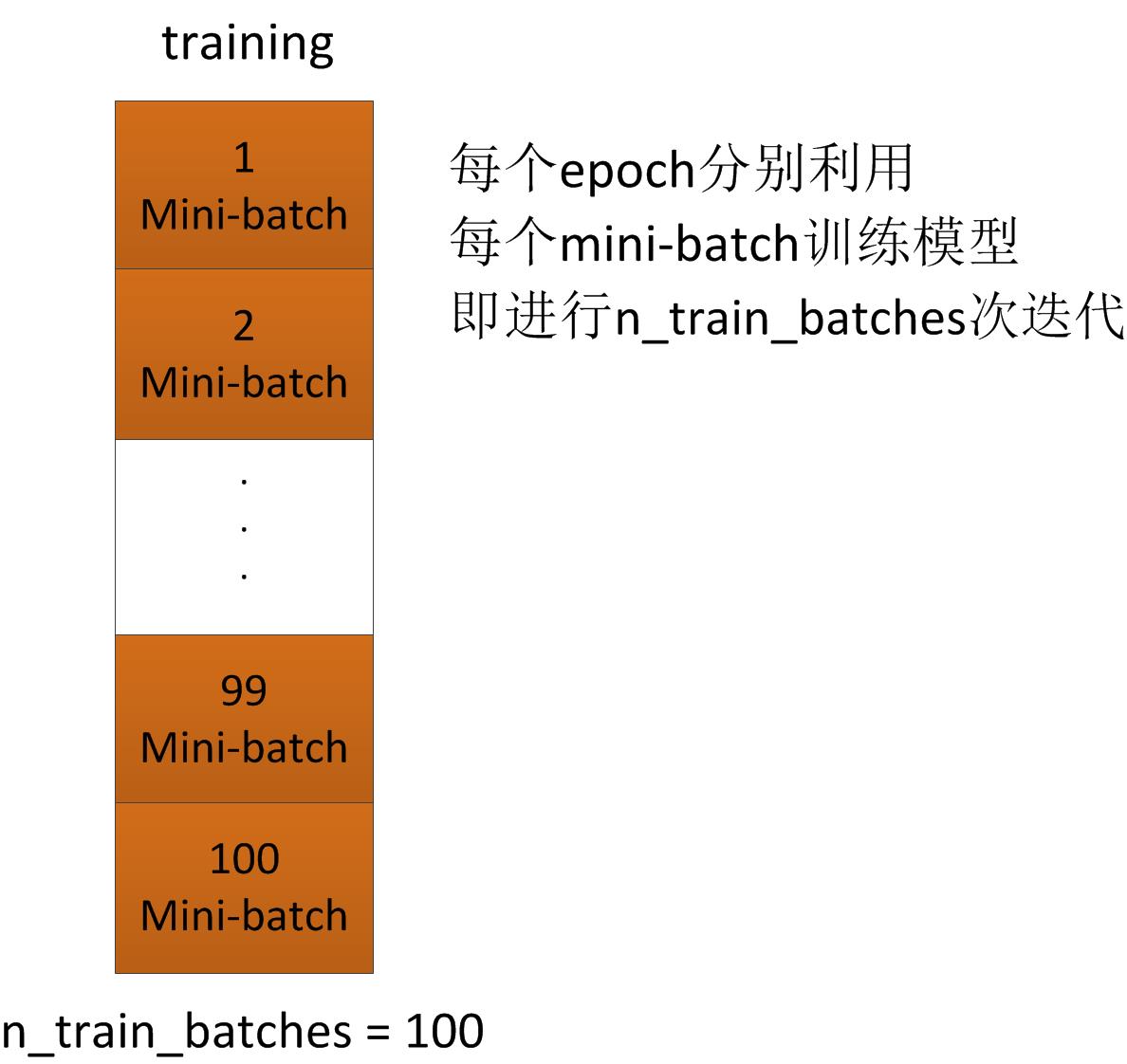
         #epoch次数增加1,每轮epoch,利用所有组mini-batch进行一次模型训练

         # 每轮epoch,整体的迭代次数iter增加n_train_batches次

         epoch = epoch + 1

         # 对于整个训练集中的第minibatch_index 个mini-batch

         # minibatch_index=0,1,...,n_train_batches-1

         for minibatch_index in xrange(n_train_batches):

             # 总的iter次数(每一轮epoch,iter个数都增加n_train_batches)

             # 即每一个iter,只利用一个mini-batch进行训练

             # 而每一个epoch,利用了所有的mini-batch进行训练

             iter = (epoch - 1) * n_train_batches + minibatch_index

             # 整体的迭代次数可以被100整除时,显示一次迭代次数

             if iter % 100 == 0:

                 print 'training @ iter = ', iter

             # 利用第minibatch_index个mini-batch训练model,得到model的代价函数

             cost_ij = train_model(minibatch_index)

             # 如果整体的迭代次数满足需要进行校验的条件,则对该次iter对应的model进行校验

             if (iter + 1) % validation_frequency == 0:

                 # 计算该model在校验集上的loss函数值

                 validation_losses = [validate_model(i) for i

                                      in xrange(n_valid_batches)]

                 this_validation_loss = numpy.mean(validation_losses)

                 print('epoch %i, minibatch %i/%i, validation error %f %%' %

                       (epoch, minibatch_index + 1, n_train_batches,

                        this_validation_loss * 100.))

                 # 如果该model在校验集的loss值小于之前的值

                 if this_validation_loss < best_validation_loss:

                     # 增加patience的值,目的是为了进行更多次的iter

                     # 也就是说,如果在测试集上的性能不如之前好,证明模型开始恶化,那么,不再进行那么多次的training了

                     if this_validation_loss < best_validation_loss *  \

                        improvement_threshold:

                         patience = max(patience, iter * patience_increase)

                     # save best validation score and iteration number

                     best_validation_loss = this_validation_loss

                     best_iter = iter

                     # 利用测试集测试该模型

                     test_losses = [

                         test_model(i)

                         for i in xrange(n_test_batches)

                     ]

                     # 计算测试集的loss值

                     test_score = numpy.mean(test_losses)

                     print(('     epoch %i, minibatch %i/%i, test error of '

                            'best model %f %%') %

                           (epoch, minibatch_index + 1, n_train_batches,

                            test_score * 100.))

             if patience <= iter:

                 done_looping = True

                 break

     # 整个训练过程结束,记录training时间

     end_time = timeit.default_timer()

     print('Optimization complete.')

     print('Best validation score of %f %% obtained at iteration %i, '

           'with test performance %f %%' %

           (best_validation_loss * 100., best_iter + 1, test_score * 100.))

     print >> sys.stderr, ('The code for file ' +

                           os.path.split(__file__)[1] +

                           ' ran for %.2fm' % ((end_time - start_time) / 60.))
(4)真个convolutional_mlp的原始代码
 """This tutorial introduces the LeNet5 neural network architecture

 using Theano.  LeNet5 is a convolutional neural network, good for

 classifying images. This tutorial shows how to build the architecture,

 and comes with all the hyper-parameters you need to reproduce the

 paper's MNIST results.

 This implementation simplifies the model in the following ways:

  - LeNetConvPool doesn't implement location-specific gain and bias parameters

  - LeNetConvPool doesn't implement pooling by average, it implements pooling

    by max.

  - Digit classification is implemented with a logistic regression rather than

    an RBF network

  - LeNet5 was not fully-connected convolutions at second layer

 References:

  - Y. LeCun, L. Bottou, Y. Bengio and P. Haffner:

    Gradient-Based Learning Applied to Document

    Recognition, Proceedings of the IEEE, 86(11):2278-2324, November 1998.

    http://yann.lecun.com/exdb/publis/pdf/lecun-98.pdf

 """

 import os

 import sys

 import timeit

 import numpy

 import theano

 import theano.tensor as T

 from theano.tensor.signal import downsample

 from theano.tensor.nnet import conv

 from logistic_sgd import LogisticRegression, load_data

 from mlp import HiddenLayer

 class LeNetConvPoolLayer(object):

     """Pool Layer of a convolutional network """

     def __init__(self, rng, input, filter_shape, image_shape, poolsize=(2, 2)):

         """

         Allocate a LeNetConvPoolLayer with shared variable internal parameters.

         :type rng: numpy.random.RandomState

         :param rng: a random number generator used to initialize weights

         :type input: theano.tensor.dtensor4

         :param input: symbolic image tensor, of shape image_shape

         :type filter_shape: tuple or list of length 4

         :param filter_shape: (number of filters, num input feature maps,

                               filter height, filter width)

         :type image_shape: tuple or list of length 4

         :param image_shape: (batch size, num input feature maps,

                              image height, image width)

         :type poolsize: tuple or list of length 2

         :param poolsize: the downsampling (pooling) factor (#rows, #cols)

         """

         assert image_shape[1] == filter_shape[1]

         self.input = input

         # there are "num input feature maps * filter height * filter width"

         # inputs to each hidden unit

         fan_in = numpy.prod(filter_shape[1:])

         # each unit in the lower layer receives a gradient from:

         # "num output feature maps * filter height * filter width" /

         #   pooling size

         fan_out = (filter_shape[0] * numpy.prod(filter_shape[2:]) /

                    numpy.prod(poolsize))

         # initialize weights with random weights

         W_bound = numpy.sqrt(6. / (fan_in + fan_out))

         self.W = theano.shared(

             numpy.asarray(

                 rng.uniform(low=-W_bound, high=W_bound, size=filter_shape),

                 dtype=theano.config.floatX

             ),

             borrow=True

         )

         # the bias is a 1D tensor -- one bias per output feature map

         b_values = numpy.zeros((filter_shape[0],), dtype=theano.config.floatX)

         self.b = theano.shared(value=b_values, borrow=True)

         # convolve input feature maps with filters

         conv_out = conv.conv2d(

             input=input,

             filters=self.W,

             filter_shape=filter_shape,

             image_shape=image_shape

         )

         # downsample each feature map individually, using maxpooling

         pooled_out = downsample.max_pool_2d(

             input=conv_out,

             ds=poolsize,

             ignore_border=True

         )

         # add the bias term. Since the bias is a vector (1D array), we first

         # reshape it to a tensor of shape (1, n_filters, 1, 1). Each bias will

         # thus be broadcasted across mini-batches and feature map

         # width & height

         self.output = T.tanh(pooled_out + self.b.dimshuffle('x', 0, 'x', 'x'))

         # store parameters of this layer

         self.params = [self.W, self.b]

         # keep track of model input

         self.input = input

 def evaluate_lenet5(learning_rate=0.1, n_epochs=200,

                     dataset='mnist.pkl.gz',

                     nkerns=[20, 50], batch_size=500):

     """ Demonstrates lenet on MNIST dataset

     :type learning_rate: float

     :param learning_rate: learning rate used (factor for the stochastic

                           gradient)

     :type n_epochs: int

     :param n_epochs: maximal number of epochs to run the optimizer

     :type dataset: string

     :param dataset: path to the dataset used for training /testing (MNIST here)

     :type nkerns: list of ints

     :param nkerns: number of kernels on each layer

     """

     rng = numpy.random.RandomState(23455)

     datasets = load_data(dataset)

     train_set_x, train_set_y = datasets[0]

     valid_set_x, valid_set_y = datasets[1]

     test_set_x, test_set_y = datasets[2]

     # compute number of minibatches for training, validation and testing

     n_train_batches = train_set_x.get_value(borrow=True).shape[0]

     n_valid_batches = valid_set_x.get_value(borrow=True).shape[0]

     n_test_batches = test_set_x.get_value(borrow=True).shape[0]

     n_train_batches /= batch_size

     n_valid_batches /= batch_size

     n_test_batches /= batch_size

     # allocate symbolic variables for the data

     index = T.lscalar()  # index to a [mini]batch

     # start-snippet-1

     x = T.matrix('x')   # the data is presented as rasterized images

     y = T.ivector('y')  # the labels are presented as 1D vector of

                         # [int] labels

     ######################

     # BUILD ACTUAL MODEL #

     ######################

     print '... building the model'

     # Reshape matrix of rasterized images of shape (batch_size, 28 * 28)

     # to a 4D tensor, compatible with our LeNetConvPoolLayer

     # (28, 28) is the size of MNIST images.

     layer0_input = x.reshape((batch_size, 1, 28, 28))

     # Construct the first convolutional pooling layer:

     # filtering reduces the image size to (28-5+1 , 28-5+1) = (24, 24)

     # maxpooling reduces this further to (24/2, 24/2) = (12, 12)

     # 4D output tensor is thus of shape (batch_size, nkerns[0], 12, 12)

     layer0 = LeNetConvPoolLayer(

         rng,

         input=layer0_input,

         image_shape=(batch_size, 1, 28, 28),

         filter_shape=(nkerns[0], 1, 5, 5),

         poolsize=(2, 2)

     )

     # Construct the second convolutional pooling layer

     # filtering reduces the image size to (12-5+1, 12-5+1) = (8, 8)

     # maxpooling reduces this further to (8/2, 8/2) = (4, 4)

     # 4D output tensor is thus of shape (batch_size, nkerns[1], 4, 4)

     layer1 = LeNetConvPoolLayer(

         rng,

         input=layer0.output,

         image_shape=(batch_size, nkerns[0], 12, 12),

         filter_shape=(nkerns[1], nkerns[0], 5, 5),

         poolsize=(2, 2)

     )

     # the HiddenLayer being fully-connected, it operates on 2D matrices of

     # shape (batch_size, num_pixels) (i.e matrix of rasterized images).

     # This will generate a matrix of shape (batch_size, nkerns[1] * 4 * 4),

     # or (500, 50 * 4 * 4) = (500, 800) with the default values.

     layer2_input = layer1.output.flatten(2)

     # construct a fully-connected sigmoidal layer

     layer2 = HiddenLayer(

         rng,

         input=layer2_input,

         n_in=nkerns[1] * 4 * 4,

         n_out=500,

         activation=T.tanh

     )

     # classify the values of the fully-connected sigmoidal layer

     layer3 = LogisticRegression(input=layer2.output, n_in=500, n_out=10)

     # the cost we minimize during training is the NLL of the model

     cost = layer3.negative_log_likelihood(y)

     # create a function to compute the mistakes that are made by the model

     test_model = theano.function(

         [index],

         layer3.errors(y),

         givens={

             x: test_set_x[index * batch_size: (index + 1) * batch_size],

             y: test_set_y[index * batch_size: (index + 1) * batch_size]

         }

     )

     validate_model = theano.function(

         [index],

         layer3.errors(y),

         givens={

             x: valid_set_x[index * batch_size: (index + 1) * batch_size],

             y: valid_set_y[index * batch_size: (index + 1) * batch_size]

         }

     )

     # create a list of all model parameters to be fit by gradient descent

     params = layer3.params + layer2.params + layer1.params + layer0.params

     # create a list of gradients for all model parameters

     grads = T.grad(cost, params)

     # train_model is a function that updates the model parameters by

     # SGD Since this model has many parameters, it would be tedious to

     # manually create an update rule for each model parameter. We thus

     # create the updates list by automatically looping over all

     # (params[i], grads[i]) pairs.

     updates = [

         (param_i, param_i - learning_rate * grad_i)

         for param_i, grad_i in zip(params, grads)

     ]

     train_model = theano.function(

         [index],

         cost,

         updates=updates,

         givens={

             x: train_set_x[index * batch_size: (index + 1) * batch_size],

             y: train_set_y[index * batch_size: (index + 1) * batch_size]

         }

     )

     # end-snippet-1

     ###############

     # TRAIN MODEL #

     ###############

     print '... training'

     # early-stopping parameters

     patience = 10000  # look as this many examples regardless

     patience_increase = 2  # wait this much longer when a new best is

                            # found

     improvement_threshold = 0.995  # a relative improvement of this much is

                                    # considered significant

     validation_frequency = min(n_train_batches, patience / 2)

                                   # go through this many

                                   # minibatche before checking the network

                                   # on the validation set; in this case we

                                   # check every epoch

     best_validation_loss = numpy.inf

     best_iter = 0

     test_score = 0.

     start_time = timeit.default_timer()

     epoch = 0

     done_looping = False

     while (epoch < n_epochs) and (not done_looping):

         epoch = epoch + 1

         for minibatch_index in xrange(n_train_batches):

             iter = (epoch - 1) * n_train_batches + minibatch_index

             if iter % 100 == 0:

                 print 'training @ iter = ', iter

             cost_ij = train_model(minibatch_index)

             if (iter + 1) % validation_frequency == 0:

                 # compute zero-one loss on validation set

                 validation_losses = [validate_model(i) for i

                                      in xrange(n_valid_batches)]

                 this_validation_loss = numpy.mean(validation_losses)

                 print('epoch %i, minibatch %i/%i, validation error %f %%' %

                       (epoch, minibatch_index + 1, n_train_batches,

                        this_validation_loss * 100.))

                 # if we got the best validation score until now

                 if this_validation_loss < best_validation_loss:

                     #improve patience if loss improvement is good enough

                     if this_validation_loss < best_validation_loss *  \

                        improvement_threshold:

                         patience = max(patience, iter * patience_increase)

                     # save best validation score and iteration number

                     best_validation_loss = this_validation_loss

                     best_iter = iter

                     # test it on the test set

                     test_losses = [

                         test_model(i)

                         for i in xrange(n_test_batches)

                     ]

                     test_score = numpy.mean(test_losses)

                     print(('     epoch %i, minibatch %i/%i, test error of '

                            'best model %f %%') %

                           (epoch, minibatch_index + 1, n_train_batches,

                            test_score * 100.))

             if patience <= iter:

                 done_looping = True

                 break

     end_time = timeit.default_timer()

     print('Optimization complete.')

     print('Best validation score of %f %% obtained at iteration %i, '

           'with test performance %f %%' %

           (best_validation_loss * 100., best_iter + 1, test_score * 100.))

     print >> sys.stderr, ('The code for file ' +

                           os.path.split(__file__)[1] +

                           ' ran for %.2fm' % ((end_time - start_time) / 60.))

 if __name__ == '__main__':

     evaluate_lenet5()

 def experiment(state, channel):

     evaluate_lenet5(state.learning_rate, dataset=state.dataset)
theano中的concolutional_mlp.py学习的更多相关文章
- theano中的logisticregression代码学习
1 class LogisticRegression (object): 2 def __int__(self,...): 3 4 #定义一些与逻辑回归相关的各种函数 5 6 def method1( ...
- 『德不孤』Pytest框架 — 14、Pytest中的conftest.py文件
目录 1.conftest.py文件介绍 2.conftest.py的注意事项 3.conftest.py的使用 4.不同位置conftest.py文件的优先级 5.conftest.py中Fixtu ...
- Python3中的字符串函数学习总结
这篇文章主要介绍了Python3中的字符串函数学习总结,本文讲解了格式化类方法.查找 & 替换类方法.拆分 & 组合类方法等内容,需要的朋友可以参考下. Sequence Types ...
- theano中的scan用法
scan函数是theano中的循环函数,相当于for loop.在读别人的代码时第一次看到,有点迷糊,不知道输入.输出怎么定义,网上也很少有example,大多数都是相互转载同一篇.所以,还是要看官方 ...
- theano中的dimshuffle
theano中的dimshuffle函数用于对张量的维度进行操作,可以增加维度,也可以交换维度,删除维度. 注意的是只有shared才能调用dimshuffle() 'x'表示增加一维,从0d sca ...
- Android中的SQLite使用学习
Android中的SQLite使用学习 SQLite是非常流行的嵌入式关系型数据库,轻载, 速度快,而且是开源.在Android中,runtime提供SQLite,所以我们可以使用SQLite,而且是 ...
- Java中的回调函数学习
Java中的回调函数学习 博客分类: J2SE JavaJ# 一般来说分为以下几步: 声明回调函数的统一接口interface A,包含方法callback(); 在调用类caller内将该接口设置 ...
- JavaSE中Collection集合框架学习笔记(1)——具有索引的List
前言:因为最近要重新找工作,Collection(集合)是面试中出现频率非常高的基础考察点,所以好好恶补了一番. 复习过程中深感之前的学习不系统,而且不能再像刚毕业那样死背面试题,例如:String是 ...
- JavaSE中Collection集合框架学习笔记(2)——拒绝重复内容的Set和支持队列操作的Queue
前言:俗话说“金三银四铜五”,不知道我要在这段时间找工作会不会很艰难.不管了,工作三年之后就当给自己放个暑假. 面试当中Collection(集合)是基础重点.我在网上看了几篇讲Collection的 ...
随机推荐
- IOS开发之——使用Segue在StoryBoard之间切换
使用Segue能够在ViewController之间来回切换,以下就来说下切换方法: 1. 使用点击button进行切换 直接上图,在须要切换的View属性界面,点击Modal然后拉到前一个view界 ...
- MFC ListControl使用方法
在原来博客中有:MF CListControl 简单功能使用 推荐文章:MFC类CtrlList用法 今天又又一次来介绍点新东西:双击击listcontrol 做出响应.当然你能够做的还有非常多,比 ...
- fscanf函数
函数定义: int fscanf( FILE *stream, const char *format [, argument ]... ); 以下是csdn的样例: /* FSCANF.C: This ...
- GDB反向调试 + 指令记录+函数历史记录
http://blog.chinaunix.net/uid-26941022-id-3199961.html b.c void fun(int a, int b){ int c; c=a+b; } v ...
- Android开发之使用广播监听网络状态变化
我们经常需要判断网络状态的变化,如有无网络,所以需要监听网络状态的变化,比如网络断开,网络连接给予友好提示.如何监听网络状态的变化呢,最近工作中需要用到这个,于是就用广播机制来实现了网络状态的监听. ...
- Java的浮点数
为了防止无良网站的爬虫抓取文章,特此标识,转载请注明文章出处.LaplaceDemon/ShiJiaqi. http://www.cnblogs.com/shijiaqi1066/p/5160771. ...
- 原生js日期时间插件鼠标点击文本框弹出日期时间表格选择日期时间
原文出处 (这是我从互联网上搜来的,感觉能满足各方面的需求.个人感觉挺不错的,所以后期修改了一下向大家推荐!) 效果图: html代码: <!DOCTYPE html PUBLIC " ...
- asp.net之动态页面和静态页面的区别
asp.net之动态页面和静态页面的区别 当我开始接触web开发的时候,首先学到的是html.css.js这一类网页语言,通过布局可以搭建出一个静态网站,效果也跟我们上网时经常看到的一些网站一样了.于 ...
- Windows I/O模型、同步/异步、阻塞/非阻塞
转载自:http://www.cppblog.com/tx7do/articles/5954.html 同步 所谓同步,就是在发出一个功能调用时,在没有得到结果之前,该调用就不返回.按照这个定义,其实 ...
- servlet(一)
百度百科是这样的: Servlet 是在服务器上运行的小程序.这个词是在 Java applet 的环境中创造的.虽然后者已很少被使用,但 Servlet 却发展的很好.是一般面试都会常考的知识. 维 ...