
locustfile中的User类和HttpUser类
locustfile是什么?
locustfile是Locust性能测试工具的用户脚本,描述了单个用户的行为。
locustfile是个普通的Python模块,如果写作locustfile.py,那么路径切换到文件所在目录,直接执行命令就能运行:
$ locust
如果换个名字,那么只能通过-f参数指定文件名运行:
$ locust -f locust_files/my_locust_file.py
与一般Python模块不同的是:locustfile必须至少定义一个类,且继承自User类。
User类
User类表示性能测试的模拟用户,Locust会在运行时创建User类的实例。
wait_time属性
设置等待时间,默认值不等待,立即执行。
Locust支持4种方式设置wait_time属性。
为了便于理解实际意义,我把源码贴在了下面。
constant函数,常量,任务执行完毕等待X秒开始下一任务。def constant(wait_time):
"""
Returns a function that just returns the number specified by the wait_time argument Example:: class MyUser(User):
wait_time = constant(3)
"""
return lambda instance: wait_time
between函数,区间随机值,任务执行完毕等待X-Y秒(中间随机取值)开始下一任务。def between(min_wait, max_wait):
"""
Returns a function that will return a random number between min_wait and max_wait. Example:: class MyUser(User):
# wait between 3.0 and 10.5 seconds after each task
wait_time = between(3.0, 10.5)
"""
return lambda instance: min_wait + random.random() * (max_wait - min_wait)
constant_pacing函数,自适应,若任务耗时超过该时间,则任务结束后立即执行下一任务;若任务耗时不超过该时间,则等待达到该时间后执行下一任务。def constant_pacing(wait_time):
"""
Returns a function that will track the run time of the tasks, and for each time it's
called it will return a wait time that will try to make the total time between task
execution equal to the time specified by the wait_time argument. In the following example the task will always be executed once every second, no matter
the task execution time:: class MyUser(User):
wait_time = constant_pacing(1)
@task
def my_task(self):
time.sleep(random.random()) If a task execution exceeds the specified wait_time, the wait will be 0 before starting
the next task.
""" def wait_time_func(self):
if not hasattr(self, "_cp_last_run"):
self._cp_last_wait_time = wait_time
self._cp_last_run = time()
return wait_time
else:
run_time = time() - self._cp_last_run - self._cp_last_wait_time
self._cp_last_wait_time = max(0, wait_time - run_time)
self._cp_last_run = time()
return self._cp_last_wait_time return wait_time_func
自定义
wait_time方法,比如每次等待时间1秒2秒3秒递增:class MyUser(User):
last_wait_time = 0 def wait_time(self):
self.last_wait_time += 1
return self.last_wait_time ...
weight属性
设置创建类实例的权重,默认每个类创建相同数量的实例。
locustfile中可以有多个继承了User类的类。
命令行可以指定运行哪些类:
$ locust -f locust_file.py WebUser MobileUser
通过weight属性可以让类更大概率创建实例,比如:
class WebUser(User):

    weight = 3

    ...

class MobileUser(User):

    weight = 1

    ...
WebUser类比MobileUser类多三倍概率创建实例。
host属性
设置URL前缀。
一般是在Locust的Web UI或者命令行,通过--host指定URL前缀。如果没有通过--host指定,并且类中设置了host属性,那么类的host属性才会生效。
environment属性
对用户运行环境的引用。
比如在task方法中通过environment属性终止运行:
self.environment.runner.quit()
注意,单机会终止所有运行,分布式只会终止单个worker节点。
on_start和on_stop方法
测试前初始化和测试后清理。
HttpUser类
开篇文章的示例脚本,没有继承User类,而是继承了它的子类HttpUser:

它比User类更常用,因为它添加了一个client属性,用来发送HTTP请求。
client属性/HttpSession
HttpUser类的client属性是HttpSession类的一个实例:
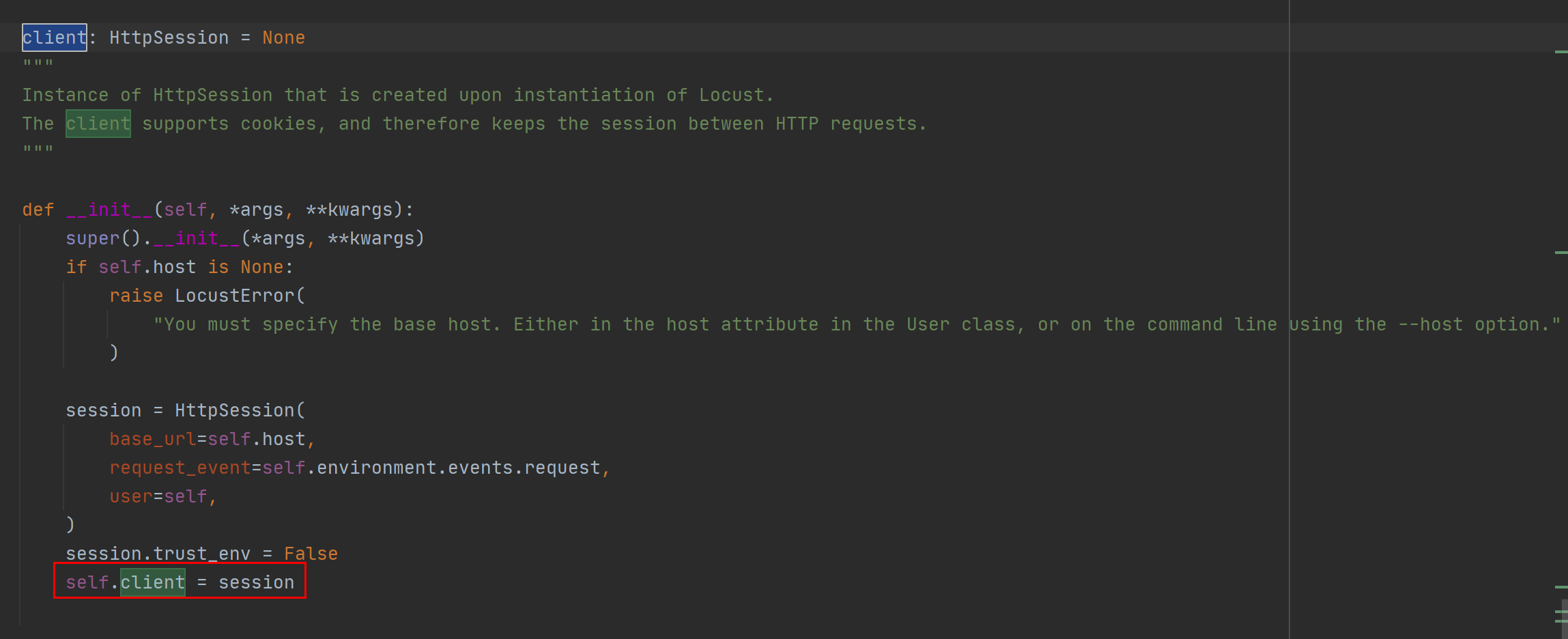
HttpSession是requests.Session的子类,requests就是常用来做接口测试的那个requests库:

HttpSession没有对requests.Session做什么改动,主要是传递请求结果给Locust,比如success/fail,response time,response length,name。
示例:
response = self.client.post("/login", {"username":"testuser", "password":"secret"})

print("Response status code:", response.status_code)

print("Response text:", response.text)

response = self.client.get("/my-profile")
由于requests.Session会暂存cookie,所以示例中登录/login请求后可以继续请求/my-profile。
断言响应结果
可以使用with语句和catch_response参数对响应结果进行断言:
with self.client.get("/", catch_response=True) as response:

    if response.text == "Success":

        response.success()

    elif response.text != "Success":

        response.failure("Got wrong response")

    elif response.elapsed.total_seconds() > 0.5:

        response.failure("Request took too long")
或者直接抛出异常:
from locust.exception import RescheduleTask

...

with self.client.get("/does_not_exist/", catch_response=True) as response:

    if response.status_code == 404:

        raise RescheduleTask()
name参数
name参数用于把不同api按同一分组进行统计,比如:
for i in range(10):

    self.client.get("/blog?id=%i" % i, name="/blog?id=[id]")
会按/blog/?id=[id]统计1条数据,而不是分成10条数据。
HTTP代理
Locust默认设置了requests.Session的trust_env为False,不查找代理,以提高运行性能。如果需要可以设置locust_instance.client.trust_env为True。
示例代码
请求REST API并断言:
from json import JSONDecodeError

...

with self.client.post("/", json={"foo": 42, "bar": None}, catch_response=True) as response:

    try:

        if response.json()["greeting"] != "hello":

            response.failure("Did not get expected value in greeting")

    except JSONDecodeError:

        response.failure("Response could not be decoded as JSON")

    except KeyError:

        response.failure("Response did not contain expected key 'greeting'")
小结
locustfile是个普通Python模块,必须继承User类或其子类HttpUser等。本文对User类和HttpUser类的属性和方法进行了介绍,使用它们可以编写性能测试的用户脚本。locustfile还有另外一个重要组成元素,@task。
参考资料:
locustfile中的User类和HttpUser类的更多相关文章
- JS面向对象(1) -- 简介,入门,系统常用类,自定义类,constructor,typeof,instanceof,对象在内存中的表现形式
相关链接: JS面向对象(1) -- 简介,入门,系统常用类,自定义类,constructor,typeof,instanceof,对象在内存中的表现形式 JS面向对象(2) -- this的使用,对 ...
- java中的 FileWriter类 和 FileReader类的一些基本用法
1,FileWriter类(字符输出流类) |--用来写入字符文件的便捷类.此类的构造方法假定默认字符编码和默认字节缓冲区大小都是可接受的.要自己指定这些值,可以先在 FileOutputStream ...
- 22.编写一个类A,该类创建的对象可以调用方法showA输出小写的英文字母表。然后再编写一个A类的子类B,子类B创建的对象不仅可以调用方法showA输出小写的英文字母表,而且可以调用子类新增的方法showB输出大写的英文字母表。最后编写主类C,在主类的main方法 中测试类A与类B。
22.编写一个类A,该类创建的对象可以调用方法showA输出小写的英文字母表.然后再编写一个A类的子类B,子类B创建的对象不仅可以调用方法showA输出小写的英文字母表,而且可以调用子类新增的方法sh ...
- Nutz中那些好用的工具类
Nutz 是国产的精品开源框架,它全无依赖,只以1兆多的身材,就可以实现SSH全部功能的90%以上.内容主要涵盖了:Ioc.Aop.MVC.Dao.Json等WEB开发的方方面面. 它不仅轻巧,而且 ...
- 【转载】C++中的基类与派生类
转自:http://www.cnblogs.com/sujz/articles/2044365.html 派生类的继承方式总结: 继承方式 说明 public 基类的public和protected的 ...
- 在lua脚本中使用我们自定义的精灵类
首先创建cocos2dx-lua项目,然后在项目中添加我们的自定义精灵类:这里Himi类名为:HSprite // // HSprite.h // cocos2dx_lua_tests_by_Himi ...
- 【JAVA中String、StringBuffer、StringBuilder类的使用】
一.String类概述 1.String对象一旦创建就不能改变. 2.字符串常量池. 字符串常量池的特点:池中有则直接使用,池中没有则创建新的字符串常量. 例1: public class Strin ...
- 理解是最好的记忆方法 之 CSS中a链接的④个伪类为何有顺序
理解是最好的记忆方法 之 CSS中a链接的④个伪类为何有顺序 在CSS中,a标签有4种伪类,分别为: a:link, a:visited, a:hover, a:active 对其稍有了解的前端er都 ...
- (转) C++中基类和派生类之间的同名函数的重载问题
下面有关派生类与基类中存在同名函数 fn: class A { public: void fn() {} void fn(int a) {} }; class B : public A { publi ...
随机推荐
- MySQL入门(2)——存储引擎
MySQL入门(2)--存储引擎 查询MySQL支持的存储引擎 查询全部支持的引擎: show engines; ";"可以使用"\g"等价替换,而使用&quo ...
- 一招教你写博客,Typora+PicGo+阿里云oss,最好用的Markdown+最好用的图床工具!
博客 写博客的好处 1.使自己变得更善于观察.一旦你养成了记博客的习惯,与此同时你也赋予了一个更好的机会给自己,让自己去更细致地观察生活.一个人的生活经历本就是价值连城的,从中学习到的知识,教训更是异 ...
- 妙味课上利用splice进行数组去重为什么要 j--
var arr = [ 1,2,2,4,4,5,8,8,9,0,4,4 ]; for ( var i=0; i<arr.length; i++ ) { for ( var j=i+1; j< ...
- java面试一日一题:java线程池
问题:请讲下java中的线程池 分析:在面试中经常问到线程池的问题,要掌握其基本概念,使用方法,注意事项等,引申下tomcat中默认的线程数是多少 回答要点: 主要从以下几点去考虑, 1.为什么要使用 ...
- Ansible 教程
[注]本文译自:https://www.edureka.co/blog/ansible-tutorial/ 在阅读本文之前,你应该已经知道,Ansible 构成了 DevOps 认证的关键部分,它 ...
- [Fundamental of Power Electronics]-PART II-9. 控制器设计-9.1 引言
9.1 引言 在所有的开关变换器中,输出电压\(v(t)\)都是输入电压\(v_{g}(t)\),占空比\(d(t)\),负载电流\(i_{load}(t)\)和电路元件值的函数.在DC-DC变换器应 ...
- 【Android】修改Android Studio的SDK位置
解决SDK占用C盘空间问题 由于Android Studio默认会将环境下载到C盘,会导致C盘空间被大量占用. 对于C盘窘迫的童鞋非常不友好. 可以通过修改SDK位置的方式缓解C盘空间焦虑. 打开&q ...
- JVM(一)内存结构
今日开篇 什么是JVM 定义 Java Virtual Machine,JAVA程序的运行环境(JAVA二进制字节码的运行环境) 好处 一次编写,到处运行 自动内存管理,垃圾回收机制 数组下标越界检查 ...
- centos7.4 卸载python2.7.5安装python3.6.3版本
CentOS 中默认安装了 2.7的Python,为了使用新版 python,可以对旧版本进行升级.但是由于很多基本的命令.软件包都依赖旧版本,比如:yum等.所以,在更新 Python 时,建议不要 ...
- day9.函数2
一.函数对象 函数是第一类对象,第一等公民,函数对象即函数可以被当作变量去用. 具体分为四个方面: 1.可以被赋值 def func(): print('from func') f = func pr ...