
asp.net core 排序过滤分页组件:sieve(2)表达式树的复习
在Sieve组件中使用了很多关于表达式树的知识,但在我们日常的工作中写表达式树的机会是非常少的,至少在我的编程生涯中没怎么写过表达式树(可能也就是3,4次)。所以,为了能够看懂Sieve里面的源代码,我决定还是再重新回顾一下表达式树这个知识点。
IEnumerable和IQueryable
表达式树提供了一个将可执行代码转换成数据的方法.如果你要在执行代码之前修改或转换此代码,那么它是很有用的.有其是当你要将C#代码—-如LINQ查询表达式转换成其他代码在另一个程序—-如SQL数据库里操作它.
说到表达式树就不能不提到两个接口,一个接口是IEnumerable和它的泛型等价接口IEnumerable<out T>(后者继承自前者),还有一个就是IQueryable和它的泛型等价接口IQueryable<out T>(后者从前者继承)。
来看一下两个接口的定义:
    //

    // 摘要:

    //     Exposes the enumerator, which supports a simple iteration over a collection of

    //     a specified type.

    //

    // 类型参数:

    //   T:

    //     The type of objects to enumerate.

    public interface IEnumerable<out T> : IEnumerable

    {

        //

        // 摘要:

        //     Returns an enumerator that iterates through the collection.

        //

        // 返回结果:

        //     An enumerator that can be used to iterate through the collection.

        IEnumerator<T> GetEnumerator();

    }
    //
    // 摘要:
    //     Exposes an enumerator, which supports a simple iteration over a non-generic collection.
    public interface IEnumerable
    {
        //
        // 摘要:
        //     Returns an enumerator that iterates through a collection.
        //
        // 返回结果:
        //     An System.Collections.IEnumerator object that can be used to iterate through
        //     the collection.
        IEnumerator GetEnumerator();
    }
 //

    // 摘要:

    //     Provides functionality to evaluate queries against a specific data source wherein

    //     the type of the data is not specified.

    public interface IQueryable : IEnumerable

    {

        //

        // 摘要:

        //     Gets the type of the element(s) that are returned when the expression tree associated

        //     with this instance of System.Linq.IQueryable is executed.

        //

        // 返回结果:

        //     A System.Type that represents the type of the element(s) that are returned when

        //     the expression tree associated with this object is executed.

        Type ElementType { get; }

        //

        // 摘要:

        //     Gets the expression tree that is associated with the instance of System.Linq.IQueryable.

        //

        // 返回结果:

        //     The System.Linq.Expressions.Expression that is associated with this instance

        //     of System.Linq.IQueryable.

        Expression Expression { get; }

        //

        // 摘要:

        //     Gets the query provider that is associated with this data source.

        //

        // 返回结果:

        //     The System.Linq.IQueryProvider that is associated with this data source.

        IQueryProvider Provider { get; }

    }

    //

    // 摘要:

    //     Provides functionality to evaluate queries against a specific data source wherein

    //     the type of the data is known.

    //

    // 类型参数:

    //   T:

    //     The type of the data in the data source.

    public interface IQueryable<out T> : IEnumerable<T>, IEnumerable, IQueryable

    {

    }
在IQueryable接口中有一个Expression类型的属性,这个属性表明IQueryable是有一个表达式树来和它关联的。
撤这么多就是为了阐述一个知识,IEnumerable用于linq to object,在内存中操作数据时,我们使用的是IEnumerable接口,当Linq查询需要从远程数据库比如SqlServer服务器上面查找数据时,这时得用IQueryable接口,IQueryable接口所代表的查询会通过其Expression属性翻译成目标平台的SQL语句来执行查询并最终返回数据。从这个层面上来说,Expression是作为一个中间层来被不同的LINQ to SQL翻译成目标平台的语言(文本,sql)。扯的有点儿远,继续复习Expression的API。
表达式树
System.Linq.Expressions命名空间中包含了代表各种表达式的各个类。他们都继承自Expression。Expression主要包含了各种工厂方法,这些方法用于创建其他表达式的实例。然而,Expression表达式也包含了两个属性
- Type属性代表表达式求值后的.NET类型,可把它视作一个返回类型。例如:
 Expression first = Expression.Parameter(typeof(string), "x");

 MemberExpression propertyEx = Expression.MakeMemberAccess(first, typeof(string).GetProperty("Length"));

 Console.WriteLine(propertyEx.Type);//返回int
- NodeType属性返回的是所代表的表达式种类。它是ExpressionType的枚举成员。包括LessThan、Multiply和Invoke以及上面这个例子会返回一个MemberAccess类型的Type。
Expression有许多派生类, 其中一些可能有多个不同的节点类型。 例如, BinaryExpression就代表了具有两个操作数的任意操作: 算术、逻辑、比较、数组索引,等等。 这正是 NodeType属性重要的地方,因为它能区分由相同的 类表示的不同种类的表达式。
下面演示一个非常简单的表达式树的创建过程:
ConstantExpression first = Expression.Constant();

ConstantExpression second = Expression.Constant();

BinaryExpression body = Expression.Add(first, second);

Console.WriteLine(body.Type);//int

Console.WriteLine(body.NodeType);//Add
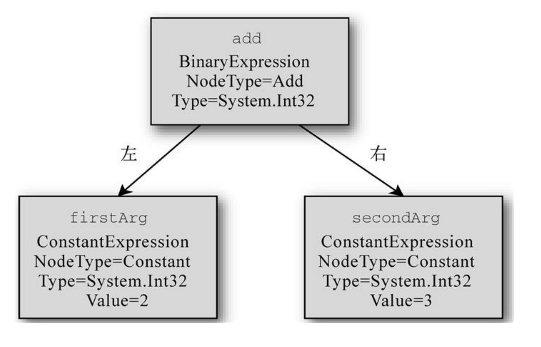
我们想要表达两个常量相加的一个表达式树,过程就是首先创建这两个常量表达式,然后根据这两个表达式创建一个相加表达式。逻辑结构如下图所示:
将表达式树编译成委托
LambdaExpression是Expression的子类之一,而Expression<TDelegate>又是LambdaExpression的子类,他们的继承结构如下:
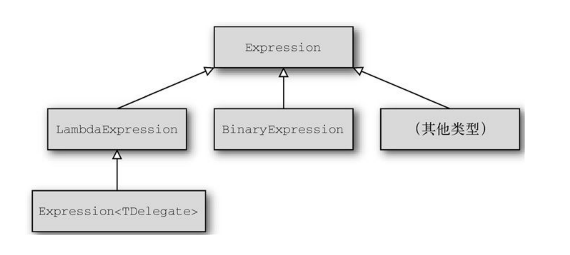
Expression和Expression<TDelegate>的区别就在于,泛型的Expression是以静态类型的方式(编译期就已经明确了表达式的类型)标识了它是什么类型的表达式,也就是说它确定了返回类型和参数。我们可以用Expression.Lambda来返回一个泛型Expression。那Expression<TDelegate>的意义何在呢?首先,LambdaExpression有一个Compile方法能够创建恰当类型的委托。Expression<TDelegate>也有一个同名的方法,但它静态类型化后返回的是TDelegate类型的委托。下面的代码演示了这个特性:
ConstantExpression first = Expression.Constant();

ConstantExpression second = Expression.Constant();

BinaryExpression body = Expression.Add(first, second);

Func<int> func = Expression.Lambda<Func<int>>(body).Compile();

Console.WriteLine(func());//
为了要打印一个5耗费了大量的时间但这并不是表达式树的本意,我们在程序中编辑了一些逻辑块,然后编译器将这些逻辑块变成真正可以执行的东西,此外,Expression<TDelegate>也有省事儿的方法,-----它可以直接由lambda表达式来显示或者隐式的转换。比如:
Expression<Func<string,int>> expression=it=>it.Length;
Lambda表达式转换成表达式树
Lambda表达式可以转换成委托,同样,他也可以转换成Expression<TDelegate>。
 Expression<Func<int>> expression = () => ;

            Func<int> func = expression.Compile();

            Console.WriteLine(func());
幸亏有了这样的转换,要不我们使用表达式会累死!!!但是他也有一些限制,只能转换单一的表达式。总之如果你的lambda在编译的过程中报错了你就会知道这些限制,这里就不一一列出了。下面演示一个更复杂的:
Expression<Func<string, string, bool>> expression = (x, y) => x.StartsWith(y);

var compiled = expression.Compile();

Console.WriteLine(compiled("pangjainxin", "pang"));
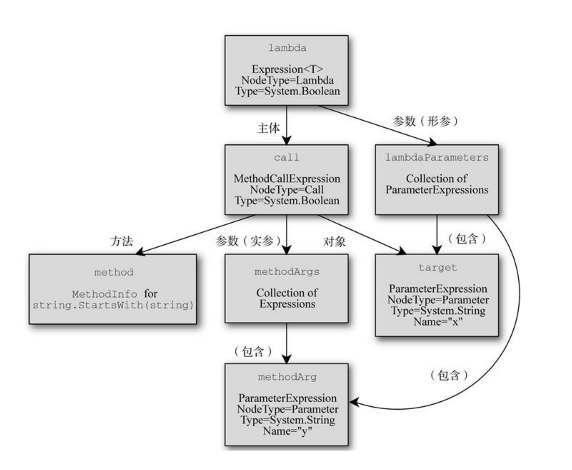
如果没有lambda表达式的隐式转换,那么我们得书写下面的代码来达到这个目的:
            //①首先构造方法调用的各个部件

            MethodInfo startWith = typeof(string).GetMethod("StartsWith", new[] { typeof(string) });

            var target = Expression.Parameter(typeof(string), "x");

            var methodArg = Expression.Parameter(typeof(string), "y");

            Expression[] methodArgs = new[] { methodArg };

            //②然后从以上部件创建CallExpression

            Expression call = Expression.Call(target, startWith, methodArgs);

            //③然后从CallExpression转换成lambda表达式

            var lambdaParameters = new[] { target, methodArg };

            var lambda = Expression.Lambda<Func<string, string, bool>>(call, lambdaParameters);

            var compiled = lambda.Compile();

            Console.WriteLine(compiled("pangjainxin", "pang"));//true

            Console.WriteLine(compiled("pangjianxin", "angjianxin"));//false
看起来要比隐式的lambda转换麻烦多了,下图展示了这一过程:
asp.net core 排序过滤分页组件:sieve(2)表达式树的复习的更多相关文章
- asp.net core 排序过滤分页组件:sieve(1)
使用asp.net core开发时避免不了要用一个合适的分页组件来让前端获取分页数据.github上面有一个开源的分页组件在这方面很适合我的使用,于是我把他的文档翻译一下,随后会分析它里面的源码.这是 ...
- asp.net core MVC 过滤器之ActionFilter过滤器(二)
本系类将会讲解asp.net core MVC中的内置全局过滤器的使用,将分为以下章节 asp.net core MVC 过滤器之ExceptionFilter过滤器(一) asp.net core ...
- ASP.NET Core MVC – Tag Helper 组件
ASP.NET Core Tag Helpers系列目录,这是第五篇,共五篇: ASP.NET Core MVC – Tag Helpers 介绍 ASP.NET Core MVC – Caching ...
- 学习ASP.NET Core(08)-过滤搜索与分页排序
上一篇我们介绍了AOP的基本概览,并使用动态代理的方式添加了服务日志:本章我们将介绍过滤与搜索.分页与排序并添加对应的功能 注:本章内容大多是基于solenovex的使用 ASP.NET Core 3 ...
- drf-jwt的过滤,筛选,排序,分页组件
目录 自定义drf-jwt配置 案例:实现多方式登陆签发token urls.py models.py serializers.py views.py 案例:自定义认证反爬规则的认证类 urls.py ...
- 玩转ASP.NET Core中的日志组件
简介 日志组件,作为程序员使用频率最高的组件,给程序员开发调试程序提供了必要的信息.ASP.NET Core中内置了一个通用日志接口ILogger,并实现了多种内置的日志提供器,例如 Console ...
- [译]ASP.NET Core 2.0 视图组件
问题 如何在ASP.NET Core 2.0中使用视图组件? 答案 新建一个空项目,修改Startup类并添加MVC服务和中间件: public void ConfigureServices(ISer ...
- Asp.Net Core中利用Seq组件展示结构化日志功能
在一次.Net Core小项目的开发中,掌握的不够深入,对日志记录并没有好好利用,以至于一出现异常问题,都得跑动服务器上查看,那时一度怀疑自己肯定没学好,不然这一块日志不可能需要自己扒服务器日志来查看 ...
- ASP.NET Core MVC 之视图组件(View Component)
1.视图组件介绍 视图组件是 ASP.NET Core MVC 的新特性,类似于局部视图,但它更强大.视图组件不使用模型绑定,并且仅依赖于调用它时所提供的数据. 视图组件特点: 呈块状,而不是整个响应 ...
随机推荐
- java面试基础(一)
1.基本数据类型.封装类和运算操作(1)简述 & 和 && ,以及 | 和 || 的区别.———&和|是位运算符也是逻辑运算符,作为逻辑运算符时左右两边都会进行判断(不 ...
- linux 下搭建php环境
linux 下搭建php环境 1.下载apache (http://httpd.apache.org/download.cgi) 下载php组件 ( http://cn2.php.net/get/ph ...
- 【重学计算机】机组D8章:输入输出系统
1. 输入输出系统概述 组成:外设.接口.总线.管理软件 基本功能 完成计算机内外的信息传递 保证CPU正确选择输出设备 利用缓冲等,实现主机与外设的速度匹配 特点:异步性.实时性.设备无关性 输入过 ...
- .NET Core微服务之基于EasyNetQ使用RabbitMQ消息队列
Tip: 此篇已加入.NET Core微服务基础系列文章索引 一.消息队列与RabbitMQ 1.1 消息队列 “消息”是在两台计算机间传送的数据单位.消息可以非常简单,例如只包含文本字符串:也可以更 ...
- with open为什么会自动关闭文件流
操作文件我们通常需要手动关闭文件流,可是通过with open()的时候却可以自动关闭,这是为什么呢?其实这就是上下文管理器.我们来看一个例子 #!/usr/bin/env python # -*- ...
- RDIFramework.NET V3.3 Web版新增系统公告、系统新闻模块方便需要的客户
1.系统新闻功能描述 在RDIFramework.NET V3.3版本中新增了系统新闻模块,用户可以根据实际情况做相应应用,如用在内部业务系统的展示中或网站上新闻的展示.新闻可以分类进行管理,非常的实 ...
- 动手写 js 沙箱
本文由云+社区发表 作者:ivweb villainthr 市面上现在流行两种沙箱模式,一种是使用iframe,还有一种是直接在页面上使用new Function + eval进行执行. 殊途同归,主 ...
- 在嵌入式设备中使用 JavaScript 的前景
by Conmajia PC上的JavaScript已经发展到ECMAScript 6(ES6),马上ES10都快出来了(虽然还是草案),但是硬件上的JS却很少听说.这几年手持设备/可穿戴设备的发展非 ...
- 把list集合的内容写入到Xml中,通过XmlDocument方式写入Xml文件中
List<Person> list = new List<Person> { new Person{Name="张三",Age=20,Email=" ...
- SpringMVC与Struts2的主要区别
区别1: Struts2 的核心是基于一个Filter即StrutsPreparedAndExcuteFilterSpringMvc的核心是基于一个Servlet即DispatcherServlet( ...