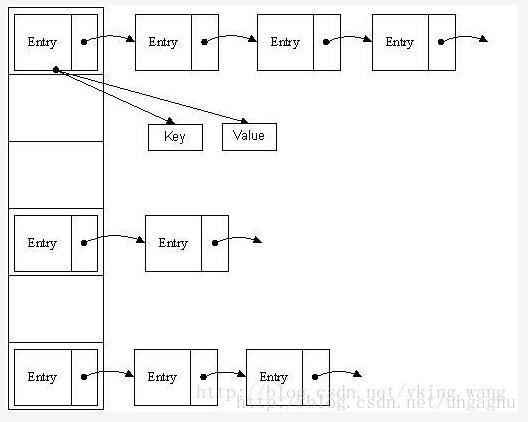
简单说: 底层原理就是采用数组加链表:


两张图片很清晰地表明存储结构:

既然是线性数组,为什么能随机存取?这里HashMap用了一个小算法,大致是这样实现:

// 存储时: 
int hash = key.hashCode(); // 这个hashCode方法这里不详述,只要理解每个key的hash是一个固定的int值 
int index = hash % Entry[].length; 
Entry[index] = value;

// 取值时: 
int hash = key.hashCode(); 
int index = hash % Entry[].length; 
return Entry[index];

public V put(K key, V value) {
 
        if (key == null)
 
            return putForNullKey(value); //null总是放在数组的第一个链表中
 
        int hash = hash(key.hashCode());
 
        int i = indexFor(hash, table.length);
 
        //遍历链表
 
        for (Entry<K,V> e = table[i]; e != null; e = e.next) {
 
            Object k;
 
            //如果key在链表中已存在,则替换为新value
 
            if (e.hash == hash && ((k = e.key) == key || key.equals(k))) {
 
                V oldValue = e.value;
 
                e.value = value;
 
                e.recordAccess(this);
 
                return oldValue;
 
            }
 
        }
 
 
        modCount++;
 
        addEntry(hash, key, value, i);
 
        return null;
 
    }


void addEntry(int hash, K key, V value, int bucketIndex) {
 
    Entry<K,V> e = table[bucketIndex];
 
    table[bucketIndex] = new Entry<K,V>(hash, key, value, e); //参数e, 是Entry.next
 
    //如果size超过threshold,则扩充table大小。再散列
 
    if (size++ >= threshold)
 
            resize(2 * table.length);
 
}
get()
 
public V get(Object key) {
 
        if (key == null)
 
            return getForNullKey();
 
        int hash = hash(key.hashCode());
 
        //先定位到数组元素,再遍历该元素处的链表
 
        for (Entry<K,V> e = table[indexFor(hash, table.length)];
 
            e != null;
 
            e = e.next) {
 
            Object k;
 
            if (e.hash == hash && ((k = e.key) == key || key.equals(k)))
 
                return e.value;
 
        }
 
        return null;
 
}


null key的存取
 
null key总是存放在Entry[]数组的第一个元素。
 
 
  private V putForNullKey(V value) {
 
        for (Entry<K,V> e = table[0]; e != null; e = e.next) {
 
            if (e.key == null) {
 
                V oldValue = e.value;
 
                e.value = value;
 
                e.recordAccess(this);
 
                return oldValue;
 
            }
 
        }
 
        modCount++;
 
        addEntry(0, null, value, 0);
 
        return null;
 
    }
 
 
    private V getForNullKey() {
 
        for (Entry<K,V> e = table[0]; e != null; e = e.next) {
 
            if (e.key == null)
 
                return e.value;
 
        }
 
        return null;
 
    }
 
再散列rehash过程
 
当哈希表的容量超过默认容量时,必须调整table的大小。当容量已经达到最大可能值时,那么该方法就将容量调整到Integer.MAX_VALUE返回,这时,需要创建一张新表,将原表的映射到新表中。
 
 
  /**
 
    * Rehashes the contents of this map into a new array with a
 
    * larger capacity.  This method is called automatically when the
 
    * number of keys in this map reaches its threshold.
 
    *
 
    * If current capacity is MAXIMUM_CAPACITY, this method does not
 
    * resize the map, but sets threshold to Integer.MAX_VALUE.
 
    * This has the effect of preventing future calls.
 
    *
 
    * @param newCapacity the new capacity, MUST be a power of two;
 
    *        must be greater than current capacity unless current
 
    *        capacity is MAXIMUM_CAPACITY (in which case value
 
    *        is irrelevant).
 
    */
 
    void resize(int newCapacity) {
 
        Entry[] oldTable = table;
 
        int oldCapacity = oldTable.length;
 
        if (oldCapacity == MAXIMUM_CAPACITY) {
 
            threshold = Integer.MAX_VALUE;
 
            return;
 
        }
 
 
        Entry[] newTable = new Entry[newCapacity];
 
        transfer(newTable);
 
        table = newTable;
 
        threshold = (int)(newCapacity * loadFactor);
 
    }


    /**
 
    * Transfers all entries from current table to newTable.
 
    */
 
    void transfer(Entry[] newTable) {
 
        Entry[] src = table;
 
        int newCapacity = newTable.length;
 
        for (int j = 0; j < src.length; j++) {
 
            Entry<K,V> e = src[j];
 
            if (e != null) {
 
                src[j] = null;
 
                do {
 
                    Entry<K,V> next = e.next;
 
                    //重新计算index
 
                    int i = indexFor(e.hash, newCapacity);
 
                    e.next = newTable[i];
 
                    newTable[i] = e;
 
                    e = next;
 
                } while (e != null);
 
            }
 
        }
    }

HashMap的底层原理的更多相关文章

  1. HashMap的底层原理(jdk1.7.0_79)

    前言 在Java中我们最常用的集合类毫无疑问就是Map,其中HashMap作为Map最重要的实现类在我们代码中出现的评率也是很高的. 我们对HashMap最常用的操作就是put和get了,那么你知道它 ...

  2. 谈一下HashMap的底层原理是什么?

    底层原理:Map + 无序 + 键唯一 + 哈希表 (数组+Entry)+ 存取值 1.HashMap是Map接口的实现类.实现HashMap对数据的操作,允许有一个null键,多个null值. Co ...

  3. HashMap的底层原理 cr:csdn:zhangshixi

    1.    HashMap概述: HashMap是基于哈希表的Map接口的非同步实现.此实现提供所有可选的映射操作,并允许使用null值和null键.此类不保证映射的顺序,特别是它不保证该顺序恒久不变 ...

  4. 深度解析HashMap集合底层原理

    目录 前置知识 ==和equals的区别 为什么要重写equals和HashCode 时间复杂度 (不带符号右移) >>> ^异或运算 &(与运算) 位移操作:1<&l ...

  5. 浅谈HashMap 的底层原理

    本文整理自漫画:什么是HashMap? -小灰的文章 .已获得作者授权. HashMap 是一个用于存储Key-Value 键值对的集合,每一个键值对也叫做Entry.这些个Entry 分散存储在一个 ...

  6. HashMap 的底层原理

    1. HashMap的数据结构 数据结构中有数组和链表来实现对数据的存储,但这两者基本上是两个极端. 数组 数组存储区间是连续的,占用内存严重,故空间复杂的很大.但数组的二分查找时间复杂度小,为O(1 ...

  7. 最简单的HashMap底层原理介绍

    HashMap 底层原理  1.HashMap底层概述 2.JDK1.7实现方式 3.JDK1.8实现方式 4.关键名词 5.相关问题 1.HashMap底层概述 在JDK1.7中HashMap采用的 ...

  8. HashMap的底层实现原理

    HashMap的底层实现原理1,属性static final int MAX_CAPACITY = 1 << 30;//1073741824(十进制)0100000000000000000 ...

  9. HashMap底层原理分析(put、get方法)

    1.HashMap底层原理分析(put.get方法) HashMap底层是通过数组加链表的结构来实现的.HashMap通过计算key的hashCode来计算hash值,只要hashCode一样,那ha ...

随机推荐

  1. linux中mysql命令方式备份数据的问题

    这几天公司新出了个组件化的项目,里面需要用到mysql数据库相关的技术,由于之前一直用的mongodb,所以mysql几乎忘光了,于是只能在linux虚拟机中重新开始学习. 基本的增删改查还好,但是在 ...

  2. jquery Dialog弹框插件

    function Dialog(options) { var defaults = { // 默认值. title: '', // 标题文本,若不想显示title请通过CSS设置其display为no ...

  3. .Net Core 1.0升级2.0(xproj项目迁移到.csproj )

    vs2015的创建的项目是以*.xproj的项目文件,迁移到vs2017需要如下准备: 1.安装好vs2017(废话) 2.下载最新的SDK和 .NET Core 2.0 Preview 1 Runt ...

  4. java中回调函数的理解

    一,案例一 "通常大家说的回调函数一般就是按照别人(李四)的定好的接口规范写,等待别人(张三)调用的函数,在C语言中,回调函数通常通过函数指针来传递:在Java中,通常就是编写另外一个类或类 ...

  5. GridView 多余字符显示省略号,并在Tooltip中显示完整信息

    效果 方法一:TemplateField 关键点 TemplateField的灵活性 CSS:overflow:hidden;text-overflow:ellipsis (溢出时隐藏;文本溢出时省略 ...

  6. Linux 的特殊变量(2)

    1.echo $?  输出结果为0 表示命令执行成功 场景:判断上一个命令是否成功 扩展 0:成功 2 :权限拒绝 1~125:表示运行失败 126:找到命令,但是无法执行 127:未找到要运行的命令 ...

  7. Linux进行AES加密每次结果都不一致并且解密失败报错

    1. 现象 windows操作系统下进行"123456"的AES加密 encrypted message is below : QLNYZyjRnKF/zxAjzDt/lw== d ...

  8. JavaScript中的this的指代对象详解

    在javascript里面,this是一个特殊的对象,它不像其他编程语言那样,是存储在实例中的值,直接指向此实例. 而是作为一个单独的指针,在不同的情况之下,指向不同的位置,这也是为什么我们会将它搞混 ...

  9. 【Luogu4137】Rmq Problem/mex (莫队)

    [Luogu4137]Rmq Problem/mex (莫队) 题面 洛谷 题解 裸的莫队 暴力跳\(ans\)就能\(AC\) 考虑复杂度有保证的做法 每次计算的时候把数字按照大小也分块 每次就枚举 ...

  10. css - 移动端reset汇总与注释

    1.解决移动端触摸a元素,会有蓝色阴影 正常状态: 点击时状态: a{ outline:none; -webkit-tap-highlight-color: rgba(,,,); } -webkit- ...