
Python——collections模块、time模块、random模块、os模块、sys模块
1. collections模块
(1)namedtuple
# (1)点的坐标

from collections import namedtuple

Point = namedtuple('point',['x','y'])

# 前两行可以用下面两行代替

# import collections

# Point = collections.namedtuple('point',['x','y'])

p = Point(1,2)

print(p.x)  #

print(p.y)  #

print(p)    #point(x=1, y=2)
扑克牌的花色和数字
from collections import namedtuple

Card = namedtuple('card',['suits','number'])

c1 = Card('红桃',2)

print(c1.suits)     #红桃

print(c1.number)    #

print(c1)     #card(suits='红桃', number=2)
(2)queue 队列——FIFO 先进先出
import queue

q = queue.Queue()

q.put(10)

q.put(5)

q.put(8)

print(q.qsize())    #

print(q)    #<queue.Queue object at 0x00000144985010B8>

print(q.get())  #

print(q.get())  #

print(q.get())  #

print(q.get())  #阻塞:取完值之后继续取,不会报错
(3)deque——双端队列
from collections import deque

dq = deque([5,6])

dq.appendleft('a')  #从前面放数据   ['a',5,6]

dq.append('b')      #从后面放数据   ['a',5,6,'b']

dq.insert(0,3)      # [3,'a',5,6,'b']

print(dq)   #deque([3, 'a', 5, 6, 'b'])

print(dq.popleft())     #从前面取数据:3

print(dq.popleft())     #从前面取数据:a

print(dq.pop())         #从后面取数据:b

print(dq.pop())         #从后面取数据:6

print(dq)   #deque([5])
(4)OrderedDict 有序字典
字典取值快,但是存储时比列表占内存多
from collections import  OrderedDict

od = dict([('a',1),('b',2),('c',3)])

print(od)   #有序:{'a': 1, 'b': 2, 'c': 3}

print(od['a'])  #

for k in od:

    print(k)    # a    b   c
(5)defaultdict——默认字典
key不存在时,返回一个默认值
举例:将大于66的数放在k1,小于66的数放在k2
from collections import defaultdict

values = [11,22,33,44,55,66,77,88,99,100]

my_dict = defaultdict(list)  #默认list

for value in values:

    if value>66:

        my_dict['k1'].append(value)

    else:

        my_dict['k2'].append(value)

print(my_dict['k1'])    #[77, 88, 99, 100]

print(my_dict['k2'])    #[11, 22, 33, 44, 55, 66]
defaultdict的用法
from collections import defaultdict

d = defaultdict(list)

print(d['k'])   #[]

from collections import defaultdict

d1 = defaultdict(dict)

print(d1['k'])   #{}

from collections import defaultdict

dd = defaultdict(lambda:'默认值')

dd['key1'] = 'abc'

print(dd['key1'])   #key1存在,返回:abc

print(dd['key2'])   #key2不存在,返回:默认值(可以随意设置)
(6)Counter——跟踪值出现的次数
from collections import Counter

c = Counter('abacadfdcbcdf')

print(c)    #Counter({'a': 3, 'c': 3, 'd': 3, 'b': 2, 'f': 2})
2. time模块
(1)时间戳时间(timestamp)——float时间:给计算机看的
(2)格式化时间(Format String)——字符串:给人看的
#格式化时间:时间字符串strftime

print(time.strftime('%Y-%m-%d %a %H:%M:%S' ))     # 2018-10-08 Mon 15:04:01 Year month day week Hour Minute Seconds

print(time.strftime('%Y/%m/%d %H:%M:%S' ))     # 2018/10/08 15:05:23  Year month day Hour Minute Seconds

print(time.strftime('%m-%d %H:%M:%S' ))     # 10-08 15:04:01  month day Hour Minute Seconds

print(time.strftime('%H:%M:%S' ))     # 15:04:01  Hour Minute Seconds

print(time.strftime('%H:%M' ))     # 15:04  Hour Minute
(3)结构化时间(struct_time)——元祖:计算用的
#结构化时间

#localtime

struct_time = time.localtime()

print(struct_time)  #time.struct_time(tm_year=2018, tm_mon=10, tm_mday=8, tm_hour=15, tm_min=7, tm_sec=53, tm_wday=0, tm_yday=281, tm_isdst=0)

print(struct_time.tm_year)  #

#gmtime

struct_time1 = time.gmtime()

print(struct_time1)  #time.struct_time(tm_year=2018, tm_mon=10, tm_mday=8, tm_hour=15, tm_min=7, tm_sec=53, tm_wday=0, tm_yday=281, tm_isdst=0)

print(struct_time1.tm_year)  #
(4)三者的相互转换
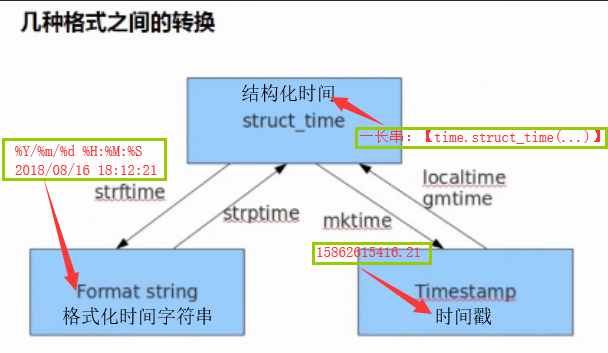
(5)相互转换代码
t = time.time()

print(t)    #1538982828.2859974

print(time.localtime(t))    #time.struct_time(tm_year=2018, tm_mon=10, tm_mday=8, tm_hour=15, tm_min=13, tm_sec=3, tm_wday=0, tm_yday=281, tm_isdst=0)

print(time.gmtime(t))       #time.struct_time(tm_year=2018, tm_mon=10, tm_mday=8, tm_hour=7, tm_min=13, tm_sec=3, tm_wday=0, tm_yday=281, tm_isdst=0)

print(time.localtime(1500000000))    #time.struct_time(tm_year=2017, tm_mon=7, tm_mday=14, tm_hour=10, tm_min=40, tm_sec=0, tm_wday=4, tm_yday=195, tm_isdst=0)

print(time.mktime(time.localtime()))    #1538982958.0

t = time.strptime('2000-12.31','%Y-%m.%d')

print(t)    #time.struct_time(tm_year=2000, tm_mon=12, tm_mday=31, tm_hour=0, tm_min=0, tm_sec=0, tm_wday=6, tm_yday=366, tm_isdst=-1)

print(time.strftime('%m/%d/%y %H:%M:%S',time.localtime(3000000000)))    #01/24/65 13:20:00

print(time.asctime())   # Mon Oct  8 15:21:02 2018

print(time.asctime(time.localtime()))   # Mon Oct  8 15:21:02 2018

print(time.asctime(time.localtime(2000000000)))   # Wed May 18 11:33:20 2033

print(time.ctime())     # Mon Oct  8 15:21:02 2018

print(time.ctime(2000000000))   # Wed May 18 11:33:20 2033
3. random模块
(1)随机小数
import random

print(random.random())  # (0,1)之间的任意一个小数

print(random.uniform(1,3))  # (1,3)之间的任意一个小数
(2)随机整数
import random

print(random.randint(1,5))         # [1,5]之间的任意一个整数

print(random.randrange(1,5))       # [1,4]之间的任意一个整数

print(random.randrange(1,10,2))    # [1,9]之间的任意一个整数奇数
(3)选择一个返回
import random

print(random.choice([1,'',[4,5]]))    # 随机选择一个返回:列表任意一个元素
(4)选择多个返回
import random

print(random.sample([1,'',[4,5],5,4,9],3))  # 随机选择多个返回:返回个数是函数的第二个参数
(5)打乱列表序列
import random

item = [1,3,5,7,9]

print(item)     # [1, 3, 5, 7, 9]

random.shuffle(item)

print(item)     # [5, 9, 3, 7, 1]
(6)验证码的生成
详见:笔试面试题 https://www.cnblogs.com/xc-718/p/9632731.html
4. sys模块
import sys

sys.exit()  # 退出程序:exit(1) 错误退出,exit(0) 正常退出

print(sys.platform) # win32【不准】

# 获取Python解释程序的版本信息

print(sys.version)  # 3.6.3 (v3.6.3:2c5fed8, Oct  3 2017, 18:11:49) [MSC v.1900 64 bit (AMD64)]

# 返回模块的搜索路径

print(sys.path)     # 所有路径

print(sys.path.clear())     # 清空之后,import sys 会报错
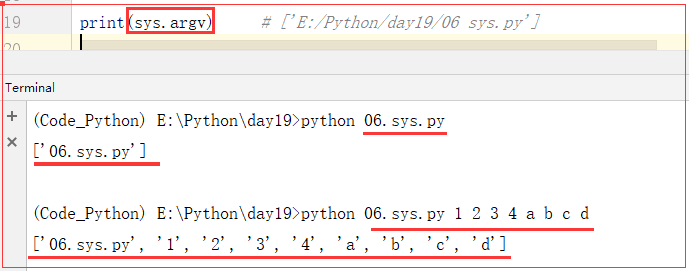
sys.argv
import sys

print(sys.argv)     # ['E:/Python/day19/06 sys.py']

ret = sys.argv

name = ret[1]

pwd = ret[2]

if name == 'xc' and pwd == '':

    print('登陆成功')

else:

    print('错误的用户名或密码')

    sys.exit()

print('你可以使用本系统了')
5.os模块
(1)os.getcwd()
import os

print(os.getcwd())  #获取当前工作目录: E:\Python\day19

os.chdir(r'E:\Python')  #改变当前脚本的工作目录,一般不会用到

print(os.getcwd())  #获取当前工作目录: E:\Python

os.chdir(r'E:\Python\day19')  #改变回原本的工作目录

print(os.getcwd())  #获取当前工作目录: E:\Python\day19
import sys

print(sys.argv)     # ['E:/Python/day19/06 sys.py']

ret = sys.argv

name = ret[1]

pwd = ret[2]

if name == 'xc' and pwd == '':

    print('登陆成功')

else:

    print('错误的用户名或密码')

    sys.exit()

print('你可以使用本系统了')
(2)文件和目录操作
import os

print(os.getcwd())  #E:\Python\day19

os.chdir('..')  #改变目录到当前目录的父目录

print(os.getcwd())  #E:\Python

print(os.curdir)    # .     当前目录

print(os.pardir)    # ..    当前目录的父目录,也就是上一层目录

os.makedirs('dir1/dir2')    #创建多层目录

os.removedirs('dir1/dir2')  #递归删除,一直删到上层目录不为空为止

os.mkdir('dir1')    #创建单级目录

os.rmdir('dir1')     #删除单极空目录,不为空不删除

print(os.listdir(r'E:\Python\day19'))   #列出指定目录下所有的文件和子目录,包含隐藏文件,并以列表方式打印

os.rename('06.sys.py','06 sys.py')      # 重命名文件

os.remove('E:/Python/day19/07 delete')      # 删除一个文件

print(os.stat('E:/Python/day19/06 作业.py'))  # 获取文件/目录信息
(3)代码跨平台
import os

# python 代码跨平台

print(os.sep)

# 输出操作系统特定的路径分隔符

    # windows  \        E:\Python\day19

    # linux    /        E:/Python/day19

print(os.pathsep)

# 输出用于分割文件路径的字符串

    # windows  ;        E:\Python\day19;E:\Python\day19;E:\Python\day19

    # linux    :        E:\Python\day19:E:\Python\day19:E:\Python\day19

print(os.name)

# 输出字符串指示当前平台

    # windows  nt

    # linux    posix
(4)与路经有关
import os

# 与路径有关的

print(os.path)  #绝对路径 <module 'ntpath' from 'D:\\download\\Python\\lib\\ntpath.py'>

# 返回path规范化的绝对路径

print(os.path.abspath(os.getcwd()))  #E:\Python\day19

print(os.getcwd())  # 获取当前路径 E:\Python\day19

# 用split将路径分割成:(目录,文件名)

print(os.path.split(os.getcwd()))   #('E:\\Python', 'day19')

# 返回path的目录

print(os.path.split(os.getcwd()))   #('E:\\Python', 'day19')

print(os.path.dirname(os.getcwd()))  # E:\Python

print(os.path.basename(os.getcwd()))   # day19

print(os.path.exists())     # path存在,返回True;不存在,返回False

print(os.path.isabs())      # path是绝对路径,返回True

print(os.path.isfile())     # path是一个存在的文件,返回True

print(os.path.isdir())      # path 是一个存在的目录,返回True

print(os.path.join('c:','user','local'))       # c:user\local 多个路径组合后返回,第一个绝对路径之前的参数被忽略

print(os.path.getatime())   # 返回path所指向的文件/目录的最后访问时间

print(os.path.getmtime())   # 返回path所指向的文件/目录的最后修改时间

# 返回path的大小

print(os.path.getsize(os.getcwd()))    # 4096【文件夹最大这么大】

print(os.path.getsize(os.path.join(os.getcwd(),'03 time.py')))    # 2546【文件大小】
(5)其他
import os

os.system('dir')   # 运行shell命令,直接显示,无返回值不能直接操作

print(os.popen('dir').read())   # 运行shell命令,获取执行结果,有返回值

# 获取系统的环境变量

print(os.environ)
Python——collections模块、time模块、random模块、os模块、sys模块的更多相关文章
- collections,time,random,os, sys 模块的使用
主要内容:1. 模块的简单认识2. collections模块3. time时间模块4. random模块5. os模块6. sys模块 一. 模块的简单认识什么是模块. 模块就是我们把装有特定功能的 ...
- python time、datetime、random、os、sys模块
一.模块1.定义模块:用来从逻辑上组织Python代码(变量,函数,类,逻辑:实现一个功能),本质就是.py结尾的python文件(文件名:test.py,对应的模块名:test)包:用来从逻辑上组织 ...
- python常用模块---collections、time、random、os、sys、序列号模块
collections模块 在内置数据类型(dict.list.set.tuple)的基础上,collections模块还提供了几个额外的数据类型:Counter.deque.defaultdict. ...
- Python进阶-XI 常用模块之一:collections、time、random、os、sys
简要介绍一下各种集合: 列表.元组.字典.集合(含frozenset).字符串.堆栈(如手枪弹夹:先进后出).队列(如马克沁机枪的弹夹:先进先出) 1.collections 1)queue 队列介绍 ...
- python之random 、os 、sys 模块
一.random模块 import random print(random.random())#(0,1)----float 大于0且小于1之间的小数 print(random.randint(1,3 ...
- Python (time、datetime、random、os、sys、shutil)模块的使用
######################################################### 模块time ################################### ...
- Python os与sys模块解析
os与sys模块的官方解释如下: os: This module provides a portable way of using operating system dependent functio ...
- Python中os与sys模块的区别
os与sys模块的官方解释如下: os: This module provides a portable way of using operating system dependent functio ...
- python os和sys模块使用
python os和sys模块使用 os.getcwd() 获取当前工作目录,即当前python脚本工作的目录路径 os.chdir("dirname") 改变当前脚本工作目录:相 ...
- Python 的 os 与 sys 模块
os与sys模块的官方解释如下: os: This module provides a portable way of using operating system dependent functio ...
随机推荐
- hdu4800 Josephina and RPG 解题报告
Josephina and RPG Time Limit: 4000/2000 MS (Java/Others) Memory Limit: 32768/32768 K (Java/Others ...
- Python Django 前后端数据交互 之 前端向后端发送数据
Python Django 之 前端向后端发送数据
- php通过$_SERVER['HTTP_USER_AGENT']获取浏览器useAgent
php通过$_SERVER['HTTP_USER_AGENT']获取浏览器useAgent
- Java——File类概述
body, table{font-family: 微软雅黑} table{border-collapse: collapse; border: solid gray; border-width: 2p ...
- hdu 1556 Color the ball (线段树+代码详解)
Color the ball Time Limit: 9000/3000 MS (Java/Others) Memory Limit: 32768/32768 K (Java/Others) T ...
- Runtime-iOS运行时应用
本篇将会总结Rutime的具体应用实例,结合其动态特性,Runtime在开发中的应用大致分为以下几个方面(Runtime应用图): 相关文章:iOS运行时Runtime基础 一.动态方法交换:Meth ...
- 向ACCESS数据库中的表导入EXCEL表,在 System.Data.OleDb.OleDbException 中第一次偶然出现的“System.Data.dll”类型的异常
向ACCESS数据库中的表导入EXCEL表,EXCEL表Sheet1中与ACCESS数据库表中的关键字对应的列的值,不能与数据库中表的主键项值重复,不然就会出现 在 System.Data.OleDb ...
- Python学习(006)-深浅拷贝及集合
深浅拷贝 import copy husband=['xiaoxin',123,[200000,100000]] wife=husband.copy() #浅拷贝 wife[0]='xiaohong ...
- 使用idea创建springboot项目并打成war包发布到weblogic上
部署tomcat也是类似的,但是需要注意项目配置的路径,或者直接将项目放到webapp的ROOT目录下. 使用工具:intelliJ IDEA2016.3, jdk1.8 ,weblogic12 一 ...
- C++ 多线程中使用cout还是printf
在多线程的设计模式下,如果多个线程都使用cout打印信息,那么很容易出现内容交替的现象,例如下图: 代码如下: 如果把cout替换成printf,那么就不会出现这个问题,运行结果如下图: 对应代码如下 ...