
2.2 Rust 数据类型
2.2 数据类型
let guess: u32 = "42".parse().expect("Not a number!");
Rust has four primary scalar types: integers, floating-point numbers, Booleans, and characters.
整数类型
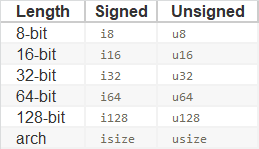
 u32,this type declaration indicates that the value it’s associated with should be an unsigned integer (signed integer types start with i, instead of u) that takes up  bits of space.

Additionally, the isize and usize types depend on the kind of computer your program is running on:  bits if you’re on a -bit architecture and  bits if you’re on a -bit architecture.
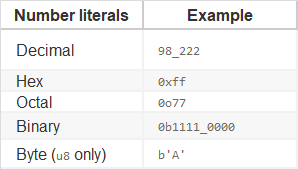
Note that all number literals except the byte literal allow a type suffix, such as 57u8, and _ as a visual separator, such as 1_000.
整数溢出
Let’s say that you have a u8, which can hold values between zero and . What happens if you try to change it to ? This is called “integer overflow,” and Rust has some interesting rules around this behavior. When compiling in debug mode, Rust checks for this kind of issue and will cause your program to panic, which is the term Rust uses when a program exits with an error.

In release builds, Rust does not check for overflow, and instead will do something called “two’s complement wrapping.” In short,  becomes ,  becomes , etc. Relying on overflow is considered an error, even if this behavior happens. If you want this behavior explicitly, the standard library has a type, Wrapping, that provides it explicitly.
浮点类型
Rust’s floating-point types are f32 and f64, which are 32 bits and 64 bits in size, respectively. The default type is f64 because on modern CPUs it’s roughly the same speed as f32 but is capable of more precision.
fn main() {

    let x = 64.0 ; //f64

    let y: f32 = 32.0; //f32

    println!("64:{},32:{}",x,y);

}
The f32 type is a single-precision float, and f64 has double precision.
数字运算
fn main() {

    // addition

    let _sum = 5 + 10;

    // subtraction

    let _difference = 95.5 - 4.3;

    // multiplication

    let _product = 4 * 30;

    // division

    let _quotient = 56.7 / 32.2; //1.7608695652173911 小数点后16位

    let _ff32 = 7f32 / 3f32;   //2.3333333  7位小数

    // remainder

    let _remainder = 13 % 5;  //3

    println!{"32位除法:{}",_ff32}

    println!{"默认64位除法:{}",_quotient};

    println!{"求余:{}",_remainder};

}
整数与浮点数不可以混合运算,比如 let _cc = 10 * 3.0; 会报以下错误
^ no implementation for `{integer} * {float}`
error: Could not compile `datatype`.
布尔类型
fn main() {

    let _t = true;

    let _f: bool = false; // with explicit type annotation

}
字符类型
fn main() {

    let _a = 'z';

    let _b = 'ℤ';

    let _c = 'Z';

}
Rust’s char type represents a Unicode Scalar Value, which means it can represent a lot more than just ASCII. Accented letters; Chinese, Japanese, and Korean characters; emoji; and zero-width spaces are all valid char values in Rust. Unicode Scalar Values range from U+ to U+D7FF and U+E000 to U+10FFFF inclusive. However, a “character” isn’t really a concept in Unicode, so your human intuition for what a “character” is may not match up with what a char is in Rust.
复合类型
Compound types can group multiple values into one type. Rust has two primitive compound types: tuples and arrays.
元组存放数据的数据类型可以不同,数组则必须是相同类型。
元组
A tuple is a general way of grouping together some number of other values with a variety of types into one compound type. Tuples have a fixed length: once declared, they cannot grow or shrink in size.
Each position in the tuple has a type, and the types of the different values in the tuple don’t have to be the same.
fn main() {

    let _tup: (i32, f64, u8) = (500, 6.4, 1);

    let _aa = (1,2.3,"wa ka ka ");

    let (_x,_y,_z) = _aa;

    println!("The value of z is:{}",_z)

}
This program first creates a tuple and binds it to the variable tup. It then uses a pattern with let to take tup and turn it into three separate variables, x, y, and z. This is called destructuring, because it breaks the single tuple into three parts.

 In addition to destructuring through pattern matching, we can access a tuple element directly by using a period (.) followed by the index of the value we want to access.
fn main() {

    let _x: (i32, f64, u8) = (500, 6.4, 1);

    let _five_hundred = _x.0;

    let _six_point_four =_x.1;

    let _one = _x.2;

    println!("第三个元素:{}",_one);

}
数组类型
Unlike a tuple, every element of an array must have the same type. Arrays in Rust are different from arrays in some other languages because arrays in Rust have a fixed length, like tuples.
fn main() {

    let _a = [1, 2, 3, 4, 5];

}
Arrays are useful when you want your data allocated on the stack rather than the heap or when you want to ensure you always have a fixed number of elements. An array isn’t as flexible as the vector type, though. A vector is a similar collection type provided by the standard library that is allowed to grow or shrink in size. If you’re unsure whether to use an array or a vector, you should probably use a vector.
It’s very unlikely that such a program will need to add or remove months, so you can use an array because you know it will always contain 12 items
fn main() {

    let _a = [1, 2, 3, 4, 5];

    let _months = ["January", "February", "March", "April", "May", "June", "July",

              "August", "September", "October", "November", "December"];

}
Arrays have an interesting type; it looks like this: [type; number]. For example:
fn main() {

    let _b: [i32; 5] = [1, 2, 3, 4, 5];

}
访问数组元素
fn main() {

    let _b: [i32; 5] = [1, 2, 3, 4, 5];

    let _c1 = _b[0];

    let _c2 = _b[1];

}
数组越界
fn main() {

    let a = [1, 2, 3, 4, 5];

    let index = 10;

    let element = a[index];

    println!("The value of element is: {}", element);

}
编译阶段不会报错,在运行时会报错
[root@itoracle src]# cargo build

   Compiling datatype v0.1.0 (/usr/local/automng/src/rust/test/datatype)

    Finished dev [unoptimized + debuginfo] target(s) in 1.39s

[root@itoracle src]# cargo run

    Finished dev [unoptimized + debuginfo] target(s) in 0.01s

     Running `/usr/local/automng/src/rust/test/datatype/target/debug/datatype`

thread 'main' panicked at 'index out of bounds: the len is 5 but the index is 10', src/main.rs:5:19

note: Run with `RUST_BACKTRACE=1` for a backtrace.
类型转换
fn data02(){

    println!("-------显式类型转换-------");

    let a = ;

    let b = a as f64;

    let c = b * 2.0;

    println!("c={}",c);  //c=2

    println!("-------------------------------------------------------");

}
2.2 Rust 数据类型的更多相关文章
- Rust 数据类型
Rust中的每个值都具有特定的数据类型. 基础类型: 整数,浮点数,布尔值和字符 i8,i16,i32,i64,i64,i128,isize, u8,u16,u32,u64,u64,u128,usiz ...
- rust数据类型
fn main() { //char支持4个字节,支持emoji let jp = "ゆ"; let emoji = "✨"; let ch = "囧 ...
- Rust学习笔记一 数据类型
写在前面 我也不是什么特别厉害的大牛,学历也很低,只是对一些新语言比较感兴趣,接触过的语言不算多也不算少,大部分也都浅尝辄止,所以理解上可能会有一些偏差. 自学了Java.Kotlin.Python. ...
- Rust <1>:数据类型、变量、可变性、常量、隐藏
rust 是强类型语言,所有变量.常量都必须有明确的数据类型:很多情况下,省略类型声明,编译器可自动推导,但不是所有情况下都会成功. rust 有整型.浮点型.布尔型.字符型.数组.元组.枚举.结构体 ...
- Rust之路(2)——数据类型 上篇
[未经书面同意,严禁转载] -- 2020-10-13 -- Rust是系统编程语言.什么意思呢?其主要领域是编写贴近操作系统的软件,文件操作.办公工具.网络系统,日常用的各种客户端.浏览器.记事本. ...
- Rust之路(3)——数据类型 下篇
[未经书面同意,严禁转载] -- 2020-10-14 -- 架构是道,数据是术.道可道,非常道:术不名,不成术!道无常形,术却可循规. 学习与分析数据类型,最基本的方法就是搞清楚其存储原理,变量和对 ...
- Rust基本数据类型
基本类型 Rust 每个值都有其确切的数据类型,总的来说可以分为两类:基本类型和复合类型. 基本类型意味着它们往往是一个最小化原子类型,无法解构为其它类型(一般意义上来说),由以下组成: 数值类型: ...
- Rust语言中的常量,变量,运算符,数据类型
简单练练, 夏天太热. const MAX_POINTS: u32 = 100_100; fn main() { let mut x = 5; let y = 5; let y = y + 1; le ...
- Rust语言的多线程编程
我写这篇短文的时候,正值Rust1.0发布不久,严格来说这是一门兼具C语言的执行效率和Java的开发效率的强大语言,它的所有权机制竟然让你无法写出线程不安全的代码,它是一门可以用来写操作系统的系统级语 ...
随机推荐
- 在Ubuntu里启用root账号
我的系统环境, 操作系统:Win7 虚拟机软件:VMware workstation 12 在虚拟机里安装了Ubuntu 18,安装时的账号frank,在安装其它软件的时候,报权限不足,因此,准备启用 ...
- multi-mechanize安装实践
关于multi-mechanize的详细介绍参见如下链接,是其官网 http://testutils.org/multi-mechanize/setup.html multi-mechanize是一款 ...
- PCL —— RCNN Family 中层次点云处理
博客转载自:http://www.cnblogs.com/ironstark/p/6046411.html RCNN是从图像中检测物体位置的方法,严格来讲不属于三维计算机视觉.但是这种方法却又非常非常 ...
- AbstractFactoryPattern(23种设计模式之一)
设计模式六大原则(1):单一职责原则 设计模式六大原则(2):里氏替换原则 设计模式六大原则(3):依赖倒置原则 设计模式六大原则(4):接口隔离原则 设计模式六大原则(5):迪米特法则 设计模式六大 ...
- Luogu 1484 种树
Luogu 1792 算是双倍经验. 我们考虑对于一个点,我们要么选它,要么选它周围的两个点. 所以我们考虑用一个堆来维护,每次从堆顶取出最大值之后我们把它的权值记为:它左边的权值加上它右边的权值减去 ...
- Luogu 3939 数颜色
随手点开一个题. 咦,这不是裸的动态开点线段树吗?写一个写一个…… Code: #include <cstdio> #include <cstring> using names ...
- 对 BFC 的理解
对CSS有了解的道友们肯定都知道盒式模型这个概念,对一个元素设置CSS,首先需要知道这个元素是block还是inline类型.而BFC就是用来格式化块级盒子,同样管理inline类型的盒子还有IFC, ...
- 无废话MVC入门教程笔记
自学mvc,看了园子里李林峰写的李林峰写的无废话MVC入门教程笔记,现在有的平时忽略的或是不太清楚的点记下来 1,Html.DropDownList //服务端写法 @{ //下拉列表的值 List& ...
- 在Android中使用FlatBuffers(中篇)
本文来自网易云社区. FlatBuffers.Protobuf及JSON对比测试 FlatBuffers相对于Protobuf的表现又如何呢?这里我们用数据说话,对比一下FlatBuffers格式.J ...
- Linux计划任务 定时任务 Crond 配置详解 crond计划任务调试 sh -x 详解 JAVA脚本环境变量定义
一.Crond 是什么?(概述) crontab 是一款linux系统中的定时任务软件用于实现无人值守或后台定期执行及循环执行任务的脚本程序,在企业中使用的非常广泛. 现在开始学习linux计 ...