
Classification and Representation
Classification
To attempt classification, one method is to use linear regression and map all predictions greater than 0.5 as a 1 and all less than 0.5 as a 0. However, this method doesn't work well because classification is not actually a linear function.
The classification problem is just like the regression problem, except that the values we now want to predict take on only a small number of discrete values. For now, we will focus on the binary classification problem in which y can take on only two values, 0 and 1. (Most of what we say here will also generalize to the multiple-class case.) For instance, if we are trying to build a spam classifier for email, then  may be some features of a piece of email, and y may be 1 if it is a piece of spam mail, and 0 otherwise. Hence, y∈{0,1}. 0 is also called the negative class, and 1 the positive class, and they are sometimes also denoted by the symbols “-” and “+.” Given x(i), the corresponding
  is also called the label for the training example.
Hypothesis Representation
We could approach the classification problem ignoring the fact that y is discrete-valued, and use our old linear regression algorithm to try to predict y given x. However, it is easy to construct examples where this method performs very poorly. Intuitively, it also doesn’t make sense for hθ(x) to take values larger than 1 or smaller than 0 when we know that y ∈ {0, 1}. To fix this, let’s change the form for our hypotheses hθ(x) to satisfy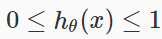 . This is accomplished by plugging
  into the Logistic Function.
Our new form uses the "Sigmoid Function," also called the "Logistic Function":

The following image shows us what the sigmoid function looks like:

The function g(z), shown here, maps any real number to the (0, 1) interval, making it useful for transforming an arbitrary-valued function into a function better suited for classification.
hθ(x) will give us the probability that our output is 1. For example, hθ(x)=0.7 gives us a probability of 70% that our output is 1. Our probability that our prediction is 0 is just the complement of our probability that it is 1 (e.g. if probability that it is 1 is 70%, then the probability that it is 0 is 30%).

Decision Boundary
In order to get our discrete 0 or 1 classification, we can translate the output of the hypothesis function as follows:

The way our logistic function g behaves is that when its input is greater than or equal to zero, its output is greater than or equal to 0.5:

Remember.

So if our input to g is  , then that means:

From these statements we can now say:

The decision boundary is the line that separates the area where y = 0 and where y = 1. It is created by our hypothesis function.
Example:


Multiclass Classification: One-vs-all
Now we will approach the classification of data when we have more than two categories. Instead of y = {0,1} we will expand our definition so that y = {0,1...n}.
Since y = {0,1...n}, we divide our problem into n+1 (+1 because the index starts at 0) binary classification problems; in each one, we predict the probability that 'y' is a member of one of our classes.

The following image shows how one could classify 3 classes:We are basically choosing one class and then lumping all the others into a single second class. We do this repeatedly, applying binary logistic regression to each case, and then use the hypothesis that returned the highest value as our prediction.

To summarize:

Classification and Representation的更多相关文章
- 浅谈Logistic回归及过拟合
判断学习速率是否合适?每步都下降即可.这篇先不整理吧... 这节学习的是逻辑回归(Logistic Regression),也算进入了比较正统的机器学习算法.啥叫正统呢?我概念里面机器学习算法一般是这 ...
- Stanford机器学习---第三讲. 逻辑回归和过拟合问题的解决 logistic Regression & Regularization
原文:http://blog.csdn.net/abcjennifer/article/details/7716281 本栏目(Machine learning)包括单参数的线性回归.多参数的线性回归 ...
- Machine Learning - 第3周(Logistic Regression、Regularization)
Logistic regression is a method for classifying data into discrete outcomes. For example, we might u ...
- 《Machine Learning》系列学习笔记之第三周
第三周 第一部分 Classification and Representation Classification 为了尝试分类,一种方法是使用线性回归,并将大于0.5的所有预测映射为1,所有小于0. ...
- Andrew Ng机器学习课程笔记--week3(逻辑回归&正则化参数)
Logistic Regression 一.内容概要 Classification and Representation Classification Hypothesis Representatio ...
- ICLR 2014 International Conference on Learning Representations深度学习论文papers
ICLR 2014 International Conference on Learning Representations Apr 14 - 16, 2014, Banff, Canada Work ...
- Course Machine Learning Note
Machine Learning Note Introduction Introduction What is Machine Learning? Two definitions of Machine ...
- Survey of single-target visual tracking methods based on online learning 翻译
基于在线学习的单目标跟踪算法调研 摘要 视觉跟踪在计算机视觉和机器人学领域是一个流行和有挑战的话题.由于多种场景下出现的目标外貌和复杂环境变量的改变,先进的跟踪框架就有必要采用在线学习的原理.本论文简 ...
- 《Learning Structured Representation for Text Classification via Reinforcement Learning》论文翻译.md
摘要 表征学习是自然语言处理中的一个基本问题.本文研究了如何学习文本分类的结构化表示.与大多数既不使用结构又依赖于预先指定结构的现有表示模型不同,我们提出了一种强化学习(RL)方法,通过自动覆盖优化结 ...
随机推荐
- Axios再记录
一个基于Promise 用于浏览器和 nodejs 的 HTTP 客户端(可实现ajax的请求) 有关学习网址:https://www.tuicool.com/articles/eMb2yuY ...
- python中lambda的另类使用
带if/else: ( lambda x, y: x if x < y else y )( 1, 2 ) 科里化: ( lambda x: ( lambda y: ( lambda z: x + ...
- 转一篇对EJB理解的文章
1. 我们不禁要问,什么是"服务集群"?什么是"企业级开发"? 既然说了EJB 是为了"服务集群"和"企业级开发",那么 ...
- POJ 2427 Smith's Problem Pell方程
题目链接 : http://poj.org/problem?id=2427 PELL方程几个学习的网址: http://mathworld.wolfram.com/PellEquation.html ...
- erroe:plot.new() : figure margins too large
使用R时多次出现这个错误,plot.new() : figure margins too large,提示图片边界太大 解决方法,win.graph(width=4.875, height=2.5,p ...
- Vue router的query对象里的值的问题
在使用 $router.push() 时,如果使用了query,则可以在跳转后从query中获取到对应的参数.如果传的是字符串自然没问题,但是如果传的其他类型的数据,在跳转之后是正常的,而跳转之后再刷 ...
- IntelliJ IDEA 2018 Community(社区版)创建J2EE项目+Tomcat9部署
博主打算开始系统地自学JAVA,首要问题就是解决IDE的问题, 以前用过像VS.Android Studio.Eclipse,知道Eclipse是JAVA最传统的IDE, 用过VS和AS的朋友都知道, ...
- VA对于开发QT是神器,VA自动补全QT
我怎么就忘了,VA也可以适用于VS下开发QT程序.其中QT的头文件自己增加,主要是: C:\Qt\4.8.6_2008\include 但还有一些特殊类不认识,所以还得继续增加: C:\Qt\4.8. ...
- 22. Spring Boot 动态数据源(多数据源自动切换)
转自:https://blog.csdn.net/catoop/article/details/50575038
- ORACLE11g R2【RAC+ASM→单实例FS】
ORACLE11g R2[RAC+ASM→单实例FS] 11g R2 RAC+ASMà单实例FS的DG,建议禁用OMF. 本演示案例所用环境: primary standby OS Hostnam ...