
ASP.NET Web API 框架研究 Action方法介绍
在根据请求解析出匹配的Controller类型并创建实例后,要在该Controller类型中的众多Action方法中选择与请求匹配的那一个,并执行,然后返回响应。
Action方法,其元数据,主要包括,ActionName,参数列表,返回类型,支持的方法,应用其上的特性,如过滤器,HttpMethod,自定义特性。
一、涉及的类及源码分析
类主要都在System.Web.Http.Controllers命名空间下
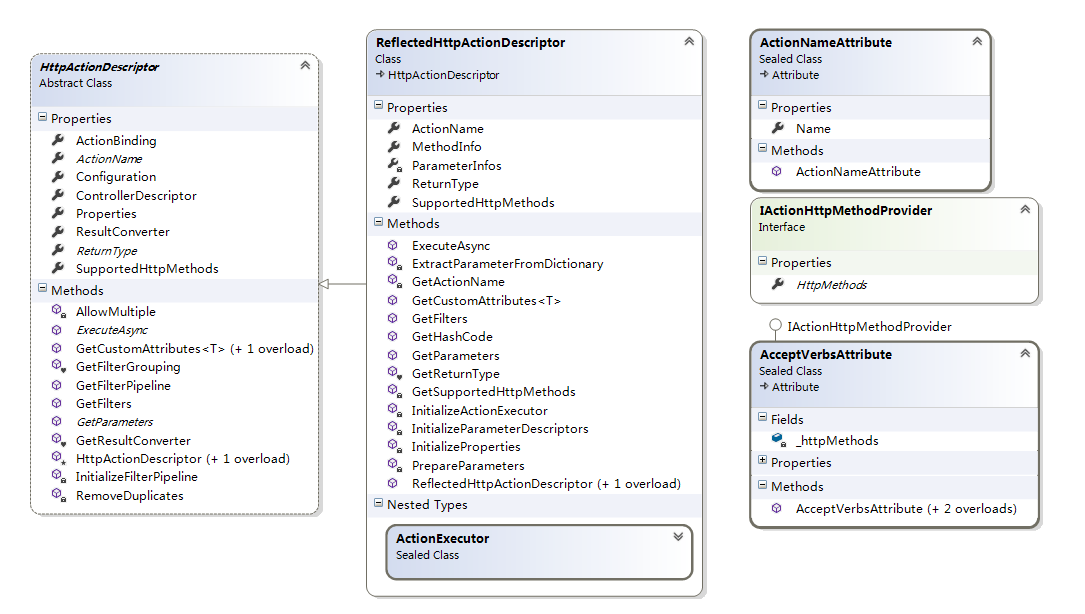
1、HttpActionDescriptor
是一个抽象类用来描述Controller类型中的每个方法的基本元数据,主要有以下成员:
属性:
public abstract string ActionName { get; } Action名称
public abstract Type ReturnType { get; } Action方法返回类型
public HttpControllerDescriptor ControllerDescriptor { get; set; } 所属Controller类型的描述符
public virtual Collection<HttpMethod> SupportedHttpMethods { get; } Action方法支持的HttpMethod集合,用来根据请求的方法来过滤当前Action方法是否在候选范围
public HttpConfiguration Configuration { get; set; } HttpConfiguration
public virtual ConcurrentDictionary<object, object> Properties { get; } 属性字典,可以附加任何对象到该属性
方法:
public abstract Collection<HttpParameterDescriptor> GetParameters() 返回方法的所有参数描述符HttpParameterDescriptor,其是HttpActionDescriptor重要组成部分
public virtual Collection<T> GetCustomAttributes<T>() where T : class 返回应用在Action方法上的各种类型的特性,特性是反射获取的,所以会缓存,该方法就是从缓存中返回
public virtual Collection<T> GetCustomAttributes<T>(bool inherit) where T : class 返回应用在Action方法上的各种类型的特性
public abstract Task<object> ExecuteAsync(HttpControllerContext controllerContext, IDictionary<string, object> arguments, CancellationToken cancellationToken); 执行方法
    public abstract class HttpActionDescriptor

    {

        private readonly ConcurrentDictionary<object, object> _properties = new ConcurrentDictionary<object, object>();

        private IActionResultConverter _converter;

        private readonly Lazy<Collection<FilterInfo>> _filterPipeline;

        private FilterGrouping _filterGrouping;

        private Collection<FilterInfo> _filterPipelineForGrouping;

        private HttpConfiguration _configuration;

        private HttpControllerDescriptor _controllerDescriptor;

        private readonly Collection<HttpMethod> _supportedHttpMethods = new Collection<HttpMethod>();

        private HttpActionBinding _actionBinding;

        private static readonly ResponseMessageResultConverter _responseMessageResultConverter = new ResponseMessageResultConverter();

        private static readonly VoidResultConverter _voidResultConverter = new VoidResultConverter();

        protected HttpActionDescriptor()

        {

            _filterPipeline = new Lazy<Collection<FilterInfo>>(InitializeFilterPipeline);

        }

        protected HttpActionDescriptor(HttpControllerDescriptor controllerDescriptor)

            : this()

        {

            if (controllerDescriptor == null)

            {

                throw Error.ArgumentNull("controllerDescriptor");

            }

            _controllerDescriptor = controllerDescriptor;

            _configuration = _controllerDescriptor.Configuration;

        }

        public abstract string ActionName { get; }

        public HttpConfiguration Configuration

        {

            get { return _configuration; }

            set

            {

                if (value == null)

                {

                    throw Error.PropertyNull();

                }

                _configuration = value;

            }

        }

        public virtual HttpActionBinding ActionBinding

        {

            get

            {

                if (_actionBinding == null)

                {

                    ServicesContainer controllerServices = _controllerDescriptor.Configuration.Services;

                    IActionValueBinder actionValueBinder = controllerServices.GetActionValueBinder();

                    HttpActionBinding actionBinding = actionValueBinder.GetBinding(this);

                    _actionBinding = actionBinding;

                }

                return _actionBinding;

            }

            set

            {

                if (value == null)

                {

                    throw Error.PropertyNull();

                }

                _actionBinding = value;

            }

        }

        public HttpControllerDescriptor ControllerDescriptor

        {

            get { return _controllerDescriptor; }

            set

            {

                if (value == null)

                {

                    throw Error.PropertyNull();

                }

                _controllerDescriptor = value;

            }

        }

        public abstract Type ReturnType { get; }

        public virtual IActionResultConverter ResultConverter

        {

            get

            {

                if (_converter == null)

                {

                    _converter = GetResultConverter(ReturnType);

                }

                return _converter;

            }

        }

        public virtual Collection<HttpMethod> SupportedHttpMethods

        {

            get { return _supportedHttpMethods; }

        }

        public virtual ConcurrentDictionary<object, object> Properties

        {

            get { return _properties; }

        }

        public virtual Collection<T> GetCustomAttributes<T>() where T : class

        {

            return GetCustomAttributes<T>(inherit: true);

        }

        public virtual Collection<T> GetCustomAttributes<T>(bool inherit) where T : class

        {

            return new Collection<T>();

        }

        public virtual Collection<IFilter> GetFilters()

        {

            return new Collection<IFilter>();

        }

        public abstract Collection<HttpParameterDescriptor> GetParameters();

        internal static IActionResultConverter GetResultConverter(Type type)

        {

            if (type != null && type.IsGenericParameter)

            {

                throw Error.InvalidOperation(SRResources.HttpActionDescriptor_NoConverterForGenericParamterTypeExists, type);

            }

            if (type == null)

            {

                return _voidResultConverter;

            }

            else if (typeof(HttpResponseMessage).IsAssignableFrom(type))

            {

                return _responseMessageResultConverter;

            }

            else if (typeof(IHttpActionResult).IsAssignableFrom(type))

            {

                return null;

            }

            else

            {

                Type valueConverterType = typeof(ValueResultConverter<>).MakeGenericType(type);

                return TypeActivator.Create<IActionResultConverter>(valueConverterType).Invoke();

            }

        }

        public abstract Task<object> ExecuteAsync(HttpControllerContext controllerContext, IDictionary<string, object> arguments, CancellationToken cancellationToken);

        public virtual Collection<FilterInfo> GetFilterPipeline()

        {

            return _filterPipeline.Value;

        }

        internal FilterGrouping GetFilterGrouping()

        {

            Collection<FilterInfo> currentFilterPipeline = GetFilterPipeline();

            if (_filterGrouping == null || _filterPipelineForGrouping != currentFilterPipeline)

            {

                _filterGrouping = new FilterGrouping(currentFilterPipeline);

                _filterPipelineForGrouping = currentFilterPipeline;

            }

            return _filterGrouping;

        }

        private Collection<FilterInfo> InitializeFilterPipeline()

        {

            IEnumerable<IFilterProvider> filterProviders = _configuration.Services.GetFilterProviders();

            IEnumerable<FilterInfo> filters = filterProviders.SelectMany(fp => fp.GetFilters(_configuration, this)).OrderBy(f => f, FilterInfoComparer.Instance);

            filters = RemoveDuplicates(filters.Reverse()).Reverse();

            return new Collection<FilterInfo>(filters.ToList());

        }

        private static IEnumerable<FilterInfo> RemoveDuplicates(IEnumerable<FilterInfo> filters)

        {

            Contract.Assert(filters != null);

            HashSet<Type> visitedTypes = new HashSet<Type>();

            foreach (FilterInfo filter in filters)

            {

                object filterInstance = filter.Instance;

                Type filterInstanceType = filterInstance.GetType();

                if (!visitedTypes.Contains(filterInstanceType) || AllowMultiple(filterInstance))

                {

                    yield return filter;

                    visitedTypes.Add(filterInstanceType);

                }

            }

        }

        private static bool AllowMultiple(object filterInstance)

        {

            IFilter filter = filterInstance as IFilter;

            return filter == null || filter.AllowMultiple;

        }

    }
2、ReflectedHttpActionDescriptor
通过对目标Action方法进行反射来获取元数据,是对一个反射获得的MethodInfo对象的封装。
继承自抽象类HttpActionDescriptor,重写了属性和方法。具体看代码:
    public class ReflectedHttpActionDescriptor : HttpActionDescriptor

    {

        private static readonly object[] _empty = new object[];

        private readonly Lazy<Collection<HttpParameterDescriptor>> _parameters;

        private ParameterInfo[] _parameterInfos;

        private Lazy<ActionExecutor> _actionExecutor;

        private MethodInfo _methodInfo;

        private Type _returnType;

        private string _actionName;

        private Collection<HttpMethod> _supportedHttpMethods;

        //反射,缓冲提高性能

        private object[] _attributeCache;

        private object[] _declaredOnlyAttributeCache;

        private static readonly HttpMethod[] _supportedHttpMethodsByConvention =

        {

            HttpMethod.Get,

            HttpMethod.Post,

            HttpMethod.Put,

            HttpMethod.Delete,

            HttpMethod.Head,

            HttpMethod.Options,

            new HttpMethod("PATCH")

        };

        public ReflectedHttpActionDescriptor()

        {

            _parameters = new Lazy<Collection<HttpParameterDescriptor>>(() => InitializeParameterDescriptors());

            _supportedHttpMethods = new Collection<HttpMethod>();

        }

        public ReflectedHttpActionDescriptor(HttpControllerDescriptor controllerDescriptor, MethodInfo methodInfo)

            : base(controllerDescriptor)

        {

            if (methodInfo == null)

            {

                throw Error.ArgumentNull("methodInfo");

            }

            InitializeProperties(methodInfo);

            _parameters = new Lazy<Collection<HttpParameterDescriptor>>(() => InitializeParameterDescriptors());

        }

        public override string ActionName

        {

            get { return _actionName; }

        }

        public override Collection<HttpMethod> SupportedHttpMethods

        {

            get { return _supportedHttpMethods; }

        }

        public MethodInfo MethodInfo

        {

            get { return _methodInfo; }

            set

            {

                if (value == null)

                {

                    throw Error.PropertyNull();

                }

                InitializeProperties(value);

            }

        }

        private ParameterInfo[] ParameterInfos

        {

            get

            {

                if (_parameterInfos == null)

                {

                    _parameterInfos = _methodInfo.GetParameters();

                }

                return _parameterInfos;

            }

        }

        /// <inheritdoc/>

        public override Type ReturnType

        {

            get { return _returnType; }

        }

        /// <inheritdoc/>

        public override Collection<T> GetCustomAttributes<T>(bool inherit)

        {

            object[] attributes = inherit ? _attributeCache : _declaredOnlyAttributeCache;

            return new Collection<T>(TypeHelper.OfType<T>(attributes));

        }

        public override Task<object> ExecuteAsync(HttpControllerContext controllerContext, IDictionary<string, object> arguments, CancellationToken cancellationToken)

        {

            if (controllerContext == null)

            {

                throw Error.ArgumentNull("controllerContext");

            }

            if (arguments == null)

            {

                throw Error.ArgumentNull("arguments");

            }

            if (cancellationToken.IsCancellationRequested)

            {

                return TaskHelpers.Canceled<object>();

            }

            try

            {

                object[] argumentValues = PrepareParameters(arguments, controllerContext);

                return _actionExecutor.Value.Execute(controllerContext.Controller, argumentValues);

            }

            catch (Exception e)

            {

                return TaskHelpers.FromError<object>(e);

            }

        }

        public override Collection<IFilter> GetFilters()

        {

            return new Collection<IFilter>(GetCustomAttributes<IFilter>().Concat(base.GetFilters()).ToList());

        }

        public override Collection<HttpParameterDescriptor> GetParameters()

        {

            return _parameters.Value;

        }

        private void InitializeProperties(MethodInfo methodInfo)

        {

            _methodInfo = methodInfo;

            _parameterInfos = null;

            _returnType = GetReturnType(methodInfo);

            _actionExecutor = new Lazy<ActionExecutor>(() => InitializeActionExecutor(_methodInfo));

            _declaredOnlyAttributeCache = _methodInfo.GetCustomAttributes(inherit: false);

            _attributeCache = _methodInfo.GetCustomAttributes(inherit: true);

            _actionName = GetActionName(_methodInfo, _attributeCache);

            _supportedHttpMethods = GetSupportedHttpMethods(_methodInfo, _attributeCache);

        }

        internal static Type GetReturnType(MethodInfo methodInfo)

        {

            Type result = methodInfo.ReturnType;

            if (typeof(Task).IsAssignableFrom(result))

            {

                result = TypeHelper.GetTaskInnerTypeOrNull(methodInfo.ReturnType);

            }

            if (result == typeof(void))

            {

                result = null;

            }

            return result;

        }

        private Collection<HttpParameterDescriptor> InitializeParameterDescriptors()

        {

            Contract.Assert(_methodInfo != null);

            List<HttpParameterDescriptor> parameterInfos = ParameterInfos.Select(

                (item) => new ReflectedHttpParameterDescriptor(this, item)).ToList<HttpParameterDescriptor>();

            return new Collection<HttpParameterDescriptor>(parameterInfos);

        }

        private object[] PrepareParameters(IDictionary<string, object> parameters, HttpControllerContext controllerContext)

        {

            // This is on a hotpath, so a quick check to avoid the allocation if we have no parameters.

            if (_parameters.Value.Count == )

            {

                return _empty;

            }

            ParameterInfo[] parameterInfos = ParameterInfos;

            int parameterCount = parameterInfos.Length;

            object[] parameterValues = new object[parameterCount];

            for (int parameterIndex = ; parameterIndex < parameterCount; parameterIndex++)

            {

                parameterValues[parameterIndex] = ExtractParameterFromDictionary(parameterInfos[parameterIndex], parameters, controllerContext);

            }

            return parameterValues;

        }

        private object ExtractParameterFromDictionary(ParameterInfo parameterInfo, IDictionary<string, object> parameters, HttpControllerContext controllerContext)

        {

            object value;

            if (!parameters.TryGetValue(parameterInfo.Name, out value))

            {

                // the key should always be present, even if the parameter value is null

                throw new HttpResponseException(controllerContext.Request.CreateErrorResponse(

                    HttpStatusCode.BadRequest,

                    SRResources.BadRequest,

                    Error.Format(SRResources.ReflectedActionDescriptor_ParameterNotInDictionary,

                                 parameterInfo.Name, parameterInfo.ParameterType, MethodInfo, MethodInfo.DeclaringType)));

            }

            if (value == null && !TypeHelper.TypeAllowsNullValue(parameterInfo.ParameterType))

            {

                // tried to pass a null value for a non-nullable parameter type

                throw new HttpResponseException(controllerContext.Request.CreateErrorResponse(

                    HttpStatusCode.BadRequest,

                    SRResources.BadRequest,

                    Error.Format(SRResources.ReflectedActionDescriptor_ParameterCannotBeNull,

                                    parameterInfo.Name, parameterInfo.ParameterType, MethodInfo, MethodInfo.DeclaringType)));

            }

            if (value != null && !parameterInfo.ParameterType.IsInstanceOfType(value))

            {

                // value was supplied but is not of the proper type

                throw new HttpResponseException(controllerContext.Request.CreateErrorResponse(

                    HttpStatusCode.BadRequest,

                    SRResources.BadRequest,

                    Error.Format(SRResources.ReflectedActionDescriptor_ParameterValueHasWrongType,

                                    parameterInfo.Name, MethodInfo, MethodInfo.DeclaringType, value.GetType(), parameterInfo.ParameterType)));

            }

            return value;

        }

        private static string GetActionName(MethodInfo methodInfo, object[] actionAttributes)

        {

            ActionNameAttribute nameAttribute = TypeHelper.OfType<ActionNameAttribute>(actionAttributes).FirstOrDefault();

            return nameAttribute != null

                       ? nameAttribute.Name

                       : methodInfo.Name;

        }

        private static Collection<HttpMethod> GetSupportedHttpMethods(MethodInfo methodInfo, object[] actionAttributes)

        {

            Collection<HttpMethod> supportedHttpMethods = new Collection<HttpMethod>();

            ICollection<IActionHttpMethodProvider> httpMethodProviders = TypeHelper.OfType<IActionHttpMethodProvider>(actionAttributes);

            if (httpMethodProviders.Count > )

            {

                // Get HttpMethod from attributes

                foreach (IActionHttpMethodProvider httpMethodSelector in httpMethodProviders)

                {

                    foreach (HttpMethod httpMethod in httpMethodSelector.HttpMethods)

                    {

                        supportedHttpMethods.Add(httpMethod);

                    }

                }

            }

            else

            {

                // Get HttpMethod from method name convention

                for (int i = ; i < _supportedHttpMethodsByConvention.Length; i++)

                {

                    if (methodInfo.Name.StartsWith(_supportedHttpMethodsByConvention[i].Method, StringComparison.OrdinalIgnoreCase))

                    {

                        supportedHttpMethods.Add(_supportedHttpMethodsByConvention[i]);

                        break;

                    }

                }

            }

            if (supportedHttpMethods.Count == )

            {

                // Use POST as the default HttpMethod

                supportedHttpMethods.Add(HttpMethod.Post);

            }

            return supportedHttpMethods;

        }

        public override int GetHashCode()

        {

            if (_methodInfo != null)

            {

                return _methodInfo.GetHashCode();

            }

            return base.GetHashCode();

        }

        /// <inheritdoc />

        public override bool Equals(object obj)

        {

            if (_methodInfo != null)

            {

                ReflectedHttpActionDescriptor otherDescriptor = obj as ReflectedHttpActionDescriptor;

                if (otherDescriptor == null)

                {

                    return false;

                }

                return _methodInfo.Equals(otherDescriptor._methodInfo);

            }

            return base.Equals(obj);

        }

        private static ActionExecutor InitializeActionExecutor(MethodInfo methodInfo)

        {

            if (methodInfo.ContainsGenericParameters)

            {

                throw Error.InvalidOperation(SRResources.ReflectedHttpActionDescriptor_CannotCallOpenGenericMethods,

                                     methodInfo, methodInfo.ReflectedType.FullName);

            }

            return new ActionExecutor(methodInfo);

        }

    }
其还有个内部类,先列出,平时多看看:
 private sealed class ActionExecutor

        {

            private readonly Func<object, object[], Task<object>> _executor;

            private static MethodInfo _convertOfTMethod = typeof(ActionExecutor).GetMethod("Convert", BindingFlags.Static | BindingFlags.NonPublic);

            public ActionExecutor(MethodInfo methodInfo)

            {

                Contract.Assert(methodInfo != null);

                _executor = GetExecutor(methodInfo);

            }

            public Task<object> Execute(object instance, object[] arguments)

            {

                return _executor(instance, arguments);

            }

            // Method called via reflection.

            private static Task<object> Convert<T>(object taskAsObject)

            {

                Task<T> task = (Task<T>)taskAsObject;

                return task.CastToObject<T>();

            }

            private static Func<object, Task<object>> CompileGenericTaskConversionDelegate(Type taskValueType)

            {

                Contract.Assert(taskValueType != null);

                return (Func<object, Task<object>>)Delegate.CreateDelegate(typeof(Func<object, Task<object>>), _convertOfTMethod.MakeGenericMethod(taskValueType));

            }

            private static Func<object, object[], Task<object>> GetExecutor(MethodInfo methodInfo)

            {

                // Parameters to executor

                ParameterExpression instanceParameter = Expression.Parameter(typeof(object), "instance");

                ParameterExpression parametersParameter = Expression.Parameter(typeof(object[]), "parameters");

                // Build parameter list

                List<Expression> parameters = new List<Expression>();

                ParameterInfo[] paramInfos = methodInfo.GetParameters();

                for (int i = ; i < paramInfos.Length; i++)

                {

                    ParameterInfo paramInfo = paramInfos[i];

                    BinaryExpression valueObj = Expression.ArrayIndex(parametersParameter, Expression.Constant(i));

                    UnaryExpression valueCast = Expression.Convert(valueObj, paramInfo.ParameterType);

                    // valueCast is "(Ti) parameters[i]"

                    parameters.Add(valueCast);

                }

                // Call method

                UnaryExpression instanceCast = (!methodInfo.IsStatic) ? Expression.Convert(instanceParameter, methodInfo.ReflectedType) : null;

                MethodCallExpression methodCall = methodCall = Expression.Call(instanceCast, methodInfo, parameters);

                // methodCall is "((MethodInstanceType) instance).method((T0) parameters[0], (T1) parameters[1], ...)"

                // Create function

                if (methodCall.Type == typeof(void))

                {

                    // for: public void Action()

                    Expression<Action<object, object[]>> lambda = Expression.Lambda<Action<object, object[]>>(methodCall, instanceParameter, parametersParameter);

                    Action<object, object[]> voidExecutor = lambda.Compile();

                    return (instance, methodParameters) =>

                    {

                        voidExecutor(instance, methodParameters);

                        return TaskHelpers.NullResult();

                    };

                }

                else

                {

                    // must coerce methodCall to match Func<object, object[], object> signature

                    UnaryExpression castMethodCall = Expression.Convert(methodCall, typeof(object));

                    Expression<Func<object, object[], object>> lambda = Expression.Lambda<Func<object, object[], object>>(castMethodCall, instanceParameter, parametersParameter);

                    Func<object, object[], object> compiled = lambda.Compile();

                    if (methodCall.Type == typeof(Task))

                    {

                        // for: public Task Action()

                        return (instance, methodParameters) =>

                        {

                            Task r = (Task)compiled(instance, methodParameters);

                            ThrowIfWrappedTaskInstance(methodInfo, r.GetType());

                            return r.CastToObject();

                        };

                    }

                    else if (typeof(Task).IsAssignableFrom(methodCall.Type))

                    {

                        // for: public Task<T> Action()

                        // constructs: return (Task<object>)Convert<T>(((Task<T>)instance).method((T0) param[0], ...))

                        Type taskValueType = TypeHelper.GetTaskInnerTypeOrNull(methodCall.Type);

                        var compiledConversion = CompileGenericTaskConversionDelegate(taskValueType);

                        return (instance, methodParameters) =>

                        {

                            object callResult = compiled(instance, methodParameters);

                            Task<object> convertedResult = compiledConversion(callResult);

                            return convertedResult;

                        };

                    }

                    else

                    {

                        // for: public T Action()

                        return (instance, methodParameters) =>

                        {

                            var result = compiled(instance, methodParameters);

                            // Throw when the result of a method is Task. Asynchronous methods need to declare that they

                            // return a Task.

                            Task resultAsTask = result as Task;

                            if (resultAsTask != null)

                            {

                                throw Error.InvalidOperation(SRResources.ActionExecutor_UnexpectedTaskInstance,

                                    methodInfo.Name, methodInfo.DeclaringType.Name);

                            }

                            return Task.FromResult(result);

                        };

                    }

                }

            }

            private static void ThrowIfWrappedTaskInstance(MethodInfo method, Type type)

            {

                // Throw if a method declares a return type of Task and returns an instance of Task<Task> or Task<Task<T>>

                // This most likely indicates that the developer forgot to call Unwrap() somewhere.

                Contract.Assert(method.ReturnType == typeof(Task));

                // Fast path: check if type is exactly Task first.

                if (type != typeof(Task))

                {

                    Type innerTaskType = TypeHelper.GetTaskInnerTypeOrNull(type);

                    if (innerTaskType != null && typeof(Task).IsAssignableFrom(innerTaskType))

                    {

                        throw Error.InvalidOperation(SRResources.ActionExecutor_WrappedTaskInstance,

                            method.Name, method.DeclaringType.Name, type.FullName);

                    }

                }

            }

        }
3、ActionNameAttribute
一般Acton方法的名字默认作为Action名称,其作为路由模板一部分,为了优化,经常要修改方法名,为了方便灵活修改,提供一个ActionNameAttribute自定义特性来定义一个与方法名不同的Action名称。
[AttributeUsage(AttributeTargets.Method, AllowMultiple = false, Inherited = true)]

    public sealed class ActionNameAttribute : Attribute

    {

        public ActionNameAttribute(string name)

        {

            Name = name;

        }

        public string Name { get; private set; }

    }
使用:
[ActionName("MyActionName")]
public void ActionMethod()
4、AcceptVerbsAttribute IActionHttpMethodProvider
“Action方法名称决定支持的Http方法“ ----- Action支持的Http方法的默认策略。
默认情况一个Action方法默认只支持一个HttpMethod,不指定,默认就是Post。
根据默认策略,Action方法名称前缀是某个HttpMethod(不区分大小写),就默认支持对应的HttpMethod方法,如GetABC,就默认支持Get(唯一),没有这种前缀,就默认是Post,如Action方法名为Other。
而IActionHttpMethodProvider提供一种自定义支持方法(可多个)的方式,它是通过自定义特性的方式,用在Action方法上。
 public interface IActionHttpMethodProvider

    {

        Collection<HttpMethod> HttpMethods { get; }

    }
ASP.NET Web API提供了一个默认实现AcceptVerbsAttribute
 public sealed class AcceptVerbsAttribute : Attribute, IActionHttpMethodProvider

    {

        private readonly Collection<HttpMethod> _httpMethods;

        public AcceptVerbsAttribute(string method)

            : this(new string[] { method })

        {

        }

        public AcceptVerbsAttribute(params string[] methods)

        {

            _httpMethods = methods != null

                                   ? new Collection<HttpMethod>(methods.Select(method => HttpMethodHelper.GetHttpMethod(method)).ToArray())

                                   : new Collection<HttpMethod>(new HttpMethod[]);

        }

        internal AcceptVerbsAttribute(params HttpMethod[] methods)

        {

            _httpMethods = new Collection<HttpMethod>(methods);

        }

        public Collection<HttpMethod> HttpMethods

        {

            get

            {

                return _httpMethods;

            }

        }

    }
使用方式:
[AcceptVerbsAttribute("PUT","POST")]
public void ActionMethod()
为了字符串书写错误,框架里又提供了七种方法对应的特性,HttpGetAtrribute,HttpPostAtrribute,HttpPutAtrribute,HttpDeleteAtrribute,HttpHeadAtrribute,HttpOptionsAtrribute,HttpPatchAtrribute。
同样可以指定多个:
[HttpPut]
[HttpPost]
public void ActionMethod()
5、HttpParameterDescriptor
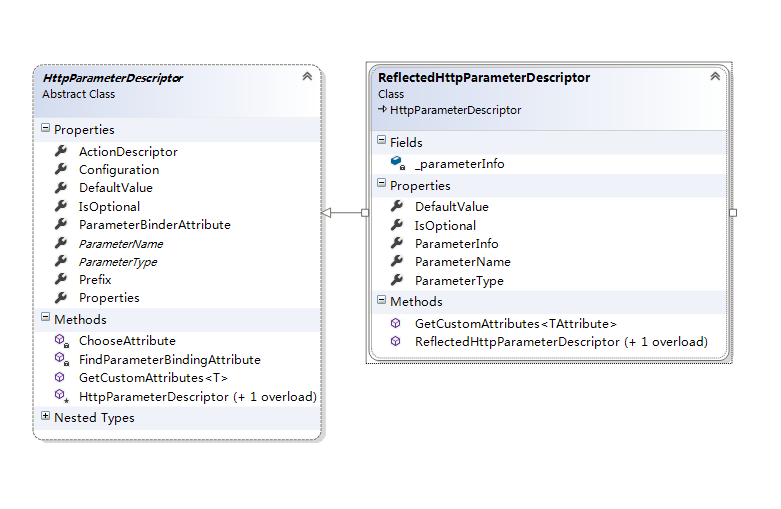
是个抽象类,第三个描述对象,前边介绍了HttpControllerDescriptor和HttpActionDescriptor,对Action方法的每个参数都通过HttpParameterDescriptor进行描述,主要成员如下:
属性:
public HttpActionDescriptor ActionDescriptor 所在Action方法的描述符
public HttpConfiguration Configuration { get; set; } 与HttpActionDescriptor 的HttpActionDescriptor同名属性有相同引用
public ConcurrentDictionary<object, object> Properties 字典属性,附加任何对象
public virtual object DefaultValue { get; } 默认值
public abstract string ParameterName { get; } 参数名称
public abstract Type ParameterType { get; } 参数类型
public virtual bool IsOptional { get; } 是否可选参数,默认不是
方法:
public virtual Collection<T> GetCustomAttributes<T>() where T : class 返回参数上定义的一个或多个特性
 public abstract class HttpParameterDescriptor

    {

        private readonly ConcurrentDictionary<object, object> _properties = new ConcurrentDictionary<object, object>();

        private ParameterBindingAttribute _parameterBindingAttribute;

        private bool _searchedModelBinderAttribute;

        private HttpConfiguration _configuration;

        private HttpActionDescriptor _actionDescriptor;

        protected HttpParameterDescriptor()

        {

        }

        protected HttpParameterDescriptor(HttpActionDescriptor actionDescriptor)

        {

            if (actionDescriptor == null)

            {

                throw Error.ArgumentNull("actionDescriptor");

            }

            _actionDescriptor = actionDescriptor;

            _configuration = _actionDescriptor.Configuration;

        }

        public HttpConfiguration Configuration

        {

            get { return _configuration; }

            set

            {

                if (value == null)

                {

                    throw Error.PropertyNull();

                }

                _configuration = value;

            }

        }

        public HttpActionDescriptor ActionDescriptor

        {

            get { return _actionDescriptor; }

            set

            {

                if (value == null)

                {

                    throw Error.PropertyNull();

                }

                _actionDescriptor = value;

            }

        }

        public ConcurrentDictionary<object, object> Properties

        {

            get { return _properties; }

        }

        public virtual object DefaultValue

        {

            get { return null; }

        }

        public abstract string ParameterName { get; }

        public abstract Type ParameterType { get; }

        public virtual string Prefix

        {

            get

            {

                ParameterBindingAttribute attribute = ParameterBinderAttribute;

                ModelBinderAttribute modelAttribute = attribute as ModelBinderAttribute;

                return modelAttribute != null

                           ? modelAttribute.Name

                           : null;

            }

        }

        public virtual bool IsOptional

        {

            get { return false; }

        }

        /// <summary>

        /// Return a <see cref="ParameterBindingAttribute"/> if present on this parameter's signature or declared type.

        /// Returns null if no attribute is specified.

        /// </summary>

        public virtual ParameterBindingAttribute ParameterBinderAttribute

        {

            get

            {

                if (_parameterBindingAttribute == null)

                {

                    if (!_searchedModelBinderAttribute)

                    {

                        _searchedModelBinderAttribute = true;

                        _parameterBindingAttribute = FindParameterBindingAttribute();

                    }

                }

                return _parameterBindingAttribute;

            }

            set { _parameterBindingAttribute = value; }

        }

        public virtual Collection<T> GetCustomAttributes<T>() where T : class

        {

            return new Collection<T>();

        }

        private ParameterBindingAttribute FindParameterBindingAttribute()

        {

            // Can be on parameter itself or on the parameter's type.  Nearest wins.

            return ChooseAttribute(GetCustomAttributes<ParameterBindingAttribute>())

                ?? ChooseAttribute(ParameterType.GetCustomAttributes<ParameterBindingAttribute>(false));

        }

        private static ParameterBindingAttribute ChooseAttribute(IList<ParameterBindingAttribute> list)

        {

            if (list.Count == )

            {

                return null;

            }

            if (list.Count > )

            {

                // Multiple attributes specified at the same level

                return new AmbiguousParameterBindingAttribute();

            }

            return list[];

        }

        private sealed class AmbiguousParameterBindingAttribute : ParameterBindingAttribute

        {

            public override HttpParameterBinding GetBinding(HttpParameterDescriptor parameter)

            {

                string message = Error.Format(SRResources.ParameterBindingConflictingAttributes, parameter.ParameterName);

                return parameter.BindAsError(message);

            }

        }

    }
6、ReflectedHttpParameterDescriptor
继承自抽象类HttpParameterDescriptor,通过反射提取描述参数的元数据,主要是通过反射获取的ParameterInfo对象提供,通过构造函数传入。ParameterInfo是关键,参数的基本数据(ParamterName, ParameterType,DefaultValue,IsOptional),以及定义在参数上的特性(GetCustomAttributes<T>)方法都是通过其提供。
另外,ReflectedHttpActionDescriptor的GetParameters返回的是ReflectedHttpParameterDescriptor列表,且ParameterInfo是通过反射出来的MethodInfo的GetParameters方法获取的。
    public class ReflectedHttpParameterDescriptor : HttpParameterDescriptor

    {

        private ParameterInfo _parameterInfo;

        public ReflectedHttpParameterDescriptor(HttpActionDescriptor actionDescriptor, ParameterInfo parameterInfo)

            : base(actionDescriptor)

        {

            if (parameterInfo == null)

            {

                throw Error.ArgumentNull("parameterInfo");

            }

            ParameterInfo = parameterInfo;

        }

        public ReflectedHttpParameterDescriptor()

        {

        }

        public override object DefaultValue

        {

            get

            {

                object value;

                if (ParameterInfo.TryGetDefaultValue(out value))

                {

                    return value;

                }

                else

                {

                    return base.DefaultValue;

                }

            }

        }

        public ParameterInfo ParameterInfo

        {

            get { return _parameterInfo; }

            set

            {

                if (value == null)

                {

                    throw Error.PropertyNull();

                }

                _parameterInfo = value;

            }

        }

        public override bool IsOptional

        {

            get { return ParameterInfo.IsOptional; }

        }

        public override string ParameterName

        {

            get { return ParameterInfo.Name; }

        }

        public override Type ParameterType

        {

            get { return ParameterInfo.ParameterType; }

        }

        public override Collection<TAttribute> GetCustomAttributes<TAttribute>()

        {

            return new Collection<TAttribute>((TAttribute[])ParameterInfo.GetCustomAttributes(typeof(TAttribute), inherit: false));

        }

    }
ASP.NET Web API 框架研究 Action方法介绍的更多相关文章
- ASP.NET Web API 框架研究 Action的选择
如何从HttpController众多方法里如何选择出有效的Action方法?主要分一下几个步骤: 首先,获取候选HttpActionDescriptor列表(ILookup(string,HttpA ...
- ASP.NET Web API 框架研究 ASP.NET Web API 路由
ASP.NET Web API 核心框架是一个独立的.抽象的消息处理管道,ASP.NET Web API有自己独立的路由系统,是消息处理管道的组成部分,其与ASP.NET路由系统有类似的设计,都能找到 ...
- ASP.NET Web API 框架研究 服务容器 ServicesContainer
ServicesContainer是一个服务的容器,可以理解为—个轻量级的IoC容器,其维护着一个服务接口类型与服务实例之间的映射关系,可以根据服务接口类型获取对应的服务实例.构成ASP.NET We ...
- ASP.NET Web API 框架研究 核心的消息处理管道
ASP.NET Web API 的核心框架是一个由一组HttpMessageHandler有序组成的双工消息处理管道:寄宿监听到请求接受后,把消息传入该管道经过所有HttpMessageHandler ...
- ASP.NET Web API 框架研究 Controller实例的销毁
我们知道项目中创建的Controller,如ProductController都继承自ApiController抽象类,其又实现了接口IDisposable,所以,框架中自动调用Dispose方法来释 ...
- ASP.NET Web API 框架研究 Self Host模式下的消息处理管道
Self Host模式下的ASP.NET Web API与WCF非常相似,都可以寄宿在任意类型的托管应用程序中,宿主可以是Windows Form .WPF.控制台应用以及Windows Servic ...
- ASP.NET Web API 框架研究 Web Host模式下的消息处理管道
寄宿的作用是开启一个进程为Web API提供一个运行环境以解决持续监听.请求监听和响应回复,即将接收到的请求转换成HttpRequestMessage对象传入管道,并将管道生成并经过处理后的HttpR ...
- ASP.NET Web API 框架研究 Web Host模式路由及将请求转出到消息处理管道
Web Host 模式下的路由本质上还是通过ASP.NET 路由系统来进行路由的,只是通过继承和组合的方式对ASP.NET路由系统的内部的类进行了一些封装,产生自己专用一套类结构,功能逻辑基本都是一样 ...
- ASP.NET Web API 框架研究 ASP.NET 路由
ASP.NET Web API 如果采用Web Host方式来寄宿,在请求进入Web API 消息处理管道之前,就会用ASP.NET 自身的路由系统根据注册的路由表,解析出当前请求的HttpContr ...
随机推荐
- iOS.mach_absolute_time
1. Technical Q&A QA1398 Mach Absolute Time Units https://developer.apple.com/library/mac/qa/qa13 ...
- python入门科普IDE工具和编译环境
应友人之邀,今天来讲述python的一些入门内容.本次讲解的并不是语法或者某个模块. python下载安装 大多数 Linux 发行版在默认安装的情况 ...
- 【UI测试】--安全性
- SQL查找指定行的记录
select top 1 * from (select top 4 * from T_GasStationPrice order by EnableTime) a order by EnableTim ...
- Windows 8风格应用-触控输入
参考:演练:创建您的第一个触控应用程序 http://msdn.microsoft.com/zh-cn/library/ee649090(v=vs.110).aspx win8支持多点触摸技术,而我们 ...
- oracle 中删除表 drop delete truncate
oracle 中删除表 drop delete truncate 相同点,使用drop delete truncate 都会删除表中的内容 drop table 表名 delete from 表名 ...
- 学会谈判zz
经常有人问我,为什么谈判到你手里就变得那么容易?你有什么诀窍?其实只要是谈判,涉及双方利益,就绝不会轻松.之所以能谈判成功,仔细想想秘诀无非是两个字:“双赢”.要想成功,就要双方都受益.如果你一开始就 ...
- ODT(old driver tree)详解(带例题)
文章目录 ODT简介 实现前提&&实现原理 初始化 split操作 assign操作 其它操作 区间第k小 区间加 区间所有数的k次方和 几道水题 ODT简介 ODT(old driv ...
- 2019.01.17 bzoj2333: [SCOI2011]棘手的操作(启发式合并)
传送门 启发式合并菜题. 题意:支持与连通块有关的几种操作. 要求支持连边,单点修改,连通块修改,全局修改和单点查值,连通块查最大值和全局最大值. 我们对每个连通块和答案用可删堆维护最大值,然后用启发 ...
- 补全爬取的url
有时爬取到的href不全,如href=‘/11031/’解决方法:from urllib import parseurl=parse.urljoin(response.url,get_url)resp ...