
hdu3713 Double Maze
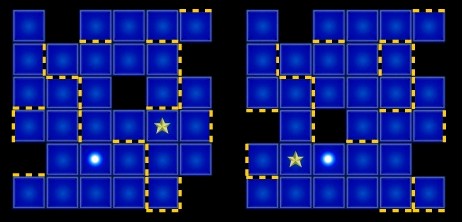
A maze is made up of 6*6 cells. A cell can be either a hole or a square. Moreover, a cell may be surrounded by barriers. There is ONLY one start cell (with a ball) and ONLY one end cell (with a star) in a single maze.These two cells are both squares. It is possible that the start cell and the end cell are the same one. The goal of a single maze is to move the ball from the start cell to the end cell. There are four commands in total,'L', 'D', 'R' and 'U' corresponding to moving the ball left, down, right and up one cell, respectively. The barriers may make the commands take no effect, i.e., the ball does NOT move if there is a barrier on the way.
When the ball gets to a hole or outside of the maze, it fails. A double maze is made up of two single mazes. The commands control two balls simultaneously, and the movements of two balls are according to the rules described above independently. Both balls will continue to move simultaneously if at least one of the balls has not got to the end cell.
So, a ball may move out of the end cell since the other ball has not been to the target. A double maze passes when both balls get to their end cells, or fails if either of the two mazes fails. The goal of double maze is to get the shortest sequence of commands to pass. If there are multiple solutions, get the lexical minimum one.
To simplify the input, a cell is encoded to an integer as follows. The lowest 4 bits signal the existence of the barriers around a cell. The fifth bit indicates whether a cell is a hole or not. The sixth and seventh bits are set for the start cell and end cell. Details are listed in the following table with bits counted from lowest bit. For a barrier, both of the two adjacent cells will have the corresponding barrier bit set. Note that the first two mazes in the sample input is the encoding of two mazes in the figure above, make sure you understand the encoding right.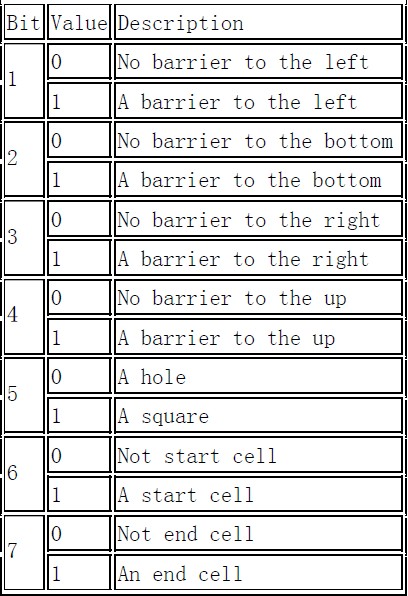
16 0 18 16 18 24
20 19 24 16 28 1
18 28 17 0 22 17
25 20 17 18 88 20
2 16 48 28 17 16
24 16 16 20 23 1
16 0 18 16 18 24
20 19 24 20 29 1
18 28 17 16 22 17
8 20 1 18 24 20
19 80 48 24 16 0
24 16 16 16 22 19
18 16 18 16 18 80
24 18 24 16 24 18
18 24 0 0 18 24
24 18 0 0 24 18
18 24 18 16 18 24
56 18 24 18 24 18
RURDRLLLURDULURRRRRDDU
题意:给出两个迷宫,每个迷宫各有起点和终点,有的格子能走有的不行,格子与格子之间还可能有护栏。同时控制两个迷宫每次朝同一个方向移动,问最快使得两个迷宫同时到达终点的步数,有多个最优解输出字典序最小的一个。
思路:把两个图合成一个图,建边,用bfs,总共也就6的4次方个点。以dlru的顺序查找,找到的保证字典序最小。用一个数组记录其前驱点,找到答案后倒着输出就好。
#include<cstdio>

#include<cstring>

#include<queue>

using namespace std;

#define two(x) (1<<x)

#define inf 200000000

int  T;

char c[4]={'D','L','R','U'};

int d[2][37][4],st[2],en[2],f[37][37];

bool can[2][37];

int fa1[37][37],fa2[37][37],dir[37][37],ans[2000];

void init(int cur)

{

	memset(d[cur],0,sizeof(d[cur]));

	memset(can[cur],1,sizeof(can[cur]));

	int x;

	for (int i=1;i<=6;++i)

		for (int j=1;j<=6;++j)

		{

			int t=(i-1)*6+j;

			scanf("%d",&x);

			if (x & two(1)) d[cur][t][0]=t;

			else if (i<6) d[cur][t][0]=t+6;

			if (x & two(0)) d[cur][t][1]=t;

			else if (j>1) d[cur][t][1]=t-1;

			if (x & two(2)) d[cur][t][2]=t;

			else if (j<6) d[cur][t][2]=t+1;

			if (x & two(3)) d[cur][t][3]=t;

			else if (i>1) d[cur][t][3]=t-6;

			if ((x & two(4))==0) can[cur][t]=false;

			if (x & two(5)) st[cur]=t;

			if (x & two(6)) en[cur]=t;

		}

}

void bfs()

{

	queue<int> q1,q2;

	bool p[37][37];

	memset(p,1,sizeof(p));

	q1.push(st[0]);

	q2.push(st[1]);

	p[st[0]][st[1]]=false;

	while (!q1.empty())

	{

		int x=q1.front(),y=q2.front();

		q1.pop();q2.pop();

		for (int i=0;i<=3;++i)

		{

			int tx=d[0][x][i],ty=d[1][y][i];

			if (tx && ty && can[0][tx] && can[1][ty])

				if (p[tx][ty])

				{

					q1.push(tx);

					q2.push(ty);

					p[tx][ty]=false;

					fa1[tx][ty]=x;

					fa2[tx][ty]=y;

					dir[tx][ty]=i;

				}

		}

	}

}

void solve()

{

	memset(dir,-1,sizeof(dir));

	dir[st[0]][st[1]]=5;

	bfs();

	int x=en[0],y=en[1];

	if (dir[x][y]==-1)

	{

		printf("-1\n");

		return;

	}

	int tot=0,tx,ty;

	while (!(x==st[0] && y==st[1]))

	{

		ans[++tot]=dir[x][y];

		tx=fa1[x][y];

		ty=fa2[x][y];

		x=tx;y=ty;

	}

	for (int i=tot;i>0;--i)

		printf("%c",c[ans[i]]);

	printf("\n");

}

int main()

{

	scanf("%d",&T);

	init(1);

	for (int i=2;i<=T;++i)

	{

		init(1 & i);

		solve();

	}

	return 0;

}
hdu3713 Double Maze的更多相关文章
- hdu - 2216 Game III && xtu 1187 Double Maze (两个点的普通bfs)
http://acm.hdu.edu.cn/showproblem.php?pid=2216 zjt和sara在同一个地图里,zjt要去寻找sara,zjt每移动一步sara就要往相反方向移动,如果他 ...
- UVA 10531 Maze Statistics 迷宫统计 迷宫插头DP 四联通 概率
题意: 有一个N*M的图,每个格子有独立概率p变成障碍物.你要从迷宫左上角走到迷宫右下角.求每个格子成为一个有解迷宫中的障碍物的概率.N <= 5,M <= 6 分析: 这真是一道好题,网 ...
- HDU 3853:LOOPS(概率DP)
http://acm.split.hdu.edu.cn/showproblem.php?pid=3853 LOOPS Problem Description Akemi Homura is a M ...
- HDU 4035:Maze(概率DP)
http://acm.split.hdu.edu.cn/showproblem.php?pid=4035 Maze Special Judge Problem Description When w ...
- HDU-4035 Maze
http://acm.hdu.edu.cn/showproblem.php?pid=4035 树上的概率dp. Maze Time Limit: 2000/1000 MS (Java/Others ...
- hdu 4035 Maze(期待更多经典的树DP)
Maze Time Limit: 2000/1000 MS (Java/Others) Memory Limit: 65768/65768 K (Java/Others) Total Submi ...
- Maze HDU - 4035(期望dp)
When wake up, lxhgww find himself in a huge maze. The maze consisted by N rooms and tunnels connecti ...
- hdu4035 Maze
题目链接 hdu4035 Maze 题解 f[u]表示在节点u通关的所需的边数期望 转移方程分叶子节点和非叶子点讨论 发现都可以化成f[x]=af[1]+bf[dad]+c的形式 然后推一下系数 还是 ...
- Meandering Through the Maze of MFC Message and Command Routing MFC消息路由机制分析
Meandering Through the Maze of MFC Message and Command Routing Paul DiLascia Paul DiLascia is a free ...
随机推荐
- win10下python2与python3以及pip共存
一 分别安装python2和python3 注意: 安装时记得勾选 Add Python.exe to Path 二 安装pip Python3最新版本有pip,无需安装 Python2: 下载pip ...
- HTML中重要的知识点,表单
今天跟大家分享一下有关HTML中比较重要的一个知识点-表单: <form></form>表单 这是一个双标签,form表单有两个必须要有的属性,①action就是指表单传递到的 ...
- js校验身份证
1 <%@page contentType="text/html;charset=UTF-8" pageEncoding="UTF-8" %> &l ...
- (转)MySql数据库索引原理(总结性)
本文引用文章如链接: http://www.codinglabs.org/html/theory-of-mysql-index.html#more-100 参考书籍:Mysql技术内幕 本文主要是阐述 ...
- PHP将数据导出Excel表中(投机型)
1.简介 如何利用最简单粗糙暴力的方法将数据写入Excel文件中呢? 因为ms word和excel的文档都支持html文本格式,因此我们可以基于这个原理采用html文本格式进行数据的输出. 在htm ...
- 一个最最简易的RPC框架雏形---转载自梁飞的博客
查阅RPC与HTTP区别的时候, 无意间发现一篇博客,内容是一个简易的RPC服务框架, 仔细一看, 不得了,博主竟然就是阿里dubbo的作者. 原文链接在此: http://javatar.iteye ...
- ECMAscript6新特性之解构赋值
在以前,我们要对变量赋值,只能直接指定值.比如:var a = 1;var b = 2;但是发现这种写法写起来有点麻烦,一点都不简洁,而在ECMAScript6中引入了一种新的概念,那就是" ...
- 在同一个sql语句中,统计不同条件的Count数量
前几天帮同事优化了个SQL,原写法使用多个子查询这里不再重现了,大家都遇到过这样一种情况,在项目后期的维护中, 修改别人的SQL代码,超过30行的语句,多层子查询,读起来很坑,时间久的项目伴随着人员的 ...
- 7. leetcode 104. Maximum Depth of Binary Tree
Given a binary tree, find its maximum depth. The maximum depth is the number of nodes along the long ...
- 游走[HNOI2013]
[题目描述] 一个无向连通图,顶点从1编号到N,边从1编号到M. 小Z在该图上进行随机游走,初始时小Z在1号顶点,每一步小Z以相等的概率随机选 择当前顶点的某条边,沿着这条边走到下一个顶点,获得等于这 ...