
【tensorflow2.0】处理文本数据
一,准备数据
imdb数据集的目标是根据电影评论的文本内容预测评论的情感标签。
训练集有20000条电影评论文本,测试集有5000条电影评论文本,其中正面评论和负面评论都各占一半。
文本数据预处理较为繁琐,包括中文切词(本示例不涉及),构建词典,编码转换,序列填充,构建数据管道等等。
在tensorflow中完成文本数据预处理的常用方案有两种,第一种是利用tf.keras.preprocessing中的Tokenizer词典构建工具和tf.keras.utils.Sequence构建文本数据生成器管道。
第二种是使用tf.data.Dataset搭配.keras.layers.experimental.preprocessing.TextVectorization预处理层。
第一种方法较为复杂,其使用范例可以参考以下文章。
https://zhuanlan.zhihu.com/p/67697840
第二种方法为TensorFlow原生方式,相对也更加简单一些。
我们此处介绍第二种方法。
首先看一下train.csv中的部分内容是什么:
"0    It really boggles my mind when someone comes across a movie like this and claims it to be one of the worst slasher films out there. This is by far not one of the worst out there"     still not a good movie     but not the worst nonetheless. Go see something like Death Nurse or Blood Lake and then come back to me and tell me if you think the Night Brings Charlie is the worst. The film has decent camera work and editing     which is way more than I can say for many more extremely obscure slasher films.<br /><br />The film doesn't deliver on the on-screen deaths     there's one death where you see his pruning saw rip into a neck     but all other deaths are hardly interesting. But the lack of on-screen graphic violence doesn't mean this isn't a slasher film     just a bad one.<br /><br />The film was obviously intended not to be taken too seriously. The film came in at the end of the second slasher cycle     so it certainly was a reflection on traditional slasher elements     done in a tongue in cheek way. For example     after a kill     Charlie goes to the town's 'welcome' sign and marks the population down one less. This is something that can only get a laugh.<br /><br />If you're into slasher films     definitely give this film a watch. It is slightly different than your usual slasher film with possibility of two killers     but not by much. The comedy of the movie is pretty much telling the audience to relax and not take the movie so god darn serious. You may forget the movie     you may remember it. I'll remember it because I love the name.

"0    Mary Pickford becomes the chieftain of a Scottish clan after the death of her father"     and then has a romance. As fellow commenter Snow Leopard said     the film is rather episodic to begin. Some of it is amusing     such as Pickford whipping her clansmen to church     while some of it is just there. All in all     the story is weak     especially the recycled     contrived romance plot-line and its climax. The transfer is so dark it's difficult to appreciate the scenery     but even accounting for that     this doesn't appear to be director Maurice Tourneur's best work. Pickford and Tourneur collaborated once more in the somewhat more accessible 'The Poor Little Rich Girl    ' typecasting Pickford as a child character.

"0    Well"     at least my theater group did     lol. So of course I remember watching Grease since I was a little girl     while it was never my favorite musical or story     it does still hold a little special place in my heart since it's still a lot of fun to watch. I heard horrible things about Grease 2 and that's why I decided to never watch it     but my boyfriend said that it really wasn't all that bad and my friend agreed     so I decided to give it a shot     but I called them up and just laughed. First off the plot is totally stolen from the first one and it wasn't really clever     not to mention they just used the same characters     but with different names and actors. Tell me     how did the Pink Ladies and T-Birds continue years on after the former gangs left? Not to mention the creator face motor cycle enemy     gee     what a striking resemblance to the guys in the first film as well as these T-Birds were just stupid and ridiculous.<br /><br />Another year at Rydell and the music and dancing hasn't stopped. But when a new student who is Sandy's cousin comes into the scene     he is love struck by a pink lady     Stephanie. But she must stick to the code where only Pink Ladies must stick with the T-Birds     so the new student     decides to train as a T-Bird to win her heart. So he dresses up as a rebel motor cycle bandit who can ride well and defeat the evil bikers from easily kicking the T-Bird's butts. But will he tell Stephanie who he really is or will she find out on her own? Well     find out for yourself.<br /><br />Grease 2 is like a silly TV show of some sort that didn't work. The gang didn't click as well as the first Grease did     not to mention Frenchy coming back was a bit silly and unbelievable     because I thought that she graduated from Rydell     but apparently she didn't. The songs were not really that catchy; I'm glad that Michelle was able to bounce back so fast     but that's probably because she was the only one with talent in this silly little sequel     I wouldn't really recommend this film     other than if you are curious     but I warned you     this is just a pathetic attempt at more money from the famous musical.<br /><br />2/10

"1    I must give How She Move a near-perfect rating because the content is truly great. As a previous reviewer commented"     I have no idea how this film has found itself in IMDBs bottom 100 list! That's absolutely ridiculous! Other films--particular those that share the dance theme--can't hold a candle to this one in terms of its combination of top-notch     believable acting     and amazing dance routines.<br /><br />From start to finish the underlying story (this is not just about winning a competition) is very easy to delve into     and surprisingly realistic. None of the main characters in this are 2-dimensional by any means and     by the end of the film     it's very easy to feel emotionally invested in them. (And     even if you're not the crying type     you might get a little weepy-eyed before the credits roll.) <br /><br />I definitely recommend this film to dance-lovers and     even more so     to those who can appreciate a poignant and well-acted storyline. How She Move isn't perfect of course (what film is?)     but it's definitely a cut above movies that use pretty faces to hide a half-baked plot and/or characters who lack substance. The actors and settings in this film make for a very realistic ride that is equally enthralling thanks to the amazing talent of the dancers!

"0    I must say"     when I read the storyline on the back of the case     It sounded really interesting     but when I started to watch the movie seemed boring at first and even more at the end. Some scenes are way too long and the story has not been worked out properly.

"0    i am 13 and i hated this film its the worst film on earth i totally wasted my time watching it and was disappointed with it cause on the cover and on the back the film it looks pretty good"     but i was wrong its bad. but when i saw delta she was totally different and a bad actress and i really didn't know how old the 2 girls was trying to be i was so confused. the film was in some parts confusing and i didn't enjoy it at all but i watched all the film just to see if it was going to get better but it didn't     it was boring    dull and did i say BORING.and i don't think many other people liked it as well as me.boring boring boring

"0    The acting may be okay"     the more u watch this movie     the more u wish you weren't     this movie is so horrible     that if I could get a hold of every copy     I would burn them all and not look back     this movie is terrible!!

"0    I've seen some bad things in my time. A half dead cow trying to get out of waist high mud; a head on collision between two cars; a thousand plates smashing on a kitchen floor; human beings living like animals.<br /><br />But never in my life have I seen anything as bad as The Cat in the Hat.<br /><br />This film is worse than 911"     worse than Hitler     worse than Vllad the Impaler     worse than people who put kittens in microwaves.<br /><br />It is the most disturbing film of all time     easy.<br /><br />I used to think it was a joke     some elaborate joke and that Mike Myers was maybe a high cocaine sniffing drug addled betting junkie who lost a bet or something.<br /><br />I shudder
每一个单元格里面都是一句话。
然后是构造训练集和测试集:
import numpy as np

import pandas as pd

from matplotlib import pyplot as plt

import tensorflow as tf

from tensorflow.keras import models,layers,preprocessing,optimizers,losses,metrics

from tensorflow.keras.layers.experimental.preprocessing import TextVectorization

import re,string

train_data_path = "./data/imdb/train.csv"

test_data_path =  "./data/imdb/test.csv"

MAX_WORDS = 10000  # 仅考虑最高频的10000个词

MAX_LEN = 200  # 每个样本保留200个词的长度

BATCH_SIZE = 20

# 构建管道

def split_line(line):

    arr = tf.strings.split(line,"\t")

    label = tf.expand_dims(tf.cast(tf.strings.to_number(arr[0]),tf.int32),axis = 0)

    text = tf.expand_dims(arr[1],axis = 0)

    return (text,label)

ds_train_raw =  tf.data.TextLineDataset(filenames = [train_data_path]) \

   .map(split_line,num_parallel_calls = tf.data.experimental.AUTOTUNE) \

   .shuffle(buffer_size = 1000).batch(BATCH_SIZE) \

   .prefetch(tf.data.experimental.AUTOTUNE)

ds_test_raw = tf.data.TextLineDataset(filenames = [test_data_path]) \

   .map(split_line,num_parallel_calls = tf.data.experimental.AUTOTUNE) \

   .batch(BATCH_SIZE) \

   .prefetch(tf.data.experimental.AUTOTUNE)

# 构建词典

def clean_text(text):

    lowercase = tf.strings.lower(text)

    stripped_html = tf.strings.regex_replace(lowercase, '<br />', ' ')

    cleaned_punctuation = tf.strings.regex_replace(stripped_html,

         '[%s]' % re.escape(string.punctuation),'')

    return cleaned_punctuation

vectorize_layer = TextVectorization(

    standardize=clean_text,

    split = 'whitespace',

    max_tokens=MAX_WORDS-1, #有一个留给占位符

    output_mode='int',

    output_sequence_length=MAX_LEN)

ds_text = ds_train_raw.map(lambda text,label: text)

vectorize_layer.adapt(ds_text)

print(vectorize_layer.get_vocabulary()[0:100])

# 单词编码

ds_train = ds_train_raw.map(lambda text,label:(vectorize_layer(text),label)) \

    .prefetch(tf.data.experimental.AUTOTUNE)

ds_test = ds_test_raw.map(lambda text,label:(vectorize_layer(text),label)) \

    .prefetch(tf.data.experimental.AUTOTUNE)
[b'the', b'and', b'a', b'of', b'to', b'is', b'in', b'it', b'i', b'this', b'that', b'was', b'as', b'for', b'with', b'movie', b'but', b'film', b'on', b'not', b'you', b'his', b'are', b'have', b'be', b'he', b'one', b'its', b'at', b'all', b'by', b'an', b'they', b'from', b'who', b'so', b'like', b'her', b'just', b'or', b'about', b'has', b'if', b'out', b'some', b'there', b'what', b'good', b'more', b'when', b'very', b'she', b'even', b'my', b'no', b'would', b'up', b'time', b'only', b'which', b'story', b'really', b'their', b'were', b'had', b'see', b'can', b'me', b'than', b'we', b'much', b'well', b'get', b'been', b'will', b'into', b'people', b'also', b'other', b'do', b'bad', b'because', b'great', b'first', b'how', b'him', b'most', b'dont', b'made', b'then', b'them', b'films', b'movies', b'way', b'make', b'could', b'too', b'any', b'after', b'characters']
二,定义模型
使用Keras接口有以下3种方式构建模型:使用Sequential按层顺序构建模型,使用函数式API构建任意结构模型,继承Model基类构建自定义模型。
此处选择使用继承Model基类构建自定义模型。
# 演示自定义模型范例,实际上应该优先使用Sequential或者函数式API

tf.keras.backend.clear_session()

class CnnModel(models.Model):

    def __init__(self):

        super(CnnModel, self).__init__()

    def build(self,input_shape):

        self.embedding = layers.Embedding(MAX_WORDS,7,input_length=MAX_LEN)

        self.conv_1 = layers.Conv1D(16, kernel_size= 5,name = "conv_1",activation = "relu")

        self.pool = layers.MaxPool1D()

        self.conv_2 = layers.Conv1D(128, kernel_size=2,name = "conv_2",activation = "relu")

        self.flatten = layers.Flatten()

        self.dense = layers.Dense(1,activation = "sigmoid")

        super(CnnModel,self).build(input_shape)

    def call(self, x):

        x = self.embedding(x)

        x = self.conv_1(x)

        x = self.pool(x)

        x = self.conv_2(x)

        x = self.pool(x)

        x = self.flatten(x)

        x = self.dense(x)

        return(x)

model = CnnModel()

model.build(input_shape =(None,MAX_LEN))

model.summary()
模型结构:
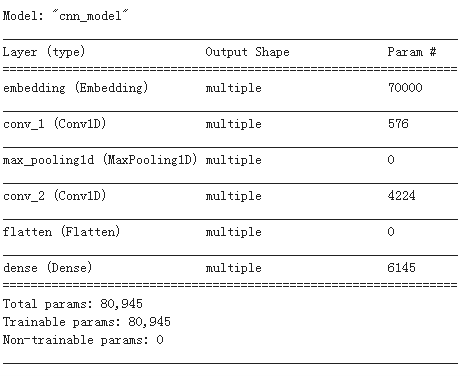
三,训练模型
训练模型通常有3种方法,内置fit方法,内置train_on_batch方法,以及自定义训练循环。此处我们通过自定义训练循环训练模型。
# 打印时间分割线

@tf.function

def printbar():

    ts = tf.timestamp()

    today_ts = ts%(24*60*60)

    hour = tf.cast(today_ts//3600+8,tf.int32)%tf.constant(24)

    minite = tf.cast((today_ts%3600)//60,tf.int32)

    second = tf.cast(tf.floor(today_ts%60),tf.int32)

    def timeformat(m):

        if tf.strings.length(tf.strings.format("{}",m))==1:

            return(tf.strings.format("0{}",m))

        else:

            return(tf.strings.format("{}",m))

    timestring = tf.strings.join([timeformat(hour),timeformat(minite),

                timeformat(second)],separator = ":")

    tf.print("=========="*8,end = "")

    tf.print(timestring)

optimizer = optimizers.Nadam()

loss_func = losses.BinaryCrossentropy()

train_loss = metrics.Mean(name='train_loss')

train_metric = metrics.BinaryAccuracy(name='train_accuracy')

valid_loss = metrics.Mean(name='valid_loss')

valid_metric = metrics.BinaryAccuracy(name='valid_accuracy')

@tf.function

def train_step(model, features, labels):

    with tf.GradientTape() as tape:

        predictions = model(features,training = True)

        loss = loss_func(labels, predictions)

    gradients = tape.gradient(loss, model.trainable_variables)

    optimizer.apply_gradients(zip(gradients, model.trainable_variables))

    train_loss.update_state(loss)

    train_metric.update_state(labels, predictions)

@tf.function

def valid_step(model, features, labels):

    predictions = model(features,training = False)

    batch_loss = loss_func(labels, predictions)

    valid_loss.update_state(batch_loss)

    valid_metric.update_state(labels, predictions)

def train_model(model,ds_train,ds_valid,epochs):

    for epoch in tf.range(1,epochs+1):

        for features, labels in ds_train:

            train_step(model,features,labels)

        for features, labels in ds_valid:

            valid_step(model,features,labels)

        #此处logs模板需要根据metric具体情况修改

        logs = 'Epoch={},Loss:{},Accuracy:{},Valid Loss:{},Valid Accuracy:{}'

        if epoch%1==0:

            printbar()

            tf.print(tf.strings.format(logs,

            (epoch,train_loss.result(),train_metric.result(),valid_loss.result(),valid_metric.result())))

            tf.print("")

        train_loss.reset_states()

        valid_loss.reset_states()

        train_metric.reset_states()

        valid_metric.reset_states()

train_model(model,ds_train,ds_test,epochs = 6)
训练结果:
================================================================================14:45:06

Epoch=1,Loss:0.474225521,Accuracy:0.7376,Valid Loss:0.336961836,Valid Accuracy:0.8526

================================================================================14:45:12

Epoch=2,Loss:0.245222151,Accuracy:0.9035,Valid Loss:0.326947063,Valid Accuracy:0.8666

================================================================================14:45:17

Epoch=3,Loss:0.165854618,Accuracy:0.93795,Valid Loss:0.365531504,Valid Accuracy:0.867

================================================================================14:45:23

Epoch=4,Loss:0.104812928,Accuracy:0.96395,Valid Loss:0.448238105,Valid Accuracy:0.861

================================================================================14:45:29

Epoch=5,Loss:0.0595887862,Accuracy:0.98125,Valid Loss:0.602612,Valid Accuracy:0.8624

================================================================================14:45:35

Epoch=6,Loss:0.0318539739,Accuracy:0.9905,Valid Loss:0.762770712,Valid Accuracy:0.8598
四,评估模型
通过自定义训练循环训练的模型没有经过编译,无法直接使用model.evaluate(ds_valid)方法
def evaluate_model(model,ds_valid):

    for features, labels in ds_valid:

         valid_step(model,features,labels)

    logs = 'Valid Loss:{},Valid Accuracy:{}'

    tf.print(tf.strings.format(logs,(valid_loss.result(),valid_metric.result())))

    valid_loss.reset_states()

    train_metric.reset_states()

    valid_metric.reset_states()

evaluate_model(model,ds_test)
评估结果:
Valid Loss:0.762770712,Valid Accuracy:0.8598
五,使用模型
可以使用以下方法:
- model.predict(ds_test)
- model(x_test)
- model.call(x_test)
- model.predict_on_batch(x_test)
推荐优先使用model.predict(ds_test)方法,既可以对Dataset,也可以对Tensor使用。
model.predict(ds_test)for x_test,_ in ds_test.take(1):

    print(model(x_test))

    #以下方法等价:

    #print(model.call(x_test))

    #print(model.predict_on_batch(x_test))
评估结果:
tf.Tensor(

[[9.9007505e-01]

 [9.9999797e-01]

 [9.9836570e-01]

 [2.6509229e-06]

 [4.7592866e-01]

 [3.7760619e-05]

 [8.0391978e-08]

 [1.6816575e-05]

 [9.9996006e-01]

 [9.9695146e-01]

 [1.0000000e+00]

 [9.9962234e-01]

 [1.9009445e-08]

 [9.7622436e-01]

 [4.4549329e-06]

 [2.8802201e-01]

 [1.0730105e-04]

 [3.8324962e-03]

 [2.2874507e-03]

 [9.9966860e-01]], shape=(20, 1), dtype=float32)
六,保存模型
推荐使用TensorFlow原生方式保存模型。
model.save('./data/tf_model_savedmodel', save_format="tf")

print('export saved model.')

model_loaded = tf.keras.models.load_model('./data/tf_model_savedmodel')

model_loaded.predict(ds_test)
结果:
WARNING:tensorflow:From /usr/local/lib/python3.6/dist-packages/tensorflow/python/ops/resource_variable_ops.py:1817: calling BaseResourceVariable.__init__ (from tensorflow.python.ops.resource_variable_ops) with constraint is deprecated and will be removed in a future version.

Instructions for updating:

If using Keras pass *_constraint arguments to layers.

INFO:tensorflow:Assets written to: ./data/tf_model_savedmodel/assets

export saved model.

WARNING:tensorflow:No training configuration found in save file, so the model was *not* compiled. Compile it manually.

array([[0.99007505],

       [0.999998  ],

       [0.9983657 ],

       ...,

       [0.9962114 ],

       [0.94716024],

       [1.        ]], dtype=float32)
参考:
开源电子书地址:https://lyhue1991.github.io/eat_tensorflow2_in_30_days/
GitHub 项目地址:https://github.com/lyhue1991/eat_tensorflow2_in_30_days
【tensorflow2.0】处理文本数据的更多相关文章
- 【tensorflow2.0】处理图片数据-cifar2分类
1.准备数据 cifar2数据集为cifar10数据集的子集,只包括前两种类别airplane和automobile. 训练集有airplane和automobile图片各5000张,测试集有airp ...
- 【tensorflow2.0】处理时间序列数据
国内的新冠肺炎疫情从发现至今已经持续3个多月了,这场起源于吃野味的灾难给大家的生活造成了诸多方面的影响. 有的同学是收入上的,有的同学是感情上的,有的同学是心理上的,还有的同学是体重上的. 那么国内的 ...
- Google工程师亲授 Tensorflow2.0-入门到进阶
第1章 Tensorfow简介与环境搭建 本门课程的入门章节,简要介绍了tensorflow是什么,详细介绍了Tensorflow历史版本变迁以及tensorflow的架构和强大特性.并在Tensor ...
- JAVASE02-Unit08: 文本数据IO操作 、 异常处理
Unit08: 文本数据IO操作 . 异常处理 * java.io.ObjectOutputStream * 对象输出流,作用是进行对象序列化 package day08; import java.i ...
- JAVASE02-Unit07: 基本IO操作 、 文本数据IO操作
基本IO操作 . 文本数据IO操作 java标准IO(input/output)操作 package day07; import java.io.FileOutputStream; import ja ...
- 10、NFC技术:读写NFC标签中的文本数据
代码实现过程如下: 读写NFC标签的纯文本数据.java import java.nio.charset.Charset; import java.util.Locale; import androi ...
- NFC(12)使用Android Beam技术传输文本数据及它是什么
Android Beam技术是什么 Android Beam的基本理念就是两部(只能是1对1,不可像蓝牙那样1对多)NFC设备靠近时(一般是背靠背),通过触摸一部NFC设备的屏幕,将数据推向另外一部N ...
- C#实现大数据量TXT文本数据快速高效去重
原文 C#实现大数据量TXT文本数据快速高效去重 对几千万的TXT文本数据进行去重处理,查找其中重复的数据,并移除.尝试了各种方法,下属方法是目前尝试到最快的方法.以下代码将重复和不重复数据进行分文件 ...
- 如何使用 scikit-learn 为机器学习准备文本数据
欢迎大家前往云+社区,获取更多腾讯海量技术实践干货哦~ 文本数据需要特殊处理,然后才能开始将其用于预测建模. 我们需要解析文本,以删除被称为标记化的单词.然后,这些词还需要被编码为整型或浮点型,以用作 ...
随机推荐
- JavaScript入门进阶(二)
JavaScript进阶入门(二) 转换为数字 使用parseInt() parseInt函数会先查看位置0处的字符,如果该位置不是有效数字,则将返回NaN,如果0处的字符是数字,则将查看位置1处的字 ...
- 这样学习Servlet,会事半功倍!!
前言 工作已经有一段时间了,如果让我重新学Servlet,我会怎么学呢?下面抛出两个常见的问题,我分开来解答 2020年了,还需要学Servlet吗? Servlet的学习路线(学习重点) 一.202 ...
- Java探针技术-retransformclasses的介绍
retransformclasses void retransformclasses(class... classes) throws unmodifiableclassexception 重转换提供 ...
- Redis(8)——发布/订阅与Stream
一.Redis 中的发布/订阅功能 发布/ 订阅系统 是 Web 系统中比较常用的一个功能.简单点说就是 发布者发布消息,订阅者接受消息,这有点类似于我们的报纸/ 杂志社之类的: (借用前边的一张图) ...
- 《前端之路》- TypeScript(二) 函数篇
目录 一.定义函数方法 二.定义函数传参 三.可选传参 四.默认传参 五.传递剩余参数 六.函数重载 七.箭头函数 八.总结 一.定义函数方法 在 es5 中定时函数的方法有 命名函数和函数表达式(匿 ...
- Spring解决循环依赖,你真的懂了吗?
导读 前几天发表的文章SpringBoot多数据源动态切换和SpringBoot整合多数据源的巨坑中,提到了一个坑就是动态数据源添加@Primary接口就会造成循环依赖异常,如下图: 这个就是典型的构 ...
- JS中iframe子页面与父页面之间通信
iframe子页面与父页面通信根据iframe中src属性是同域链接还是跨域链接,通信方式也不同. 一.同域下父子页面的通信 父页面parent.html <html> <head& ...
- win7系统下的Nodejs开发环境配置
此处不推荐使用msi安装包直接安装nodejs,我们应该知道它里面做了哪些事情,这样以后出问题的时候,可以更快速地定位问题点.另一方面,直接安装的情况,以后更新了版本的话会很麻烦,因为如果我们想体验新 ...
- python浅学【网络服务中间件】之Redis
一.关于NoSQL: NoSQL(NoSQL = Not Only SQL ),"不仅仅是SQL". 相比MySQL等关系型数据库,NoSQL为非关系型的数据存储 Nosql中比较 ...
- Java日期处理易踩的十个坑
前言 整理了Java日期处理的十个坑,希望对大家有帮助. 一.用Calendar设置时间的坑 反例: Calendar c = Calendar.getInstance(); c.set(Calend ...