
The The Garbage-First (G1) collector since Oracle JDK 7 update 4 and later releases
- Refer to http://www.oracle.com/technetwork/tutorials/tutorials-1876574.html for detail.
- 一些内容复制到这儿
The G1 Garbage Collector
The Garbage-First (G1) collector is a server-style garbage collector, targeted for multi-processor machines with large memories. It meets garbage collection (GC) pause time goals with a high probability, while achieving high throughput. The G1 garbage collector is fully supported in Oracle JDK 7 update 4 and later releases. The G1 collector is designed for applications that:
- Can operate concurrently with applications threads like the CMS collector.
- Compact free space without lengthy GC induced pause times.
- Need more predictable GC pause durations.
- Do not want to sacrifice a lot of throughput performance.
- Do not require a much larger Java heap.
G1 is planned as the long term replacement for the Concurrent Mark-Sweep Collector (CMS). Comparing G1 with CMS, there are differences that make G1 a better solution. One difference is that G1 is a compacting collector. G1 compacts sufficiently to completely avoid the use of fine-grained free lists for allocation, and instead relies on regions. This considerably simplifies parts of the collector, and mostly eliminates potential fragmentation issues. Also, G1 offers more predictable garbage collection pauses than the CMS collector, and allows users to specify desired pause targets.
G1 Operational Overview
The older garbage collectors (serial, parallel, CMS) all structure the heap into three sections: young generation, old generation, and permanent generation of a fixed memory size.
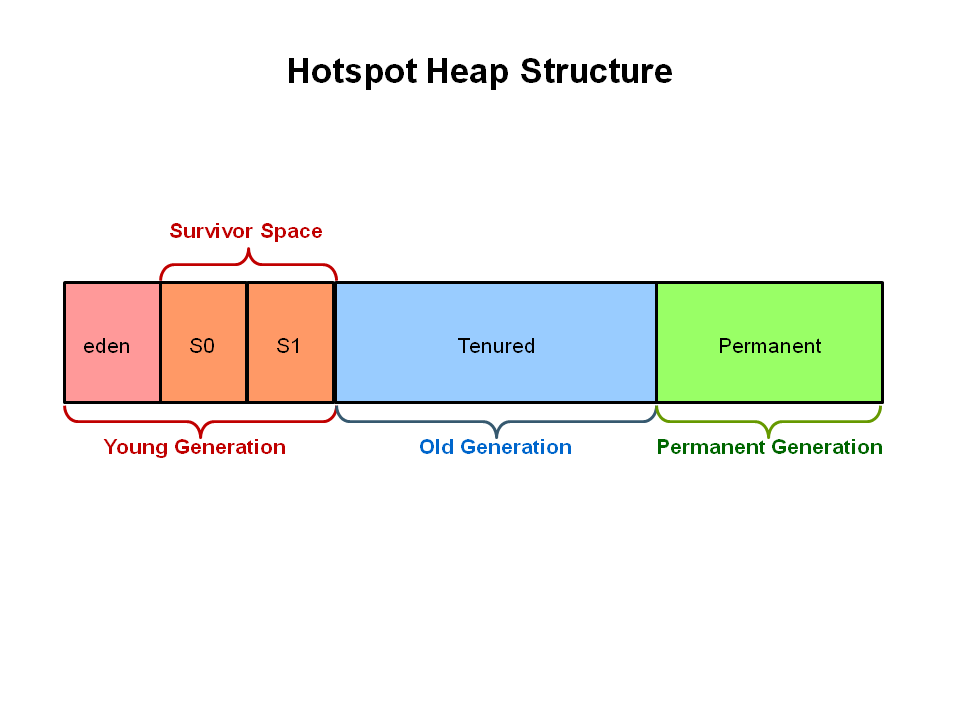
All memory objects end up in one of these three sections.
The G1 collector takes a different approach.
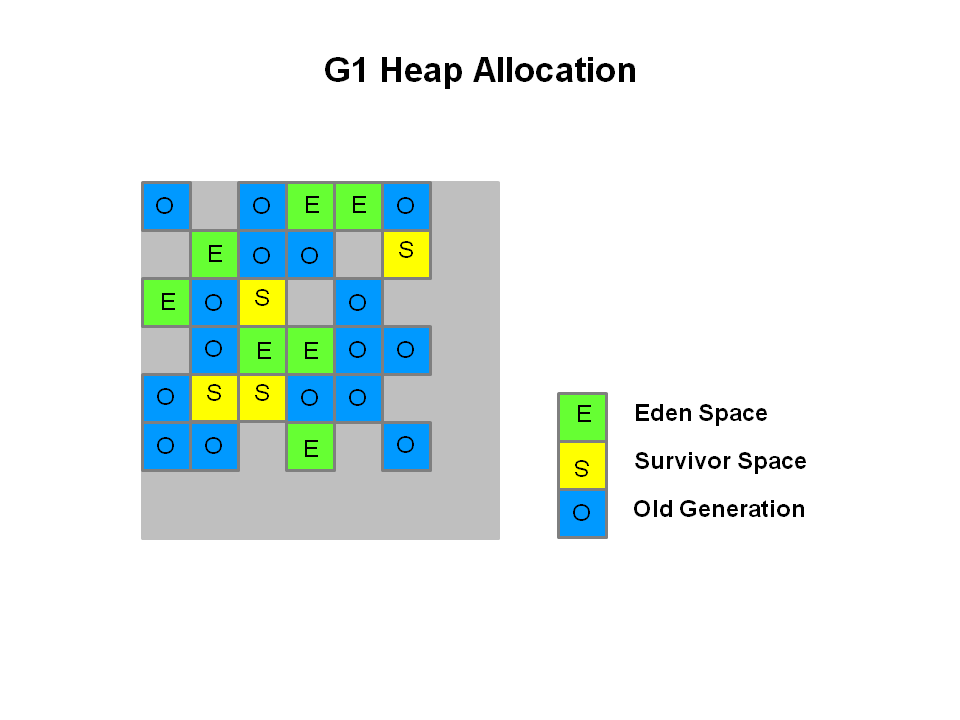
The heap is partitioned into a set of equal-sized heap regions, each a contiguous range of virtual memory. Certain region sets are assigned the same roles (eden, survivor, old) as in the older collectors, but there is not a fixed size for them. This provides greater flexibility in memory usage.
When performing garbage collections, G1 operates in a manner similar to the CMS collector. G1 performs a concurrent global marking phase to determine the liveness of objects throughout the heap. After the mark phase completes, G1 knows which regions are mostly empty. It collects in these regions first, which usually yields a large amount of free space. This is why this method of garbage collection is called Garbage-First. As the name suggests, G1 concentrates its collection and compaction activity on the areas of the heap that are likely to be full of reclaimable objects, that is, garbage. G1 uses a pause prediction model to meet a user-defined pause time target and selects the number of regions to collect based on the specified pause time target.
The regions identified by G1 as ripe for reclamation are garbage collected using evacuation. G1 copies objects from one or more regions of the heap to a single region on the heap, and in the process both compacts and frees up memory. This evacuation is performed in parallel on multi-processors, to decrease pause times and increase throughput. Thus, with each garbage collection, G1 continuously works to reduce fragmentation, working within the user defined pause times. This is beyond the capability of both the previous methods. CMS (Concurrent Mark Sweep ) garbage collector does not do compaction. ParallelOld garbage collection performs only whole-heap compaction, which results in considerable pause times.
It is important to note that G1 is not a real-time collector. It meets the set pause time target with high probability but not absolute certainty. Based on data from previous collections, G1 does an estimate of how many regions can be collected within the user specified target time. Thus, the collector has a reasonably accurate model of the cost of collecting the regions, and it uses this model to determine which and how many regions to collect while staying within the pause time target.
Note: G1 has both concurrent (runs along with application threads, e.g., refinement, marking, cleanup) and parallel (multi-threaded, e.g., stop the world) phases. Full garbage collections are still single threaded, but if tuned properly your applications should avoid full GCs.
G1 Footprint
If you migrate from the ParallelOldGC or CMS collector to G1, you will likely see a larger JVM process size. This is largely related to "accounting" data structures such as Remembered Sets and Collection Sets.
Remembered Sets or RSets track object references into a given region. There is one RSet per region in the heap. The RSet enables the parallel and independent collection of a region. The overall footprint impact of RSets is less than 5%.
Collection Sets or CSets the set of regions that will be collected in a GC. All live data in a CSet is evacuated (copied/moved) during a GC. Sets of regions can be Eden, survivor, and/or old generation. CSets have a less than 1% impact on the size of the JVM.
Recommended Use Cases for G1
The first focus of G1 is to provide a solution for users running applications that require large heaps with limited GC latency. This means heap sizes of around 6GB or larger, and stable and predictable pause time below 0.5 seconds.
Applications running today with either the CMS or the ParallelOldGC garbage collector would benefit switching to G1 if the application has one or more of the following traits.
- Full GC durations are too long or too frequent.
- The rate of object allocation rate or promotion varies significantly.
- Undesired long garbage collection or compaction pauses (longer than 0.5 to 1 second)
Note: If you are using CMS or ParallelOldGC and your application is not experiencing long garbage collection pauses, it is fine to stay with your current collector. Changing to the G1 collector is not a requirement for using the latest JDK.
The The Garbage-First (G1) collector since Oracle JDK 7 update 4 and later releases的更多相关文章
- G1 collector 介绍
背景:由于CMS算法产生空间碎片和其它一系列的问题缺陷,HotSpot提供了另外一种垃圾回收策略,G1(也就是Garbage First)算法,该算法在JDK7u4版本被正式推出,官网对此描述如下: ...
- CMS Collector and G1 Collector
Understanding the CMS Collector CMS has three basic operations: CMS collects the young generation (s ...
- 详解 JVM Garbage First(G1) 垃圾收集器(转载)
前言 Garbage First(G1)是垃圾收集领域的最新成果,同时也是HotSpot在JVM上力推的垃圾收集器,并赋予取代CMS的使命.如果使用Java 8/9,那么有很大可能希望对G1收集器进行 ...
- [转帖] Oracle JDK 11 正式发布.. 版本号真快
Java 11 / JDK 11 正式发布! oschina 发布于 2018年09月26日 收藏 19 评论 38 在您的既有IT基础设施上按需构建人工智能更高效>>> 美 ...
- Oracle JDK迁移指南
Oracle JDK迁移指南 https://docs.oracle.com/en/java/javase/11/migrate/index.html#JSMIG-GUID-C25E2B1D-6C24 ...
- 在 Linux 中安装 Oracle JDK 8 以及 JVM 的类加载机制
参考资料 该文中的内容来源于 Oracle 的官方文档 Java SE Tools Reference .Oracle 在 Java 方面的文档是非常完善的.对 Java 8 感兴趣的朋友,可以直接找 ...
- 在Ubuntu和Linux Mint上安装Oracle JDK
在Ubuntu和Linux Mint上安装Oracle JDK 使用下面的命令安装,只需一些时间,它就会下载许多的文件,所及你要确保你的网络环境良好: sudo add-apt-repository ...
- Ubuntu Linux上安装oracle jdk
说明:由于很多系统不支持使用OpenJDK,因此在ubuntu下会需要安装Oracle JDK.而Oracle JDK的安装貌似没有提供apt方式,因此安装Oracle JDK的方式相对麻烦一些,我经 ...
- mac上卸载oracle jdk 1.8.0_31
mac上卸载oracle jdk 1.8.0_31版本,因为版本太高了.得安装旧版本才行.卸载的顺序是:进入finder,然后点应用程序,按command+向上箭头键,分别进入根目录的系统与资源库找到 ...
随机推荐
- Flex 布局2
Flex 布局2 你会看到,不管是什么布局,Flex往往都可以几行命令搞定. 我只列出代码,详细的语法解释请查阅<Flex布局教程:语法篇>.我的主要参考资料是Landon Sch ...
- Adobe AIR对本地文件(XML文件)的操作
引用:http://addiwang.blog.163.com/blog/static/118130772011221114230288/ Air的文件操做主要涉及两个类,FIle和FileStrea ...
- Select For update语句浅析 (转)
Select … for update语句是我们经常使用手工加锁语句.通常情况下,select语句是不会对数据加锁,妨碍影响其他的DML和DDL操作.同时,在多版本一致读机制的支持下,select语句 ...
- Linux超快速安装Ruby on Rails
Linux超快速安装Ruby on Rails 时间 2014-11-25 11:45:11 Flincllck Talk 原文 http://www.flincllck.com/quick-ins ...
- html与css面试结合工作的总结难点
面试的时候一般会常常问起的,同时也是工作的时候会常常问道的几个问题,一下之列表内容,详细的后会附有文章,希望能帮到大家,同时有不足希望大家多多补充交流. 1.主要是的是浮动的问题(常见的问题有,三列布 ...
- 实现一个自适应网页用到的css知识
1 div导致父级高度没有变化是应该子元素设置了float:left等 2 div元素居中 text-align:center; margin-left: auto;margin-right: 3 大 ...
- openlayers 3监听地图分辨率变化事件
map.getView().on('change:resolution',checkZoom);//checkZoom为调用的函数 function checkZoom() { // alert(&q ...
- php就业网版本已改版成功
php就业网简介:www.php91.net,专注于Thinkphp框架教程的php框架学习中心.同时也有小崔老师自学php的教程,与你一起成长哦 同时,php就业网教程部分:http://www.p ...
- php如何在某个时间上加一天?一小时? 时间加减
<?php date_default_timezone_set('PRC'); //默认时区 echo "今天:",date("Y-m-d",time() ...
- xcopy /r /y "$(TargetPath)" "$(ProjectDir)"..\CMSAdmin\DLL\
作用:1.所有都生成这里容易管理 2.tfs获取的时候不会有出问题 3.如果都是引用项目 会存在先后顺序 也会导致生成代码的时候出问题