
青岛 2016ICPC 区域现场赛题目
- 1000ms
- 262144K
The Pocket Cube, also known as the Mini Cube or the Ice Cube, is the 2×2×22 \times 2 \times 22×2×2 equivalence of a Rubik’s Cube. The cube consists of 888 pieces, all corners.
Each piece is labeled by a three dimensional coordinate (h,k,l)(h, k, l)(h,k,l) where hhh, kkk, l∈0,1l \in {0, 1}l∈0,1. Each of the six faces owns four small faces filled with a positive integer.
For each step, you can choose a certain face and turn the face ninety degrees clockwise or counterclockwise.
You should judge that if one can restore the pocket cube in one step. We say a pocket cube has been restored if each face owns four same integers.
Input
The first line of input contains one integer N(N≤30)N(N \le 30)N(N≤30) which is the number of test cases.
For each test case, the first line describes the top face of the pocket cube, which is the common 2×22 \times 22×2 face of pieceslabelled by (0,0,1)(0, 0, 1)(0,0,1), (0,1,1)(0, 1, 1)(0,1,1), (1,0,1)(1, 0, 1)(1,0,1), (1,1,1)(1, 1, 1)(1,1,1). Four integers are given corresponding to the above pieces.
The second line describes the front face, the common face of (1,0,1)(1,0,1)(1,0,1), (1,1,1)(1,1,1)(1,1,1), (1,0,0)(1,0,0)(1,0,0), (1,1,0)(1,1,0)(1,1,0). Four integers aregiven corresponding to the above pieces.
The third line describes the bottom face, the common face of (1,0,0)(1, 0, 0)(1,0,0), (1,1,0)(1, 1, 0)(1,1,0), (0,0,0)(0, 0, 0)(0,0,0), (0,1,0)(0, 1, 0)(0,1,0). Four integers are given corresponding to the above pieces.
The fourth line describes the back face, the common face of (0,0,0)(0,0,0)(0,0,0), (0,1,0)(0,1,0)(0,1,0), (0,0,1)(0,0,1)(0,0,1), (0,1,1)(0,1,1)(0,1,1). Four integers are given corresponding to the above pieces.
The fifth line describes the left face, the common face of (0,0,0)(0, 0, 0)(0,0,0), (0,0,1)(0, 0, 1)(0,0,1), (1,0,0)(1, 0, 0)(1,0,0), (1,0,1)(1, 0, 1)(1,0,1). Four integers are given corresponding to the above pieces.
The six line describes the right face, the common face of (0,1,1)(0, 1, 1)(0,1,1), (0,1,0)(0, 1, 0)(0,1,0), (1,1,1)(1, 1, 1)(1,1,1), (1,1,0)(1, 1, 0)(1,1,0). Four integers are given corresponding to the above pieces.
In other words, each test case contains 242424 integers aaa, bbb, ccc to xxx. You can flat the surface to get the surface development as follows.
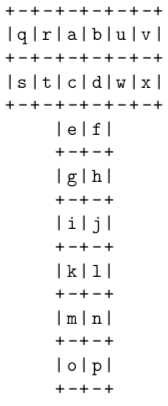
Output
For each test case, output YES if can be restored in one step, otherwise output NO.
样例输入
4

1 1 1 1

2 2 2 2

3 3 3 3

4 4 4 4

5 5 5 5

6 6 6 6

6 6 6 6

1 1 1 1

2 2 2 2

3 3 3 3

5 5 5 5

4 4 4 4

1 4 1 4

2 1 2 1

3 2 3 2

4 3 4 3

5 5 5 5

6 6 6 6

1 3 1 3

2 4 2 4

3 1 3 1

4 2 4 2

5 5 5 5

6 6 6 6
样例输出
YES

YES

YES

NO
 #include<bits/stdc++.h>

 using namespace std;

 int a[][];

 int main()

 {

     int n;

     scanf("%d",&n);

     while(n--)

     {

         for(int i=; i<=; i++)

         {

             for(int j=; j<=; j++)

             {

                 scanf("%d",&a[i][j]);

             }

         }

         int summ=;

         int sum=;

         for(int i=; i<=; i++)

         {

             if(a[i][]==a[i][] && a[i][]==a[i][] && a[i][]==a[i][])

             {

                 summ++;

             }

         }

         if((a[][]==a[][] && a[][]==a[][] && a[][]==a[][]) && (a[][]==a[][] && a[][]==a[][] && a[][]==a[][]))

         {

             sum=;

         }

         if((a[][]==a[][] && a[][]==a[][] && a[][]==a[][]) && (a[][]==a[][] && a[][]==a[][] && a[][]==a[][]))

         {

             sum=;

         }

         if((a[][]==a[][] && a[][]==a[][] && a[][]==a[][]) && (a[][]==a[][] && a[][]==a[][] && a[][]==a[][]))

         {

             sum=;

         }

         if(summ==)

         {

             printf("YES\n");

         }

         else if(sum==)

         {

             printf("NO\n");

         }

         else if(sum==)

         {

             if(a[][]==a[][] &&a[][]==a[][] &&a[][]==a[][]&&

                     a[][]==a[][] &&a[][]==a[][] &&a[][]==a[][]&&

                     a[][]==a[][] &&a[][]==a[][] &&a[][]==a[][]&&

                     a[][]==a[][] &&a[][]==a[][] &&a[][]==a[][])

                 printf("YES\n");

             else if(a[][]==a[][] &&a[][]==a[][] &&a[][]==a[][]&&

                     a[][]==a[][] &&a[][]==a[][] &&a[][]==a[][]&&

                     a[][]==a[][] &&a[][]==a[][] &&a[][]==a[][]&&

                     a[][]==a[][] &&a[][]==a[][] &&a[][]==a[][])

                 printf("YES\n");

             else

                 printf("NO\n");

         }

         else if(sum==)

         {

             if(a[][]==a[][] &&a[][]==a[][] &&a[][]==a[][]&&

                     a[][]==a[][] &&a[][]==a[][] &&a[][]==a[][]&&

                     a[][]==a[][] &&a[][]==a[][] &&a[][]==a[][]&&

                     a[][]==a[][] &&a[][]==a[][] &&a[][]==a[][])

                 printf("YES\n");

             else if(a[][]==a[][] &&a[][]==a[][] &&a[][]==a[][]&&

                     a[][]==a[][] &&a[][]==a[][] &&a[][]==a[][]&&

                     a[][]==a[][] &&a[][]==a[][] &&a[][]==a[][]&&

                     a[][]==a[][] &&a[][]==a[][] &&a[][]==a[][])

                 printf("YES\n");

             else

                 printf("NO\n");

         }

         else if(sum==)

         {

             if(a[][]==a[][] &&a[][]==a[][] &&a[][]==a[][]&&

                     a[][]==a[][] &&a[][]==a[][] &&a[][]==a[][]&&

                     a[][]==a[][] &&a[][]==a[][] &&a[][]==a[][]&&

                     a[][]==a[][] &&a[][]==a[][] &&a[][]==a[][])

                 printf("YES\n");

             else if(a[][]==a[][] &&a[][]==a[][] &&a[][]==a[][]&&

                     a[][]==a[][] &&a[][]==a[][] &&a[][]==a[][]&&

                     a[][]==a[][] &&a[][]==a[][] &&a[][]==a[][]&&

                     a[][]==a[][] &&a[][]==a[][] &&a[][]==a[][])

                 printf("YES\n");

             else

                 printf("NO\n");

         }

         else

         {

              printf("NO\n");

         }

     }

     return ;

 }
- 1000ms
- 262144K
Let’s talking about something of eating a pocky. Here is a Decorer Pocky, with colorful decorative stripes in the coating, of length LLL.
While the length of remaining pocky is longer than ddd, we perform the following procedure. We break the pocky at any point on it in an equal possibility and this will divide the remaining pocky into two parts. Take the left part and eat it. When it is not longer than ddd, we do not repeat this procedure.
Now we want to know the expected number of times we should repeat the procedure above. Round it to 666 decimal places behind the decimal point.
Input
The first line of input contains an integer NNN which is the number of test cases. Each of the NNN lines contains two float-numbers LLL and ddd respectively with at most 555 decimal places behind the decimal point where 1≤d,L≤1501 \le d, L \le 1501≤d,L≤150.
Output
For each test case, output the expected number of times rounded to 666 decimal places behind the decimal point in a line.
样例输入
6

1.0 1.0

2.0 1.0

4.0 1.0

8.0 1.0

16.0 1.0

7.00 3.00
样例输出
0.000000

1.693147

2.386294

3.079442

3.772589

1.847298

思路:微分。
代码:
 #include<bits/stdc++.h>

 using namespace std;

 int n;

 double l,d;

 int main()

 {

     scanf("%d",&n);

     while(n--)

     {

         scanf("%lf%lf",&l,&d);

         if(l<=d)

         {

             printf("0.000000\n");

         }

         else

         {

             printf("%.6f\n",+log(l/d));

         }

     }

     return ;

 }
青岛 2016ICPC 区域现场赛题目的更多相关文章
- HDU 5920 Ugly Problem 高精度减法大模拟 ---2016CCPC长春区域现场赛
题目链接 题意:给定一个很大的数,把他们分为数个回文数的和,分的个数不超过50个,输出个数并输出每个数,special judge. 题解:现场赛的时候很快想出来了思路,把这个数从中间分为两部分,当位 ...
- HDU 4802 && HDU 4803 贪心,高精 && HDU 4804 轮廓线dp && HDU 4805 计算几何 && HDU 4811 (13南京区域赛现场赛 题目重演A,B,C,D,J)
A.GPA(HDU4802): 给你一些字符串对应的权重,求加权平均,如果是N,P不计入统计 GPA Time Limit: 2000/1000 MS (Java/Others) Memory ...
- HDU 4811 Ball -2013 ICPC南京区域现场赛
题目链接 题意:三种颜色的球,现给定三种球的数目,每次取其中一个放到桌子上,排成一条线,每次放的位置任意,问得到的最大得分. 把一个球放在末尾得到的分数是它以前球的颜色种数 把一个球放在中间得到的分数 ...
- 2013ACM/ICPC亚洲区南京站现场赛——题目重现
GPA http://acm.hdu.edu.cn/showproblem.php?pid=4802 签到题,输入两个表,注意细心点就行了. #include<cstdio> #inclu ...
- 2013ACM/ICPC亚洲区南京站现场赛---Poor Warehouse Keeper(贪心)
题目链接 http://acm.hdu.edu.cn/showproblem.php?pid=4803 Problem Description Jenny is a warehouse keeper. ...
- 2016 ACM/ICPC亚洲区青岛站现场赛(部分题解)
摘要 本文主要列举并求解了2016 ACM/ICPC亚洲区青岛站现场赛的部分真题,着重介绍了各个题目的解题思路,结合详细的AC代码,意在熟悉青岛赛区的出题策略,以备战2018青岛站现场赛. HDU 5 ...
- 2014ACM/ICPC亚洲区域赛牡丹江现场赛总结
不知道怎样说起-- 感觉还没那个比赛的感觉呢?如今就结束了. 9号.10号的时候学校还评比国奖.励志奖啥的,由于要来比赛,所以那些事情队友的国奖不能答辩.自己的励志奖班里乱搞要投票,自己又不在,真是无 ...
- 2014ACMICPC亚洲区域赛牡丹江现场赛之旅
下午就要坐卧铺赶回北京了.闲来无事.写个总结,给以后的自己看. 因为孔神要保研面试,所以仅仅有我们队里三个人上路. 我们是周五坐的十二点出发的卧铺,一路上不算无聊.恰巧邻床是北航的神犇.于是下午和北航 ...
- 2018ICPC青岛现场赛 重现训练
先贴代码,以及简要题解. 和一个队友下午双排打了一下,队友光速签到,我签的J被嫌弃写得慢以及演员...然后我秒出了E了思路然而难以置信这么简单的思路当时才过了十几个,于是发现D.F不是太好做.最后交了 ...
随机推荐
- less的编译
less其实也文本类型,跟txt的性质差不多 less有自己语法(变量,函数,作用域.Mixin混入),使css样式更加方便,有逻辑性,提高可维护性,减少重复性代码的冗余. 把less编译成css文件 ...
- 动态链接库 —— Dll 基础
1. DLL 的初识 在 windows 中,动态链接库是不可缺少的一部分,windows 应用程序程序接口提供的所有函数都包含在 DLL 中,其中有三个非常重要的系统 DLL 文件,分别为 Kern ...
- python格式化输出、逻辑表达式和字符编码
格式化输出: %s 字符串占位符;%d 整数占位符 注意:如果前面有了占位符,那么后面所有的%都是占位,如果要输出“%”,需要使用转移符,即"%%" #定义三个变量 name = ...
- JAVA乐观锁实现-CAS
是什么 全称compare and swap,一个CPU原子指令,在硬件层面实现的机制,体现了乐观锁的思想. JVM用C语言封装了汇编调用.Java的基础库中有很多类就是基于JNI调用C接口实现了多线 ...
- sourcetree的安装及使用
sourcetree下载地址:https://www.sourcetreeapp.com/ 点击安装包安装 此前需要跳转到bitbucket登录,我没有账号,所以我直接跳转到到https://bitb ...
- hash环/consistent hashing一致性哈希算法
一致性哈希算法在1997年由麻省理工学院提出的一种分布式哈希(DHT)实现算法,设计目标是为了解决因特网中的热点(Hot spot)问题,初衷和CARP十分类似.一致性哈希修正了CARP使用的 ...
- latex常用符号
希腊字母 字母名称 大写 小写 大写latex 小写latex alpha A \(\alpha\) \alpha beta B \(\beta\) \beta gamma \(\Gamma\) \( ...
- gulp 输出到同一目录
gulp.task('jsx', function () { var src='app/script/**/*.jsx'; // src='app/script/components/selloff/ ...
- 20155207JAVA第十二周课堂练习
20155207JAVA第十二周课堂练习 教材代码检查--P98 修改教材P98 Score2.java, 让执行结果数组填充是自己的学号 Arrays和String单元测试 在IDEA中以TDD的方 ...
- 20155212Arrays和String测试_MySort
Arrays和String单元测试 在IDEA中以TDD的方式对String类和Arrays类进行学习 测试相关方法的正常,错误和边界情况 String类 charAt split Arrays类 s ...