
模型融合之blending和stacking
1. blending
- 需要得到各个模型结果集的权重,然后再线性组合。
"""Kaggle competition: Predicting a Biological Response.

Blending {RandomForests, ExtraTrees, GradientBoosting} + stretching to

[0,1]. The blending scheme is related to the idea Jose H. Solorzano

presented here:

http://www.kaggle.com/c/bioresponse/forums/t/1889/question-about-the-process-of-ensemble-learning/10950#post10950

'''You can try this: In one of the 5 folds, train the models, then use

the results of the models as 'variables' in logistic regression over

the validation data of that fold'''. Or at least this is the

implementation of my understanding of that idea :-)

The predictions are saved in test.csv. The code below created my best

submission to the competition:

- public score (25%): 0.43464

- private score (75%): 0.37751

- final rank on the private leaderboard: 17th over 711 teams :-)

Note: if you increase the number of estimators of the classifiers,

e.g. n_estimators=1000, you get a better score/rank on the private

test set.

Copyright 2012, Emanuele Olivetti.

BSD license, 3 clauses.

"""

from __future__ import division

import numpy as np

import load_data

from sklearn.cross_validation import StratifiedKFold

from sklearn.ensemble import RandomForestClassifier, ExtraTreesClassifier

from sklearn.ensemble import GradientBoostingClassifier

from sklearn.linear_model import LogisticRegression

def logloss(attempt, actual, epsilon=1.0e-15):

    """Logloss, i.e. the score of the bioresponse competition.

    """

    attempt = np.clip(attempt, epsilon, 1.0-epsilon)

    return - np.mean(actual * np.log(attempt) +

                     (1.0 - actual) * np.log(1.0 - attempt))

if __name__ == '__main__':

    np.random.seed(0)  # seed to shuffle the train set

    n_folds = 10

    verbose = True

    shuffle = False

    X, y, X_submission = load_data.load()

    if shuffle:

        idx = np.random.permutation(y.size)

        X = X[idx]

        y = y[idx]

    skf = list(StratifiedKFold(y, n_folds))

    clfs = [RandomForestClassifier(n_estimators=100, n_jobs=-1, criterion='gini'),

            RandomForestClassifier(n_estimators=100, n_jobs=-1, criterion='entropy'),

            ExtraTreesClassifier(n_estimators=100, n_jobs=-1, criterion='gini'),

            ExtraTreesClassifier(n_estimators=100, n_jobs=-1, criterion='entropy'),

            GradientBoostingClassifier(learning_rate=0.05, subsample=0.5, max_depth=6, n_estimators=50)]

    print ("Creating train and test sets for blending.")

    dataset_blend_train = np.zeros((X.shape[0], len(clfs)))

    dataset_blend_test = np.zeros((X_submission.shape[0], len(clfs)))

    for j, clf in enumerate(clfs):

        print (j, clf)

        dataset_blend_test_j = np.zeros((X_submission.shape[0], len(skf)))

        for i, (train, test) in enumerate(skf):

            print ("Fold", i)

            X_train = X[train]

            y_train = y[train]

            X_test = X[test]

            y_test = y[test]

            clf.fit(X_train, y_train)

            y_submission = clf.predict_proba(X_test)[:, 1]

            dataset_blend_train[test, j] = y_submission

            dataset_blend_test_j[:, i] = clf.predict_proba(X_submission)[:, 1]

        dataset_blend_test[:, j] = dataset_blend_test_j.mean(1)

    print()

    print( "Blending.")

    clf = LogisticRegression()

    clf.fit(dataset_blend_train, y)

    y_submission = clf.predict_proba(dataset_blend_test)[:, 1]

    print( "Linear stretch of predictions to [0,1]")

    y_submission = (y_submission - y_submission.min()) / (y_submission.max() - y_submission.min())

    print( "Saving Results.")

    tmp = np.vstack([range(1, len(y_submission)+1), y_submission]).T

    np.savetxt(fname='submission.csv', X=tmp, fmt='%d,%0.9f',

               header='MoleculeId,PredictedProbability', comments='')
2.stacking
- stacking的核心:在训练集上进行预测,从而构建更高层的学习器。
- stacking训练过程:
1) 拆解训练集。将训练数据随机且大致均匀的拆为m份。
2)在拆解后的训练集上训练模型,同时在测试集上预测。利用m-1份训练数据进行训练,预测剩余一份;在此过程进行的同时,利用相同的m-1份数据训练,在真正的测试集上预测;如此重复m次,将训练集上m次结果叠加为1列,将测试集上m次结果取均值融合为1列。
3)使用k个分类器重复2过程。将分别得到k列训练集的预测结果,k列测试集预测结果。
4)训练3过程得到的数据。将k列训练集预测结果和训练集真实label进行训练,将k列测试集预测结果作为测试集。
# -*- coding: utf-8 -*-

import numpy as np

from sklearn.model_selection import StratifiedKFold

from sklearn.svm import SVC

from sklearn.ensemble import RandomForestClassifier

from sklearn.neighbors import KNeighborsClassifier

import xgboost as xgb

from sklearn.ensemble import ExtraTreesClassifier

from sklearn.linear_model import LogisticRegression

def load_data():

    pass

def stacking(train_x, train_y, test):

    """ stacking

    input: train_x, train_y, test

    output: test的预测值

    clfs: 5个一级分类器

    dataset_blend_train: 一级分类器的prediction, 二级分类器的train_x

    dataset_blend_test: 二级分类器的test

    """

    # 5个一级分类器

    clfs = [SVC(C = 3, kernel="rbf"),

            RandomForestClassifier(n_estimators=100, max_features="log2", max_depth=10, min_samples_leaf=1, bootstrap=True, n_jobs=-1, random_state=1),

            KNeighborsClassifier(n_neighbors=15, n_jobs=-1),

            xgb.XGBClassifier(n_estimators=100, objective="binary:logistic", gamma=1, max_depth=10, subsample=0.8, nthread=-1, seed=1),

            ExtraTreesClassifier(n_estimators=100, criterion="gini", max_features="log2", max_depth=10, min_samples_split=2, min_samples_leaf=1,bootstrap=True, n_jobs=-1, random_state=1)]

    # 二级分类器的train_x, test

    dataset_blend_train = np.zeros((train_x.shape[0], len(clfs)), dtype=np.int)

    dataset_blend_test = np.zeros((test.shape[0], len(clfs)), dtype=np.int)

    # 5个分类器进行8_folds预测

    n_folds = 8

    skf = StratifiedKFold(n_splits=n_folds, shuffle=True, random_state=1)

    for i,clf in enumerate(clfs):

        dataset_blend_test_j = np.zeros((test.shape[0], n_folds))  # 每个分类器的单次fold预测结果

        for j,(train_index,test_index) in enumerate(skf.split(train_x, train_y)):

            tr_x = train_x[train_index]

            tr_y = train_y[train_index]

            clf.fit(tr_x, tr_y)

            dataset_blend_train[test_index, i] = clf.predict(train_x[test_index])

            dataset_blend_test_j[:, j] = clf.predict(test)

        dataset_blend_test[:, i] = dataset_blend_test_j.sum(axis=1) // (n_folds//2 + 1)

    # 二级分类器进行预测

    clf = LogisticRegression(penalty="l1", tol=1e-6, C=1.0, random_state=1, n_jobs=-1)

    clf.fit(dataset_blend_train, train_y)

    prediction = clf.predict(dataset_blend_test)

    return prediction

def main():

    (train_x, train_y, test) = load_data()

    prediction = stacking(train_x, train_y, test)

    return prediction

if __name__ == "__main__":

    prediction = main()
ensemble model
比较简明的资源有:
- 1.https://zhuanlan.zhihu.com/p/26890738
- 2.数据应用学院 Kaggle案例实战 公开课 Part 2 https://www.youtube.com/watch?v=BS4SY3HhVDI&t=4320s
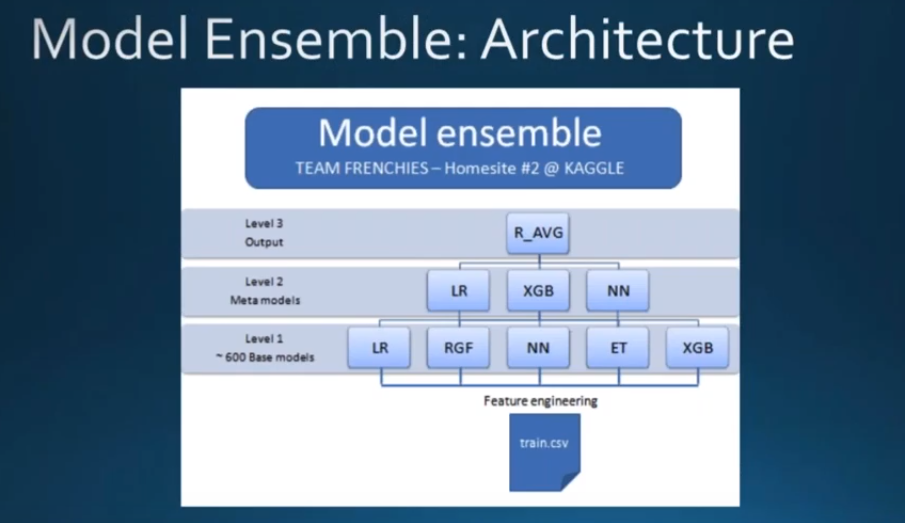
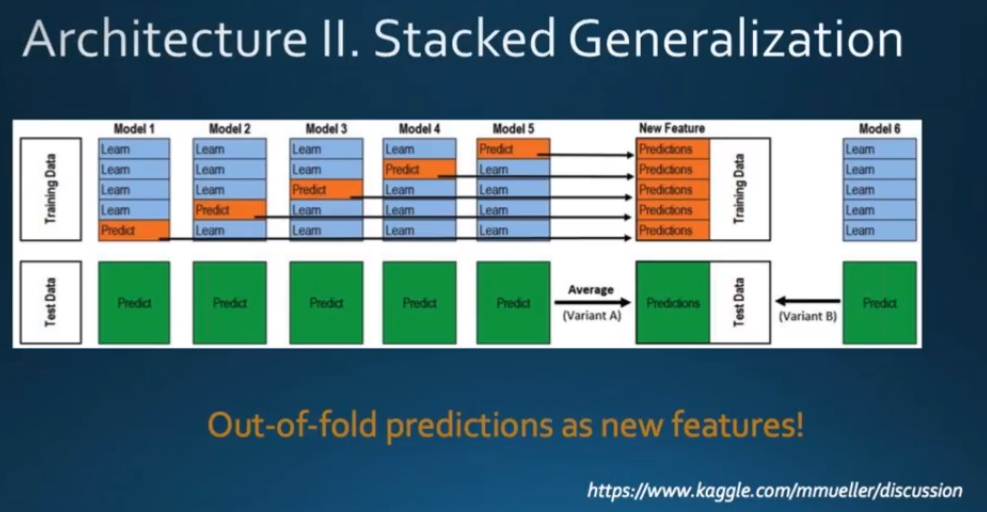
上面的是以5折为例,如果是2折的话就更简单了!

-----------------------------------------------------分割线------------------------------------------------------------------
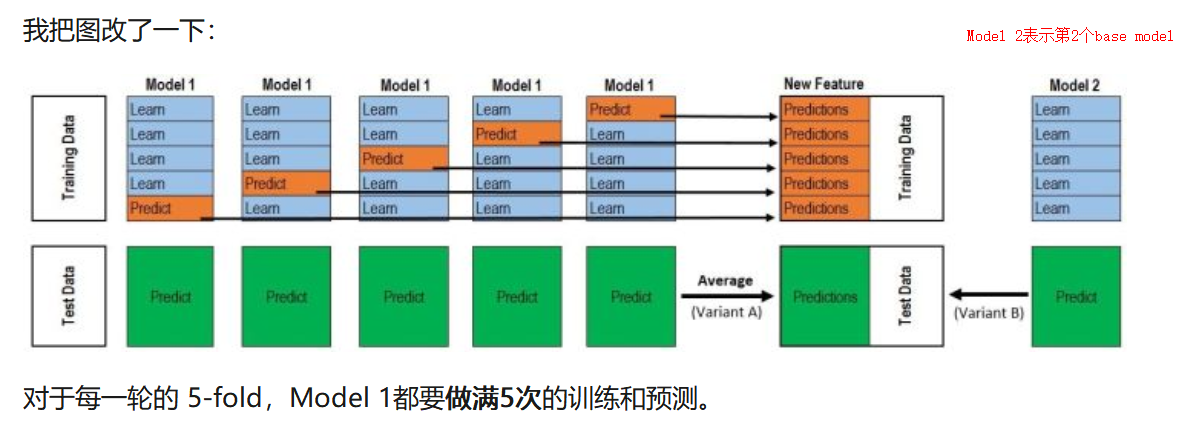
- 以Kaggle的泰坦尼克号为例子
# out-of-Fold Prdictions

TrainingData = train.shape[0] # 891行

TestData = test.shape[0] # 418 行

# 5 折

kf = KFold(n_splits = 5, random_state = 2017)

# X_train, y_train, X_test表示原生的数据

def get_oof(clf, X_train, y_train, X_test):

	# oof_train对应于训练数据集TrainingData

	oof_train = np.zeros((TrainingData, ))  # 1 * 891型

	# oof_test对应于测试集TestData

	oof_test  = np.zeros((TestData, ))     # 1 * 418型

	# oof_test_skf对应于5折之后的所有predict作为新的TestData(测试集),只要最后对行(axis = 0)取平均就得到平均predict值Test Data

	oof_test_skf = np.empty((5, TestData))  # 5 * 418型

	for i, (train_index, test_index) in enumerate(kf.split(X_train)):

		# kf_X_train 表示train data每一折中用于训练的训练集(4份共有712个样本)

		kf_X_train = X_train[train_index] # 712 * 7  例如712 instances for each fold

		kf_y_train = y_train[train_index] # 712 * 1  例如712 instances for each fold

		#  kf_X_test 表示train data每一折中用于predict的数据集(也就是验证集validation data)

		kf_X_test  = X_train[test_index]  # 179 * 7  例如178 instances for each fold

		clf.train(kf_X_train, kf_y_train)  # 训练模型

		# 得到predict值(输出值)作为new feature输入用于第二层的训练

		# 一个base model 就对应于new feature的一列,此时的new feature有多少列取决于你第一层用了多少个base model

		oof_train[test_index] = clf.prdict(kf_X_test)  # 1 * 179 ===> will be 1 * 891 after 5 folds

		# 用TestData --这里X_test(测试集)用于预测

		oof_test_skf[i, :] = clf.predict(X_test)  # oof_test_skf[i, :],1 * 418 ===> will be 5 * 418 after 5 folds

    # 5折stacking结束后

	# 对测试集预测得到的predict值进行行(axis = 0)平均:  5 * 418 ===> 1 * 418

	oof_test[:] = oof_test_skf.mean(axis = 0)

	return oof_train.reshpae(-1, 1), oof_test.reshpae(-1, 1)

	# oof_train.reshpae(-1, 1): 891 * 1    oof_test.reshpae(-1, 1): 418 * 1
-------------------------------------------------补充----------------------------------------------
Udacity的几张图

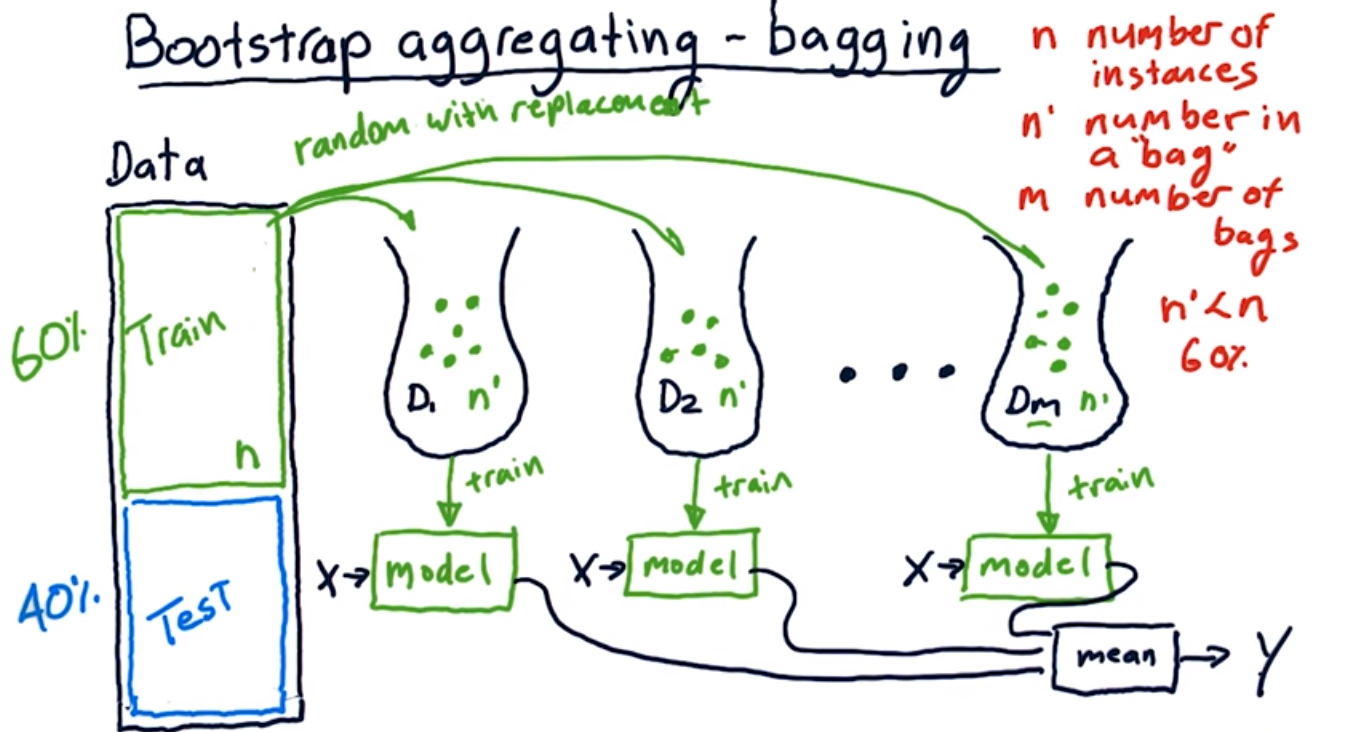
模型融合之blending和stacking的更多相关文章
- 模型融合——stacking原理与实现
一般提升模型效果从两个大的方面入手 数据层面:数据增强.特征工程等 模型层面:调参,模型融合 模型融合:通过融合多个不同的模型,可能提升机器学习的性能.这一方法在各种机器学习比赛中广泛应用, 也是在比 ...
- 深度学习模型融合stacking
当你的深度学习模型变得很多时,选一个确定的模型也是一个头痛的问题.或者你可以把他们都用起来,就进行模型融合.我主要使用stacking和blend方法.先把代码贴出来,大家可以看一下. import ...
- 深度学习模型stacking模型融合python代码,看了你就会使
话不多说,直接上代码 def stacking_first(train, train_y, test): savepath = './stack_op{}_dt{}_tfidf{}/'.format( ...
- 谈谈模型融合之一 —— 集成学习与 AdaBoost
前言 前面的文章中介绍了决策树以及其它一些算法,但是,会发现,有时候使用使用这些算法并不能达到特别好的效果.于是乎就有了集成学习(Ensemble Learning),通过构建多个学习器一起结合来完成 ...
- 在Caffe中实现模型融合
模型融合 有的时候我们手头可能有了若干个已经训练好的模型,这些模型可能是同样的结构,也可能是不同的结构,训练模型的数据可能是同一批,也可能不同.无论是出于要通过ensemble提升性能的目的,还是要设 ...
- Gluon炼丹(Kaggle 120种狗分类,迁移学习加双模型融合)
这是在kaggle上的一个练习比赛,使用的是ImageNet数据集的子集. 注意,mxnet版本要高于0.12.1b2017112. 下载数据集. train.zip test.zip labels ...
- 模型融合策略voting、averaging、stacking
原文:https://zhuanlan.zhihu.com/p/25836678 1.voting 对于分类问题,采用多个基础模型,采用投票策略选择投票最多的为最终的分类. 2.averaging 对 ...
- 基于sklearn的 BaseEstimator开发接口:模型融合Stacking
转载:https://github.com/LearningFromBest/CMB-credit-card-department-prediction-of-purchasing-behavior- ...
- 22(8).模型融合---RegionBoost
在adaboost当中,样本的权重alpha是固定的,蓝色五角星所在的圈中3个○分错了,红色五角星所在的圈中4个×和1个○都分对了,很容易让人想到,这个模型,对于红色位置的判断更加可信. 动态权重,每 ...
随机推荐
- python 自动化之路 day 18 前端内容回顾、补充/Django安装、创建
前端回顾: 整体: - HTML - CSS - JavaScript - 基本数据类型 - for,while.. - DOM - obj = document.getElementById('.. ...
- 一些常用的html css整理--文本长度截取
div+css设置列表div超出部分显示...(单行文本) width:200px; //指定宽度: overflow:hidden; //将超出内容隐藏 text-overflow:ellipsis ...
- mvc ajax给control传值问题
jquery中的ajax操作给后台传值 $.ajax({ type: 'POST', url: '<%=Url.Action("test","testIndex ...
- Android ADB 命令链接模拟器出现 daemon not running 解决方法
用adb命令链接远程模拟器 有时候会遇到如下问题: C:Documents and SettingsAdministrator>adb connect 192.168.0.183 * daemo ...
- hdu 1853 (费用流 拆点)
// 给定一个有向图,必须用若干个环来覆盖整个图,要求这些覆盖的环的权值最小. 思路:原图每个点 u 拆为 u 和 u' ,从源点引容量为 1 费用为 0 的边到 u ,从 u' 引相同性质的边到汇点 ...
- POJ1751 Highways
题目链接 http://poj.org/problem?id=1751 题目大意:输入n:然后给你n个点的坐标(任意两点之间皆可达):输入m:接下来m行每行输入两个整数x,y表示 点x与点y 已 ...
- 【BZOJ2648】SJY摆棋子 KDtree
[BZOJ2648]SJY摆棋子 Description 这天,SJY显得无聊.在家自己玩.在一个棋盘上,有N个黑色棋子.他每次要么放到棋盘上一个黑色棋子,要么放上一个白色棋子,如果是白色棋子,他会找 ...
- 学习 Tornado
异步编程 预习 lambda Lambda functions can be used wherever function objects are required. They are syntact ...
- TFS二次开发-基线文件管理器(5)-源码文件的读取
在上一节中,我们在保存标签之前,已经将勾选的文件路径保存到了Listbox中,这里只需要将保存的数据输出去为txt文档就可以做版本控制了. 版本文件比较复杂的是如何读取,也就是如何通过文件路径 ...
- if you have content fetched asynchronously on pages where SEO is important, SSR might be necessary
if you have content fetched asynchronously on pages where SEO is important, SSR might be necessary