
Java自定义注解(1)
Java注解简介
1. Java注解(Annotation)
Java注解是附加在代码中的一些元信息,用于一些工具在编译、
运行时进行解析和使用,起到说明、配置的功能。
注解相关类都包含在java.lang.annotation包中。
2. Java注解分类
2.1 JDK基本注解
2.2 JDK元注解
2.3 自定义注解
3. JDK基本注解
3.1 @Override
重写
3.2 @Deprecated
已过时
3.3 @SuppressWarnings(value = "unchecked")
压制编辑器警告
Java元注解
作用:元注解用于修饰其他的注解
@Retention:定义注解的保留策略
@Retention(RetentionPolicy.SOURCE) //注解仅存在于源码中,在class字节码文件中不包含
@Retention(RetentionPolicy.CLASS) //默认的保留策略,注解会在class字节码文件中存在,但运行时无法获得,
@Retention(RetentionPolicy.RUNTIME) //注解会在class字节码文件中存在,在运行时可以通过反射获取到
@Target:指定被修饰的Annotation可以放置的位置(被修饰的目标)
@Target(ElementType.TYPE) //接口、类
@Target(ElementType.FIELD) //属性
@Target(ElementType.METHOD) //方法
@Target(ElementType.PARAMETER) //方法参数
@Target(ElementType.CONSTRUCTOR) //构造函数
@Target(ElementType.LOCAL_VARIABLE) //局部变量
@Target(ElementType.ANNOTATION_TYPE) //注解
@Target(ElementType.PACKAGE) //包
注:可以指定多个位置,例如:
@Target({ElementType.METHOD, ElementType.TYPE}),也就是此注解可以在方法和类上面使用
@Inherited:指定被修饰的Annotation将具有继承性
@Documented:指定被修饰的该Annotation可以被javadoc工具提取成文档.
自定义注解
注解分类(根据Annotation是否包含成员变量,可以把Annotation分为两类):
标记Annotation:
没有成员变量的Annotation; 这种Annotation仅利用自身的存在与否来提供信息
元数据Annotation:
包含成员变量的Annotation; 它们可以接受(和提供)更多的元数据;
如何自定义注解?
使用@interface关键字, 其定义过程与定义接口非常类似, 需要注意的是:
Annotation的成员变量在Annotation定义中是以无参的方法形式来声明的, 其方法名和返回值类型定义了该成员变量的名字和类型,
而且我们还可以使用default关键字为这个成员变量设定默认值;
注意:只有名字为“value”属性,赋值时可以省略属性名
案例一(获取类与方法上的注解值):
package com.ssm.annotation;

/**

 *  @author xyls

 *  @blog name & blog address 027@0030

 *  @create  2019-11-12 18:52

 */

public enum  TranscationModel {

    Read, Write, ReadWrite

}
package com.ssm.annotation;

import java.lang.annotation.*;

/**

 *  @author xyls

 *  @blog name & blog address 027@0030

 *  @create  2019-11-12 18:52

 *

 * MyAnnotation1注解可以用在类、接口、属性、方法上

 * 注解运行期也保留

 * 不可继承

 */

@Target({ElementType.TYPE, ElementType.FIELD,ElementType.METHOD})

@Retention(RetentionPolicy.RUNTIME)

@Documented

public @interface MyAnnotation1 {

    String name();

}
package com.ssm.annotation;

/**

 * @author xyls

 * @blog name & blog address 027@0030

 * @create  2019-11-12 18:52

 */

import java.lang.annotation.*;

@Target(ElementType.METHOD)

@Retention(RetentionPolicy.RUNTIME)

@Documented

public @interface MyAnnotation2 {

    TranscationModel model() default TranscationModel.ReadWrite;

}
package com.ssm.annotation;

/**

 * @author xyls

 * @blog name & blog address 027@0030

 * @create  2019-11-12 18:52

 */

import java.lang.annotation.*;

@Target(ElementType.METHOD)

@Retention(RetentionPolicy.RUNTIME)

@Inherited

@Documented

public @interface MyAnnotation3 {

    TranscationModel[] models() default TranscationModel.ReadWrite;

}
package com.ssm.annotation;

/**

 * @author xyls

 * @blog name & blog address 027@0030

 * @create  2019-11-12 18:52

 */

@MyAnnotation1(name = "abc")

public class Demo1 {

    @MyAnnotation1(name = "xyz")

    private Integer age;

    @MyAnnotation2(model = TranscationModel.Read)

    public void list() {

        System.out.println("list");

    }

    @MyAnnotation3(models = {TranscationModel.Read, TranscationModel.Write})

    public void edit() {

        System.out.println("edit");

    }

}
import com.ssm.annotation.*;

import org.junit.Test;

/**

 * @author xyls

 * @blog name & blog address 027@0030

 * @create  2019-11-12 18:52

 */

public class Demo1Test {

    @Test

    public void list() throws Exception {

//        获取类上的注解

        MyAnnotation1 annotation1 = Demo1.class.getAnnotation(MyAnnotation1.class);

        System.out.println(annotation1.name());//abc

//        获取方法上的注解

        MyAnnotation2 myAnnotation2 = Demo1.class.getMethod("list").getAnnotation(MyAnnotation2.class);

        System.out.println(myAnnotation2.model());//Read

    }

    @Test

    public void edit() throws Exception {

        MyAnnotation3 myAnnotation3 = Demo1.class.getMethod("edit").getAnnotation(MyAnnotation3.class);

        for (TranscationModel model : myAnnotation3.models()) {

            System.out.println(model);//输出Read,Write

        }

    }

}
案例二(获取类属性上的注解属性值)
package com.ssm.annotation2;

import java.lang.annotation.ElementType;

import java.lang.annotation.Retention;

import java.lang.annotation.RetentionPolicy;

import java.lang.annotation.Target;

/**

 * @author xyls

 * @blog name & blog address 027@0030

 * @create  2019-11-12 18:52

 */

//@Retention(RetentionPolicy.SOURCE)

@Retention(RetentionPolicy.RUNTIME)

@Target(ElementType.FIELD)

public @interface TestAnnotation {

    String value() default "默认value值";

    String what() default "这里是默认的what属性对应的值";

}
package com.ssm.annotation2;

/**

 * @author xyls

 * @blog name & blog address 027@0030

 * @create  2019-11-12 18:52

 */

public class Demo2 {

    @TestAnnotation(value = "这就是value对应的值_msg1", what = "这就是what对应的值_msg1")

    private static String msg1;

    @TestAnnotation("这就是value对应的值1")

    private static String msg2;

    @TestAnnotation(value = "这就是value对应的值2")

    private static String msg3;

    @TestAnnotation(what = "这就是what对应的值")

    private static String msg4;

}
import com.ssm.annotation2.Demo2;

import com.ssm.annotation2.TestAnnotation;

import org.junit.Test;

/**

 * @author xyls

 * @blog name & blog address 027@0030

 * @create  2019-11-12 18:52

 */

public class Demo2Test {

    @Test

    public void test1() throws Exception {

        TestAnnotation msg1 = Demo2.class.getDeclaredField("msg1").getAnnotation(TestAnnotation.class);

        System.out.println(msg1.value());

        System.out.println(msg1.what());

    }

    @Test

    public void test2() throws Exception {

        TestAnnotation msg2 = Demo2.class.getDeclaredField("msg2").getAnnotation(TestAnnotation.class);

        System.out.println(msg2.value());

        System.out.println(msg2.what());

    }

    @Test

    public void test3() throws Exception {

        TestAnnotation msg3 = Demo2.class.getDeclaredField("msg3").getAnnotation(TestAnnotation.class);

        System.out.println(msg3.value());

        System.out.println(msg3.what());

    }

    @Test

    public void test4() throws Exception {

        TestAnnotation msg4 = Demo2.class.getDeclaredField("msg4").getAnnotation(TestAnnotation.class);

        System.out.println(msg4.value());

        System.out.println(msg4.what());

    }

}
案例三(获取参数修饰注解对应的属性值):
package com.ssm.annotation3;

import java.lang.annotation.*;

/**

 * @author xyls

 * @blog name & blog address 027@0030

 * @create  2019-11-12 18:52

 */

@Documented

@Target({ElementType.PARAMETER})

@Retention(RetentionPolicy.RUNTIME)

public @interface IsNotNull {

    boolean value() default false;

}
package com.ssm.annotation3;

/**

 * @author xyls

 * @blog name & blog address 027@0030

 * @create  2019-11-12 18:52

 */

public class Demo3 {

    public void hello1(@IsNotNull(true) String name) {

        System.out.println("hello:" + name);

    }

    public void hello2(@IsNotNull String name) {

        System.out.println("hello:" + name);

    }

}
import com.ssm.annotation3.Demo3;

import com.ssm.annotation3.IsNotNull;

import org.junit.Test;

/**

 * @author xyls

 * @blog name & blog address 027@0030

 * @create  2019-11-12 18:52

 */

import java.lang.reflect.Parameter;

public class Demo3Test {

    @Test

    public void hello1() throws Exception {

        Demo3 demo3 = new Demo3();

        for (Parameter parameter : demo3.getClass().getMethod("hello1", String.class).getParameters()) {

            IsNotNull annotation = parameter.getAnnotation(IsNotNull.class);

            if (annotation != null) {

                System.out.println(annotation.value());//true

            }

        }

    }

    @Test

    public void hello2() throws Exception {

        Demo3 demo3 = new Demo3();

        for (Parameter parameter : demo3.getClass().getMethod("hello2", String.class).getParameters()) {

            IsNotNull annotation = parameter.getAnnotation(IsNotNull.class);

            if (annotation != null) {

                System.out.println(annotation.value());//false

            }

        }

    }

}
Aop自定义注解的应用
package com.ssm.AOP;

import java.lang.annotation.ElementType;

import java.lang.annotation.Retention;

import java.lang.annotation.RetentionPolicy;

import java.lang.annotation.Target;

/**

   * @author xyls

   * @blog name & blog address 027@0030

   * @create  2019-11-12 18:52

 */

@Target(ElementType.METHOD)

@Retention(RetentionPolicy.RUNTIME)

public @interface MyLog {

    String desc();

}
package com.ssm.AOP;

import org.aspectj.lang.JoinPoint;

import org.aspectj.lang.annotation.Aspect;

import org.aspectj.lang.annotation.Before;

import org.aspectj.lang.annotation.Pointcut;

import org.aspectj.lang.reflect.MethodSignature;

import org.slf4j.Logger;

import org.slf4j.LoggerFactory;

import org.springframework.stereotype.Component;

/**

 * @author xyls

 * @blog name & blog address 027@0030

 * @create  2019-11-12 18:52

 */

@Component

@Aspect

public class MyLogAspect {

    private static final Logger logger = LoggerFactory.getLogger(MyLogAspect.class);

    /**

     * 只要用到了com.ssmAOP.MyLog这个注解的,就是目标类

     */

    @Pointcut("@annotation(com.ssm.AOP.MyLog)")

    private void MyValid() {

    }

    @Before("MyValid()")

    public void before(JoinPoint joinPoint) {

        MethodSignature signature = (MethodSignature) joinPoint.getSignature();

        logger.debug("[" + signature.getName() + " : start.....]");

        MyLog myLog = signature.getMethod().getAnnotation(MyLog.class);

        logger.debug("【目标对象方法被调用时候产生的日志,记录到日志表中】:" + myLog.desc());

    }

}
package com.ssm.AOP;

import org.springframework.stereotype.Component;

/**

 * @author xyls

 * @blog name & blog address 027@0030

 * @create  2019-11-12 18:52

 */

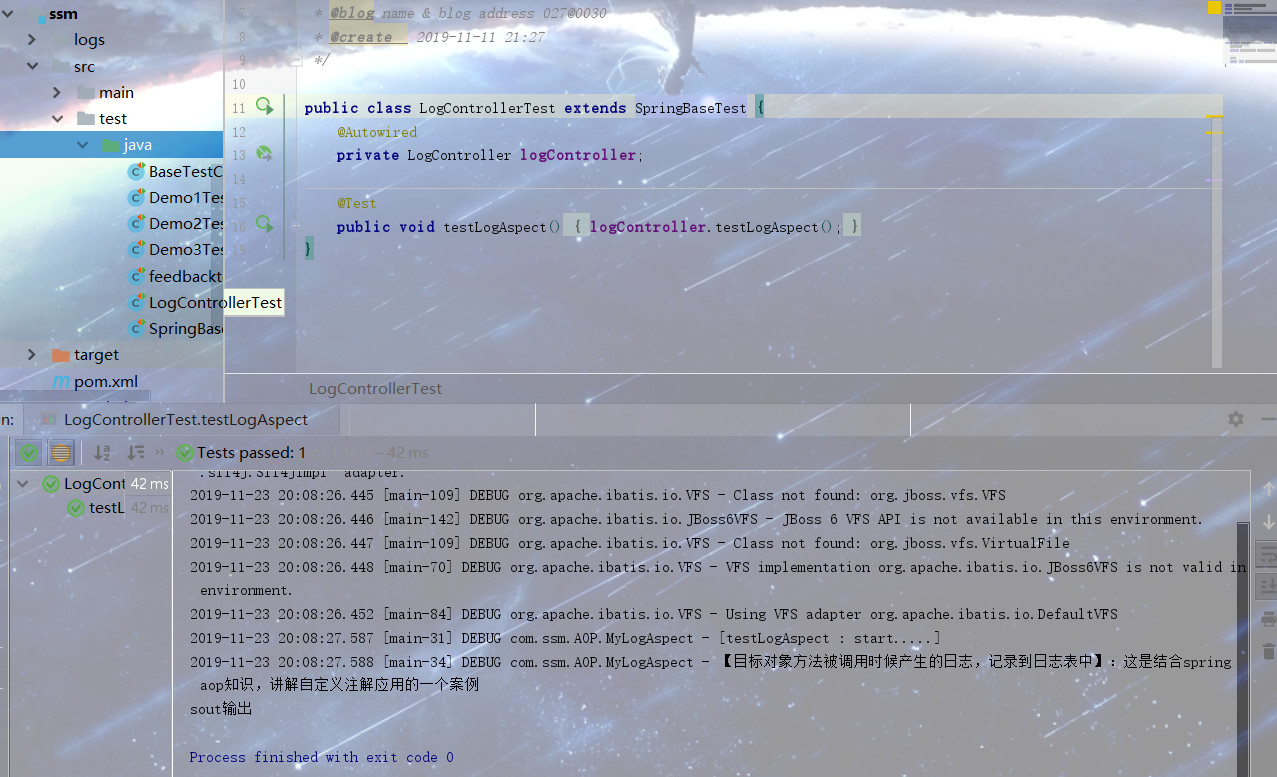
@Component

public class LogController {

    @MyLog(desc = "这是结合spring aop知识,讲解自定义注解应用的一个案例")

    public void testLogAspect() {

        System.out.println("sout输出");

    }

}
import com.ssm.model.feedback;

import com.ssm.util.PageBean;

import org.junit.Before;

import org.junit.runner.RunWith;

import org.springframework.test.context.ContextConfiguration;

import org.springframework.test.context.junit4.SpringJUnit4ClassRunner;

/**

 * @author xyls

 * @blog name & blog address 027@0030

 * @create  2019-11-15 9:52

 */

@RunWith(SpringJUnit4ClassRunner.class)

@ContextConfiguration(locations={"classpath:applicationContext.xml"})

public class SpringBaseTest {

//protected feedback feedback;

//protected  PageBean pageBean;

//    @Before

//    public void init(){

//        feedback feedback=new feedback();

//    }

}
Java自定义注解(1)的更多相关文章
- java自定义注解类
一.前言 今天阅读帆哥代码的时候,看到了之前没有见过的新东西, 比如java自定义注解类,如何获取注解,如何反射内部类,this$0是什么意思? 于是乎,学习并整理了一下. 二.代码示例 import ...
- java自定义注解实现前后台参数校验
2016.07.26 qq:992591601,欢迎交流 首先介绍些基本概念: Annotations(also known as metadata)provide a formalized way ...
- java自定义注解注解方法、类、属性等等【转】
http://anole1982.iteye.com/blog/1450421 http://www.open-open.com/doc/view/51fe76de67214563b20b385320 ...
- java自定义注解知识实例及SSH框架下,拦截器中无法获得java注解属性值的问题
一.java自定义注解相关知识 注解这东西是java语言本身就带有的功能特点,于struts,hibernate,spring这三个框架无关.使用得当特别方便.基于注解的xml文件配置方式也受到人们的 ...
- Java自定义注解的实现
Java自定义注解的实现,总共三步(eg.@RandomlyThrowsException): 1.首先编写一个自定义注解@RandomlyThrowsException package com.gi ...
- Java自定义注解源码+原理解释(使用Java自定义注解校验bean传入参数合法性)
Java自定义注解源码+原理解释(使用Java自定义注解校验bean传入参数合法性) 前言:由于前段时间忙于写接口,在接口中需要做很多的参数校验,本着简洁.高效的原则,便写了这个小工具供自己使用(内容 ...
- JAVA自定义注解 ------ Annotation
日常开发工作中,合理的使用注解,可以简化代码编写以及使代码结构更加简单,下面记录下,JAVA自定义注解的开发过程. 定义注解声明类. 编写注解处理器(主要起作用部分). 使用注解. 相关知识点介绍, ...
- Java自定义注解和运行时靠反射获取注解
转载:http://blog.csdn.net/bao19901210/article/details/17201173/ java自定义注解 Java注解是附加在代码中的一些元信息,用于一些工具在编 ...
- JAVA自定义注解
在学习使用Spring和MyBatis框架的时候,使用了很多的注解来标注Bean或者数据访问层参数,那么JAVA的注解到底是个东西,作用是什么,又怎样自定义注解呢?这篇文章,即将作出简单易懂的解释. ...
- Java 自定义注解
在spring的应用中,经常使用注解进行开发,这样有利于加快开发的速度. 介绍一下自定义注解: 首先,自定义注解要新建一个@interface,这个是一个注解的接口,在此接口上有这样几个注解: @Do ...
随机推荐
- 墙上你APP设计与实现
墙上你APP,听名字你们就应该可以想到是一个类似于表白墙吧,其实在做这个项目的时候我就是看到我们学校有一个专门工程墙,但是你找它发布消息表白或者找寻自己在学校掉了的饭卡或者身份证的时候,需要等它们同意 ...
- python高级编程——进程和进程池
python提供了一个跨平台的多进程支持——multiprocessing模块,其包含Process类来代表一个进程对象 1.Process语法结构:(注: 传参的时候一定使用关键字传参) 2.自定义 ...
- 使用vue在开发中的一些小问题--使用vue-cli起的服务器无法在局域网访问
2.使用vue-cli起的服务器无法在局域网访问 这个很简单,在package.json文件中的js启动项配置中增加--host 0.0.0.0 注意是--host而不是-host,此时如果有--op ...
- Cesium专栏-热力图(附源码下载)
Cesium Cesium 是一款面向三维地球和地图的,世界级的JavaScript开源产品.它提供了基于JavaScript语言的开发包,方便用户快速搭建一款零插件的虚拟地球Web应用,并在性能,精 ...
- View和ViewGroup
1.继承关系 2.组合关系 3.View 的绘制流程 3.1.创建R.attrs.styleable,申明需要用到的属性值,在使用时可以根据属性进行定义 3.2.extends View ,依次 ...
- Thymeleaf对象的使用:字符串对象
Thymeleaf主要使用 org.thymeleaf.expression.Strings 类处理字符串,在模板中使用 #strings 对象来处理字符串. 开发环境:IntelliJ IDEA 2 ...
- css3的新属性 新增的颜色--- 透明度---两种渐变---定义多张背景图--background-size
css31==>颜色的6种表示的方法有6种表示颜色的方法 关键字 rgb rgba(css3) 16进制 hsl hsla hsla h=>是色相,值为360, s=>饱和度,0%- ...
- 剑指Offer-35.两个链表的第一个公共结点(C++/Java)
题目: 输入两个链表,找出它们的第一个公共结点. 分析: 先统计两个链表的长度,计算他们的差值,然后将两个链表对齐,再去寻找公共节点即可. 程序: C++ class Solution { publi ...
- Vue 组件通信的多种方式(props、$ref、$emit、$attr、 $listeners)
prop和$ref之间的区别: prop 着重于数据的传递,它并不能调用子组件里的属性和方法.像创建文章组件时,自定义标题和内容这样的使用场景,最适合使用prop. $ref 着重于索引,主要用来调用 ...
- Linux学习笔记-第19天 结束了。突然感觉配置一个服务好简单的样子
课程结束了,这本书又过了一遍,感觉学习到了不少的新知识.虽然整个过程老师讲的有点仓促,但回头想想身处于这个知识大爆炸的时代,学习不单要追求知识面宽广,更需要注重学习的效率,某种角度来讲,这也是一种鞭策 ...