
ACE - Reactor模式源码剖析及具体实现(大量源码慎入)
原文出自http://www.cnblogs.com/binchen-china,禁止转载。
在之前的文章中提到过Reactor模式和Preactor模式,现在利用ACE的Reactor来实现一个基于Reactor框架的服务器。
首先回顾下Reactor模式和Preactor模式。
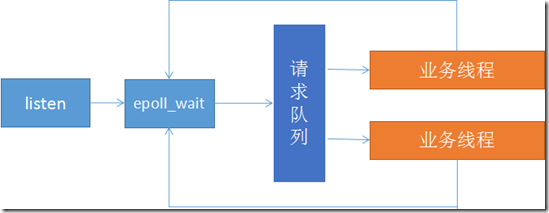
Reactor模式:
Reactor模式实现非常简单,使用同步IO模型,即业务线程处理数据需要主动等待或询问,主要特点是利用epoll监听listen描述符是否有响应,及时将客户连接信息放于一个队列,epoll和队列都是在主进程/线程中,由子进程/线程来接管描述符传输的数据,对描述符进行下一步操作,包括connect和数据读写。主程读写就绪事件。整个过程都需要先获取描述符状态,在状态允许下再执行任务。
大致流程图如下:
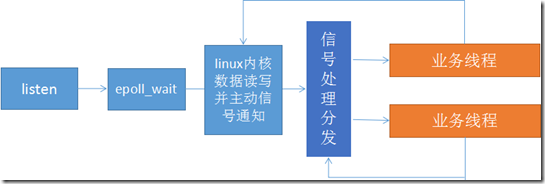
Preactor模式:
Preactor模式完全将IO处理和业务分离,使用异步IO模型,即内核完成数据处理后主动通知给应用处理,主进程/线程不仅要完成listen任务,还需要完成内核数据缓冲区的映射,直接将数据buff传递给业务线程,业务线程只需要处理业务逻辑即可。整个过程直接推送任务,描述符状态是否允许执行任务由内核去调度处理。
大致流程如下:
ACE的Reactor模式
所有服务器都可以归纳为以下三层:
- I/O:处理底层IO事件
- Dispatch:事件消息派发
- Service:业务处理
ACE的Reactor处于I/O和Dispatch层。提供了I/O监控和消息Dispatch。其中I/O需要用户以handle的形式提供到ACE_Reactor内。
Dispatch需要以ACE_Event_Handler为载体,也就是说要实现一个完整的Reactor只依赖ACE_Reactor类是无法完成的。
上篇博文利用ACE的Socket可以看出一个ACE_SOCK_Acceptor和ACE_SOCK_Stream就可以完成服务器代码。现在要做的是,
1.引入Reactor,把Acceptor和Stream两个I/O分别放在两个继承于ACE_Event_Handler的类中注册给ACE_Reactor。
2.主函数注册包含ACE_SOCK_Acceptor的类到ACE_Reactor中,当ACE_SOCK_Acceptor收到数据即有客户端连接后再给对应的客户端创建一个ACE_SOCK_Stream通道并注册到ACE_Reactor中。
使用ACE_Reactor实现的Server代码:
 #include <ace/INET_Addr.h>

 #include <ace/SOCK_Acceptor.h>

 #include <ace/SOCK_Stream.h>

 #include <ace/Reactor.h>

 #include <ace/Log_Msg.h>

 #include <list>

 #define MAX_BUFF_SIZE     1024

 #define LISTEN_PORT     5010

 #define SERVER_IP        ACE_LOCALHOST

 class ServerStream : public ACE_Event_Handler

 {

 public:

     ServerStream();

     ~ServerStream();

     ACE_SOCK_Stream& GetStream(){return Svr_stream;}    //给accept提供接口绑定数据通道

     virtual int handle_input(ACE_HANDLE fd);    //I/O触发事件后调用

     void close();

     virtual ACE_HANDLE get_handle(void) const {return Svr_stream.get_handle();}    //不重载需要手动将handle传入ACE_Reactor

 private:

     ACE_INET_Addr Cli_addr;

     ACE_SOCK_Stream Svr_stream;

 };

 ServerStream::ServerStream()

 {

 }

 ServerStream::~ServerStream()

 {

     close();

 }

 int ServerStream::handle_input(ACE_HANDLE fd)

 {

     char strBuffer[MAX_BUFF_SIZE];

     int byte = Svr_stream.recv(strBuffer,MAX_BUFF_SIZE); //可读数据

     if (- == byte)

     {

         ACE_DEBUG((LM_INFO, ACE_TEXT("receive data failed\n")));

     }

     else if( == byte)

     {

         close();

         ACE_DEBUG((LM_INFO, ACE_TEXT("client closed!\n")));

     }

     else

     {

         ACE_DEBUG((LM_INFO, ACE_TEXT("receive from client: %s\n"),strBuffer));

     }

 }

 void ServerStream::close()

 {

     Svr_stream.close();

     ACE_Reactor::instance()->remove_handler(this,ACE_Event_Handler::READ_MASK | ACE_Event_Handler::DONT_CALL);

     //delete this;

 }

 class ServerAcceptor : public ACE_Event_Handler

 {

 public:

     ServerAcceptor(int port,char* ip);

     ~ServerAcceptor();

     bool open();

     virtual int handle_input(ACE_HANDLE fd);  //有client连接

     void close();

     virtual ACE_HANDLE get_handle(void) const {return Svr_aceept.get_handle();}

 private:

     ACE_INET_Addr Svr_addr;

     ACE_SOCK_Acceptor Svr_aceept;

     std::list<ServerStream*> m_streamPool;  //stream pool

 };

 ServerAcceptor::ServerAcceptor(int port,char* ip):Svr_addr(port,ip)

 {

     if (!open())    //open listen port

     {

         ACE_DEBUG((LM_INFO, ACE_TEXT("open failed!\n")));

     }

     else

     {

         ACE_DEBUG((LM_INFO, ACE_TEXT("open success!\n")));

     }

 }

 ServerAcceptor::~ServerAcceptor()

 {

     close();

     std::list<ServerStream*>::iterator it;

     for (it = m_streamPool.begin();it != m_streamPool.end();++it)

     {

         if (NULL != (*it))

         {

             (*it)->close();

             delete (*it);

         }

     }

 }

 bool ServerAcceptor::open()

 {

     if (- == Svr_aceept.open(Svr_addr,))

     {

         ACE_DEBUG((LM_ERROR,ACE_TEXT("failed to accept\n")));

         Svr_aceept.close();

         return false;

     }

     return true;

 }

 int ServerAcceptor::handle_input(ACE_HANDLE fd )

 {

     ServerStream *stream = new ServerStream();    //产生新通道

     if (NULL != stream)

     {

         m_streamPool.push_back(stream);

     }

     if (Svr_aceept.accept(stream->GetStream()) == -)  //绑定通道

     {

         printf("accept client fail\n");

         return -;

     }

     ACE_Reactor::instance()->register_handler(stream,ACE_Event_Handler::READ_MASK);  //通道注册到ACE_Reactor

     ACE_DEBUG((LM_ERROR,ACE_TEXT("User connect success!\n")));

 }

 void ServerAcceptor::close()

 {

     ACE_Reactor::instance()->remove_handler(this,ACE_Event_Handler::ACCEPT_MASK);

     Svr_aceept.close();

 }

 int ACE_TMAIN()

 {

     ServerAcceptor server(LISTEN_PORT,(char *)SERVER_IP);

     ACE_Reactor::instance()->register_handler(&server,ACE_Event_Handler::ACCEPT_MASK);    //listen port注册到ACE_Reactor

     ACE_Reactor::instance()->run_reactor_event_loop();  //进入消息循环,有I/O事件回调handle_input

     return ;

 }
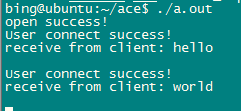
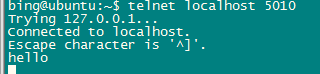
测试结果:
终端1:
终端2:
终端3:

ACE_Reactor内部已经帮我们实现了IO复用。
有了Reactor的demo后,下面一步步查看ACE_Reactor内部是如何运作的:
ACE_Reactor注册EVENT,重载了一个register_handler:
 int

 ACE_Reactor::register_handler (ACE_Event_Handler *event_handler,

                                ACE_Reactor_Mask mask)

 {

   // Remember the old reactor.

   ACE_Reactor *old_reactor = event_handler->reactor ();

   // Assign *this* <Reactor> to the <Event_Handler>.

   event_handler->reactor (this);

   int result = this->implementation ()->register_handler (event_handler, mask);

   if (result == -)

     // Reset the old reactor in case of failures.

     event_handler->reactor (old_reactor);

   return result;

 }
第11行实际是ACE_Reactor_Impl *implementation (void) const;在做实际功能。进一步查看implementation 是如何注册的。
 template <class ACE_SELECT_REACTOR_TOKEN> int

 ACE_Select_Reactor_T<ACE_SELECT_REACTOR_TOKEN>::register_handler

   (ACE_Event_Handler *handler,

    ACE_Reactor_Mask mask)

 {

   ACE_TRACE ("ACE_Select_Reactor_T::register_handler");

   ACE_MT (ACE_GUARD_RETURN (ACE_SELECT_REACTOR_TOKEN, ace_mon, this->token_, -));

   return this->register_handler_i (handler->get_handle (), handler, mask);

 }
这里开始大量使用模板,这里重载了两个在最后调用register_handler_i,在第8行,可以看到调用了get_handle,也就是我们重载的那个函数,所以我们不需要传入ACE_Reactor,它在这一步调用了我们重新的虚函数,获得了handle,当然也可以不做重写,手动传入handle。这个handle就是我们要处理的I/O,而handler则是我们继承ACE_Event_Handler的类。
 template <class ACE_SELECT_REACTOR_TOKEN> int

 ACE_Select_Reactor_T<ACE_SELECT_REACTOR_TOKEN>::register_handler_i

   (ACE_HANDLE handle,

    ACE_Event_Handler *event_handler,

    ACE_Reactor_Mask mask)

 {

   ACE_TRACE ("ACE_Select_Reactor_T::register_handler_i");

   // Insert the <handle, event_handle> tuple into the Handler

   // Repository.

   return this->handler_rep_.bind (handle, event_handler, mask);

 }
到这里,我们看到代码handler_rep_将hande和event_handler绑定了起来,handler_rep_在Select_Reactor_Base.h内为ACE_Select_Reactor_Impl的成员变量。下面我们继续看bind实际是在做什么操作。
 // Bind the <ACE_Event_Handler *> to the <ACE_HANDLE>.

 int

 ACE_Select_Reactor_Handler_Repository::bind (ACE_HANDLE handle,

                                              ACE_Event_Handler *event_handler,

                                              ACE_Reactor_Mask mask)

 {

   ACE_TRACE ("ACE_Select_Reactor_Handler_Repository::bind");

   if (event_handler == )

     return -;

   if (handle == ACE_INVALID_HANDLE)

     handle = event_handler->get_handle ();

   if (this->invalid_handle (handle))

     return -;

   // Is this handle already in the Reactor?

   bool existing_handle = false;

 #if defined (ACE_WIN32)

   map_type::ENTRY * entry = ;

   int const result =

     this->event_handlers_.bind (handle, event_handler, entry);

   if (result == -)

     {

       return -;

     }

   else if (result == )  // Entry already exists.

     {

       // Cannot use a different handler for an existing handle.

       if (event_handler != entry->item ())

         {

           return -;

         }

       else

         {

           // Remember that this handle is already registered in the

           // Reactor.

           existing_handle = true;

         }

     }

 #else

   // Check if this handle is already registered.

   ACE_Event_Handler * const current_handler =

     this->event_handlers_[handle];

   if (current_handler)

     {

       // Cannot use a different handler for an existing handle.

       if (current_handler != event_handler)

         return -;

       // Remember that this handle is already registered in the

       // Reactor.

       existing_handle = true;

     }

   this->event_handlers_[handle] = event_handler;

   if (this->max_handlep1_ < handle + )

     this->max_handlep1_ = handle + ;

 #endif /* ACE_WIN32 */

   if (this->select_reactor_.is_suspended_i (handle))

     {

       this->select_reactor_.bit_ops (handle,

                                      mask,

                                      this->select_reactor_.suspend_set_,

                                      ACE_Reactor::ADD_MASK);

     }

   else

     {

       this->select_reactor_.bit_ops (handle,

                                      mask,

                                      this->select_reactor_.wait_set_,

                                      ACE_Reactor::ADD_MASK);

       // Note the fact that we've changed the state of the <wait_set_>,

       // which is used by the dispatching loop to determine whether it can

       // keep going or if it needs to reconsult select().

       // this->select_reactor_.state_changed_ = 1;

     }

   // If new entry, call add_reference() if needed.

   if (!existing_handle)

     event_handler->add_reference ();

   return ;

 }
这里非常关键,第50行,event_handlers_实则是一个容器,handle和event_hander以index的方式绑定了起来,存储在了一个容器内,第80行还有一行关键代码,ADD_MASK形式的操作加入到了wait_set_成员内。
注册的代码到这里为止,ACE_Reactor实际上调用了几层N个文件,其实就是把handle,即I/O和handler,即继承ACE_Event_Handler的类绑定在了一个容器里。下面看ACE_Reactor是如何进行消息循环的。
 int

 ACE_Reactor::run_reactor_event_loop (REACTOR_EVENT_HOOK eh)

 {

   ACE_TRACE ("ACE_Reactor::run_reactor_event_loop");

   if (this->reactor_event_loop_done ())

     return ;

   while ()

     {

       int const result = this->implementation_->handle_events ();

       if (eh !=  && (*eh)(this))

         continue;

       else if (result == - && this->implementation_->deactivated ())

         return ;

       else if (result == -)

         return -;

     }

   ACE_NOTREACHED (return ;)

 }
同样,将loop交给了ACE_Reactor_Impl *implementation (void) const;操作。
继续跟踪
 template <class ACE_SELECT_REACTOR_TOKEN> int

 ACE_Select_Reactor_T<ACE_SELECT_REACTOR_TOKEN>::handle_events

   (ACE_Time_Value &max_wait_time)

 {

   ACE_TRACE ("ACE_Select_Reactor_T::handle_events");

   return this->handle_events (&max_wait_time);

 }
再次到了模板,调用handle_events,下面到了关键代码
 template <class ACE_SELECT_REACTOR_TOKEN> int

 ACE_Select_Reactor_T<ACE_SELECT_REACTOR_TOKEN>::handle_events_i

   (ACE_Time_Value *max_wait_time)

 {

   int result = -;

   ACE_SEH_TRY

     {

       // We use the data member dispatch_set_ as the current dispatch

       // set.

       // We need to start from a clean dispatch_set

       this->dispatch_set_.rd_mask_.reset ();

       this->dispatch_set_.wr_mask_.reset ();

       this->dispatch_set_.ex_mask_.reset ();

       int number_of_active_handles =

         this->wait_for_multiple_events (this->dispatch_set_,

                                         max_wait_time);

       result =

         this->dispatch (number_of_active_handles,

                         this->dispatch_set_);

     }

   ACE_SEH_EXCEPT (this->release_token ())

     {

       // As it stands now, we catch and then rethrow all Win32

       // structured exceptions so that we can make sure to release the

       // <token_> lock correctly.

     }

   return result;

 }
第18行wait_for_multiple_events和第22行dispatch。分别做了两件非常关键的事。
 // Must be called with lock held.

 template <class ACE_SELECT_REACTOR_TOKEN> int

 ACE_Select_Reactor_T<ACE_SELECT_REACTOR_TOKEN>::wait_for_multiple_events

   (ACE_Select_Reactor_Handle_Set &dispatch_set,

    ACE_Time_Value *max_wait_time)

 {

   ACE_TRACE ("ACE_Select_Reactor_T::wait_for_multiple_events");

   ACE_Time_Value timer_buf ();

   ACE_Time_Value *this_timeout = ;

   int number_of_active_handles = this->any_ready (dispatch_set);

   // If there are any bits enabled in the <ready_set_> then we'll

   // handle those first, otherwise we'll block in <select>.

   if (number_of_active_handles == )

     {

       do

         {

           if (this->timer_queue_ == )

             return ;

           this_timeout =

             this->timer_queue_->calculate_timeout (max_wait_time,

                                                    &timer_buf);

 #ifdef ACE_WIN32

           // This arg is ignored on Windows and causes pointer

           // truncation warnings on 64-bit compiles.

           int const width = ;

 #else

           int const width = this->handler_rep_.max_handlep1 ();

 #endif  /* ACE_WIN32 */

           dispatch_set.rd_mask_ = this->wait_set_.rd_mask_;

           dispatch_set.wr_mask_ = this->wait_set_.wr_mask_;

           dispatch_set.ex_mask_ = this->wait_set_.ex_mask_;

           number_of_active_handles = ACE_OS::select (width,

                                                      dispatch_set.rd_mask_,

                                                      dispatch_set.wr_mask_,

                                                      dispatch_set.ex_mask_,

                                                      this_timeout);

         }

       while (number_of_active_handles == - && this->handle_error () > );

       if (number_of_active_handles > )

         {

 #if !defined (ACE_WIN32)

           // Resynchronize the fd_sets so their "max" is set properly.

           dispatch_set.rd_mask_.sync (this->handler_rep_.max_handlep1 ());

           dispatch_set.wr_mask_.sync (this->handler_rep_.max_handlep1 ());

           dispatch_set.ex_mask_.sync (this->handler_rep_.max_handlep1 ());

 #endif /* ACE_WIN32 */

         }

       else if (number_of_active_handles == -)

         {

           // Normally, select() will reset the bits in dispatch_set

           // so that only those filed descriptors that are ready will

           // have bits set.  However, when an error occurs, the bit

           // set remains as it was when the select call was first made.

           // Thus, we now have a dispatch_set that has every file

           // descriptor that was originally waited for, which is not

           // correct.  We must clear all the bit sets because we

           // have no idea if any of the file descriptors is ready.

           //

           // NOTE: We dont have a test case to reproduce this

           // problem. But pleae dont ignore this and remove it off.

           dispatch_set.rd_mask_.reset ();

           dispatch_set.wr_mask_.reset ();

           dispatch_set.ex_mask_.reset ();

         }

     }

   // Return the number of events to dispatch.

   return number_of_active_handles;

 }
第35行熟悉的变量wait_set_和第38行函数select,到这里发现,Reactor的I/O监控,就是利用select函数监控之前注册进去且ADD到wait_set_的handle,即I/O。
当有I/O事件,即返回值的number_of_active_handles不为0时,将进行dispatch。
 template <class ACE_SELECT_REACTOR_TOKEN> int

 ACE_Select_Reactor_T<ACE_SELECT_REACTOR_TOKEN>::dispatch

   (int active_handle_count,

    ACE_Select_Reactor_Handle_Set &dispatch_set)

 {

   ACE_TRACE ("ACE_Select_Reactor_T::dispatch");

   int io_handlers_dispatched = ;

   int other_handlers_dispatched = ;

   int signal_occurred = ;

   // The following do/while loop keeps dispatching as long as there

   // are still active handles.  Note that the only way we should ever

   // iterate more than once through this loop is if signals occur

   // while we're dispatching other handlers.

   do

     {

       // We expect that the loop will decrease the number of active

       // handles in each iteration.  If it does not, then something is

       // inconsistent in the state of the Reactor and we should avoid

       // the loop.  Please read the comments on bug 2540 for more

       // details.

       int initial_handle_count = active_handle_count;

       // Note that we keep track of changes to our state.  If any of

       // the dispatch_*() methods below return -1 it means that the

       // <wait_set_> state has changed as the result of an

       // <ACE_Event_Handler> being dispatched.  This means that we

       // need to bail out and rerun the select() loop since our

       // existing notion of handles in <dispatch_set> may no longer be

       // correct.

       //

       // In the beginning, our state starts out unchanged.  After

       // every iteration (i.e., due to signals), our state starts out

       // unchanged again.

       this->state_changed_ = false;

       // Perform the Template Method for dispatching all the handlers.

       // First check for interrupts.

       if (active_handle_count == -)

         {

           // Bail out -- we got here since <select> was interrupted.

           if (ACE_Sig_Handler::sig_pending () != )

             {

               ACE_Sig_Handler::sig_pending ();

               // If any HANDLES in the <ready_set_> are activated as a

               // result of signals they should be dispatched since

               // they may be time critical...

               active_handle_count = this->any_ready (dispatch_set);

               // Record the fact that the Reactor has dispatched a

               // handle_signal() method.  We need this to return the

               // appropriate count below.

               signal_occurred = ;

             }

           else

             return -;

         }

       // Handle timers early since they may have higher latency

       // constraints than I/O handlers.  Ideally, the order of

       // dispatching should be a strategy...

       else if (this->dispatch_timer_handlers (other_handlers_dispatched) == -)

         // State has changed or timer queue has failed, exit loop.

         break;

       // Check to see if there are no more I/O handles left to

       // dispatch AFTER we've handled the timers...

       else if (active_handle_count == )

         return io_handlers_dispatched

           + other_handlers_dispatched

           + signal_occurred;

       // Next dispatch the notification handlers (if there are any to

       // dispatch).  These are required to handle multi-threads that

       // are trying to update the <Reactor>.

       else if (this->dispatch_notification_handlers

                (dispatch_set,

                 active_handle_count,

                 other_handlers_dispatched) == -)

         // State has changed or a serious failure has occured, so exit

         // loop.

         break;

       // Finally, dispatch the I/O handlers.

       else if (this->dispatch_io_handlers

                (dispatch_set,

                 active_handle_count,

                 io_handlers_dispatched) == -)

         // State has changed, so exit loop.

         break;

       // if state changed, we need to re-eval active_handle_count,

       // so we will not end with an endless loop

       if (initial_handle_count == active_handle_count

           || this->state_changed_)

       {

         active_handle_count = this->any_ready (dispatch_set);

       }

     }

   while (active_handle_count > );

   return io_handlers_dispatched + other_handlers_dispatched + signal_occurred;

 }
这里一步步按顺序进行判断分发,进入dispatch_notification_handlers,调用到Select_Reactor_Base.cpp的dispatch_notifications,到这里终于看到熟悉的函数。
 // Handles pending threads (if any) that are waiting to unblock the

 // Select_Reactor.

 int

 ACE_Select_Reactor_Notify::dispatch_notifications (int &number_of_active_handles,

                                                    ACE_Handle_Set &rd_mask)

 {

   ACE_TRACE ("ACE_Select_Reactor_Notify::dispatch_notifications");

   ACE_HANDLE const read_handle =

     this->notification_pipe_.read_handle ();

   if (read_handle != ACE_INVALID_HANDLE

       && rd_mask.is_set (read_handle))

     {

       --number_of_active_handles;

       rd_mask.clr_bit (read_handle);

       return this->handle_input (read_handle);

     }

   else

     return ;

 }
第18行,调用了自己的handle_input,还不是最开始外部重载的handle_input,查看最后这个函数。
 int

 ACE_Select_Reactor_Notify::handle_input (ACE_HANDLE handle)

 {

   ACE_TRACE ("ACE_Select_Reactor_Notify::handle_input");

   // Precondition: this->select_reactor_.token_.current_owner () ==

   // ACE_Thread::self ();

   int number_dispatched = ;

   int result = ;

   ACE_Notification_Buffer buffer;

   // If there is only one buffer in the pipe, this will loop and call

   // read_notify_pipe() twice.  The first time will read the buffer, and

   // the second will read the fact that the pipe is empty.

   while ((result = this->read_notify_pipe (handle, buffer)) > )

     {

       // Dispatch the buffer

       // NOTE: We count only if we made any dispatches ie. upcalls.

       if (this->dispatch_notify (buffer) > )

         ++number_dispatched;

       // Bail out if we've reached the <notify_threshold_>.  Note that

       // by default <notify_threshold_> is -1, so we'll loop until all

       // the notifications in the pipe have been dispatched.

       if (number_dispatched == this->max_notify_iterations_)

         break;

     }

   // Reassign number_dispatched to -1 if things have gone seriously

   // wrong.

   if (result < )

     number_dispatched = -;

   // Enqueue ourselves into the list of waiting threads.  When we

   // reacquire the token we'll be off and running again with ownership

   // of the token.  The postcondition of this call is that

   // <select_reactor_.token_.current_owner> == <ACE_Thread::self>.

   this->select_reactor_->renew ();

   return number_dispatched;

 }
第15行,取数据,第19行dispatch_notify
 int

 ACE_Select_Reactor_Notify::dispatch_notify (ACE_Notification_Buffer &buffer)

 {

   int result = ;

 #if defined (ACE_HAS_REACTOR_NOTIFICATION_QUEUE)

   // Dispatch one message from the notify queue, and put another in

   // the pipe if one is available.  Remember, the idea is to keep

   // exactly one message in the pipe at a time.

   bool more_messages_queued = false;

   ACE_Notification_Buffer next;

   result = notification_queue_.pop_next_notification(buffer,

                                                      more_messages_queued,

                                                      next);

   if (result ==  || result == -)

     {

       return result;

     }

   if(more_messages_queued)

     {

       (void) ACE::send(this->notification_pipe_.write_handle(),

             (char *)&next, sizeof(ACE_Notification_Buffer));

     }

 #endif /* ACE_HAS_REACTOR_NOTIFICATION_QUEUE */

   // If eh == 0 then another thread is unblocking the

   // <ACE_Select_Reactor> to update the <ACE_Select_Reactor>'s

   // internal structures.  Otherwise, we need to dispatch the

   // appropriate handle_* method on the <ACE_Event_Handler> pointer

   // we've been passed.

   if (buffer.eh_ != )

     {

       ACE_Event_Handler *event_handler = buffer.eh_;

       bool const requires_reference_counting =

         event_handler->reference_counting_policy ().value () ==

         ACE_Event_Handler::Reference_Counting_Policy::ENABLED;

       switch (buffer.mask_)

         {

         case ACE_Event_Handler::READ_MASK:

         case ACE_Event_Handler::ACCEPT_MASK:

           result = event_handler->handle_input (ACE_INVALID_HANDLE);

           break;

         case ACE_Event_Handler::WRITE_MASK:

           result = event_handler->handle_output (ACE_INVALID_HANDLE);

           break;

         case ACE_Event_Handler::EXCEPT_MASK:

           result = event_handler->handle_exception (ACE_INVALID_HANDLE);

           break;

         case ACE_Event_Handler::QOS_MASK:

           result = event_handler->handle_qos (ACE_INVALID_HANDLE);

           break;

         case ACE_Event_Handler::GROUP_QOS_MASK:

           result = event_handler->handle_group_qos (ACE_INVALID_HANDLE);

           break;

         default:

           // Should we bail out if we get an invalid mask?

           ACE_ERROR ((LM_ERROR,

                       ACE_TEXT ("invalid mask = %d\n"),

                       buffer.mask_));

         }

       if (result == -)

         event_handler->handle_close (ACE_INVALID_HANDLE,

                                      ACE_Event_Handler::EXCEPT_MASK);

       if (requires_reference_counting)

         {

           event_handler->remove_reference ();

         }

     }

   return ;

 }
到这里,终于看到调用到我们最开始继承ACE_Event_Handler重写的那个回调handle_input()了。
至此,ACE_Reactor内部源码的执行过程全部结束,其实ACE并没有做非常特别的事,注册利用一个容器进行I/O和回调方法的绑定,I/O复用利用select,最后发生I/O事件找到对应的event函数handle_input执行。
怪不得网上有人抱怨ACE代码臃肿了,这些我们关心“简单”过程的代码就这么多的复杂用法和调用,更不用说我们还没用上的了,但是ACE提供的Reactor框架确实方便了我们使用,也提供了可靠的移植性和性能。
ACE - Reactor模式源码剖析及具体实现(大量源码慎入)的更多相关文章
- Spring源码剖析9:Spring事务源码剖析
转自:http://www.linkedkeeper.com/detail/blog.action?bid=1045 声明式事务使用 Spring事务是我们日常工作中经常使用的一项技术,Spring提 ...
- Apache Spark源码剖析
Apache Spark源码剖析(全面系统介绍Spark源码,提供分析源码的实用技巧和合理的阅读顺序,充分了解Spark的设计思想和运行机理) 许鹏 著 ISBN 978-7-121-25420- ...
- Django Rest Framework源码剖析(五)-----解析器
一.简介 解析器顾名思义就是对请求体进行解析.为什么要有解析器?原因很简单,当后台和前端进行交互的时候数据类型不一定都是表单数据或者json,当然也有其他类型的数据格式,比如xml,所以需要解析这类数 ...
- Java ArrayList源码剖析
转自: Java ArrayList源码剖析 总体介绍 ArrayList实现了List接口,是顺序容器,即元素存放的数据与放进去的顺序相同,允许放入null元素,底层通过数组实现.除该类未实现同步外 ...
- Java HashSet和HashMap源码剖析
转自: Java HashSet和HashMap源码剖析 总体介绍 之所以把HashSet和HashMap放在一起讲解,是因为二者在Java里有着相同的实现,前者仅仅是对后者做了一层包装,也就是说Ha ...
- drf源码剖析系列(系列目录)
drf源码剖析系列(系列目录) 01 drf源码剖析之restful规范 02 drf源码剖析之快速了解drf 03 drf源码剖析之视图 04 drf源码剖析之版本 05 drf源码剖析之认证 06 ...
- muduo库源码剖析(一) reactor模式
一. Reactor模式简介 Reactor释义“反应堆”,是一种事件驱动机制.和普通函数调用的不同之处在于:应用程序不是主动的调用某个API完成处理,而是恰恰相反,Reactor逆置了事件处理流程, ...
- ACE - ACE_Task源码剖析及线程池实现
原文出自http://www.cnblogs.com/binchen-china,禁止转载. 上篇提到用Reactor模式,利用I/O复用,获得Socket数据并且实现I/O层单线程并发,和dispa ...
- 设计模式(二十二)——状态模式(APP抽奖活动+借贷平台源码剖析)
24.1 APP 抽奖活动问题 请编写程序完成 APP 抽奖活动 具体要求如下: 1) 假如每参加一次这个活动要扣除用户 50 积分,中奖概率是 10% 2) 奖品数量固定,抽完就不能抽奖 3) 活动 ...
随机推荐
- word2013 blog test
测试一:style里的内容能保存吗?: int read; byte * buf; int tries; int read; byte * buf ...
- STM32学习笔记(十) CAN通讯测试(环回模式)
1.CAN通讯的理解 想学习CAN通讯,那么要对通讯协议有一定的认知.通讯协议是指通信双方对数据传送控制的一种约定.约定中包括对数据格式,同步方式,传输速度,传送步骤,检纠错方式以及控制字符定义等问题 ...
- Android属性动画完全解析(上),初识属性动画的基本用法
转载请注明出处:http://blog.csdn.net/guolin_blog/article/details/43536355 在手机上去实现一些动画效果算是件比较炫酷的事情,因此Android系 ...
- Unity5 GI与PBS渲染从用法到着色代码
http://www.cnblogs.com/zhouxin/p/5168632.html 本文主要介绍Untiy5以后的GI,PBS,以及光源探头,反射探头的用法以及在着色器代码中如何发挥作用,GI ...
- DAS、SAN、NAS的区别
在服务企业的过程中,经常会接触到存储,但是又容易和市面上的一些什么NAS等混淆. DAS 与主机直连的存储设备 NAS 存储设备自带文件系统 SAN 存储设备的互联依赖网络,比如IP-SAN, FC- ...
- callee
首先解释callee 参考网站 http://www.css88.com/archives/1706 callee是arguments的一个成员,仅当函数正在执行的时候才可用,so用于递归也行 代码示 ...
- js+css3文字模糊代码
在写文字模糊的时候要理清自己的思路,根据以下的步骤来: 对你要模糊的文字进行布局 <body style="background:#ccc;"> <ul clas ...
- [转]浏览器渲染机制——一定要放在body底部的js引用
转自:http://blog.csdn.net/u012251421/article/details/50536265 说明: 本文提到的浏览器均是指Chrome. “script标签“指的都是普通的 ...
- 转linq中的Single()、First()、Take(1) LINQ 标准的查询操作符 排序 orderby、thenby、Take
Single():操作一个集合,同时强要求只有一个对象匹配,并返回这一个. First():操作一个集合,可以有多个对象匹配,但是只返回第一个. Take(1):操作一个集合,可以有对个对象匹配,单只 ...
- android 发短信
SmsManager smsManager = SmsManager.getDefault(); List<String> divideContents = smsManager.divi ...