
WebAPI 2参数绑定方法
简单类型参数
Example 1: Sending a simple parameter in the Url
[RoutePrefix("api/values")]

public class ValuesController : ApiController

{

  // http://localhost:49407/api/values/example1?id=2

  [Route("example1")]

  [HttpGet]

  public string Get(int id)

  {

     return "value";

  }

}
Example 2: Sending simple parameters in the Url
// http://localhost:49407/api/values/example2?id1=1&id2=2&id3=3

[Route("example2")]

[HttpGet]

public string GetWith3Parameters(int id1, long id2, double id3)

{

    return "value";

}
Example 3: Sending simple parameters using attribute routing
// http://localhost:49407/api/values/example3/2/3/4

[Route("example3/{id1}/{id2}/{id3}")]

[HttpGet]

public string GetWith3ParametersAttributeRouting(int id1, long id2, double id3)

{

   return "value";

}
Example 4: Sending an object in the Url
// http://localhost:49407/api/values/example4?id1=1&id2=2&id3=3

[Route("example4")]

[HttpGet]

public string GetWithUri([FromUri] ParamsObject paramsObject)

{

  return "value:" + paramsObject.Id1;

}
Example 5: Sending an object in the Request body
[Route("example5")]

[HttpPost]

public string GetWithBody([FromBody] ParamsObject paramsObject)

{

  return "value:" + paramsObject.Id1;

}
注意 [FromBody] 只能用一次,多于一次将不能正常工作
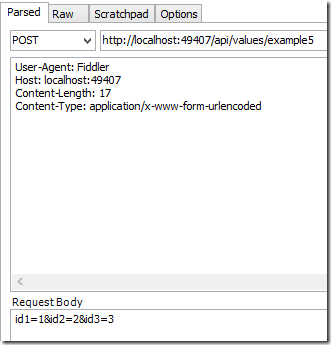
Calling the method using Urlencoded in the body:
User-Agent: Fiddler

Host: localhost:49407

Content-Length: 32

Content-Type: application/x-www-form-urlencoded

id1=1&id2=2&id3=3
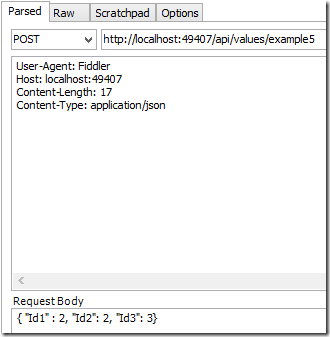
Calling the method using Json in the body:
User-Agent: Fiddler

Host: localhost:49407

Content-Length: 32

Content-Type: application/json

{ "Id1" : 2, "Id2": 2, "Id3": 3}
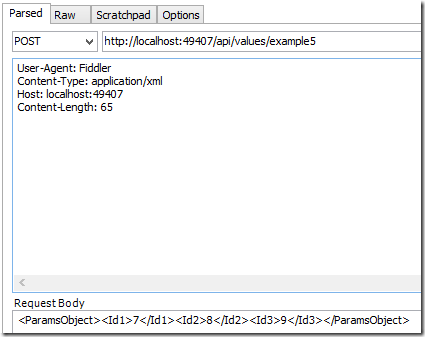
Calling the method using XML in the body
This requires extra code in the Global.asax
protected void Application_Start()

{

   var xml = GlobalConfiguration.Configuration.Formatters.XmlFormatter;

   xml.UseXmlSerializer = true;

The client request is as follows:

User-Agent: Fiddler

Content-Type: application/xml

Host: localhost:49407

Content-Length: 65

<ParamsObject><Id1>7</Id1><Id2>8</Id2><Id3>9</Id3></ParamsObject>
数组和列表(Array,List)
Example 6: Sending a simple list in the Url
// http://localhost:49407/api/values/example6?paramsObject=2,paramsObject=4,paramsObject=9

[Route("example6")]

[HttpGet]

public string GetListFromUri([FromUri] List<int> paramsObject)

{

  if (paramsObject != null)

  {

	return "recieved a list with length:" + paramsObject.Count;

  }

  return "NOTHING RECIEVED...";

}
Example 7: Sending an object list in the Body
// http://localhost:49407/api/values/example8

[Route("example8")]

[HttpPost]

public string GetListFromBody([FromBody] List<ParamsObject> paramsList)

{

  if (paramsList != null)

  {

     return "recieved a list with length:" + paramsList.Count;

  }

  return "NOTHING RECIEVED...";

}
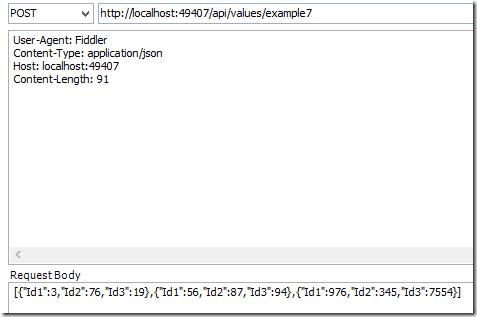
Calling with Json:
User-Agent: Fiddler

Content-Type: application/json

Host: localhost:49407

Content-Length: 91

[{"Id1":3,"Id2":76,"Id3":19},{"Id1":56,"Id2":87,"Id3":94},{"Id1":976,"Id2":345,"Id3":7554}]
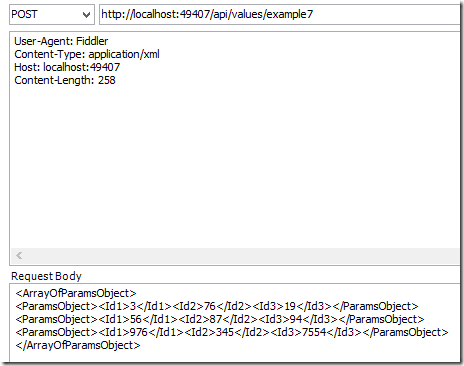
Calling with XML:
User-Agent: Fiddler

Content-Type: application/xml

Host: localhost:49407

Content-Length: 258

<ArrayOfParamsObject>

<ParamsObject><Id1>3</Id1><Id2>76</Id2><Id3>19</Id3></ParamsObject>

<ParamsObject><Id1>56</Id1><Id2>87</Id2><Id3>94</Id3></ParamsObject>

<ParamsObject><Id1>976</Id1><Id2>345</Id2><Id3>7554</Id3></ParamsObject>

</ArrayOfParamsObject>
Example 8: Sending object lists in the Body
[Route("example8")]

[HttpPost]

public string GetListsFromBody([FromBody] List<List<ParamsObject>> paramsList)

{

  if (paramsList != null)

  {

	return "recieved a list with length:" + paramsList.Count;

  }

  return "NOTHING RECIEVED...";

}
This is a little bit different to the previous examples. The body can only send one single object to Web API. Because of this, the lists of objects are wrapped in a list or a parent object.
POST http://localhost:49407/api/values/example8 HTTP/1.1

User-Agent: Fiddler

Content-Type: application/json

Host: localhost:49407

Content-Length: 185

[

 [

  {"Id1":3,"Id2":76,"Id3":19},

  {"Id1":56,"Id2":87,"Id3":94},

  {"Id1":976,"Id2":345,"Id3":7554}

 ],

 [

  {"Id1":3,"Id2":76,"Id3":19},

  {"Id1":56,"Id2":87,"Id3":94},

  {"Id1":976,"Id2":345,"Id3":7554}

 ]

]
自定义参数
What if the default parameter binding is not enough? Then you can use the ModelBinder class to change your parameters and create your own parameter formats. You could also use ActionFilters for this. Many blogs exist which already explains how to use the ModelBinder class. See the links underneath.
文件和二进制
Files or binaries can also be sent to Web API methods. The articledemonstrates how to do this.
参考
http://aspnet.codeplex.com/SourceControl/latest#Samples/WebApi/CustomParameterBinding/
http://www.asp.net/web-api/overview/formats-and-model-binding/parameter-binding-in-aspnet-web-api
http://www.roelvanlisdonk.nl/?p=3505
http://stackoverflow.com/questions/14628576/passing-an-json-array-to-mvc-web-api-via-get
WebAPI 2参数绑定方法的更多相关文章
- WebApi 参数绑定方法
WebAPI 2参数绑定方法 简单类型参数 Example 1: Sending a simple parameter in the Url 01 02 03 04 05 06 07 08 09 ...
- ASP.NET WebAPI 05 参数绑定
ParameterBindingAttribute 在上一篇中重点讲了ModelBinderAttribute的使用场景.这一篇详细的讲一下ModelBinder背后的参数绑定原理. ModelBin ...
- springMVC使用HandlerMethodArgumentResolver 自定义解析器实现请求参数绑定方法参数
http://blog.csdn.net/truong/article/details/30971317 http://blog.csdn.net/fytain/article/details/439 ...
- [译]WebAPI下的如何实现参数绑定
本文将概述在WebAPI方式下将如何将参数绑定到一个action方法,包括参数是如何被读取,一系列规则决定特定环境采用的那种绑定方式,文章最后将给出一些实际的例子. Parameter binding ...
- SpringMVC-简单参数绑定
SpringMVC-简单参数绑定 众所周知,springmvc是用来处理页面的一些请求,然后将数据再通过视图返回给用户的,前面的几篇博文中使用的都是静态数据,为了能快速入门springmvc,在 ...
- 使用ASP.Net WebAPI构建REST服务(四)——参数绑定
默认绑定方式 WebAPI把参数分成了简单类型和复杂类型: 简单类型主要包括CLR的primitive types,(int.double.bool等),系统内置的几个strcut类型(TimeSpa ...
- WebAPI下的如何实现参数绑定
本文将概述在WebAPI方式下将如何将参数绑定到一个action方法,包括参数是如何被读取,一系列规则决定特定环境采用的那种绑定方式,文章最后将给出一些实际的例子. Parameter binding ...
- WebAPI路由、参数绑定
一.测试Web API a)测试Web API可以用来检测请求和返回数据是否正常,可以使用Fiddler.Postman等工具.以Fiddler为例,这是一个http协议调试代理工具,它能够记录客 ...
- 使用@RequestParam绑定请求参数到方法参数
@RequestParam注解用于在控制器中绑定请求参数到方法参数.用法如下:@RequestMapping public void advancedSearch( @RequestParam(& ...
随机推荐
- 从0开始搭建SQL Server AlwaysOn 第三篇(配置AlwaysOn)
从0开始搭建SQL Server AlwaysOn 第三篇(配置AlwaysOn) 第一篇http://www.cnblogs.com/lyhabc/p/4678330.html第二篇http://w ...
- angular 源码分析 1 - angularInit()
angularjs 是个神奇的框架,由于我的好奇,想了解她的内部工作原理,只能一步一步的走进她,靠近她,和她深入的交流. angularjs 的入口是什么样子的呢?一起掀起她的盖头吧. 在这里我只讲方 ...
- Angularjs参考框架地址
1.Table(Grid)参考地址 https://github.com/samu/angular-table https://github.com/daniel-nagy/md-data-table ...
- Effective前端2:优化html标签
div { float: left; } .keyboard > div + div { margin-left: 8px; } --> div{display:table-cell;ve ...
- if __name__== "__main__" 的意思(作用)python代码复用
if __name__== "__main__" 的意思(作用)python代码复用 转自:大步's Blog http://www.dabu.info/if-__-name__ ...
- 【夯实PHP基础】UML序列图总结
原文地址 序列图主要用于展示对象之间交互的顺序. 序列图将交互关系表示为一个二维图.纵向是时间轴,时间沿竖线向下延伸.横向轴代表了在协作中各独立对象的类元角色.类元角色用生命线表示.当对象存在时,角色 ...
- Linux基础介绍【第六篇】
定时任务crond介绍 crond是什么? crond是linux系统中用来定期执行命令或指定程序任务的一种服务或软件.一般情况下,安装完CentOS5/6 linux操作系统之后,默认便会启动cro ...
- mac下生成ssh keys 并上传github仓储
使用github仓储需要本机生成一个公钥key 添加到自己的git账户SSH keys中 mac 生成方法: 1. 打开终端 输入 ssh-keygen 然后系统提示输入文件保存位置等信息 ...
- 排序算法----调用库函数qsort进行快速排序
功 能: 快速排序 头文件:stdlib.h 用 法: void qsort(void *base,int nelem,int width,int (*fcmp)(const void *,const ...
- BZOJ 4453: cys就是要拿英魂![后缀数组 ST表 单调栈类似物]
4453: cys就是要拿英魂! Time Limit: 3 Sec Memory Limit: 128 MBSubmit: 90 Solved: 46[Submit][Status][Discu ...