
【转】Android应用底部导航栏(选项卡)实例
现在很多android的应用都采用底部导航栏的功能,这样可以使得用户在使用过程中随意切换不同的页面,现在我采用TabHost组件来自定义一个底部的导航栏的功能。
我们先看下该demo实例的框架图:
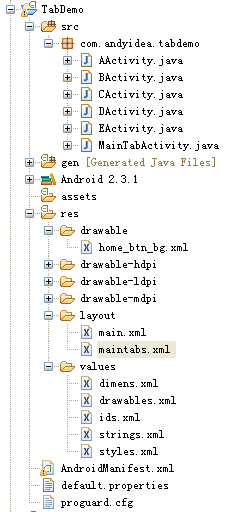
其中各个类的作用以及资源文件就不详细解释了,还有资源图片(在该Demo中借用了其它应用程序的资源图片)也不提供了,大家可以自行更换自己需要的资源图片。直接上各个布局文件或各个类的代码:
[1] res/layout目录下的 maintabs.xml 源码:
<?xml version="1.0" encoding="UTF-8"?>
<TabHost android:id="@android:id/tabhost" android:layout_width="fill_parent" android:layout_height="fill_parent"
xmlns:android="http://schemas.android.com/apk/res/android">
<LinearLayout android:orientation="vertical" android:layout_width="fill_parent" android:layout_height="fill_parent">
<FrameLayout android:id="@android:id/tabcontent" android:layout_width="fill_parent" android:layout_height="0.0dip" android:layout_weight="1.0" />
<TabWidget android:id="@android:id/tabs" android:visibility="gone" android:layout_width="fill_parent" android:layout_height="wrap_content" android:layout_weight="0.0" />
<RadioGroup
android:gravity="center_vertical" android:layout_gravity="bottom" android:orientation="horizontal" android:id="@id/main_radio" android:background="@drawable/maintab_toolbar_bg"
android:layout_width="fill_parent" android:layout_height="wrap_content">
<RadioButton android:id="@id/radio_button0" android:layout_marginTop="2.0dip" android:text="@string/main_home" android:drawableTop="@drawable/icon_1_n" style="@style/main_tab_bottom" />
<RadioButton android:id="@id/radio_button1" android:layout_marginTop="2.0dip" android:text="@string/main_news" android:drawableTop="@drawable/icon_2_n" style="@style/main_tab_bottom" />
<RadioButton android:id="@id/radio_button2" android:layout_marginTop="2.0dip" android:text="@string/main_manage_date" android:drawableTop="@drawable/icon_3_n" style="@style/main_tab_bottom" />
<RadioButton android:id="@id/radio_button3" android:layout_marginTop="2.0dip" android:text="@string/main_friends" android:drawableTop="@drawable/icon_4_n" style="@style/main_tab_bottom" />
<RadioButton android:id="@id/radio_button4" android:layout_marginTop="2.0dip" android:text="@string/more" android:drawableTop="@drawable/icon_5_n" style="@style/main_tab_bottom" />
</RadioGroup>
</LinearLayout>
</TabHost>
[2] res/drawable 下的 home_btn_bg.xml 源码:
<?xml version="1.0" encoding="UTF-8"?>
<selector
xmlns:android="http://schemas.android.com/apk/res/android">
<item android:state_focused="true" android:state_enabled="true" android:state_pressed="false" android:drawable="@drawable/home_btn_bg_s" />
<item android:state_enabled="true" android:state_pressed="true" android:drawable="@drawable/home_btn_bg_s" />
<item android:state_enabled="true" android:state_checked="true" android:drawable="@drawable/home_btn_bg_d" />
<item android:drawable="@drawable/transparent" />
</selector>
[3] res/values 下的源码:
dimens.xml源码
<?xml version="1.0" encoding="utf-8"?> <resources>
<dimen name="bottom_tab_font_size">10.0sp</dimen>
<dimen name="bottom_tab_padding_up">5.0dip</dimen>
<dimen name="bottom_tab_padding_drawable">2.0dip</dimen>
<dimen name="switch_logo_bottom_padding">30.0sp</dimen>
<dimen name="widget_height">100.0dip</dimen>
<dimen name="sta_height">48.0dip</dimen>
<dimen name="large_padding_length">20.0dip</dimen>
<dimen name="widget_write_margin_top">19.0dip</dimen>
<dimen name="widget_write_margin_left">10.0dip</dimen>
<dimen name="widget_content_margin_top">20.0dip</dimen>
<dimen name="widget_content_margin_left">10.0dip</dimen>
<dimen name="widget_logo_size">35.0dip</dimen>
<dimen name="title_height">74.0dip</dimen>
<dimen name="new_blog_size">70.0dip</dimen>
<dimen name="emotion_item_view_height">13.299988dip</dimen>
<dimen name="splash_test_top_margin_top">20.0dip</dimen>
<dimen name="splash_test_center_margin_right">0.0dip</dimen>
<dimen name="title_text_size">20.0sp</dimen>
<dimen name="normal_padding_length">10.0dip</dimen>
<dimen name="no_result_padding_length">50.0dip</dimen>
</resources>
drawables.xml源码:
<?xml version="1.0" encoding="utf-8"?> <resources>
<item type="drawable" name="ltgray">#fff4f4f4</item>
<item type="drawable" name="ltyellow">#fffff4db</item>
<item type="drawable" name="black">#ff000000</item>
<item type="drawable" name="transparent">#00000000</item>
<item type="drawable" name="widget_edit_block_bg_normal">@android:color/transparent</item>
<item type="drawable" name="transparent_background">#99000000</item>
<item type="drawable" name="list_background">#fff4f4f4</item>
<item type="drawable" name="namcard_picker_bkg_normal">#ff272727</item>
<item type="drawable" name="namcard_picker_bkg_hover">#ff333333</item>
</resources>
ids.xml源码:
<?xml version="1.0" encoding="utf-8"?> <resources>
<item type="id" name="main_radio">false</item>
<item type="id" name="radio_button0">false</item>
<item type="id" name="radio_button1">false</item>
<item type="id" name="radio_button2">false</item>
<item type="id" name="radio_button3">false</item>
<item type="id" name="radio_button4">false</item>
</resources>
strings.xml源码:
<?xml version="1.0" encoding="utf-8"?>
<resources>
<string name="hello">Hello World, MainTabActivity!</string>
<string name="app_name">TabDemo</string>
<string name="main_news">消息</string>
<string name="main_home">首页</string>
<string name="more">更多</string>
<string name="main_manage_date">时间</string>
<string name="main_friends">好友</string>
</resources>
styles.xml源码:
<?xml version="1.0" encoding="utf-8"?> <resources>
<style name="main_tab_bottom">
<item name="android:textSize">@dimen/bottom_tab_font_size</item>
<item name="android:textColor">#ffffffff</item>
<item name="android:ellipsize">marquee</item>
<item name="android:gravity">center_horizontal</item>
<item name="android:background">@drawable/home_btn_bg</item>
<item name="android:paddingTop">@dimen/bottom_tab_padding_up</item>
<item name="android:paddingBottom">2.0dip</item>
<item name="android:layout_width">fill_parent</item>
<item name="android:layout_height">wrap_content</item>
<item name="android:layout_marginBottom">2.0dip</item>
<item name="android:button">@null</item>
<item name="android:singleLine">true</item>
<item name="android:drawablePadding">@dimen/bottom_tab_padding_drawable</item>
<item name="android:layout_weight">1.0</item>
</style>
</resources>
[4] src/com.andyidea.tabdemo包下面各个UI界面类源码:
MainTabActivity.java源码:
package com.andyidea.tabdemo;
import android.app.TabActivity; import android.content.Intent; import android.os.Bundle; import android.view.Window; import android.widget.CompoundButton; import android.widget.RadioButton; import android.widget.CompoundButton.OnCheckedChangeListener; import android.widget.TabHost;
public class MainTabActivity extends TabActivity implements OnCheckedChangeListener{
private TabHost mTabHost;
private Intent mAIntent;
private Intent mBIntent;
private Intent mCIntent;
private Intent mDIntent;
private Intent mEIntent;
/** Called when the activity is first created. */
@Override
public void onCreate(Bundle savedInstanceState) {
super.onCreate(savedInstanceState);
requestWindowFeature(Window.FEATURE_NO_TITLE);
setContentView(R.layout.maintabs);
this.mAIntent = new Intent(this,AActivity.class);
this.mBIntent = new Intent(this,BActivity.class);
this.mCIntent = new Intent(this,CActivity.class);
this.mDIntent = new Intent(this,DActivity.class);
this.mEIntent = new Intent(this,EActivity.class);
((RadioButton) findViewById(R.id.radio_button0)) .setOnCheckedChangeListener(this);
((RadioButton) findViewById(R.id.radio_button1)) .setOnCheckedChangeListener(this);
((RadioButton) findViewById(R.id.radio_button2)) .setOnCheckedChangeListener(this);
((RadioButton) findViewById(R.id.radio_button3)) .setOnCheckedChangeListener(this);
((RadioButton) findViewById(R.id.radio_button4)) .setOnCheckedChangeListener(this);
setupIntent();
}
@Override
public void onCheckedChanged(CompoundButton buttonView, boolean isChecked) {
if(isChecked){
switch (buttonView.getId()) {
case R.id.radio_button0: this.mTabHost.setCurrentTabByTag("A_TAB"); break;
case R.id.radio_button1: this.mTabHost.setCurrentTabByTag("B_TAB"); break;
case R.id.radio_button2: this.mTabHost.setCurrentTabByTag("C_TAB"); break;
case R.id.radio_button3: this.mTabHost.setCurrentTabByTag("D_TAB"); break;
case R.id.radio_button4: this.mTabHost.setCurrentTabByTag("MORE_TAB"); break;
}
}
}
private void setupIntent() {
this.mTabHost = getTabHost();
TabHost localTabHost = this.mTabHost;
localTabHost.addTab(buildTabSpec("A_TAB", R.string.main_home, R.drawable.icon_1_n, this.mAIntent));
localTabHost.addTab(buildTabSpec("B_TAB", R.string.main_news, R.drawable.icon_2_n, this.mBIntent));
localTabHost.addTab(buildTabSpec("C_TAB", R.string.main_manage_date, R.drawable.icon_3_n, this.mCIntent));
localTabHost.addTab(buildTabSpec("D_TAB", R.string.main_friends, R.drawable.icon_4_n, this.mDIntent));
localTabHost.addTab(buildTabSpec("MORE_TAB", R.string.more, R.drawable.icon_5_n, this.mEIntent));
}
private TabHost.TabSpec buildTabSpec(String tag, int resLabel, int resIcon, final Intent content) {
return this.mTabHost.newTabSpec(tag).setIndicator(getString(resLabel), getResources().getDrawable(resIcon)).setContent(content);
}
}
其中 AActivity.java 与 BActivity.java ,CActivity.java ,DActivity.java ,EActivity.java 中的源码都一样,只是用来表示不同的界面展示,故这里只列出 AActivity.java的源码:
package com.andyidea.tabdemo;
import android.app.Activity; import android.os.Bundle; import android.view.Gravity; import android.widget.TextView;
public class AActivity extends Activity{
@Override
public void onCreate(Bundle savedInstanceState) {
super.onCreate(savedInstanceState);
TextView tv = new TextView(this);
tv.setText("This is A Activity!");
tv.setGravity(Gravity.CENTER);
setContentView(tv);
}
}
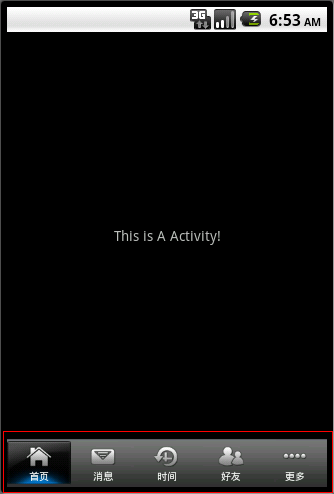
最后,大家别忘了在 AndroidManifest.xml 文件中注册各个 Activity 组件哦。好了,现在我们看下我们程序运行的效果图:
注:本文转载http://blog.csdn.net/cjjky/article/details/7209056,源码下载地址http://download.csdn.net/detail/cjjky/4236055
转载请注明出处。
【转】Android应用底部导航栏(选项卡)实例的更多相关文章
- Android应用底部导航栏(选项卡)实例
现在很多android的应用都采用底部导航栏的功能,这样可以使得用户在使用过程中随意切换不同的页面,现在我采用TabHost组件来自定义一个底部的导航栏的功能. 我们先看下该demo实例的框架图: 其 ...
- Android 修改底部导航栏navigationbar的颜色
Android 修改底部导航栏navigationbar的颜色 getWindow().setNavigationBarColor(Color.BLUE); //写法一 getWindow().set ...
- Android应用-底部导航栏的使用
目录 1. 设计底部导航栏页面 1.1. 创建必须的文件夹 1.2. 设计主页面 2. 设计逻辑函数 3. 项目展示 底部导航栏是基于Bottom Navigation Bar 插件使用的 这个插件包 ...
- Android学习笔记- Fragment实例 底部导航栏的实现
1.要实现的效果图以及工程目录结构: 先看看效果图吧: 接着看看我们的工程的目录结构: 2.实现流程: Step 1:写下底部选项的一些资源文件 我们从图上可以看到,我们底部的每一项点击的时候都有不同 ...
- Android底部导航栏——FrameLayout + RadioGroup
原创文章,转载请注明出处http://www.cnblogs.com/baipengzhan/p/6285881.html Android底部导航栏有多种实现方式,本文详细介绍FrameLayout ...
- Android底部导航栏创建——ViewPager + RadioGroup
原创文章,引用请注明出处:http://www.cnblogs.com/baipengzhan/p/6270201.html Android底部导航栏有多种实现方式,本文详解其中的ViewPager ...
- Android底部导航栏(可滑动)----TabLayout+viewPager
[TabLayout] ①TabLayout是选项卡,在屏幕空间有限的情况下,对不同的空间进行分组.属于android support design,更多的用于新闻上,如果放在底部也可做底部导航栏 ② ...
- Android商城开发系列(三)——使用Fragment+RadioButton实现商城底部导航栏
在商城第一篇的开篇当中,我们看到商城的效果图里面有一个底部导航栏效果,如下图所示: 今天我们就来实现商城底部导航栏,最终效果图如下所示: 那么这种效果是如何实现,实现的方式有很多种,最常见的就是使 ...
- [置顶]
xamarin android Fragment实现底部导航栏
前段时间写了篇关于Fragment的文章,介绍了基础的概念,用静态和动态的方式加载Fragment Xamarin Android Fragment的两种加载方式.下面的这个例子介绍xamarin ...
随机推荐
- python学习笔记:第六天
一.元组(通用格式a=(1,),结束后面加个逗号,不同与数组是中括号,只能是只读的,不能修改,是有序的): 列表之间可以嵌套(列表之间嵌套,嵌套元组,是有序的):a[b[1,2],c[3,4]],输出 ...
- 空暇时候思考之const
对于多数人来说那些const的使用方法比方修饰返回值和修饰參数都应该是十分好理解的下来我要讨论 对于C语言中 #include <stdio.h> void main() { const ...
- iOS9适配小结
前言 最新公布的app版本号适配了iOS9.总结一下适配过程的几个要点. Bitcode iOS9此番推出了新的特性:Bitcode,关于Bitcode的资料大家能够在网上找.Bitcode要求pro ...
- jquery去重
<!DOCTYPE HTML> <html> <head> <meta charset="utf-8"> <title> ...
- eclipse:报错信息The superclass “javax.servlet.http.HttpServlet” was not found on the Java Build Path
JavaWeb: 报错信息The superclass "javax.servlet.http.HttpServlet" was not found on the Java Bui ...
- 用DOM动态控制表格
<%@ page language="java" contentType="text/html; charset=UTF-8" pageEncoding= ...
- BsonDocument
http://api.mongodb.com/csharp/current/html/T_MongoDB_Bson_BsonDocument.htm 如何取出document中的数据 BsonDocu ...
- mysql if使用实例
//DELIMITER DROP PROCEDURE if EXISTS createAmountCount; create PROCEDURE createAmountCount() BEGIN D ...
- Scala基础简述
* Scala基础简述 本文章作为Scala快速学习的教程,前提环境是:我假设在此之前,你已经学会了Java编程语言,并且我们以随学随用为目标(在此不会深度挖掘探讨Scala更高级层次的知识).其中语 ...
- 使用Onedrive
买了个某捷的大硬盘,于是发现比较坑,非要用云存储才能获得额外200G.于是费了一个多小时.不过学习到了很多. 首先硬盘下会给出对应的exe文件,点击运行就可以. 之后注册希捷的账号,以及微软的账号. ...