
NioEventLoopGroup源码分析与线程设定
我的以Netty Socket编程的代码为例,
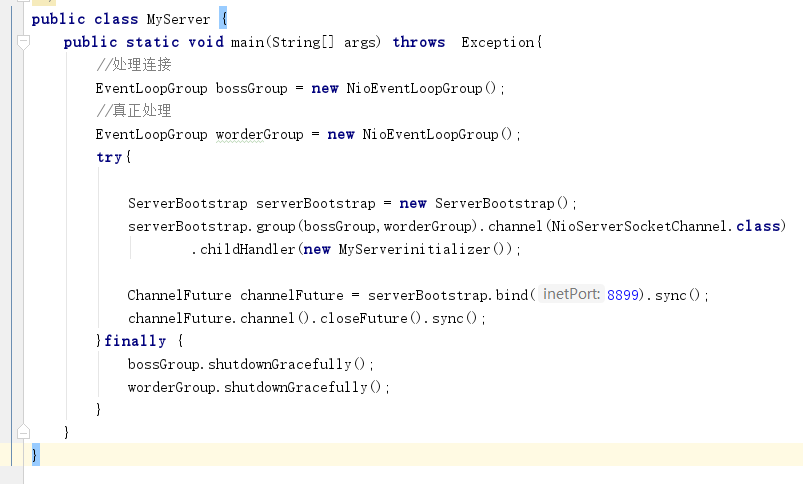
1、EventLoopGroup
进入EventLoopGroup,这是一个特殊的EventExecutorGroup,在事件循环中,在selection选择的时候,可以注册Channel。(Channel可以理解为跟客户端的连接)
/**

 * Special {@link EventExecutorGroup} which allows registering {@link Channel}s that get

 * processed for later selection during the event loop.

 *

 */

public interface EventLoopGroup extends EventExecutorGroup {

    /**

     * Return the next {@link EventLoop} to use

     */

    @Override

    EventLoop next();

    /**

     * Register a {@link Channel} with this {@link EventLoop}. The returned {@link ChannelFuture}

     * will get notified once the registration was complete.

     */

    ChannelFuture register(Channel channel);

    /**

     * Register a {@link Channel} with this {@link EventLoop} using a {@link ChannelFuture}. The passed

     * {@link ChannelFuture} will get notified once the registration was complete and also will get returned.

     */

    ChannelFuture register(ChannelPromise promise);

    /**

     * Register a {@link Channel} with this {@link EventLoop}. The passed {@link ChannelFuture}

     * will get notified once the registration was complete and also will get returned.

     *

     * @deprecated Use {@link #register(ChannelPromise)} instead.

     */

    @Deprecated

    ChannelFuture register(Channel channel, ChannelPromise promise);

}
2、EventExecutorGroup
/**

 * The {@link EventExecutorGroup} is responsible for providing the {@link EventExecutor}'s to use

 * via its {@link #next()} method. Besides this, it is also responsible for handling their

 * life-cycle and allows shutting them down in a global fashion.

 *

 */

public interface EventExecutorGroup extends ScheduledExecutorService, Iterable<EventExecutor> {

    /**

     * Returns {@code true} if and only if all {@link EventExecutor}s managed by this {@link EventExecutorGroup}

     * are being {@linkplain #shutdownGracefully() shut down gracefully} or was {@linkplain #isShutdown() shut down}.

     */

    boolean isShuttingDown();

    /**

     * Shortcut method for {@link #shutdownGracefully(long, long, TimeUnit)} with sensible default values.

     *

     * @return the {@link #terminationFuture()}

     */

    Future<?> shutdownGracefully();

    /**

     * Signals this executor that the caller wants the executor to be shut down.  Once this method is called,

     * {@link #isShuttingDown()} starts to return {@code true}, and the executor prepares to shut itself down.

     * Unlike {@link #shutdown()}, graceful shutdown ensures that no tasks are submitted for <i>'the quiet period'</i>

     * (usually a couple seconds) before it shuts itself down.  If a task is submitted during the quiet period,

     * it is guaranteed to be accepted and the quiet period will start over.

     *

     * @param quietPeriod the quiet period as described in the documentation

     * @param timeout     the maximum amount of time to wait until the executor is {@linkplain #shutdown()}

     *                    regardless if a task was submitted during the quiet period

     * @param unit        the unit of {@code quietPeriod} and {@code timeout}

     *

     * @return the {@link #terminationFuture()}

     */

    Future<?> shutdownGracefully(long quietPeriod, long timeout, TimeUnit unit);

    /**

     * Returns the {@link Future} which is notified when all {@link EventExecutor}s managed by this

     * {@link EventExecutorGroup} have been terminated.

     */

    Future<?> terminationFuture();

    /**

     * @deprecated {@link #shutdownGracefully(long, long, TimeUnit)} or {@link #shutdownGracefully()} instead.

     */

    @Override

    @Deprecated

    void shutdown();

    /**

     * @deprecated {@link #shutdownGracefully(long, long, TimeUnit)} or {@link #shutdownGracefully()} instead.

     */

    @Override

    @Deprecated

    List<Runnable> shutdownNow();

    /**

     * Returns one of the {@link EventExecutor}s managed by this {@link EventExecutorGroup}.

     */

    EventExecutor next();

    @Override

    Iterator<EventExecutor> iterator();

    @Override

    Future<?> submit(Runnable task);

    @Override

    <T> Future<T> submit(Runnable task, T result);

    @Override

    <T> Future<T> submit(Callable<T> task);

    @Override

    ScheduledFuture<?> schedule(Runnable command, long delay, TimeUnit unit);

    @Override

    <V> ScheduledFuture<V> schedule(Callable<V> callable, long delay, TimeUnit unit);

    @Override

    ScheduledFuture<?> scheduleAtFixedRate(Runnable command, long initialDelay, long period, TimeUnit unit);

    @Override

    ScheduledFuture<?> scheduleWithFixedDelay(Runnable command, long initialDelay, long delay, TimeUnit unit);

}
3、NioEventLoopGroup ,继承自MultithreadEventLoopGroup
/**

 * {@link MultithreadEventLoopGroup} implementations which is used for NIO {@link Selector} based {@link Channel}s.

 */

public class NioEventLoopGroup extends MultithreadEventLoopGroup {

    /**

     * Create a new instance using the default number of threads, the default {@link ThreadFactory} and

     * the {@link SelectorProvider} which is returned by {@link SelectorProvider#provider()}.

     */

    public NioEventLoopGroup() {

        this(0);

    }

    /**

     * Create a new instance using the specified number of threads, {@link ThreadFactory} and the

     * {@link SelectorProvider} which is returned by {@link SelectorProvider#provider()}.

     */

    public NioEventLoopGroup(int nThreads) {

        this(nThreads, (Executor) null);

    }

    /**

     * Create a new instance using the specified number of threads, the given {@link ThreadFactory} and the

     * {@link SelectorProvider} which is returned by {@link SelectorProvider#provider()}.

     */

    public NioEventLoopGroup(int nThreads, ThreadFactory threadFactory) {

        this(nThreads, threadFactory, SelectorProvider.provider());

    }

    public NioEventLoopGroup(int nThreads, Executor executor) {

        this(nThreads, executor, SelectorProvider.provider());

    }

    /**

     * Create a new instance using the specified number of threads, the given {@link ThreadFactory} and the given

     * {@link SelectorProvider}.

     */

    public NioEventLoopGroup(

            int nThreads, ThreadFactory threadFactory, final SelectorProvider selectorProvider) {

        this(nThreads, threadFactory, selectorProvider, DefaultSelectStrategyFactory.INSTANCE);

    }

    public NioEventLoopGroup(int nThreads, ThreadFactory threadFactory,

        final SelectorProvider selectorProvider, final SelectStrategyFactory selectStrategyFactory) {

        super(nThreads, threadFactory, selectorProvider, selectStrategyFactory, RejectedExecutionHandlers.reject());

    }

    public NioEventLoopGroup(

            int nThreads, Executor executor, final SelectorProvider selectorProvider) {

        this(nThreads, executor, selectorProvider, DefaultSelectStrategyFactory.INSTANCE);

    }

    public NioEventLoopGroup(int nThreads, Executor executor, final SelectorProvider selectorProvider,

                             final SelectStrategyFactory selectStrategyFactory) {

        super(nThreads, executor, selectorProvider, selectStrategyFactory, RejectedExecutionHandlers.reject());

    }

    public NioEventLoopGroup(int nThreads, Executor executor, EventExecutorChooserFactory chooserFactory,

                             final SelectorProvider selectorProvider,

                             final SelectStrategyFactory selectStrategyFactory) {

        super(nThreads, executor, chooserFactory, selectorProvider, selectStrategyFactory,

                RejectedExecutionHandlers.reject());

    }

    public NioEventLoopGroup(int nThreads, Executor executor, EventExecutorChooserFactory chooserFactory,

                             final SelectorProvider selectorProvider,

                             final SelectStrategyFactory selectStrategyFactory,

                             final RejectedExecutionHandler rejectedExecutionHandler) {

        super(nThreads, executor, chooserFactory, selectorProvider, selectStrategyFactory, rejectedExecutionHandler);

    }

    public NioEventLoopGroup(int nThreads, Executor executor, EventExecutorChooserFactory chooserFactory,

                             final SelectorProvider selectorProvider,

                             final SelectStrategyFactory selectStrategyFactory,

                             final RejectedExecutionHandler rejectedExecutionHandler,

                             final EventLoopTaskQueueFactory taskQueueFactory) {

        super(nThreads, executor, chooserFactory, selectorProvider, selectStrategyFactory,

                rejectedExecutionHandler, taskQueueFactory);

    }

    /**

     * Sets the percentage of the desired amount of time spent for I/O in the child event loops.  The default value is

     * {@code 50}, which means the event loop will try to spend the same amount of time for I/O as for non-I/O tasks.

     */

    public void setIoRatio(int ioRatio) {

        for (EventExecutor e: this) {

            ((NioEventLoop) e).setIoRatio(ioRatio);

        }

    }

    /**

     * Replaces the current {@link Selector}s of the child event loops with newly created {@link Selector}s to work

     * around the  infamous epoll 100% CPU bug.

     */

    public void rebuildSelectors() {

        for (EventExecutor e: this) {

            ((NioEventLoop) e).rebuildSelector();

        }

    }

    @Override

    protected EventLoop newChild(Executor executor, Object... args) throws Exception {

        EventLoopTaskQueueFactory queueFactory = args.length == 4 ? (EventLoopTaskQueueFactory) args[3] : null;

        return new NioEventLoop(this, executor, (SelectorProvider) args[0],

            ((SelectStrategyFactory) args[1]).newSelectStrategy(), (RejectedExecutionHandler) args[2], queueFactory);

    }

}
进入构造函数NioEventLoopGroup函数,
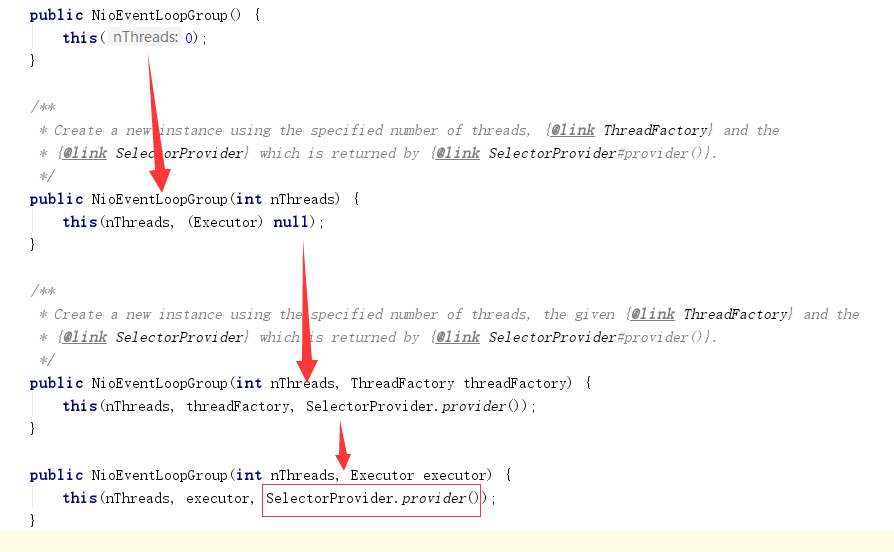
然后进入下面这个构造函数,调用了父类的方法

进入父类的方法 MultithreadEventLoopGroup,继承自 MultithreadEventExecutorGroup
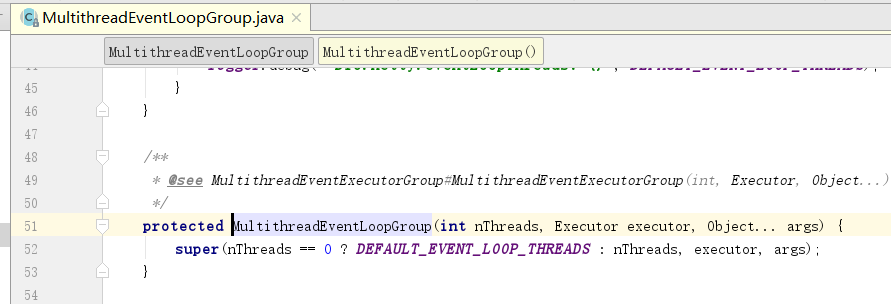
如果nThrads==0,则使用 DEFAULT_EVENT_LOOP_THREADS
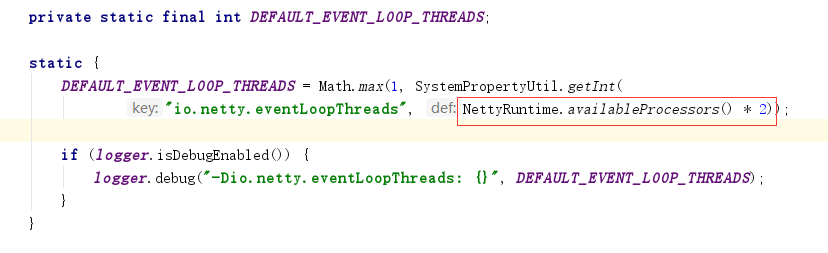
如果io.netty.eventLoopThreads没有定义,则使用NettyRuntime.availableProcessors() * 2 作为默认线程数
进入父类MultithreadEventExecutorGroup构造函数
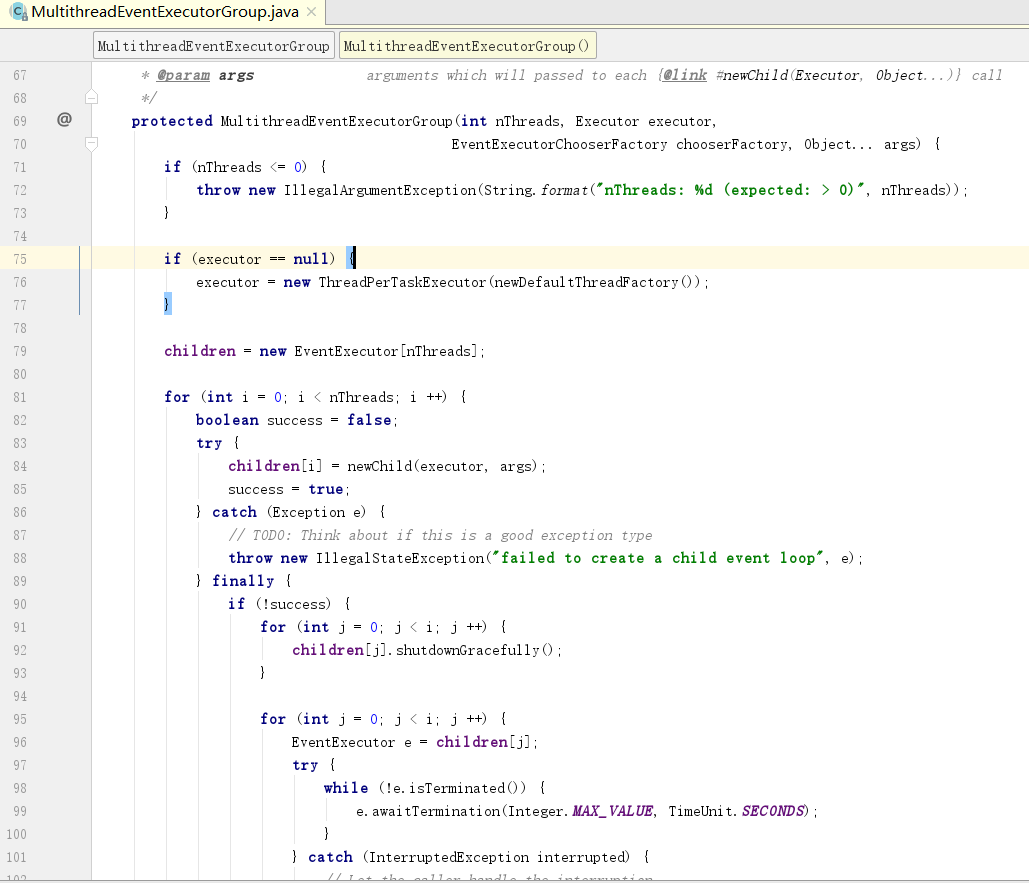
newChild是一个抽象方法

进入NioEventLoopGroup中newChild的实现

NioEventLoopGroup源码分析与线程设定的更多相关文章
- netty : NioEventLoopGroup 源码分析
NioEventLoopGroup 源码分析 1. 在阅读源码时做了一定的注释,并且做了一些测试分析源码内的执行流程,由于博客篇幅有限.为了方便 IDE 查看.跟踪.调试 代码,所以在 github ...
- Memcached源码分析之线程模型
作者:Calix 一)模型分析 memcached到底是如何处理我们的网络连接的? memcached通过epoll(使用libevent,下面具体再讲)实现异步的服务器,但仍然使用多线程,主要有两种 ...
- SOFA 源码分析 — 自定义线程池原理
前言 在 SOFA-RPC 的官方介绍里,介绍了自定义线程池,可以为指定服务设置一个独立的业务线程池,和 SOFARPC 自身的业务线程池是隔离的.多个服务可以共用一个独立的线程池. API使用方式如 ...
- 源码分析—ThreadPoolExecutor线程池三大问题及改进方案
前言 在一次聚会中,我和一个腾讯大佬聊起了池化技术,提及到java的线程池实现问题,我说这个我懂啊,然后巴拉巴拉说了一大堆,然后腾讯大佬问我说,那你知道线程池有什么缺陷吗?我顿时哑口无言,甘拜下风,所 ...
- netty之NioEventLoopGroup源码分析二
大家好,今天我准备死磕NioEventLoopGroup的源码,首先讲下概念,NioEventLoopGroup 它是一个线程池,存放NioEventLoop,一个数组,今天打算先看下这行代码的初始化 ...
- 深入源码分析Java线程池的实现原理
程序的运行,其本质上,是对系统资源(CPU.内存.磁盘.网络等等)的使用.如何高效的使用这些资源是我们编程优化演进的一个方向.今天说的线程池就是一种对CPU利用的优化手段. 通过学习线程池原理,明白所 ...
- lua 源码分析之线程对象lua_State
lua_State 中放的是 lua 虚拟机中的环境表.注册表.运行堆栈.虚拟机的上下文等数据. 从一个主线程(特指 lua 虚拟机中的线程,即 coroutine)中创建出来的新的 lua_Stat ...
- Memcached源码分析之从SET命令开始说起
作者:Calix 如果直接把memcached的源码从main函数开始说,恐怕会有点头大,所以这里以一句经典的“SET”命令简单地开个头,算是回忆一下memcached的作用,后面的结构篇中关于命令解 ...
- Memcached源码分析
作者:Calix,转载请注明出处:http://calixwu.com 最近研究了一下memcached的源码,在这里系统总结了一下笔记和理解,写了几 篇源码分析和大家分享,整个系列分为“结构篇”和“ ...
随机推荐
- [linux]查找最大的文件
查找最大的日志文件,命令: find ./ -type f | xargs -I{} du -m {}|sort -rnk1|head -10 offline一台机器保留限产,其他机器删除日志,命令: ...
- Linux装B命令
原文:https://mp.weixin.qq.com/s/CNmMRjl0iZ8EBPq5VgJHsA 1.空心字体 yum install -y figlet figlet happy 1.0 2 ...
- elasticsearch 连接查询 基于es5.1.1
ElasticSerch 的连接查询有两种方式实现 nested parent和child关联查询 nested 存储结构 nested的方式和其他字段一样,在同一个type里面存储,以数组的方式存储 ...
- Python学习日记(三十八) Mysql数据库篇 六
Mysql视图 假设执行100条SQL语句时,里面都存在一条相同的语句,那我们可以把这条语句单独拿出来变成一个'临时表',也就是视图可以用来查询. 创建视图: CREATE VIEW passtvie ...
- 简述-selenium对web实现自动化测试
首先,我是基于python进行对selenium操作和使用的,主要分为selenium的实现原理和selenium的操作这两大部分的简单分享(由于本人水平有限,仅做基础的概述和总结): 一.selen ...
- VS code key shortcuts for windows
mac上的快捷键,尽量是选择像我用vs studio上靠近. ctrl+K+S: 显示快捷键列 ctrl+shift+p: 系统配置命令行 ctrl+p:项目中文件列表,选择文件 Alt+M:当前文件 ...
- OSPF 虚链路
通过配置OSPF虚链路连接到骨干区域. 实验拓扑 如图所示连接,地址规划如下: 名称 接口 IP地址 R1 f0/0 192.168.10.1/24 R1 f0/1 192.168.20.1/24 R ...
- manager.add_command('runserver', Server('0.0.0.0', port='8093', extra_files=extra_files))
extra_files: a list of files the reloader should watch additionally to the module ...
- 安卓QQ聊天记录导出、备份完全攻略
发到知乎竟然被删掉,我也不知道我到底违反了哪条.唉,别人的毕竟是别人的.虽然博客园也是别人的 前言 我对聊天记录的备份比较执着,也在这上面折腾过不少.碰到过不少令人头疼的麻烦,在这里分享一下经验. 关 ...
- spring boot flyway 配置说明(摘抄)
flyway.baseline-description对执行迁移时基准版本的描述. flyway.baseline-on-migrate当迁移时发现目标schema非空,而且带有没有元数据的表时,是否 ...