
ArcGIS基于DEM计算水流方向的方法(D8算法)
ArcGIS采用D8算法计算水流方向(9.3.1后新增),输入数据应首先完成了洼地填充处理:
One of the keys to deriving hydrologic characteristics about a surface is the ability to determine the direction of flow from every cell in the raster. This is done with the Flow Direction function.
This function takes a surface as input and outputs a raster showing the direction of flow out of each cell. If the output drop raster option is chosen, an output raster is created showing a ratio of the maximum change in elevation from each cell along the direction of flow to the path length between centers of cells and is expressed in percentages. If the force all edge cells to flow outward option is chosen, all cells at the edge of the surface raster will flow outward from the surface raster.
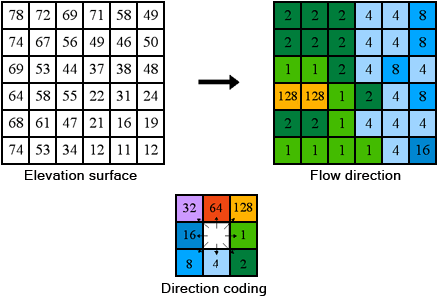
There are eight valid output directions relating to the eight adjacent cells into which flow could travel. This approach is commonly referred to as an eight direction (D8) flow model and follows an approach presented in Jensen and Domingue (1988).
The direction of flow is determined by finding the direction of steepest descent, or maximum drop, from each cell. This is calculated as
maximum drop = change in z-value / distance
The distance is determined between cell centers. Therefore if the cell size is one, the distance between two orthogonal cells is one and the distance between two diagonal cells is 1.414216, the square root of two. If the maximum descent to several cells is the same, the neighborhood is enlarged until the steepest descent is found.
When a direction of steepest descent is found, the output cell is coded with the value representing that direction.
If all neighbors are higher than the processing cell, the processing cell is a sink and has an undefined flow direction. Cells with undefined flow direction can be flagged as sinks using the Sink function. To obtain an accurate representation of flow direction across a surface, the sinks should be filled.
ArcGIS基于DEM计算水流方向的方法(D8算法)的更多相关文章
- Arcgis基于高程(DEM)计算地形湿度指数(TWI),以及坡度(Slope)度单位转换为弧度
以30m*30m分辨率的图层为例 一.基于表面工具箱Surface计算Slope 1.如下图输入图层DEM,输出Slope 2.单位转换: Scale_slope=Slope*pi/180 二.基于水 ...
- 基于MATLAB的多项式数据拟合方法研究-毕业论文
摘要:本论文先介绍了多项式数据拟合的相关背景,以及对整个课题做了一个完整的认识.接下来对拟合模型,多项式数学原理进行了详细的讲解,通过对文献的阅读以及自己的知识积累对原理有了一个系统的认识.介绍多项式 ...
- 一种基于uCos-II操作系统和lwIP协议栈的IEEE-1588主站以及基于该主站的报文处理方法
主站以及应用于电力系统的支持IEEE‐1588协议的主时钟(IEEE‐1588主站)的实现方法.该方法是在一个低成本的硬件平台上,借助uCos‐II操作系统和TCP/IP的协议栈,对以太网数据进行了分 ...
- 基于Deep Learning 的视频识别方法概览
深度学习在最近十来年特别火,几乎是带动AI浪潮的最大贡献者.互联网视频在最近几年也特别火,短视频.视频直播等各种新型UGC模式牢牢抓住了用户的消费心里,成为互联网吸金的又一利器.当这两个火碰在一起,会 ...
- -05 08:57 ARCGIS地统计学计算文件后缀名为.shp文件制作
2011-07-05 08:57 ARCGIS地统计学计算文件后缀名为.shp文件制作 ARCAMP软件要进行地统计计算的文件后格式后缀名必须为.shp的文件,网上介绍的方法复杂难懂,那么制作.shp ...
- 基于查表的整数霍夫变换方法实现(matlab)
暂时先用matlab把算法弄一下,这是基于查表的整数霍夫变换方法实现及解释. 接着再实现FPGA的霍夫变换. 霍夫变换原理和算法这里不多说,可参考以下链接: http://blog.csdn.net/ ...
- 【转】STM32: 一种计算CPU使用率的方法及其实现原理
1 前言出于性能方面的考虑,有的时候,我们希望知道CPU的使用率为多少,进而判断此CPU的负载情况和对于当前运行环境是否足够“胜任”.本文将介绍一种计算CPU占有率的方法以及其实现原理. 2 移植 ...
- Spark 介绍(基于内存计算的大数据并行计算框架)
Spark 介绍(基于内存计算的大数据并行计算框架) Hadoop与Spark 行业广泛使用Hadoop来分析他们的数据集.原因是Hadoop框架基于一个简单的编程模型(MapReduce),它支持 ...
- 使用基于Apache Spark的随机森林方法预测贷款风险
使用基于Apache Spark的随机森林方法预测贷款风险 原文:Predicting Loan Credit Risk using Apache Spark Machine Learning R ...
随机推荐
- Webstorm使用教程详解
Webstorm使用教程详解 Webstorm垂直分栏.左右分栏 Webstorm 主题.背景.颜色等设置的导入导出 使用WebStorm开发web前端 网页中文乱码问题的解决方案 Webstor ...
- mac操作记录
1.mac'主目录地址' 类似我的电脑 点桌面空白处按shift+command+C, 双击Macintosh HD图标后就能看见system文件夹 2.做excel表格,下载Microsoft Of ...
- [每天解决一问题系列 - 0002] Xcopy cannot copy file with long directory
现象: 当xcopy的文件的全名(包括目录和文件名)的长度超过255字符时,会copy失败,得到insufficient memory错误 解决方法: 在Server 版的OS中,有robcopy命令 ...
- JDK提供的四种线程池代码详解
一.线程池什么时候使用,会给我们带来什么好处? 如果很多用户去访问服务器,用户访问服务器的时间是非常短暂的,那么有可能在创建线程和销毁线程上花费的时间会远远大于访问所消耗的时间,如果采用线程池会使线程 ...
- (转)Python3之shutil模块
原文:https://www.cnblogs.com/wang-yc/p/5625046.html 一. 简介 shutil 是高级的文件,文件夹,压缩包处理模块. 二. 使用 shutil.copy ...
- git自己用得着的命令
-----------随笔记记,给自己备份------------ 1.查看分支 查看当前分支:git branch 查看远程所有分支:git branch -r/git branch -a 2.切换 ...
- 全网最详细的Cloudera Hue执行./build/env/bin/supervisor 时出现KeyError: "Couldn't get user id for user hue"的解决办法(图文详解)
不多说,直接上干货! 问题详情 如下: [root@bigdata-pro01 hue--cdh5.12.1]# ./build/env/bin/supervisor Traceback (most ...
- Element ui tree树形控件获取当前节点id和父节点id
低版本Element ui tree树形控件获取当前节点id和父节点id的方法:点击查看 最新版本Element ui tree树形控件获取当前节点id和父节点id教程: 1.找到node_modul ...
- Java集合——HashMap,HashTable,ConcurrentHashMap区别
Map:“键值”对映射的抽象接口.该映射不包括重复的键,一个键对应一个值. SortedMap:有序的键值对接口,继承Map接口. NavigableMap:继承SortedMap,具有了针对给定搜索 ...
- JavaScript对象Object
<script> var obj = new Object(); var obj2 = {}; obj2.firstName = "wang"; obj2.lastNa ...