
MonolithFirst
As I hear stories about teams using a microservices architecture, I've noticed a common pattern.
- Almost all the successful microservice stories have started with a monolith that got too big and was broken up
- Almost all the cases where I've heard of a system that was built as a microservice system from scratch, it has ended up in serious trouble.
This pattern has led many of my colleagues to argue that you shouldn't start a new project with microservices, even if you're sure your application will be big enough to make it worthwhile..
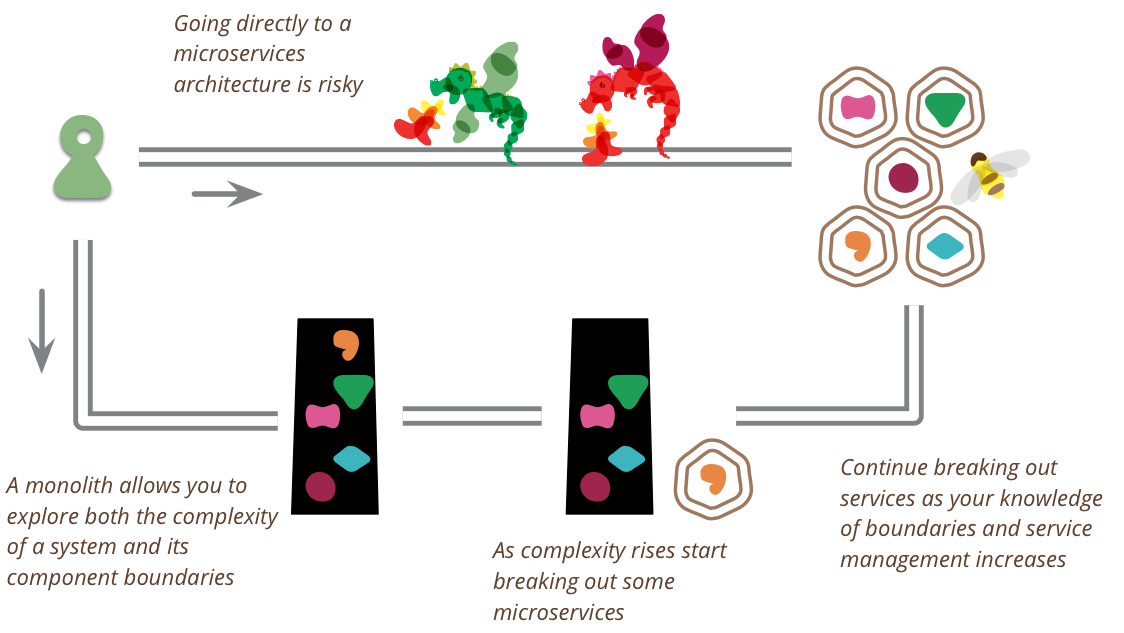
Microservices are a useful architecture, but even their advocates say that using them incurs a significant MicroservicePremium, which means they are only useful with more complex systems. This premium, essentially the cost of managing a suite of services, will slow down a team, favoring a monolith for simpler applications. This leads to a powerful argument for a monolith-first strategy, where you should build a new application as a monolith initially, even if you think it's likely that it will benefit from a microservices architecture later on.
The first reason for this is classic Yagni. When you begin a new application, how sure are you that it will be useful to your users? It may be hard to scale a poorly designed but successful software system, but that's still a better place to be than its inverse. As we're now recognizing, often the best way to find out if a software idea is useful is to build a simplistic version of it and see how well it works out. During this first phase you need to prioritize speed (and thus cycle time for feedback), so the premium of microservices is a drag you should do without.
The second issue with starting with microservices is that they only work well if you come up with good, stable boundaries between the services - which is essentially the task of drawing up the right set of BoundedContexts. Any refactoring of functionality between services is much harder than it is in a monolith. But even experienced architects working in familiar domains have great difficulty getting boundaries right at the beginning. By building a monolith first, you can figure out what the right boundaries are, before a microservices design brushes a layer of treacle over them. It also gives you time to develop the MicroservicePrerequisites you need for finer-grained services.
I've heard different ways to execute a monolith-first strategy. The logical way is to design a monolith carefully, paying attention to modularity within the software, both at the API boundaries and how the data is stored. Do this well, and it's a relatively simple matter to make the shift to microservices. However I'd feel much more comfortable with this approach if I'd heard a decent number of stories where it worked out that way. [1]
A more common approach is to start with a monolith and gradually peel off microservices at the edges. Such an approach can leave a substantial monolith at the heart of the microservices architecture, but with most new development occurring in the microservices while the monolith is relatively quiescent.
Another common approach is to just replace the monolith entirely. Few people look at this as an approach to be proud of, yet there are advantages to building a monolith as a SacrificialArchitecture. Don't be afraid of building a monolith that you will discard, particularly if a monolith can get you to market quickly.
Another route I've run into is to start with just a couple of coarse-grained services, larger than those you expect to end up with. Use these coarse-grained services to get used to working with multiple services, while enjoying the fact that such coarse granularity reduces the amount of inter-service refactoring you have to do. Then as boundaries stabilize, break down into finer-grained services. [2]
While the bulk of my contacts lean toward the monolith-first approach, it is by no means unanimous. The counter argument says that starting with microservices allows you to get used to the rhythm of developing in a microservice environment. It takes a lot, perhaps too much, discipline to build a monolith in a sufficiently modular way that it can be broken down into microservices easily. By starting with microservices you get everyone used to developing in separate small teams from the beginning, and having teams separated by service boundaries makes it much easier to scale up the development effort when you need to. This is especially viable for system replacements where you have a better chance of coming up with stable-enough boundaries early. Although the evidence is sparse, I feel that you shouldn't start with microservices unless you have reasonable experience of building a microservices system in the team.
I don't feel I have enough anecdotes yet to get a firm handle on how to decide whether to use a monolith-first strategy. These are early days in microservices, and there are relatively few anecdotes to learn from. So anybody's advice on these topics must be seen as tentative, however confidently they argue.
Further Reading
Sam Newman describes a case study of a team considering using microservices on a greenfield project.
Notes
1: You cannot assume that you can take an arbitrary system and break it into microservices. Most systems acquire too many dependencies between their modules, and thus can't be sensibly broken apart. I've heard of plenty of cases where an attempt to decompose a monolith has quickly ended up in a mess. I've also heard of a few cases where a gradual route to microservices has been successful - but these cases required a relatively good modular design to start with.
2: I suppose that strictly you should call this a "duolith", but I think the approach follows the essence of monolith-first strategy: start with coarse-granularity to gain knowledge and split later.
Acknowledgements
I stole much of this thinking from my coleagues: James Lewis, Sam Newman, Thiyagu Palanisamy, and Evan Bottcher. Stefan Tilkov's comments on an earlier draft played a pivotal role in clarifying my thoughts. Chad Currie created the lovely glyphy dragons. Steven Lowe, Patrick Kua, Jean Robert D'amore, Chelsea Komlo, Ashok Subramanian, Dan Siwiec, Prasanna Pendse, Kief Morris, Chris Ford, and Florian Sellmayr discussed drafts on our internal mailing list.
https://www.martinfowler.com/bliki/MonolithFirst.html
MonolithFirst的更多相关文章
- 【译文】用Spring Cloud和Docker搭建微服务平台
by Kenny Bastani Sunday, July 12, 2015 转自:http://www.kennybastani.com/2015/07/spring-cloud-docker-mi ...
- How Microservices are Transforming Python Development
https://blog.appdynamics.com/engineering/how-microservices-are-transforming-python-development/ Summ ...
- Atitit s2018.2 s2 doc list on home ntpc.docx \Atiitt uke制度体系 法律 法规 规章 条例 国王诏书.docx \Atiitt 手写文字识别 讯飞科大 语音云.docx \Atitit 代码托管与虚拟主机.docx \Atitit 企业文化 每日心灵 鸡汤 值班 发布.docx \Atitit 几大研发体系对比 Stage-Gat
Atitit s2018.2 s2 doc list on home ntpc.docx \Atiitt uke制度体系 法律 法规 规章 条例 国王诏书.docx \Atiitt 手写文字识别 ...
- Spring Cloud和Docker搭建微服务平台
用Spring Cloud和Docker搭建微服务平台 This blog series will introduce you to some of the foundational concepts ...
随机推荐
- Android Bootloader LittleKernel的两篇文章
Android 开发之 ---- bootloader (LK) LK是什么 LK 是 Little Kernel 它是 appsbl (Applications ARM Boot Loader)流程 ...
- 【Matlab编程】马氏链随机模拟
本文是利用蒙特卡罗算法对马氏链过程的模拟.假设有10个状态,从每个状态到与之相邻状态的概率是相同的,仿真次数为1000,及进行了1000次状态转移.我们以动画的形式再现了状态转移的过程,并记录了到达每 ...
- The content of elements must consist of well-formed character data or markup
java 中使用dom4j解析含有特殊字符的xml文件出现了如题的错误 这个时候需要在特殊字符外面加上 <![CDATA[ /6169220648+20671/1>7+-47390045& ...
- 2010-01-20 12:09 ubuntu下minicom的安装及使用
转http://hi.baidu.com/npugtawqdnbgqrq/item/106f805409b42813db163527 ubuntu下minicom的安装及使用 安装: sudo apt ...
- objective-c中线程编程一例
/* print with threads : print every file's first n char contents under the path that pass to this pr ...
- leetcode之旅(10)-Roman to Integer
题目描述: Given a roman numeral, convert it to an integer. Input is guaranteed to be within the range fr ...
- ruby技巧001:求md5散列
ruby核心库中未包含md5之类的功能,不过在其标准库digest中可以方便的使用该功能: = Digest (from ruby core) ---------------------------- ...
- 使用bootstrap table 插件固定表头时 表头与表格内容无法对齐
在使用bootstrap table开发后台管理系统,表格利用bootstrap-table插件来实现,使用bootstrap-table过程中,会出现表头错位的情况 表头对不齐效果: 解决的方法: ...
- Python 3 中的json模块使用
1. 概述 JSON (JavaScript Object Notation)是一种使用广泛的轻量数据格式. Python标准库中的json模块提供了JSON数据的处理功能. Python中一种非常常 ...
- sqlplus 登录数据库
sqlplus pams/pamscncc@ORCLMIS