
关于 tf.nn.softmax_cross_entropy_with_logits 及 tf.clip_by_value
In order to train our model, we need to define what it means for the model to be good. Well, actually, in machine learning we typically define what it means for a model to be bad. We call this the cost, or the loss, and it represents how far off our model is from our desired outcome. We try to minimize that error, and the smaller the error margin, the better our model is.
One very common, very nice function to determine the loss of a model is called "cross-entropy." Cross-entropy arises from thinking about information compressing codes in information theory but it winds up being an important idea in lots of areas, from gambling to machine learning. It's defined as:
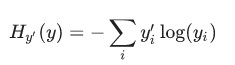
Where y is our predicted probability distribution, and y′ is the true distribution (the one-hot vector with the digit labels). In some rough sense, the cross-entropy is measuring how inefficient our predictions are for describing the truth. Going into more detail about cross-entropy is beyond the scope of this tutorial, but it's well worthunderstanding.
To implement cross-entropy we need to first add a new placeholder to input the correct answers:
y_ = tf.placeholder(tf.float32, [None, 10])
Then we can implement the cross-entropy function, 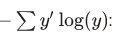
cross_entropy = tf.reduce_mean(-tf.reduce_sum(y_ * tf.log(y), reduction_indices=[1]))
First, tf.log computes the logarithm of each element of y. Next, we multiply each element of y_ with the corresponding element of tf.log(y). Then tf.reduce_sum adds the elements in the second dimension of y, due to the reduction_indices=[1] parameter. Finally, tf.reduce_mean computes the mean over all the examples in the batch.
Note that in the source code, we don't use this formulation, because it is numerically unstable. Instead, we apply tf.nn.softmax_cross_entropy_with_logits on the unnormalized logits (e.g., we call softmax_cross_entropy_with_logits on tf.matmul(x, W) + b), because this more numerically stable function internally computes the softmax activation. In your code, consider usingtf.nn.softmax_cross_entropy_with_logits instead.
大意是:如果使用 cross_entropy = tf.reduce_mean(-tf.reduce_sum(y_ * tf.log(y), reduction_indices=[1]))
来计算交叉熵,则需要使用 tf.clip_by_value 来使某些求 log 的值,因为 log 会产生 none (如 log-3 ), 用它来限定不出现none,具体使用方式如下:
cross_entropy = -tf.reduce_sum(y_*tf.log(tf.clip_by_value(y_conv, 1e-10, 1.0)))但后来有人用了一个更好的方法来避免none:
cross_entropy = -tf.reduce_sum(y_*tf.log(y_conv + 1e-10))具体参见 http://stackoverflow.com/questions/33712178/tensorflow-nan-bug 的讨论。
而如果直接用 tf.nn.softmax_cross_entropy_with_logits 则你再没有上面的后顾之忧了,它自动解决了上面的问题。
关于 tf.nn.softmax_cross_entropy_with_logits 及 tf.clip_by_value的更多相关文章
- 【TensorFlow】tf.nn.softmax_cross_entropy_with_logits的用法
在计算loss的时候,最常见的一句话就是 tf.nn.softmax_cross_entropy_with_logits ,那么它到底是怎么做的呢? 首先明确一点,loss是代价值,也就是我们要最小化 ...
- 深度学习原理与框架-Tensorflow卷积神经网络-卷积神经网络mnist分类 1.tf.nn.conv2d(卷积操作) 2.tf.nn.max_pool(最大池化操作) 3.tf.nn.dropout(执行dropout操作) 4.tf.nn.softmax_cross_entropy_with_logits(交叉熵损失) 5.tf.truncated_normal(两个标准差内的正态分布)
1. tf.nn.conv2d(x, w, strides=[1, 1, 1, 1], padding='SAME') # 对数据进行卷积操作 参数说明:x表示输入数据,w表示卷积核, stride ...
- [TensorFlow] tf.nn.softmax_cross_entropy_with_logits的用法
在计算loss的时候,最常见的一句话就是tf.nn.softmax_cross_entropy_with_logits,那么它到底是怎么做的呢? 首先明确一点,loss是代价值,也就是我们要最小化的值 ...
- tf.nn.softmax_cross_entropy_with_logits的用法
http://blog.csdn.net/mao_xiao_feng/article/details/53382790 计算loss的时候,最常见的一句话就是tf.nn.softmax_cross_e ...
- tf.nn.softmax & tf.nn.reduce_sum & tf.nn.softmax_cross_entropy_with_logits
tf.nn.softmax softmax是神经网络的最后一层将实数空间映射到概率空间的常用方法,公式如下: \[ softmax(x)_i=\frac{exp(x_i)}{\sum_jexp(x_j ...
- tf.nn.softmax_cross_entropy_with_logits()函数的使用方法
import tensorflow as tf labels = [[0.2,0.3,0.5], [0.1,0.6,0.3]]logits = [[2,0.5,1], [0.1,1,3]] a=tf. ...
- 1、求loss:tf.reduce_mean(tf.nn.softmax_cross_entropy_with_logits(logits, labels, name=None))
1.求loss: tf.reduce_mean(tf.nn.softmax_cross_entropy_with_logits(logits, labels, name=None)) 第一个参数log ...
- tf.nn.softmax_cross_entropy_with_logits 分类
tf.nn.softmax_cross_entropy_with_logits(logits, labels, name=None) 参数: logits:就是神经网络最后一层的输出,如果有batch ...
- 深度学习原理与框架-图像补全(原理与代码) 1.tf.nn.moments(求平均值和标准差) 2.tf.control_dependencies(先执行内部操作) 3.tf.cond(判别执行前或后函数) 4.tf.nn.atrous_conv2d 5.tf.nn.conv2d_transpose(反卷积) 7.tf.train.get_checkpoint_state(判断sess是否存在
1. tf.nn.moments(x, axes=[0, 1, 2]) # 对前三个维度求平均值和标准差,结果为最后一个维度,即对每个feature_map求平均值和标准差 参数说明:x为输入的fe ...
随机推荐
- 飞思卡尔烧写工具mfgtools的使用
MFGTool是飞思卡尔提供的烧写工具,使用起来非常方便.但是,在使用MFGTool有几点是需要注意的,否则就会在烧写过程中遇到一些问题: 1.在使用MFGTool前,文件cfg.ini 和 UICf ...
- IE下使用location对象有时会出现“没有权限”的错误
http://jadyyang.blog.sohu.com/145340845.html ——————————————————————————————————————————————————————— ...
- 宝宝书 & 网站
1. 网站 妈妈帮 宝宝树 2. 图书推荐 育儿百科 育儿经 中国儿童智力方程 聪明宝宝营养食谱1001例
- 本地连接linux虚拟机的方法
1.给虚拟机添加一个ehtX: 2. 3.添加一个ethX 4. 5.设置使用的是哪一个网卡,ifconfig的时候变会得到相应的ip 6. 再在cmd那ping ifconfig出来的自动获取的ip ...
- Android插件化开发之OpenAtlas生成插件信息列表
上一篇文章.[Android插件化开发之Atlas初体验]( http://blog.csdn.net/sbsujjbcy/article/details/47446733),简单的介绍了使用Atla ...
- Laravel5.1 登录和注册
关于登录和注册 Laravel自带了一套组件实现了这一功能,我们只需要实现简单的视图即可. AuthController是专门管理用户注册和登录的. PassWordController是重置密码用的 ...
- 61、常规控件(4)TabLayout-便捷实现标签
<android.support.design.widget.TabLayout android:id="@+id/tabs" android:layout_width=&q ...
- Android去掉标题的方法
我们写程序的时候经常要全屏显示或者不显示标题.比如我们做地图导航的时候就不要标题了,下面介绍三种方法来实现Android去掉标题. 第一种:也一般入门的时候经常使用的一种方法 在setContentV ...
- oracle用于判断时间条件为当天的写法(当前日期加一天)
trunc(sysdate + 1, 'dd')为当前日期加一天: 来自: and wf.start_time between sysdate and trunc(sysdate + 1, 'dd') ...
- 【转】 JS实现HTML标签转义及反转义
原文地址:http://blog.600km.xyz/2015/12/15/js-encode-html-tags/ 简单说一下业务场景,前台用户通过input输入内容,在离开焦点时,将内容在div中 ...