
[Repost]Events and Signals in PyQt4
Reference:http://zetcode.com/gui/pyqt4/eventsandsignals/
Events and Signals in PyQt4
In this part of the PyQt4 programming tutorial, we will explore events and signals occurring in applications.
Events
All GUI applications are event-driven. Events are generated mainly by the user of an application. But they can be generated by other means as well: e.g. an Internet connection, a window manager, or a timer. When we call the application's exec_() method, the application enters the main loop. The main loop fetches events and sends them to the objects.
In the event model, there are three participants:
- event source
- event object
- event target
The event source is the object whose state changes. It generates events. The event object (event) encapsulates the state changes in the event source. The event target is the object that wants to be notified. Event source object delegates the task of handling an event to the event target.
PyQt4 has a unique signal and slot mechanism to deal with events. Signals and slots are used for communication between objects. A signal is emitted when a particular event occurs. A slot can be any Python callable. A slot is called when a signal connected to it is emitted.
New API
PyQt4.5 introduced a new style API for working with signals and slots.
QtCore.QObject.connect(button, QtCore.SIGNAL('clicked()'), self.onClicked)
This is the old style API.
button.clicked.connect(self.onClicked)
The new style adheres more to the Python standards.
Signals & Slots
This is a simple example demonstrating signals and slots in PyQt4.
#!/usr/bin/python

# -*- coding: utf-8 -*-

"""

ZetCode PyQt4 tutorial

In this example, we connect a signal

of a QtGui.QSlider to a slot

of a QtGui.QLCDNumber.

author: Jan Bodnar

website: zetcode.com

last edited: October 2011

"""

import sys

from PyQt4 import QtGui, QtCore

class Example(QtGui.QWidget):

    def __init__(self):

        super(Example, self).__init__()

        self.initUI()

    def initUI(self):

        lcd = QtGui.QLCDNumber(self)

        sld = QtGui.QSlider(QtCore.Qt.Horizontal, self)

        vbox = QtGui.QVBoxLayout()

        vbox.addWidget(lcd)

        vbox.addWidget(sld)

        self.setLayout(vbox)

        sld.valueChanged.connect(lcd.display)

        self.setGeometry(300, 300, 250, 150)

        self.setWindowTitle('Signal & slot')

        self.show()

def main():

    app = QtGui.QApplication(sys.argv)

    ex = Example()

    sys.exit(app.exec_())

if __name__ == '__main__':

    main()
In our example, we display a QtGui.QLCDNumber and a QtGui.QSlider. We change the lcd number by dragging the slider knob.
sld.valueChanged.connect(lcd.display)
Here we connect a valueChanged signal of the slider to the display slot of the lcd number.
The sender is an object that sends a signal. The receiver is the object that receives the signal. Theslot is the method that reacts to the signal.
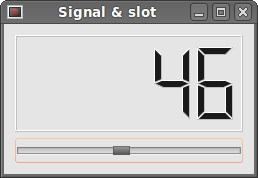 Figure: Signal & slot
Reimplementing event handler
Events in PyQt4 are processed often by reimplementing event handlers.
#!/usr/bin/python

# -*- coding: utf-8 -*-

"""

ZetCode PyQt4 tutorial

In this example, we reimplement an

event handler.

author: Jan Bodnar

website: zetcode.com

last edited: October 2011

"""

import sys

from PyQt4 import QtGui, QtCore

class Example(QtGui.QWidget):

    def __init__(self):

        super(Example, self).__init__()

        self.initUI()

    def initUI(self):

        self.setGeometry(300, 300, 250, 150)

        self.setWindowTitle('Event handler')

        self.show()

    def keyPressEvent(self, e):

        if e.key() == QtCore.Qt.Key_Escape:

            self.close()

def main():

    app = QtGui.QApplication(sys.argv)

    ex = Example()

    sys.exit(app.exec_())

if __name__ == '__main__':

    main()
In our example, we reimplement the keyPressEvent() event handler.
def keyPressEvent(self, e):

    if e.key() == QtCore.Qt.Key_Escape:

        self.close()
If we click the Escape button, the application terminates.
Event sender
Sometimes it is convenient to know which widget is the sender of a signal. For this, PyQt4 has thesender() method.
#!/usr/bin/python

# -*- coding: utf-8 -*-

"""

ZetCode PyQt4 tutorial

In this example, we determine the event sender

object.

author: Jan Bodnar

website: zetcode.com

last edited: October 2011

"""

import sys

from PyQt4 import QtGui, QtCore

class Example(QtGui.QMainWindow):

    def __init__(self):

        super(Example, self).__init__()

        self.initUI()

    def initUI(self):

        btn1 = QtGui.QPushButton("Button 1", self)

        btn1.move(30, 50)

        btn2 = QtGui.QPushButton("Button 2", self)

        btn2.move(150, 50)

        btn1.clicked.connect(self.buttonClicked)

        btn2.clicked.connect(self.buttonClicked)

        self.statusBar()

        self.setGeometry(300, 300, 290, 150)

        self.setWindowTitle('Event sender')

        self.show()

    def buttonClicked(self):

        sender = self.sender()

        self.statusBar().showMessage(sender.text() + ' was pressed')

def main():

    app = QtGui.QApplication(sys.argv)

    ex = Example()

    sys.exit(app.exec_())

if __name__ == '__main__':

    main()
We have two buttons in our example. In the buttonClicked() method we determine which button we have clicked by calling the sender() method.
btn1.clicked.connect(self.buttonClicked)

btn2.clicked.connect(self.buttonClicked)
Both buttons are connected to the same slot.
def buttonClicked(self):

    sender = self.sender()

    self.statusBar().showMessage(sender.text() + ' was pressed')
We determine the signal source by calling the sender() method. In the statusbar of the application, we show the label of the button being pressed.
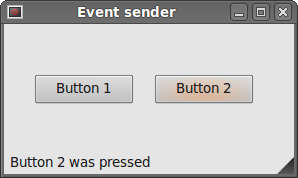 Figure: Event sender
Emitting signals
Objects created from a QtCore.QObject can emit signals. In the following example we will see how we can emit custom signals.
#!/usr/bin/python

# -*- coding: utf-8 -*-

"""

ZetCode PyQt4 tutorial

In this example, we show how to emit a

signal.

author: Jan Bodnar

website: zetcode.com

last edited: January 2015

"""

import sys

from PyQt4 import QtGui, QtCore

class Communicate(QtCore.QObject):

    closeApp = QtCore.pyqtSignal()

class Example(QtGui.QMainWindow):

    def __init__(self):

        super(Example, self).__init__()

        self.initUI()

    def initUI(self):

        self.c = Communicate()

        self.c.closeApp.connect(self.close)

        self.setGeometry(300, 300, 290, 150)

        self.setWindowTitle('Emit signal')

        self.show()

    def mousePressEvent(self, event):

        self.c.closeApp.emit()

def main():

    app = QtGui.QApplication(sys.argv)

    ex = Example()

    sys.exit(app.exec_())

if __name__ == '__main__':

    main()
We create a new signal called closeApp. This signal is emitted during a mouse press event. The signal is connected to the close() slot of the QtGui.QMainWindow.
class Communicate(QtCore.QObject):

    closeApp = QtCore.pyqtSignal()
A signal is created with the QtCore.pyqtSignal() as a class attribute of the external Communicate class.
self.c.closeApp.connect(self.close)
The custom closeApp signal is connected to the close() slot of the QtGui.QMainWindow.
def mousePressEvent(self, event):

    self.c.closeApp.emit()
When we click on the window with a mouse pointer, the closeApp signal is emitted. The application terminates.
In this part of the PyQt4 tutorial, we have covered signals and slots.
[Repost]Events and Signals in PyQt4的更多相关文章
- PyQt4入门
PyQt4入门教程(6)_对话框 文中译者的话将用方括号[]标出.对话框(Dialogs)是现代GUI程序中不可缺少的一部分.对话本来指的是两个或者更多人之间的交流,而在计算机应用中,对话是一个可以让 ...
- pyqt4_应用例子(计算器,对话框,进度条,日历等等)
sklearn实战-乳腺癌细胞数据挖掘(博客主亲自录制视频教程) https://study.163.com/course/introduction.htm?courseId=1005269003&a ...
- [wxWidgets] 2. 重访“Hello World” 程序
这是四年多来在博客园的第二篇博客.有了上一次的排版使用经验,这一篇文章应该有些进步(^_^). 闲话按下不表,言归正传.在编译.成功运行了上一个helloWorld.cpp(后文中'hw'简称hell ...
- STM32定时器级联 -- AN2592
Master configuration When a timer is selected as a master timer, the corresponding trigger output si ...
- API Design Principles -- QT Project
[the original link] One of Qt’s most reputed merits is its consistent, easy-to-learn, powerfulAPI. T ...
- Signal Handling--ref
http://www.chemie.fu-berlin.de/chemnet/use/info/libc/libc_21.html A signal is a software interrupt d ...
- Reactor Pattern and Non-blocking IO--reference
reference from:http://www.cs.bgu.ac.il/~spl051/Personal_material/Practical_sessions/Ps_12/ps12.html ...
- [转]使用gdb调试异常
有时程序中有未捕获的异常会导致程序异常的行为甚至导致程序的直接退出. 这对服务器程序来说是不可接受的. 可以使用gdb的catch命令来帮助我们调试异常. 使用gdb捕获异常的扔出点(相当于在扔出异常 ...
- ZetCode PyQt4 tutorial signals and slots
#!/usr/bin/python # -*- coding: utf-8 -*- """ ZetCode PyQt4 tutorial In this example, ...
随机推荐
- 根据浏览器显示界面大小变换,替换css文件方法
在1024屏幕下,选择适配1024屏幕的css文件, 在大于1024屏幕下,选择适配大屏幕的css文件. 在html中的head标签中引用css文件时,加入media属性. 例: <link r ...
- 【BZOJ-2730】矿场搭建 Tarjan 双连通分量
2730: [HNOI2012]矿场搭建 Time Limit: 10 Sec Memory Limit: 128 MBSubmit: 1602 Solved: 751[Submit][Statu ...
- AutoVFL(适配)
1.添加约束(系统) a.一个约束(上下左右) +(instancetype)constraintWithItem:(id)view1 attribute:(NSLayoutAttribute)att ...
- 第一次部署Struts2时出现错误java.lang.ClassNotFoundException: org.apache.struts2.dispatcher.ng.filter.StrutsPrepareAndExecuteFilter.class
报如下错误 at org.apache.catalina.loader.WebappClassLoader.loadClass(WebappClassLoader.java:1720) at org. ...
- alpha版、beta版、rc版的意思
很多软件在正式发布前都会发布一些预览版或者测试版,一般都叫“beta版”或者 “rc版”,特别是开源软件,甚至有“alpha版”,下面来解释一下各个版本的意思. alpha版:内部测试版.α是希腊字母 ...
- 每秒执行一个shell脚本(转载)
上周迁移了一台服务器,发现其中一个项目的数据没有更新,查询原服务器的数据,数据有更新,并找到了rsync服务,从其他服务器传输数据,那么如何找到这台服务器?因为是从远程传输到本地,而且不是很频繁, ...
- tyvj1938 最优战舰
描述 太空战队顺利地完成了它的第一次使命,这一行动的受益者陆军本部当即决定,请陆军的战士们投票选出最优战舰并报司令总部进行表彰.为防止有人利用高科技手段造假,陆军本部决定使用最原始的方法进行投票.可不 ...
- ACM 计算几何中的精度问题(转)
http://www.cnblogs.com/acsmile/archive/2011/05/09/2040918.html 计算几何头疼的地方一般在于代码量大和精度问题,代码量问题只要平时注意积累模 ...
- C#常用类库(100多个)
http://download.csdn.net/download/dxf1213cs/8238153
- SVN版本控制与分支设置
使用SVN+Eclipse做软件版本控制. (2009年5月) 1,SVN目录结构 Trunk : 主干目录,此目录下的文件为基准文件 Branches : 用于开发的分支目录 Tags : 用于发布 ...