
Qt下libusb-win32的使用(转)
源:Qt下libusb-win32的使用(一)打印设备描述符
主要是在前一篇的基础上,学习libusb-win32的API使用。程序很简单,就是打印指定USB设备的设备描述符(当然其他描述符也是可以的)。
#include "testlibusb.h"

#define MY_VID 0x5345

#define MY_PID 0x1234

USB::USB()

{

    usb_init(); /* initialize the library */

    //usb_set_debug(255);

    usb_find_busses(); /* find all busses */

    usb_find_devices(); /* find all connected devices */

    if (!(udev = open_dev())) {

        qDebug("error opening device: %s", usb_strerror());

        exit();

    } else

        qDebug("open success: device %04X:%04X opened", MY_VID, MY_PID);

    printf_device_descriptor(&dev->descriptor);

    usb_close(udev);

    //my_usb_get_device_list();

    resize(, );

}

usb_dev_handle *USB::open_dev(void)

{

    struct usb_bus *bus;

    //struct usb_device *dev;

    for(bus = usb_get_busses(); bus; bus = bus->next) {

        for(dev = bus->devices; dev; dev = dev->next) {

            if((dev->descriptor.idVendor == MY_VID) && (dev->descriptor.idProduct == MY_PID)) {

                    return usb_open(dev);

            }

        }

    }

    return ;

}

void USB::printf_device_descriptor(usb_device_descriptor *desc)

{

        qDebug("bLength:             %u",     desc->bLength);

        qDebug("bDescriptorType:     %02Xh",  desc->bDescriptorType);

        qDebug("bcdUSB:              %04Xh",  desc->bcdUSB);

        qDebug("bDeviceClass:        %02Xh",  desc->bDeviceClass);

        qDebug("bDeviceSubClass:     %02Xh",  desc->bDeviceSubClass);

        qDebug("bDeviceProtocol:     %02Xh",  desc->bDeviceProtocol);

        qDebug("bMaxPacketSize0:     %02Xh",  desc->bMaxPacketSize0);

        qDebug("idVendor:            %04Xh",  desc->idVendor);

        qDebug("idProduct:           %04Xh",  desc->idProduct);

        qDebug("bcdDevice:           %04Xh",  desc->bcdDevice);

        qDebug("iManufacturer:       %u",     desc->iManufacturer);

        qDebug("iProduct:            %u",     desc->iProduct);

        qDebug("iSerialNumber:       %u",     desc->iSerialNumber);

        qDebug("bNumConfigurations:  %u",     desc->bNumConfigurations);

}
这里我指定的USB设备是Tiny6410开发板。运行效果如下:
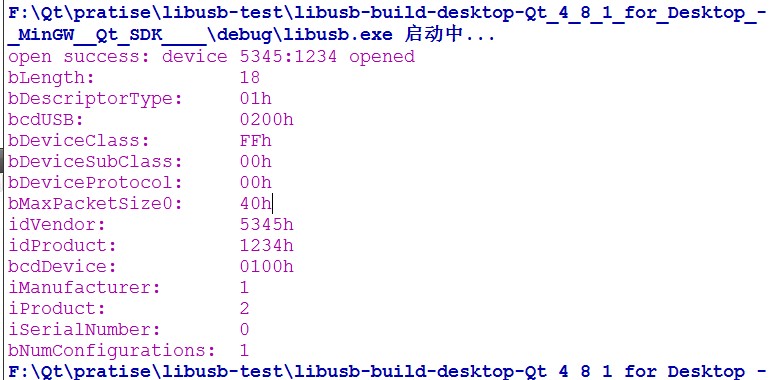
下一步就是上位机与开发板进行数据互传。
一、概述
学习libusb-win32的使用。使用批量传输方式与USB开发板进行数据读、写操作。上位机使用Qt做界面, 使用USB开发板的端点2作为批量传输端点。
二、实现
代码比较简单,直接给出,如下:
#include "testlibusb.h"

//for Tiny6410

//#define MY_VID 0x5345

//#define MY_PID 0x1234

//for 51 USB Board

#define MY_VID 0x8888

#define MY_PID 0x0001

// Device configuration and interface id.

#define MY_CONFIG 1

#define MY_INTF 0

// Device endpoint 2

#define EP_IN 0x82

#define EP_OUT 0x02

// Device of bytes to transfer.

#define BUF_SIZE 64

//#define DEBUG_GUI

USB::USB()

{

#ifndef DEBUG_GUI

    usb_init(); /* initialize the library */

    //usb_set_debug(255);

    usb_find_busses(); /* find all busses */

    usb_find_devices(); /* find all connected devices */

    if (!(udev = open_dev())) {

        qDebug("error opening device: %s", usb_strerror());

        exit();

    } else

        qDebug("open success: device %04X:%04X opened", MY_VID, MY_PID);

    printf_device_descriptor(&dev->descriptor);

    my_init_usbdev();

#endif

    textEdit = new QTextEdit(this);

    textEdit->setGeometry(,,,);

    sendButton = new QPushButton(this);

    sendButton->setText("send");

    sendButton->setGeometry(,,,);

    connect(sendButton,SIGNAL(clicked()),this,SLOT(send_slot()));

    readButton = new QPushButton(this);

    readButton->setText("read");

    readButton->setGeometry(,,,);

    connect(readButton,SIGNAL(clicked()),this,SLOT(read_slot()));

    recvLabel = new QLabel(this);

    recvLabel->setText("recv data:");

    recvLabel->setGeometry(,,,);

    //my_usb_get_device_list();

    resize(, );

}

//关闭程序时被调用

USB::~USB()

{

#ifndef DEBUG_GUI

    qDebug("close usb device.");

    usb_close(udev);

#endif

}

//打开指定VID、PID的USB设备

usb_dev_handle *USB::open_dev(void)

{

    struct usb_bus *bus;

    for(bus = usb_get_busses(); bus; bus = bus->next) {

        for(dev = bus->devices; dev; dev = dev->next) {

            if((dev->descriptor.idVendor == MY_VID) && (dev->descriptor.idProduct == MY_PID)) {

                    return usb_open(dev);

            }

        }

    }

    return ;

}

//打印USB设备描述符

void USB::printf_device_descriptor(usb_device_descriptor *desc)

{

        qDebug("bLength:             %u",     desc->bLength);

        qDebug("bDescriptorType:     %02Xh",  desc->bDescriptorType);

        qDebug("bcdUSB:              %04Xh",  desc->bcdUSB);

        qDebug("bDeviceClass:        %02Xh",  desc->bDeviceClass);

        qDebug("bDeviceSubClass:     %02Xh",  desc->bDeviceSubClass);

        qDebug("bDeviceProtocol:     %02Xh",  desc->bDeviceProtocol);

        qDebug("bMaxPacketSize0:     %02Xh",  desc->bMaxPacketSize0);

        qDebug("idVendor:            %04Xh",  desc->idVendor);

        qDebug("idProduct:           %04Xh",  desc->idProduct);

        qDebug("bcdDevice:           %04Xh",  desc->bcdDevice);

        qDebug("iManufacturer:       %u",     desc->iManufacturer);

        qDebug("iProduct:            %u",     desc->iProduct);

        qDebug("iSerialNumber:       %u",     desc->iSerialNumber);

        qDebug("bNumConfigurations:  %u",     desc->bNumConfigurations);

}

//指定USB设备的配置和接口

void USB::my_init_usbdev()

{

    //libusb规定下面这两个函数必须要被调用

    if (usb_set_configuration(udev, MY_CONFIG) < ) {

        qDebug("error setting config #%d: %s", MY_CONFIG, usb_strerror());

        exit();

    }

    if (usb_claim_interface(udev, MY_INTF) < ) {

        qDebug("error claiming interface #%d:\n%s", MY_INTF, usb_strerror());

        exit();

    }

}

//发送按钮响应函数

void USB::send_slot()

{

    int ret, num;

    QString s = textEdit->toPlainText();

    QByteArray a = s.toLatin1();

    char *tmp = a.data();

    num = s.length();

    //qDebug()<<"text: "<<tmp<<"length: "<<num;

    //批量写(同步)

    ret = usb_bulk_write(udev, EP_OUT, tmp, num, );

    if (ret < ) {

            qDebug("error writing: %s", usb_strerror());

            exit();

    }

}

//读按钮响应函数

void USB::read_slot()

{

    int ret;

    char readdata[BUF_SIZE];

    //批量读(同步)

    ret = usb_bulk_read(udev, EP_IN, readdata, sizeof(readdata), );

    if (ret < ) {

            qDebug("error reading:%s", usb_strerror());

            exit();

    }

    readdata[ret] = '\0';

    //将接收到的数据显示在Label上

    recvLabel->setText("recv: " + QLatin1String(readdata));

}
三、结果
运行上位机程序,在编辑框输入一些字符(数字),然后点击“send”按钮将数据发送给USB设备,点击“read”按钮将USB设备接收到的数据读回到上位机并显示在界面上,效果如下:

Qt下libusb-win32的使用(转)的更多相关文章
- 【转】Qt下使用glut库
ps:这个说的很明白,尤其是win10环境下用mingw环境时编程时碰到的问题, 1.加 windows.h 2.在.pro 添加libs 博文地址:Qt下使用glut库 本人使用的环境 ...
- VC++或QT下 高精度 多媒体定时器
在VC编程中,用SetTimer可以定义一个定时器,到时间了,就响应OnTimer消息,但这种定时器精度太低了.如果需要精度更高一些的定时器(精 确到1ms),可以使用下面的高精度多媒体定时器进行代码 ...
- Qt下libusb-win32的使用方法(转)
源:Qt下libusb-win32的使用方法 之前一直找不到适合WIN7下的Tiny6410的USB下载软件,正好这几天开始学习USB,所以打算自己写一个专门用于Tiny6410的WIN7下的USB下 ...
- Qt下libusb-win32的使用方法
之前一直找不到适合WIN7下的Tiny6410的USB下载软件,正好这几天开始学习USB,所以打算自己写一个专门用于Tiny6410的WIN7下的USB下载软件. 发现了libusb这个库可以用作无驱 ...
- delphi中formatFloat代码初探(在qt下实现floatformat的函数)
由于项目需要,需要在qt下实现floatformat的函数.之前写过一个,但是写得不好.决定重新写一个,参考delphi xe2下的实现.把xe2下的相关代码都看了一遍,xe2的代码思路在这里贴出来. ...
- QT下资源使用和资源占用…(可以动态加载资源文件,这样不占内存)
原文地址:关于QT下资源使用和资源占用内存过多的问题作者:技术成就梦想 最近研究了一下如何从外部动态调用图片的问题,从而研究了图片资源的使用方法.网上最常见的帖子是这个,感觉总结的还不错. h ...
- windows下实现win32俄罗斯方块练手,编程的几点心得
编程珠玑2阅读笔记: 1.使用c语言性能监视器,完成对代码的调优工作 2.关联数组: 拓扑排序算法,可以用于当存在遮挡的时候决定三维场景的绘制顺序. 3.小型算法中的测试与调试工具 脚手架程序:&l ...
- 关于QT下资源使用和资源占用…
原文地址:关于QT下资源使用和资源占用内存过多的问题作者:技术成就梦想 最近研究了一下如何从外部动态调用图片的问题,从而研究了图片资源的使用方法.网上最常见的帖子是这个,感觉总结的还不错. h ...
- Qt下QString转char*
Qt下面,字符串都用QString,确实给开发者提供了方便,想想VC里面定义的各种变量类型,而且函数参数类型五花八门,经常需要今年新那个类型转换 Qt再使用第三方开源库时,由于库的类型基本上都是标准的 ...
随机推荐
- iOS 开发中的各种证书
公钥和私钥 转载自:http://www.samirchen.com/ios-certificates/ 先简单的介绍一下公钥和私钥.我们常见的加密算法有两类:对称加密算法(Symmetric Cry ...
- 10款免费Bootstrap后台模板演示及下载
自从有了类似Bootstrap这样强大的前端框架之后,无论我们是做静态页面,还是做网站主题,着实方便很多.即便有很多类似的其他国产.海外的前端框架比较,Bootstrap用户量以及功能文档还是比较大的 ...
- JS-运动基础(一)
<title>无标题文档</title> <style> #div1{width:200px;height:200px; background:red; posit ...
- gulp相关知识(2)
将之前的东西的理论部分整理了一下—— gulp 前端构建工具 它可以帮助我们完成一些自动化操作 它需要一些插件的支持 var gulp = require('gulp'); --> gulp命令 ...
- 多校 Babelfish
题目链接:http://acm.hust.edu.cn/vjudge/contest/124435#problem/A 密码:acm Sample Input dog ogday cat atcay ...
- C#无边框窗体移动 将事件绑定到想实现的控件上
[DllImport("user32.dll")] public static extern bool ReleaseCapture(); [DllImport("use ...
- XML回顾
xml加强 一.sax解析 1)原理: 读取xml的某个部分,解析一部分(读取一点,解析一点) 2)步骤: SAXParserFactory factory = SAXPa ...
- Linux通过防火墙禁止IP来防止攻击
1. iptables -I INPUT -s 211.1.0.0 -j DROP 禁止211.1.0.0这个IP访问服务器 2. iptables -I INPUT -s 211.1.0.0 -j ...
- zf-关于业务量图表没有出现统计柱形图问题
是实现类里的 objs[0] = ht.get("BUS_NAME");objs[1] = ht.get("NUM"); 这个写成小写了 改成大写即可,原来这个 ...
- dom4j解析xml实例
dom4j是一个java的XML API,类似jdom,用来读写XML文件,它性能优异.功能强大和极易使用等特点 所用jar包:dom4j-1.6.1.jar 需要解析的xml文件:people.xm ...