
Spark笔记之累加器(Accumulator)
一、累加器简介
在Spark中如果想在Task计算的时候统计某些事件的数量,使用filter/reduce也可以,但是使用累加器是一种更方便的方式,累加器一个比较经典的应用场景是用来在Spark Streaming应用中记录某些事件的数量。
使用累加器时需要注意只有Driver能够取到累加器的值,Task端进行的是累加操作。
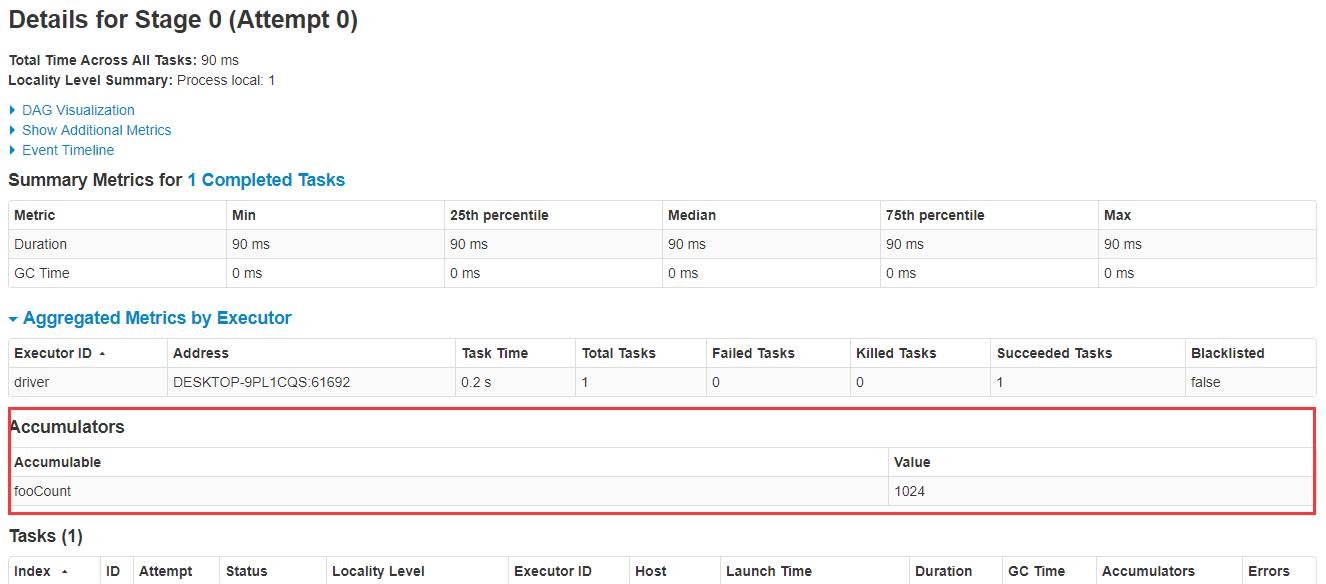
创建的Accumulator变量的值能够在Spark Web UI上看到,在创建时应该尽量为其命名,下面探讨如何在Spark Web UI上查看累加器的值。
示例代码:
package cc11001100.spark.sharedVariables.accumulators;

import org.apache.spark.api.java.function.ForeachFunction;

import org.apache.spark.sql.Encoders;

import org.apache.spark.sql.SparkSession;

import org.apache.spark.util.LongAccumulator;

import java.util.Collections;

import java.util.concurrent.TimeUnit;

/**

 * @author CC11001100

 */

public class SparkWebUIShowAccumulatorDemo {

	public static void main(String[] args) {

		SparkSession spark = SparkSession.builder().master("local[*]").getOrCreate();

		LongAccumulator fooCount = spark.sparkContext().longAccumulator("fooCount");

		spark.createDataset(Collections.singletonList(1024), Encoders.INT())

				.foreach((ForeachFunction<Integer>) fooCount::add);

		try {

			TimeUnit.DAYS.sleep(365 * 10000);

		} catch (InterruptedException e) {

			e.printStackTrace();

		}

	}

}
启动的时候注意观察控制台上输出的Spark Web UI的地址:

打开此链接,点进去Jobs-->Stage,可以看到fooCount累加器的值已经被累加到了1024:
二、Accumulator的简单使用
Spark内置了三种类型的Accumulator,分别是LongAccumulator用来累加整数型,DoubleAccumulator用来累加浮点型,CollectionAccumulator用来累加集合元素。
package cc11001100.spark.sharedVariables.accumulators;

import org.apache.spark.SparkContext;

import org.apache.spark.api.java.function.MapFunction;

import org.apache.spark.sql.Dataset;

import org.apache.spark.sql.Encoders;

import org.apache.spark.sql.SparkSession;

import org.apache.spark.util.CollectionAccumulator;

import org.apache.spark.util.DoubleAccumulator;

import org.apache.spark.util.LongAccumulator;

import java.util.Arrays;

/**

 * 累加器的基本使用

 *

 * @author CC11001100

 */

public class AccumulatorsSimpleUseDemo {

	public static void main(String[] args) {

		SparkSession spark = SparkSession.builder().master("local[*]").getOrCreate();

		SparkContext sc = spark.sparkContext();

		// 内置的累加器有三种,LongAccumulator、DoubleAccumulator、CollectionAccumulator

		// LongAccumulator: 数值型累加

		LongAccumulator longAccumulator = sc.longAccumulator("long-account");

		// DoubleAccumulator: 小数型累加

		DoubleAccumulator doubleAccumulator = sc.doubleAccumulator("double-account");

		// CollectionAccumulator:集合累加

		CollectionAccumulator<Integer> collectionAccumulator = sc.collectionAccumulator("double-account");

		Dataset<Integer> num1 = spark.createDataset(Arrays.asList(1, 2, 3), Encoders.INT());

		Dataset<Integer> num2 = num1.map((MapFunction<Integer, Integer>) x -> {

			longAccumulator.add(x);

			doubleAccumulator.add(x);

			collectionAccumulator.add(x);

			return x;

		}, Encoders.INT()).cache();

		num2.count();

		System.out.println("longAccumulator: " + longAccumulator.value());

		System.out.println("doubleAccumulator: " + doubleAccumulator.value());

		// 注意,集合中元素的顺序是无法保证的,多运行几次发现每次元素的顺序都可能会变化

		System.out.println("collectionAccumulator: " + collectionAccumulator.value());

	}

}
三、自定义Accumulator
当内置的Accumulator无法满足要求时,可以继承AccumulatorV2实现自定义的累加器。
实现自定义累加器的步骤:
1. 继承AccumulatorV2,实现相关方法
2. 创建自定义Accumulator的实例,然后在SparkContext上注册它
假设要累加的数非常大,内置的LongAccumulator已经无法满足需求,下面是一个简单的例子用来累加BigInteger:
package cc11001100.spark.sharedVariables.accumulators;

import org.apache.spark.SparkContext;

import org.apache.spark.api.java.function.MapFunction;

import org.apache.spark.sql.Dataset;

import org.apache.spark.sql.Encoders;

import org.apache.spark.sql.SparkSession;

import org.apache.spark.util.AccumulatorV2;

import java.math.BigInteger;

import java.util.Arrays;

import java.util.List;

/**

 * 自定义累加器

 *

 * @author CC11001100

 */

public class CustomAccumulatorDemo {

	// 需要注意的是累加操作不能依赖顺序,比如类似于StringAccumulator这种则会得到错误的结果

	public static class BigIntegerAccumulator extends AccumulatorV2<BigInteger, BigInteger> {

		private BigInteger num = BigInteger.ZERO;

		public BigIntegerAccumulator() {

		}

		public BigIntegerAccumulator(BigInteger num) {

			this.num = new BigInteger(num.toString());

		}

		@Override

		public boolean isZero() {

			return num.compareTo(BigInteger.ZERO) == 0;

		}

		@Override

		public AccumulatorV2<BigInteger, BigInteger> copy() {

			return new BigIntegerAccumulator(num);

		}

		@Override

		public void reset() {

			num = BigInteger.ZERO;

		}

		@Override

		public void add(BigInteger num) {

			this.num = this.num.add(num);

		}

		@Override

		public void merge(AccumulatorV2<BigInteger, BigInteger> other) {

			num = num.add(other.value());

		}

		@Override

		public BigInteger value() {

			return num;

		}

	}

	public static void main(String[] args) {

		SparkSession spark = SparkSession.builder().master("local[*]").getOrCreate();

		SparkContext sc = spark.sparkContext();

		// 直接new自定义的累加器

		BigIntegerAccumulator bigIntegerAccumulator = new BigIntegerAccumulator();

		// 然后在SparkContext上注册一下

		sc.register(bigIntegerAccumulator, "bigIntegerAccumulator");

		List<BigInteger> numList = Arrays.asList(new BigInteger("9999999999999999999999"), new BigInteger("9999999999999999999999"), new BigInteger("9999999999999999999999"));

		Dataset<BigInteger> num = spark.createDataset(numList, Encoders.kryo(BigInteger.class));

		Dataset<BigInteger> num2 = num.map((MapFunction<BigInteger, BigInteger>) x -> {

			bigIntegerAccumulator.add(x);

			return x;

		}, Encoders.kryo(BigInteger.class));

		num2.count();

		System.out.println("bigIntegerAccumulator: " + bigIntegerAccumulator.value());

	}

}
思考:内置的累加器LongAccumulator、DoubleAccumulator、CollectionAccumulator和我上面的自定义BigIntegerAccumulator,它们都有一个共同的特点,就是最终的结果不受累加数据顺序的影响(对于CollectionAccumulator来说,可以简单的将结果集看做是一个无序Set),看到网上有博主举例子StringAccumulator,这个就是一个错误的例子,就相当于开了一百个线程,每个线程随机sleep若干毫秒然后往StringBuffer中追加字符,最后追加出来的字符串是无法被预测的。总结一下就是累加器的最终结果应该不受累加顺序的影响,否则就要重新审视一下这个累加器的设计是否合理。
四、使用Accumulator的陷阱
来讨论一下使用累加器的一些陷阱,累加器的累加是在Task中进行的,而这些Task就是我们在Dataset上调用的一些算子操作,这些算子操作有Transform的,也有Action的,来探讨一下不同类型的算子对Accumulator有什么影响。
package cc11001100.spark.sharedVariables.accumulators;

import org.apache.spark.SparkContext;

import org.apache.spark.api.java.function.MapFunction;

import org.apache.spark.sql.Dataset;

import org.apache.spark.sql.Encoders;

import org.apache.spark.sql.SparkSession;

import org.apache.spark.util.LongAccumulator;

import java.util.Arrays;

/**

 * 累加器使用的陷阱

 *

 * @author CC11001100

 */

public class AccumulatorTrapDemo {

	public static void main(String[] args) {

		SparkSession spark = SparkSession.builder().master("local[*]").getOrCreate();

		SparkContext sc = spark.sparkContext();

		LongAccumulator longAccumulator = sc.longAccumulator("long-account");

		// ------------------------------- 在transform算子中的错误使用 -------------------------------------------

		Dataset<Integer> num1 = spark.createDataset(Arrays.asList(1, 2, 3), Encoders.INT());

		Dataset<Integer> nums2 = num1.map((MapFunction<Integer, Integer>) x -> {

			longAccumulator.add(1);

			return x;

		}, Encoders.INT());

		// 因为没有Action操作,nums.map并没有被执行,因此此时广播变量的值还是0

		System.out.println("num2 1: " + longAccumulator.value()); // 0

		// 调用一次action操作,num.map得到执行,广播变量被改变

		nums2.count();

		System.out.println("num2 2: " + longAccumulator.value());  // 3

		// 又调用了一次Action操作,广播变量所在的map又被执行了一次,所以累加器又被累加了一遍,就悲剧了

		nums2.count();

		System.out.println("num2 3: " + longAccumulator.value()); // 6

		// ------------------------------- 在transform算子中的正确使用 -------------------------------------------

		// 累加器不应该被重复使用,或者在合适的时候进行cache断开与之前Dataset的血缘关系,因为cache了就不必重复计算了

		longAccumulator.setValue(0);

		Dataset<Integer> nums3 = num1.map((MapFunction<Integer, Integer>) x -> {

			longAccumulator.add(1);

			return x;

		}, Encoders.INT()).cache(); // 注意这个地方进行了cache

		// 因为没有Action操作,nums.map并没有被执行,因此此时广播变量的值还是0

		System.out.println("num3 1: " + longAccumulator.value()); // 0

		// 调用一次action操作,广播变量被改变

		nums3.count();

		System.out.println("num3 2: " + longAccumulator.value());  // 3

		// 又调用了一次Action操作,因为前一次调用count时num3已经被cache,num2.map不会被再执行一遍,所以这里的值还是3

		nums3.count();

		System.out.println("num3 3: " + longAccumulator.value()); // 3

		// ------------------------------- 在action算子中的使用 -------------------------------------------

		longAccumulator.setValue(0);

		num1.foreach(x -> {

			longAccumulator.add(1);

		});

		// 因为是Action操作,会被立即执行所以打印的结果是符合预期的

		System.out.println("num4: " + longAccumulator.value()); // 3

	}

}
五、Accumulator使用的奇淫技巧
累加器并不是只能用来实现加法,也可以用来实现减法,直接把要累加的数值改成负数就可以了:
package cc11001100.spark.sharedVariables.accumulators;

import org.apache.spark.sql.Dataset;

import org.apache.spark.sql.Encoders;

import org.apache.spark.sql.SparkSession;

import org.apache.spark.util.LongAccumulator;

import java.util.Arrays;

/**

 * 使用累加器实现减法

 *

 * @author CC11001100

 */

public class AccumulatorSubtraction {

	public static void main(String[] args) {

		SparkSession spark = SparkSession.builder().master("local[*]").getOrCreate();

		Dataset<Integer> nums = spark.createDataset(Arrays.asList(1, 2, 3, 4, 5, 6, 7, 8), Encoders.INT());

		LongAccumulator longAccumulator = spark.sparkContext().longAccumulator("AccumulatorSubtraction");

		nums.foreach(x -> {

			if (x % 3 == 0) {

				longAccumulator.add(-2);

			} else {

				longAccumulator.add(1);

			}

		});

		System.out.println("longAccumulator: " + longAccumulator.value()); // 2

	}

}
相关资料:
1. Accumulators
2. When are accumulators truly reliable?
.
Spark笔记之累加器(Accumulator)的更多相关文章
- Spark中自定义累加器Accumulator
1. 自定义累加器 自定义累加器需要继承AccumulatorParam,实现addInPlace和zero方法. 例1:实现Long类型的累加器 object LongAccumulatorPara ...
- spark笔记 环境配置
spark笔记 spark简介 saprk 有六个核心组件: SparkCore.SparkSQL.SparkStreaming.StructedStreaming.MLlib,Graphx Spar ...
- Spark累加器(Accumulator)陷阱及解决办法
累加器(accumulator)是Spark中提供的一种分布式的变量机制,其原理类似于mapreduce,即分布式的改变,然后聚合这些改变.累加器的一个常见用途是在调试时对作业执行过程中的事件进行计数 ...
- Spark笔记——技术点汇总
目录 概况 手工搭建集群 引言 安装Scala 配置文件 启动与测试 应用部署 部署架构 应用程序部署 核心原理 RDD概念 RDD核心组成 RDD依赖关系 DAG图 RDD故障恢复机制 Standa ...
- pyspark中使用累加器Accumulator统计指标
评价分类模型的性能时需要用到以下四个指标 最开始使用以下代码计算,发现代码需要跑近一个小时,而且这一个小时都花在这四行代码上 # evaluate model TP = labelAndPreds.f ...
- spark 笔记 5: SparkContext,SparkConf
SparkContext 是spark的程序入口,相当于熟悉的'main'函数.它负责链接spark集群.创建RDD.创建累加计数器.创建广播变量. ) scheduler.initialize(ba ...
- 大数据学习——spark笔记
变量的定义 val a: Int = 1 var b = 2 方法和函数 区别:函数可以作为参数传递给方法 方法: def test(arg: Int): Int=>Int ={ 方法体 } v ...
- spark 笔记 16: BlockManager
先看一下原理性的文章:http://jerryshao.me/architecture/2013/10/08/spark-storage-module-analysis/ ,http://jerrys ...
- spark 笔记 15: ShuffleManager,shuffle map两端的stage/task的桥梁
无论是Hadoop还是spark,shuffle操作都是决定其性能的重要因素.在不能减少shuffle的情况下,使用一个好的shuffle管理器也是优化性能的重要手段. ShuffleManager的 ...
随机推荐
- Python与rrdtool的结合模块
rrdtool(round robin database)工具为环状数据库的存储格式,round robin是一种处理定量数据以及当前元素指针的技术.rrdtool主要用来跟踪对象的变化情况,生成这些 ...
- Linux内核分析——第二周学习笔记20135308
第二周 操作系统是如何工作的 第一节 函数调用堆栈 存储程序计算机:是所有计算机基础的框架 堆栈:计算机中基础的部分,在计算机只有机器语言.汇编语言时,就有了堆栈.堆栈机制是高级语言可以运行的基础. ...
- wordpress学习五: 通过wordpress_xmlrpc的python包远程操作wordpress
wordpress提供了丰富的xmlrpc接口api来供我们远程操控wp的内容.伟大的开源社区有人就将这些api做了一下封装,提供了一个功能比较完整的python库,库的使用文档地址http://py ...
- 毕业设计---json,Struts,ajax以及JQuery简单案例
<!-- Struts2的xml文件配置 --><struts> <package name="default" namespace="/& ...
- 初学Nutch之简介与安装
1.Nutch简介 Nutch是一个由Java实 现的,开放源代码(open-source)的web搜索引擎.主要用于收集网页数据,然后对其进行分析,建立索引,以提供相应的接口来对其网页数据进行 查询 ...
- Beta阶段敏捷冲刺②
1.提供当天站立式会议照片一张. 每个人的工作 (有work item 的ID),并将其记录在码云项目管理中: 1.1昨天已完成的工作. 姓名 昨天已完成的工作 徐璐琳 完成设置界面的排版 祁泽文 实 ...
- Alpha冲刺——day8
Alpha冲刺--day8 作业链接 Alpha冲刺随笔集 github地址 团队成员 031602636 许舒玲(队长) 031602237 吴杰婷 031602220 雷博浩 031602634 ...
- GS 服务器端开启webservice 远程调试的方法
1. 修改 安装目录下 web.config的文件. 一般目录为: C:\Program Files\GenerSoft\bscw_local\web.config 为了保证安全想把文件备份一下. 2 ...
- CF 1070J Streets and Avenues in Berhattan
DP的数组f其实开得不够大,应该开200000,但是它在cf上就是过了... 题意是把一堆字母分别分配到行和列. 分析一下,答案实际上只和n行中和m列中每种字母分配的个数有关.而且答案只和" ...
- JSP 获取真实IP地址的代码
[转载]JSP 获取真实IP地址的代码 JSP 获取真实IP地址的代码 在JSP里,获取客户端的IP地址的方法是:request.getRemoteAddr(),这种方法在大部分情况下都是有效的. ...