
spark 笔记 16: BlockManager
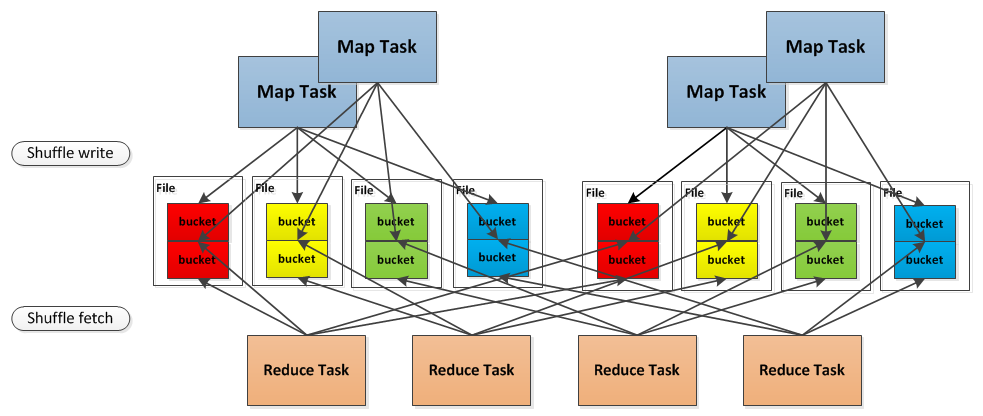
/* Class for returning a fetched block and associated metrics. */
private[spark] class BlockResult(
    val data: Iterator[Any],
    readMethod: DataReadMethod.Value,
    bytes: Long) {
  val inputMetrics = new InputMetrics(readMethod)
  inputMetrics.bytesRead = bytes
}

private[spark] class BlockManager(
    executorId: String,
    actorSystem: ActorSystem,
    val master: BlockManagerMaster,
    defaultSerializer: Serializer,
    maxMemory: Long,
    val conf: SparkConf,
    securityManager: SecurityManager,
    mapOutputTracker: MapOutputTracker,
    shuffleManager: ShuffleManager)
  extends BlockDataProvider with Logging {
/**
 * Contains all the state related to a particular shuffle. This includes a pool of unused
 * ShuffleFileGroups, as well as all ShuffleFileGroups that have been created for the shuffle.
 */
private class ShuffleState(val numBuckets: Int) {
  val nextFileId = new AtomicInteger(0)
  val unusedFileGroups = new ConcurrentLinkedQueue[ShuffleFileGroup]()
  val allFileGroups = new ConcurrentLinkedQueue[ShuffleFileGroup]()

  /**
   * The mapIds of all map tasks completed on this Executor for this shuffle.
   * NB: This is only populated if consolidateShuffleFiles is FALSE. We don't need it otherwise.
   */
  val completedMapTasks = new ConcurrentLinkedQueue[Int]()
}
private val shuffleStates = new TimeStampedHashMap[ShuffleId, ShuffleState]

private val metadataCleaner =
  new MetadataCleaner(MetadataCleanerType.SHUFFLE_BLOCK_MANAGER, this.cleanup, conf)
/**
 * Register a completed map without getting a ShuffleWriterGroup. Used by sort-based shuffle
 * because it just writes a single file by itself.
 */
def addCompletedMap(shuffleId: Int, mapId: Int, numBuckets: Int): Unit = {
  shuffleStates.putIfAbsent(shuffleId, new ShuffleState(numBuckets))
  val shuffleState = shuffleStates(shuffleId)
  shuffleState.completedMapTasks.add(mapId)
}
/**
 * Initialize the BlockManager. Register to the BlockManagerMaster, and start the
 * BlockManagerWorker actor.
 */
private def initialize(): Unit = {
  master.registerBlockManager(blockManagerId, maxMemory, slaveActor)
  BlockManagerWorker.startBlockManagerWorker(this)
}
/**
 * A short-circuited method to get blocks directly from disk. This is used for getting
 * shuffle blocks. It is safe to do so without a lock on block info since disk store
 * never deletes (recent) items.
 */
def getLocalFromDisk(blockId: BlockId, serializer: Serializer): Option[Iterator[Any]] = {
  diskStore.getValues(blockId, serializer).orElse {
    throw new BlockException(blockId, s"Block $blockId not found on disk, though it should be")
  }
}
/** A group of writers for a ShuffleMapTask, one writer per reducer. */
private[spark] trait ShuffleWriterGroup {
  val writers: Array[BlockObjectWriter]

  /** @param success Indicates all writes were successful. If false, no blocks will be recorded. */
  def releaseWriters(success: Boolean)
}

/**
 * Manages assigning disk-based block writers to shuffle tasks. Each shuffle task gets one file
 * per reducer (this set of files is called a ShuffleFileGroup).
 *
 * As an optimization to reduce the number of physical shuffle files produced, multiple shuffle
 * blocks are aggregated into the same file. There is one "combined shuffle file" per reducer
 * per concurrently executing shuffle task. As soon as a task finishes writing to its shuffle
 * files, it releases them for another task.
 * Regarding the implementation of this feature, shuffle files are identified by a 3-tuple:
 *   - shuffleId: The unique id given to the entire shuffle stage.
 *   - bucketId: The id of the output partition (i.e., reducer id)
 *   - fileId: The unique id identifying a group of "combined shuffle files." Only one task at a
 *       time owns a particular fileId, and this id is returned to a pool when the task finishes.
 * Each shuffle file is then mapped to a FileSegment, which is a 3-tuple (file, offset, length)
 * that specifies where in a given file the actual block data is located.
 *
 * Shuffle file metadata is stored in a space-efficient manner. Rather than simply mapping
 * ShuffleBlockIds directly to FileSegments, each ShuffleFileGroup maintains a list of offsets for
 * each block stored in each file. In order to find the location of a shuffle block, we search the
 * files within a ShuffleFileGroups associated with the block's reducer.
 */
// TODO: Factor this into a separate class for each ShuffleManager implementation
private[spark]
class ShuffleBlockManager(blockManager: BlockManager,
                          shuffleManager: ShuffleManager) extends Logging {
private[spark]
object ShuffleBlockManager {
  /**
   * A group of shuffle files, one per reducer.
   * A particular mapper will be assigned a single ShuffleFileGroup to write its output to.
   */
  private class ShuffleFileGroup(val shuffleId: Int, val fileId: Int, val files: Array[File]) {
    private var numBlocks: Int = 0

    /**
     * Stores the absolute index of each mapId in the files of this group. For instance,
     * if mapId 5 is the first block in each file, mapIdToIndex(5) = 0.
     */
    private val mapIdToIndex = new PrimitiveKeyOpenHashMap[Int, Int]()

    /**
     * Stores consecutive offsets and lengths of blocks into each reducer file, ordered by
     * position in the file.
     * Note: mapIdToIndex(mapId) returns the index of the mapper into the vector for every
     * reducer.
     */
    private val blockOffsetsByReducer = Array.fill[PrimitiveVector[Long]](files.length) {
      new PrimitiveVector[Long]()
    }
    private val blockLengthsByReducer = Array.fill[PrimitiveVector[Long]](files.length) {
      new PrimitiveVector[Long]()
    }

    def apply(bucketId: Int) = files(bucketId)

    def recordMapOutput(mapId: Int, offsets: Array[Long], lengths: Array[Long]) {
      assert(offsets.length == lengths.length)
      mapIdToIndex(mapId) = numBlocks
      numBlocks += 1
      for (i <- 0 until offsets.length) {
        blockOffsetsByReducer(i) += offsets(i)
        blockLengthsByReducer(i) += lengths(i)
      }
    }

    /** Returns the FileSegment associated with the given map task, or None if no entry exists. */
    def getFileSegmentFor(mapId: Int, reducerId: Int): Option[FileSegment] = {
      val file = files(reducerId)
      val blockOffsets = blockOffsetsByReducer(reducerId)
      val blockLengths = blockLengthsByReducer(reducerId)
      val index = mapIdToIndex.getOrElse(mapId, -1)
      if (index >= 0) {
        val offset = blockOffsets(index)
        val length = blockLengths(index)
        Some(new FileSegment(file, offset, length))
      } else {
        None
      }
    }
  }
}
spark 笔记 16: BlockManager的更多相关文章
- Ext.Net学习笔记16:Ext.Net GridPanel 折叠/展开行
Ext.Net学习笔记16:Ext.Net GridPanel 折叠/展开行 Ext.Net GridPanel的行支持折叠/展开功能,这个功能个人觉得还说很有用处的,尤其是数据中包含图片等内容的时候 ...
- 安装Hadoop及Spark(Ubuntu 16.04)
安装Hadoop及Spark(Ubuntu 16.04) 安装JDK 下载jdk(以jdk-8u91-linux-x64.tar.gz为例) 新建文件夹 sudo mkdir /usr/lib/jvm ...
- SQL反模式学习笔记16 使用随机数排序
目标:随机排序,使用高效的SQL语句查询获取随机数据样本. 反模式:使用RAND()随机函数 SELECT * FROM Employees AS e ORDER BY RAND() Limit 1 ...
- golang学习笔记16 beego orm 数据库操作
golang学习笔记16 beego orm 数据库操作 beego ORM 是一个强大的 Go 语言 ORM 框架.她的灵感主要来自 Django ORM 和 SQLAlchemy. 目前该框架仍处 ...
- spark的存储系统--BlockManager源码分析
spark的存储系统--BlockManager源码分析 根据之前的一系列分析,我们对spark作业从创建到调度分发,到执行,最后结果回传driver的过程有了一个大概的了解.但是在分析源码的过程中也 ...
- spark笔记 环境配置
spark笔记 spark简介 saprk 有六个核心组件: SparkCore.SparkSQL.SparkStreaming.StructedStreaming.MLlib,Graphx Spar ...
- spark 笔记 15: ShuffleManager,shuffle map两端的stage/task的桥梁
无论是Hadoop还是spark,shuffle操作都是决定其性能的重要因素.在不能减少shuffle的情况下,使用一个好的shuffle管理器也是优化性能的重要手段. ShuffleManager的 ...
- spark 笔记 12: Executor,task最后的归宿
spark的Executor是执行task的容器.和java的executor概念类似. ===================start executor runs task============ ...
- Spark笔记:复杂RDD的API的理解(下)
本篇接着谈谈那些稍微复杂的API. 1) flatMapValues:针对Pair RDD中的每个值应用一个返回迭代器的函数,然后对返回的每个元素都生成一个对应原键的键值对记录 这个方法我最开始接 ...
随机推荐
- IAP技术原理
目录 IAP技术原理 更新记录 IAP与ISP的概念及原理 ISP简介 ISP原理 IAP简介 IAP原理 IAP优势 IAP的设计 1.程序启动流程 2.中断向量表的重定位 3.IAP跳转APP函数 ...
- 帝国cms 描述和关键词动态获取
之前列表页首页和内容页调用的关键词和描述的字段不一样,所以说需要写好几套模板. 下边这个判断就不用像之前做几套模板了,通过判断获取不一样的字段. $GLOBALS[navinfor] 这个判断的是此页 ...
- BLOB和CLOB
mysql各数据类型及字节长度一览表: 数据类型 字节长度 范围或用法 Bit 1 无符号[0,255],有符号[-128,127],天缘博客备注:BIT和BOOL布尔型都占用1字节 TinyInt ...
- 4G漏洞
4G VoLTE漏洞:可致用户地理位置和其它个人信息泄露 2017-08-05 LBS 首先要了解下,什么是VoLTE. VoLTE为英文Voice Over LTE的缩写,直译就是音频通过LTE网络 ...
- linux系统设置登录失败n次锁定账户:vim /etc/pam.d/system-auth
auth required pam_env.so 登陆后的环境变量 auth sufficient pam_fprintd.so 指纹认证 auth sufficient pam_unix.so nu ...
- WebSocket是什么原理,为什么可以实现持久连接
本文摘抄自知乎,原文标题:WebSocket 是什么原理?为什么可以实现持久连接? Websocket只是协议而已. 一.WebSocket是HTML5出的东西(协议),也就是说HTTP协议没有变化, ...
- const与constexpr
关于const型数据,谭浩强老爷子这么总结道: Time const t; //t是常对象,其值在任何情况下都不能改变 void Time::fun()const; //fun是Time类中的常成员函 ...
- Summer training round2 #9(Training28)
A:签到题 C:模拟搜索题 #include <bits/stdc++.h> #include <cstring> #include <iostream> #inc ...
- IANA
IANA,全称The Internet Assigned Numbers Authority,即互联网数字分配机构1. Internet已成为全球范围的网络.为保证其正常运作,全球有很多机构参与进来. ...
- linux 下mysql忘记密码或者安装好linux后不知道mysql初始密码解决方案
1.使用yum安装mysql后 2.初始密码在/var/log/mysqld.log这个文件里 3.输入命令:grep 'temporary password' /var/log/mysqld.log ...