
浅谈Android系统开发中LOG的使用【转】
本文转载自:http://blog.csdn.net/luoshengyang/article/details/6581828
在程序开发过程中,LOG是广泛使用的用来记录程序执行过程的机制,它既可以用于程序调试,也可以用于产品运营中的事件记录。在Android系统中,提供了简单、便利的LOG机制,开发人员可以方便地使用。在这一篇文章中,我们简单介绍在Android内核空间和用户空间中LOG的使用和查看方法。
一. 内核开发时LOG的使用。Android内核是基于Linux Kerne 2.36的,因此,Linux Kernel的LOG机制同样适合于Android内核,它就是有名的printk,与C语言的printf齐名。与printf类似,printk提供格式化输入功能,同时,它也具有所有LOG机制的特点--提供日志级别过虑功能。printk提供了8种日志级别(<linux/kernel.h>):
 #define KERN_EMERG    "<0>"     /* system is unusable             */

 #define KERN_ALERT    "<1>"     /* action must be taken immediately    */

 #define KERN_CRIT    "<2>"     /* critical conditions            */

 #deinfe KERN_ERR    "<3>"     /* error conditions            */

 #deinfe KERN_WARNING    "<4>"     /* warning conditions            */

 #deinfe KERN_NOTICE    "<5>"     /* normal but significant condition    */

 #deinfe KERN_INFO    "<6>"     /* informational             */

 #deinfe KERN_DEBUG    "<7>"     /* debug-level messages         */
printk的使用方法:
printk(KERN_ALERT"This is the log printed by printk in linux kernel space.");
KERN_ALERT表示日志级别,后面紧跟着要格式化字符串。
在Android系统中,printk输出的日志信息保存在/proc/kmsg中,要查看/proc/kmsg的内容,参照在Ubuntu上下载、编译和安装Android最新内核源代码(Linux Kernel)一文,在后台中运行模拟器:
USER-NAME@MACHINE-NAME:~/Android$ emulator &
启动adb shell工具:
USER-NAME@MACHINE-NAME:~/Android$ adb shell
查看/proc/kmsg文件:
root@android:/ # cat /proc/kmsg
二. 用户空间程序开发时LOG的使用。Android系统在用户空间中提供了轻量级的logger日志系统,它是在内核中实现的一种设备驱动,与用户空间的logcat工具配合使用能够方便地跟踪调试程序。在Android系统中,分别为C/C++ 和Java语言提供两种不同的logger访问接口。C/C++日志接口一般是在编写硬件抽象层模块或者编写JNI方法时使用,而Java接口一般是在应用层编写APP时使用。
Android系统中的C/C++日志接口是通过宏来使用的。在system/core/include/android/log.h定义了日志的级别:
 /*

  * Android log priority values, in ascending priority order.

  */

 typedef enum android_LogPriority {

     ANDROID_LOG_UNKNOWN = ,

     ANDROID_LOG_DEFAULT,    /* only for SetMinPriority() */

     ANDROID_LOG_VERBOSE,

     ANDROID_LOG_DEBUG,

     ANDROID_LOG_INFO,

     ANDROID_LOG_WARN,

     ANDROID_LOG_ERROR,

     ANDROID_LOG_FATAL,

     ANDROID_LOG_SILENT,    /* only for SetMinPriority(); must be last */

 } android_LogPriority;
在system/core/include/cutils/log.h中,定义了对应的宏,如对应于ANDROID_LOG_VERBOSE的宏LOGV
 /*

  * This is the local tag used for the following simplified

  * logging macros. You can change this preprocessor definition

  * before using the other macros to change the tag.

  */

 #ifndef LOG_TAG

 #define LOG_TAG NULL

 #endif

 /*

  * Simplified macro to send a verbose log message using the current LOG_TAG.

  */

 #ifndef LOGV

 #if LOG_NDEBUG

 #define LOGV(...)   ((void)0)

 #else

 #define LOGV(...)   ((void)LOG(LOG_VERBOSE, LOG_TAG, __VA_ARGS__))

 #endif

 #endif

 /*

  * Basic log message macro.

  *

  * Example:

  *  LOG(LOG_WARN, NULL, "Failed with error %d", errno);

  *

  * The second argument may be NULL or "" to indicate the "global" tag.

  */

 #ifndef LOG

 #define LOG(priority, tag, ...) \

      LOG_PRI(ANDROID_##priority, tag, __VA_ARGS__)

 #endif

 /*

  * Log macro that allows you to specify a number for priority.

  */

 #ifndef LOG_PRI

 #define LOG_PRI(priority, tag, ...) \

      android_printLog(priority, tag, __VA_ARGS__)

 #endif

 /*

  * ================================================================

  *

  * The stuff in the rest of this file should not be used directly.

  */

 #define android_printLog(prio, tag, fmt...) \

      __android_log_print(prio, tag, fmt)
因此,如果要使用C/C++日志接口,只要定义自己的LOG_TAG宏和包含头文件system/core/include/cutils/log.h就可以了:
#define LOG_TAG "MY LOG TAG"
#include <cutils/log.h>
就可以了,例如使用LOGV:
LOGV("This is the log printed by LOGV in android user space.");
再来看Android系统中的Java日志接口。Android系统在Frameworks层中定义了Log接口(frameworks/base/core/java/android/util/Log.java):
 ................................................

 public final class Log {

 ................................................

     /**

      * Priority constant for the println method; use Log.v.

          */

     public static final int VERBOSE = ;

     /**

      * Priority constant for the println method; use Log.d.

          */

     public static final int DEBUG = ;

     /**

      * Priority constant for the println method; use Log.i.

          */

     public static final int INFO = ;

     /**

      * Priority constant for the println method; use Log.w.

          */

     public static final int WARN = ;

     /**

      * Priority constant for the println method; use Log.e.

          */

     public static final int ERROR = ;

     /**

      * Priority constant for the println method.

          */

     public static final int ASSERT = ;

 .....................................................

     public static int v(String tag, String msg) {

         return println_native(LOG_ID_MAIN, VERBOSE, tag, msg);

     }

     public static int v(String tag, String msg, Throwable tr) {

         return println_native(LOG_ID_MAIN, VERBOSE, tag, msg + '\n' + getStackTraceString(tr));

     }

     public static int d(String tag, String msg) {

         return println_native(LOG_ID_MAIN, DEBUG, tag, msg);

     }

     public static int d(String tag, String msg, Throwable tr) {

         return println_native(LOG_ID_MAIN, DEBUG, tag, msg + '\n' + getStackTraceString(tr));

     }

     public static int i(String tag, String msg) {

         return println_native(LOG_ID_MAIN, INFO, tag, msg);

     }

     public static int i(String tag, String msg, Throwable tr) {

         return println_native(LOG_ID_MAIN, INFO, tag, msg + '\n' + getStackTraceString(tr));

     }

     public static int w(String tag, String msg) {

         return println_native(LOG_ID_MAIN, WARN, tag, msg);

     }

     public static int w(String tag, String msg, Throwable tr) {

         return println_native(LOG_ID_MAIN, WARN, tag, msg + '\n' + getStackTraceString(tr));

     }

     public static int w(String tag, Throwable tr) {

         return println_native(LOG_ID_MAIN, WARN, tag, getStackTraceString(tr));

     }

     public static int e(String tag, String msg) {

         return println_native(LOG_ID_MAIN, ERROR, tag, msg);

     }

     public static int e(String tag, String msg, Throwable tr) {

         return println_native(LOG_ID_MAIN, ERROR, tag, msg + '\n' + getStackTraceString(tr));

     }

 ..................................................................

     /**@hide */ public static native int println_native(int bufID,

         int priority, String tag, String msg);

 }
因此,如果要使用Java日志接口,只要在类中定义的LOG_TAG常量和引用android.util.Log就可以了:
private static final String LOG_TAG = "MY_LOG_TAG";
Log.i(LOG_TAG, "This is the log printed by Log.i in android user space.");
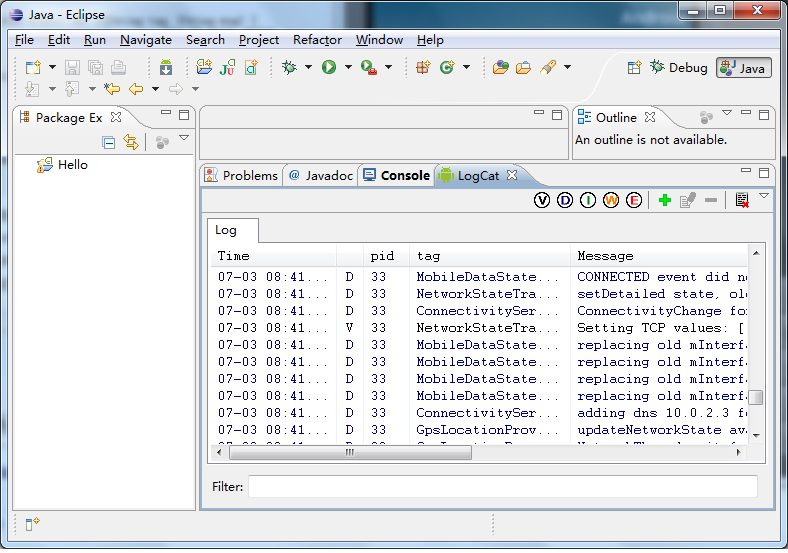
要查看这些LOG的输出,可以配合logcat工具。如果是在Eclipse环境下运行模拟器,并且安装了Android插件,那么,很简单,直接在Eclipse就可以查看了:
如果是在自己编译的Android源代码工程中使用,则在后台中运行模拟器:
USER-NAME@MACHINE-NAME:~/Android$ emulator &
启动adb shell工具:
USER-NAME@MACHINE-NAME:~/Android$ adb shell
使用logcat命令查看日志:
root@android:/ # logcat
这样就可以看到输出的日志了。
浅谈Android系统开发中LOG的使用【转】的更多相关文章
- 浅谈Android系统开发中LOG的使用
文章转载至CSDN社区罗升阳的安卓之旅,原文地址:http://blog.csdn.net/luoshengyang/article/details/6581828 在程序开发过程中,LOG是广泛使用 ...
- 浅谈Android系统进程间通信(IPC)机制Binder中的Server和Client获得Service Manager接口之路
文章转载至CSDN社区罗升阳的安卓之旅,原文地址:http://blog.csdn.net/luoshengyang/article/details/6627260 在前面一篇文章浅谈Service ...
- 浅谈Android样式开发之布局优化
引言 今天我们来谈一下Android中布局优化常用的一些手段.官方给出了3种优化方案,分别是</include>.</viewstub>.</merge>标签,下面 ...
- 浅谈Android系统移植、Linux设备驱动
一.Android系统架构 第一层:Linux内核 包括驱动程序,管理内存.进程.电源等资源的程序 第二层:C/C++代码库 包括Linux的.so文件以及嵌入到APK程序中的NDK代码 第三层:An ...
- 浅谈Android系统的图标设计规范
http://homepage.yesky.com/89/11620089.shtml 目前移动平台的竞争日益激烈,友好的用户界面可以帮助提高用户体验满意度,图标Icon是用户界面中一个重要的组成部分 ...
- 浅谈Android移动开发程序员的职业发展之路
现在几乎每个it公司都在开发移动产品,我最早知道Android还是在09年成都某学院上大学的时候,从新闻上知道有这么一家公司,创始人安迪·鲁宾很有名,但安卓到底是做什么的,我并没有关注. 到2010年 ...
- 【Unity游戏开发】浅谈Unity游戏开发中的单元测试
一.单元测试的定义与作用 单元测试定义:单元测试在传统软件开发中是非常重要的工具,它是指对软件中的最小可测试单元进行检查和验证,一般情况下就是对代码中的一个函数去进行验证,检查它的正确性.一个单元测试 ...
- 浅谈在Java开发中的枚举的作用和用法
枚举(enum),是指一个经过排序的.被打包成一个单一实体的项列表.一个枚举的实例可以使用枚举项列表中任意单一项的值.枚举在各个语言当中都有着广泛的应用,通常用来表示诸如颜色.方式.类别.状态等等数目 ...
- 安卓开发_浅谈Android动画(四)
Property动画 概念:属性动画,即通过改变对象属性的动画. 特点:属性动画真正改变了一个UI控件,包括其事件触发焦点的位置 一.重要的动画类及属性值: 1. ValueAnimator 基本属 ...
随机推荐
- go http请求基础
1.请求方法: get post get 加请求参数,请求参数会加到url后面 post加请求参数,请求参数会放在body里面 请求方式:1.直接在url后面加参数 如:http://www.tes ...
- performSelector 方法的自己主动俘获特性
局部变量自己主动俘获 偶然在调试中发现,performSelector 方法具有自己主动俘获变量的特性.试看例如以下代码: CGFloat c = _addViewShowing ? 0 : 80; ...
- Python基础之迭代器
迭代器的优点: 1.可以使用for循环遍历: 2.可以节省内存空间: 3.可以有序的访问集合(set)数据结构内的元素. 迭代器的缺点: 只能向前,不能后退. 可迭代对象与不可迭代对象: 可迭代对象: ...
- Spring 中的Null-Safety
之前一直在某些代码中看到过使用@Nullable 标注过的注释,当时也没有在意到底是什么意思,所以这篇文章来谈谈Spring中关于Null的那些事. 在Java中不允许让你使用类型表示其null的安全 ...
- IIS8应用池重启脚本
重启 IIS8 应用程序池的批处理 批处理很简单:c:\windows\system32\inetsrv\AppCmd.exe stop apppool /apppool.name:"ASP ...
- 快速自检电脑是否被黑客入侵过(Linux版)
前言 严谨地说, Linux只是一个内核, `GNU Linux`才算完整的操作系统, 但在本文里还是用通俗的叫法, 把`Ubuntu`,`Debian`,`RedHat`,`CentOS`,`Arc ...
- 刷脸支付真的来啦!华为nova3带你玩转酷时代~
无论是不愿脱离手套的怕冷手. 或是沾满泥土芬芳的勤劳手. 还是挂着水滴的清洁手…… 每当这些时刻,打开支付宝认证支付, 指纹解锁的能力总是光彩尽失. 不过,就在华为nova 3的发布会上, 一项传说已 ...
- 使用MongoDB 记录业务日志
最近公司有个需求,要对业务日志进行记录并根据日志排查问题,以前都是使用log4net之类的日志组件来记录到文件,这种方式已经不能满足业务的需要,因为日志文件会很大,即使进行分割后,查找也是很不方便,何 ...
- 如何玩转最新的项目的搭配springmvc+mybatis+Redis+Nginx+tomcat+mysql
上一次完成nginx+tomcat组合搭配,今天我们就说说,这几个软件在项目中充当的角色: 要想完成这几个软件的组合,我们必须知道和熟悉应用这个框架, 一: Nginx:在项目中大多数作为反向代理服务 ...
- readonly const关键字
readonly 关键字与 const 关键字不同. const 字段只能在该字段的声明中初始化. readonly 字段可以在声明或构造函数中初始化. 因此,根据所使用的构造函数,readonly ...