Preface
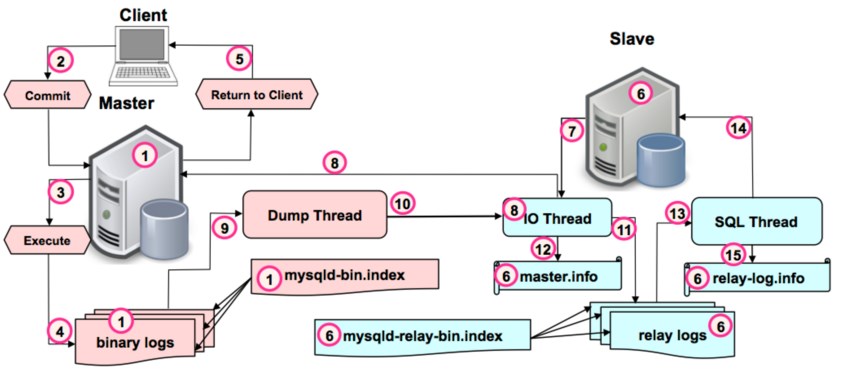
As we all know,there're three kinds of replication in MySQL nowadays.Such as,asynchronous replication,(full)synchronous replication,semi-synchronous replication.What's the difference between them?First of all,let's see the intact architecture picture of MySQL replication:
What will master do?
What will slave do?
- connects to master
- IO Thread asks for data(binary logs) and gets them
- generates relay logs
- SQL Thread applies data(relay logs)
Method of different MySQL Replication
Generally speaking,the data changed on master will be continuously sent to slave.So the data on slave seems to be equal with the master.This mechanism is usually used to backup on slave(reduce the pressure of master),construct HA architecture(failover or separate reading/writing operations),etc.
Nevertheless,on account of different reasons,slave frequently defers in almost all the scenarios what's often grumbled by MySQL dba.Below are different kinds of MySQL replication.Let's see the details.
Since MySQL 3.2.22,this kind of replication was supported with statement format of binary log.Then,untill MySQL 5.1.5,row format of binary log was supported either.The mechanism of it is that as soon as the master dump thread has sent the binary logs to the slave,the master server returns the result to client.There's nothing to guarantee the binary logs are normally received by the slave(maybe the network failure occurs simultaneously).So it's unsafe in consistency what means your transactions will lose in the replication.This is also the original replication of MySQL.Here's the picture about the procedure:
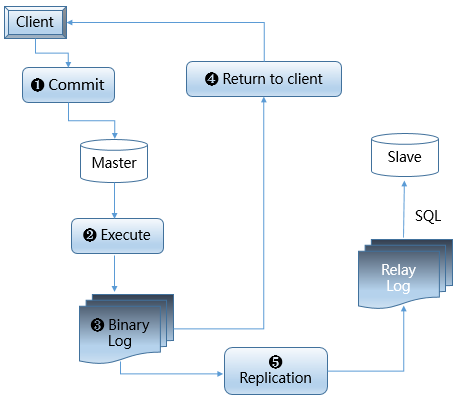

1. Client sends dml operations to the master while the transaction starts.
2. Master executes these dml operations from client in transaction.
3. Generates some binary logs which contains the transaction information.
4. Master will return results to the client immediately after dump thread has sent these binary logs to slave.
5. Slave receives the binary logs by IO_Thread and apply the relay logs by SQL_Thread.
In step 4,master won't judge whether slave has received the binary logs (which are sent by itself) or not.If the master crashs suddenly after it has sent the binary logs,but slave does not receive them at all on account of network delay.Only if the slave takes over the application at this time,the committed transactions will miss which means data loss.This is not commonly acceptable in most important product systems especially in the financial ones.
Synchronous replication requires master to return results to client only after the transactions have been committed by all the slaves(receive and apply).This method will severely lead to bad performance on master unless you can guarantee the slaves can commit immediate without any delay(infact it's tough).Now,the only solution of synchronous replication is still the MySQL NDB Cluster.Therefore,it's not recommended to use synchronous replication way.
- semi-synchronous replication
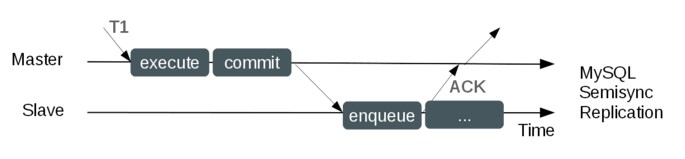
Semi-synchronous replication seems a workaround of above two method which can strongly increase the consistency between master and slave.It's supported since MySQL 5.5 and enhanced in MySQL 5.7.What's the mechanism of semi-sychronouos replication?Master is permitted to return the result to client merely after only one slave has received binary logs,write them to the relay logs and returns an ACK signal to master.There're two ways of it,that is,after_commit & after_sync.Let's see the difference of them:
after_commit(Since MySQL 5.5):
In this method,master performs a commit before it receives ACK signal from slave.Let's suppose a situation that once master crashs after it commits a transaction but it hasn't receive the ACK signal from slave.Meanwhile,failover makes slave become the new master.How does the slave deal with then?Will the transaction lose?It depends.There're two scenarios:
- Slave has received the binary log,and then turns it into relay log and applys it.There's no transaction loss.
- Slave hasn't received the binary log,the transaction committed by master just now will lose,but the client won't fail(only inconsistent in replication).
Therefore,after_commit cannot guarantee lossless replication.after_commit is the default mode(actually it's the only mode can be use) which is supported by MySQL 5.5 & 5.6.
after_sync(since MySQL 5.7):
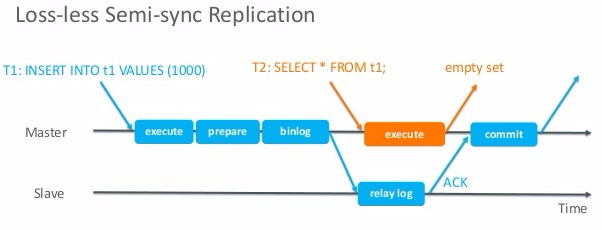
In the picture above,the t1 transaction shouldn't be lost because of the master merely commits to the storage engine after receive the ACK signal from slave.In spite of master may crash before receiving ACK signal,no transaction will lose as the master hasn't commit at all.Meanwhile,the t2 transaction also get consistent query here.
In order to improve the data consistency(since after_commit has avoidless deficiency),MySQL official enhances the semi-synchronous replication which can be called "loss-less semi-synchronous replication" in MySQL 5.7 by add after_sync mode in parameter "rpl_semi_sync_master_wait_point".
Caution,semi-synchronous replication may turn into asynchronous replication whenever the delay time of slave surpass the value which is specified in parameter "rpl_semi_sync_master_timeout"(default values is 10000 milliseconds).Why it is permitted?I'm afraid in order to consider the performance of master.Notwithstanding,you can also play a trick to prevent it from being converted over by set a infinite number in this parameter such as "10000000" or above.Especially in case that your product system is too important to not lose data.
Further more,to configure semi-sychronous replication,you should implement the optional plugin component "rpl_semi_sync_master",which can be check by using command "show plugins;"
Summary:
- Commonly,semi-sync replication is strongly recommended when implements MySQL replication nowadays(with gtid).
- I utterly recommend to upgrade product system to MySQL 5.7 in order to use "after_sync" mode which can avoid data loss.
- Be careful of specify an inappropriate value in parameter "rpl_semi_sync_master_timeout" which will cause converting semi-sync to async replication.
- MySQL 5.7 新特性之增强半同步复制
1. 背景介绍 半同步复制 普通的replication,即mysql的异步复制,依靠mysql二进制日志也即binary log进行数据复制.比如两台机器,一台主机(master),另外一台是从机( ...
- 深入MySQL复制(三):半同步复制
1.半同步复制 半同步复制官方手册:https://dev.mysql.com/doc/refman/5.7/en/replication-semisync.html 默认情况下,MySQL的复制是异 ...
- mysql半同步复制跟无损半同步区别
mysql半同步复制跟无损半同步复制的区别: 无损复制其实就是对semi sync增加了rpl_semi_sync_master_wait_point参数,来控制半同步模式下主库在返回给会话事务成功之 ...
- MySQL主从复制技术与读写分离技术amoeba应用
MySQL主从复制技术与读写分离技术amoeba应用 前言:眼下在搭建一个人才站点,估计流量会非常大,须要用到分布式数据库技术,MySQL的主从复制+读写分离技术.读写分离技术有官方的MySQL-pr ...
- MySQL异步、同步、半同步复制
异步复制 MySQL复制默认是异步复制,Master将事件写入binlog,提交事务,自身并不知道slave是否接收是否处理: 缺点:不能保证所有事务都被所有slave接收. 同步复制 Master提 ...
- MySQL高可用方案 MHA之四 keepalived 半同步复制
主从架构(开启5.7的增强半同步模式)master: 10.150.20.90 ed3jrdba90slave: 10.150.20.97 ed3jrdba97 10.150.20.132 ...
- MySQL主从复制技术(纯干货)
1.复制配置 主机一定要开启二进制日志(这里建议配置RBR) 每个主机和每个从机一定要配置一个位移的id,即server-id 每个从机配置一定要包含主机名称,日志名称,和位置 ...
- MySQL主从同步和半同步配置
mysql主从配置: 1,安装maraidb,使用国内yum镜像站下载:[root@localhost mysql]# cat /etc/yum.repos.d/MairaDB.repo # Mari ...
- MySQL主从复制技术的简单实现
配置环境: 主从服务器操作系统均为 ubuntu15.10 主从服务器MySQL版本均为 MySQL5.6.31 主服务器IP:192.168.0.178 从服务器IP:192.168.0.145 主 ...
随机推荐
- Linux系统搭建GitLab---阿里云Centos7搭建Gitlab踩坑
一.简介 GitLab,是一个利用 Ruby on Rails 开发的开源应用程序,实现一个自托管的Git项目仓库,可通过Web界面进行访问公开的或者私人项目安装. 它拥有与GitHub类似的功能,能 ...
- vs2017源文件创建代码自动版权声明注释
原来在vs2015下用的挺好,顺便移植到2017下. 用文本打开,在其头部加上 “C:\Program Files (x86)\Microsoft Visual Studio\2017\Enterpr ...
- Kafka配额讨论(流量限制)
Kafka自0.9.0.0版本引入了配额管理(quota management),旨在broker端对clients发送请求进行限流(throttling).目前Kafka支持两大类配额管理: 网络带 ...
- Qt 之 QSS(样式表语法)
https://blog.csdn.net/liang19890820/article/details/51691212 简述 Qt样式表(以下统称QSS)的术语和语法规则几乎和CSS相同.如果你熟悉 ...
- first-软件工程
第一部分:结缘计算机 1.你为什么选择计算机专业?你认为你的条件如何?和这些博主比呢?(必答) 之前高中班上男生特别喜欢软件这类的东西,每期电脑报都要买,我也会每期电脑报都会借来看,久而久之我就喜欢上 ...
- Netty入门1之----认识Netty
Netty 什么是Netty? Netty 是一个利用 Java 的高级网络的能力,隐藏其背后的复杂性而提供一个易于使用的 API 的客户端/服务器框架. Netty 是一个广泛使用的 Java ...
- Oracle案例06—— OGG-01098 Could not flush "./dirdat/e1000004383" (error 28, No space left on device)
一.前言 自从换了新环境,各种问题层出不穷,如果不是之前积累的经验丰富,估计都歇菜了,看来作为数据库全栈工程师(oracle/mysql/sqlserver/sap hana/pg/mongodb/r ...
- sqlite 用法整理
转载:http://blog.csdn.net/zhaoweixing1989/article/details/19080593 先纪录到这,以后慢慢整理. 1. 在Android下通过adb she ...
- linux下 signal信号机制的透彻分析与各种实例讲解
转自:http://blog.sina.com.cn/s/blog_636a55070101vs2d.html 转自:http://blog.csdn.net/tiany524/article/det ...
- ADOBE READER把PDF转换成WORD教程
目前国外很多软件的支持信息都使用PDF方式进行发布,如果没有Adobe Reader,无法查看其内容,如果没有相关的编辑软件又无法编辑PDF文件.转换为DOC格式则可以实现编辑功能.尽管有些软件也可 ...