
最短路(Floyed、Dijkstra、Bellman-Ford、SPFA)
一、Floyed-Warshall算法
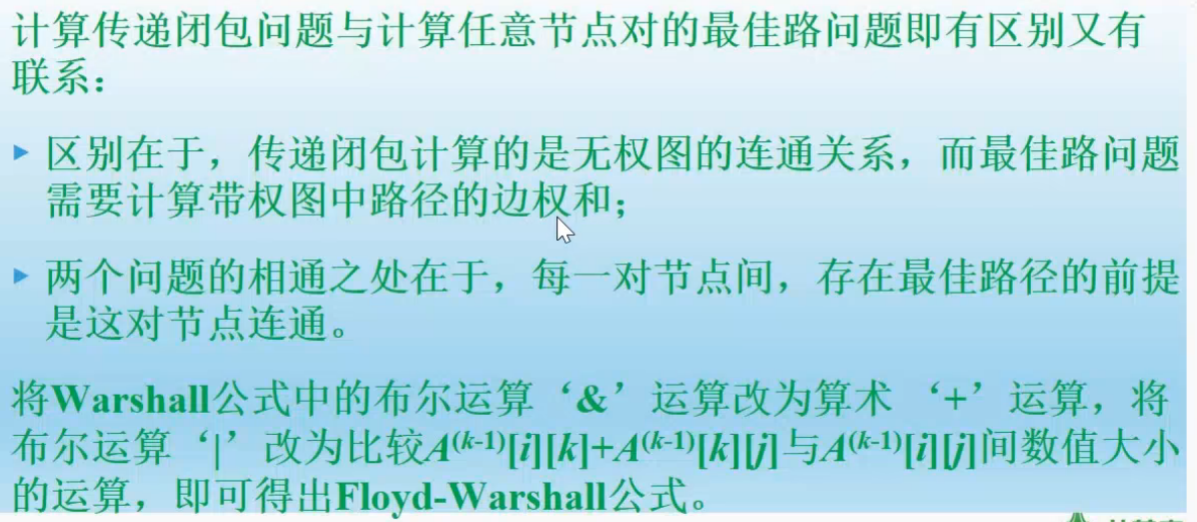
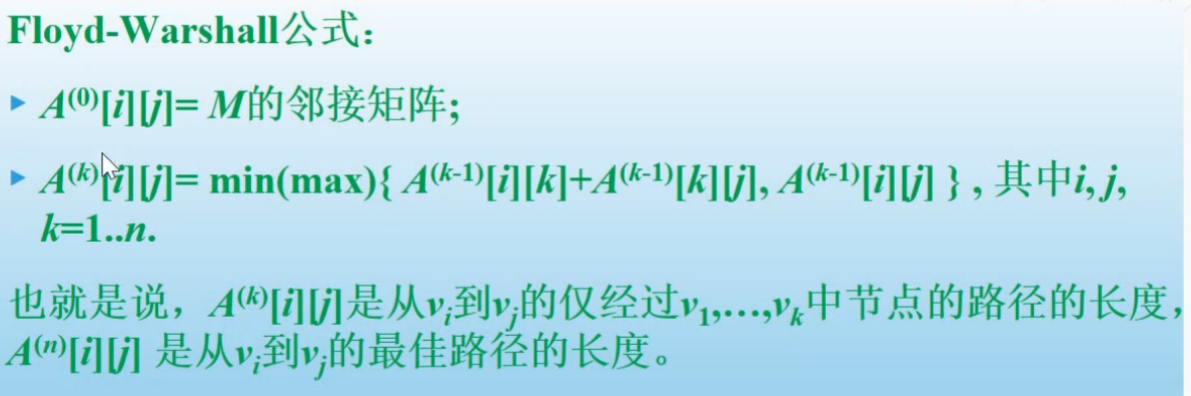
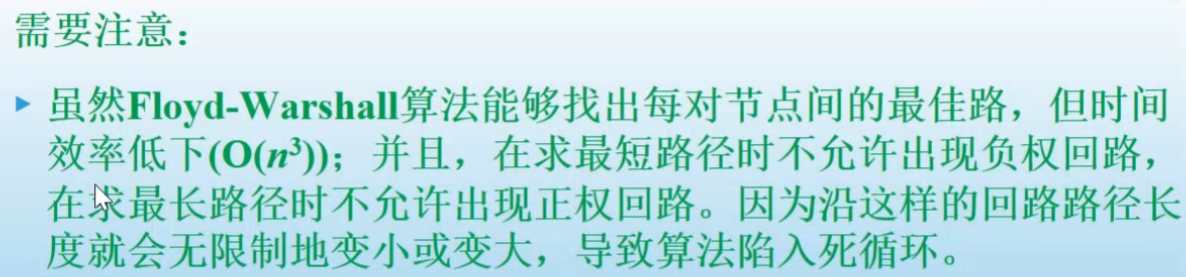
枚举中间点起点终点,对整个图进行松弛操作,就能得到整个图的多源最短路径;
例:POJ2240 Arbitrage
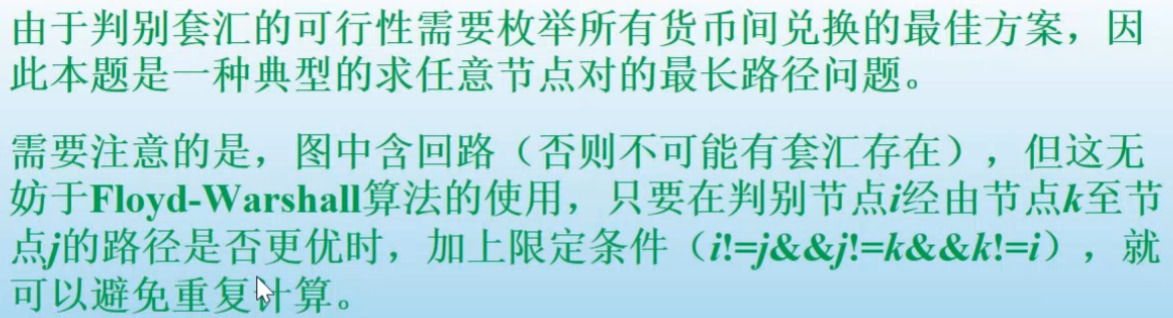
Your job is to write a program that takes a list of currency exchange rates as input and then determines whether arbitrage is possible or not.
Input
Test cases are separated from each other by a blank line. Input is terminated by a value of zero (0) for n.
Output
Sample Input
3

USDollar

BritishPound

FrenchFranc

3

USDollar 0.5 BritishPound

BritishPound 10.0 FrenchFranc

FrenchFranc 0.21 USDollar

3

USDollar

BritishPound

FrenchFranc

6

USDollar 0.5 BritishPound

USDollar 4.9 FrenchFranc

BritishPound 10.0 FrenchFranc

BritishPound 1.99 USDollar

FrenchFranc 0.09 BritishPound

FrenchFranc 0.19 USDollar

0
Sample Output
Case 1: Yes

Case 2: No
Source

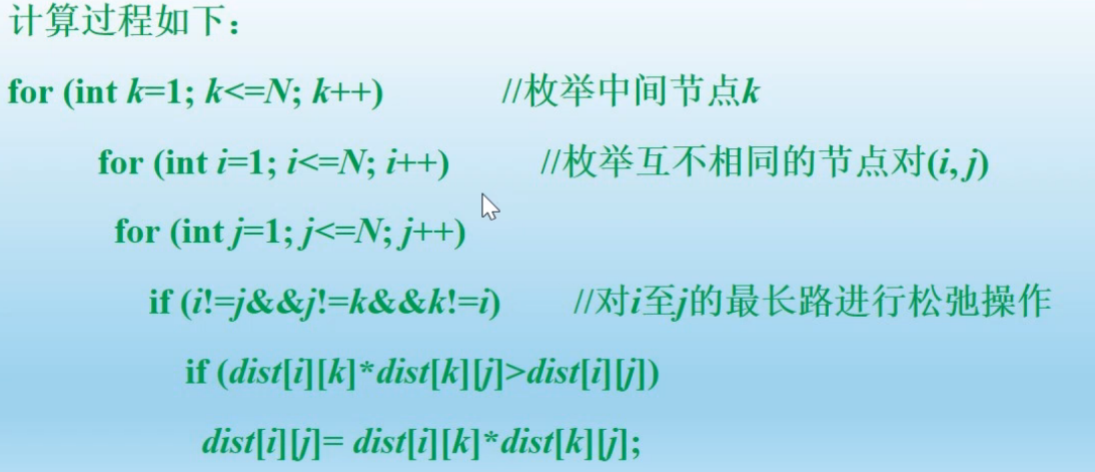
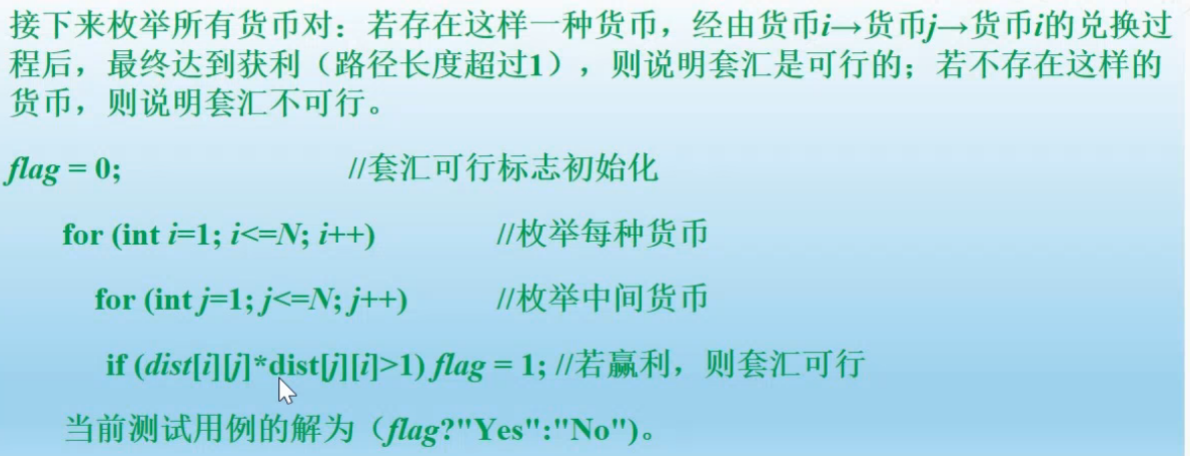
#include <iostream>

#include <cstdio>

#include <map>

using namespace std;

const int maxn=35;

int n,m;

map<string,int> N;

double dis[maxn][maxn];

int main()

{

    int kase=1;

    //freopen("Atext.in","r",stdin);

    while(cin >> n,n)

    {

        string a,b;

        double tmp;

        bool flag=false;

        for(int i=0;i<n;i++)

            for(int j=0;j<n;j++)

                dis[i][j]=-1;

        for(int i=0;i<n;i++){

            cin >> a;

            N.insert(make_pair(a,i));

        }

        cin >> m;

        for(int i=0;i<m;i++)

        {

            cin >> a >> tmp >> b;

            dis[N[a]][N[b]]=tmp;        //邻接矩阵存边的信息;

        }

        for(int k=0;k<n;k++)

            for(int i=0;i<n;i++)

                for(int j=0;j<n;j++)

                if(i!=j&&j!=k&&k!=i&&dis[i][k]!=-1&&dis[k][j]!=-1)

                dis[i][j]=max(dis[i][k]*dis[k][j],dis[i][j]);

        /*for(int i=0;i<n;i++)

        {

            for(int j=0;j<n;j++)

                cout << dis[i][j] << " ";

            cout << endl;

        }

        cout << endl;*/

        for(int i=0;i<n;i++)

            for(int j=0;j<n;j++)

            if(dis[i][j]*dis[j][i]>1)flag=1;

        printf("Case %d: %s\n",kase,flag?"Yes":"No");

        N.clear();

        kase++;

    }

    return 0;

}
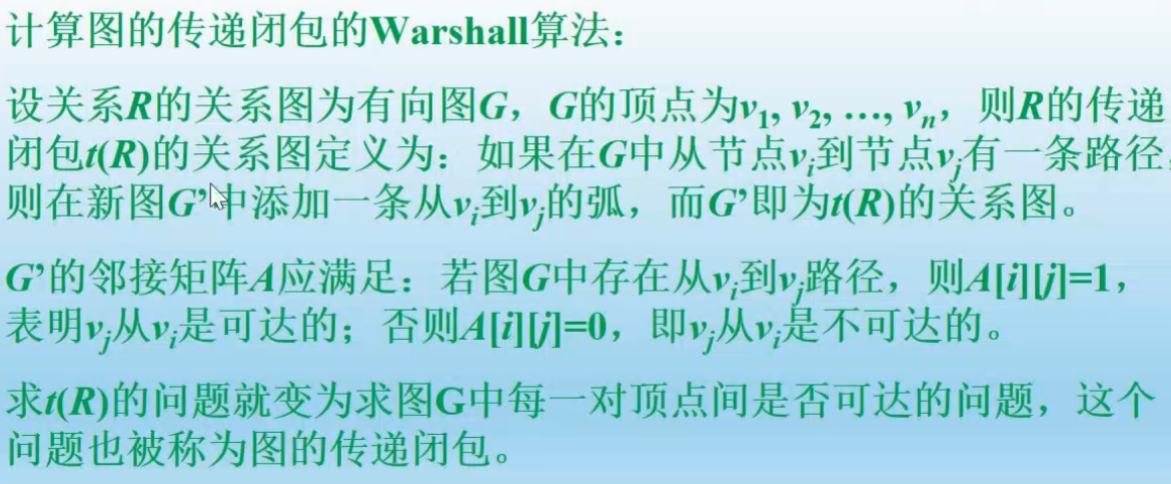
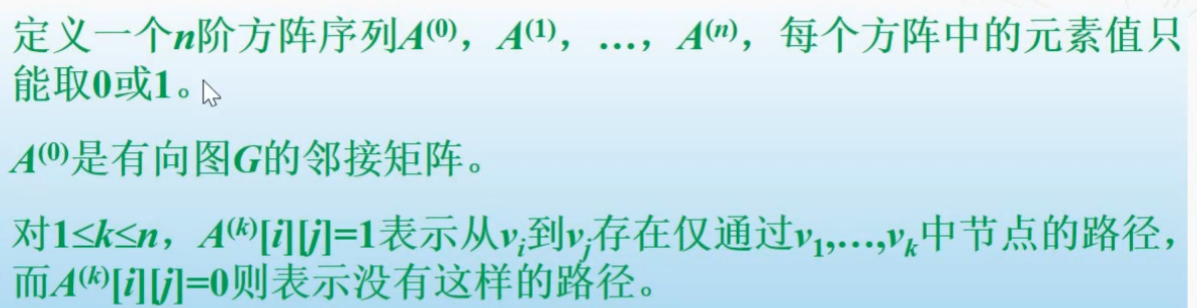
附:Warshall算法的传递闭包

例:POJ2253 Frogger
Description
Unfortunately Fiona's stone is out of his jump range. Therefore Freddy considers to use other stones as intermediate stops and reach her by a sequence of several small jumps.
To execute a given sequence of jumps, a frog's jump range obviously must be at least as long as the longest jump occuring in the sequence.
The frog distance (humans also call it minimax distance) between two stones therefore is defined as the minimum necessary jump range over all possible paths between the two stones.
You are given the coordinates of Freddy's stone, Fiona's stone and all other stones in the lake. Your job is to compute the frog distance between Freddy's and Fiona's stone.
Input
Output
Sample Input
2

0 0

3 4

3

17 4

19 4

18 5

0
Sample Output
Scenario #1

Frog Distance = 5.000

Scenario #2

Frog Distance = 1.414
Source
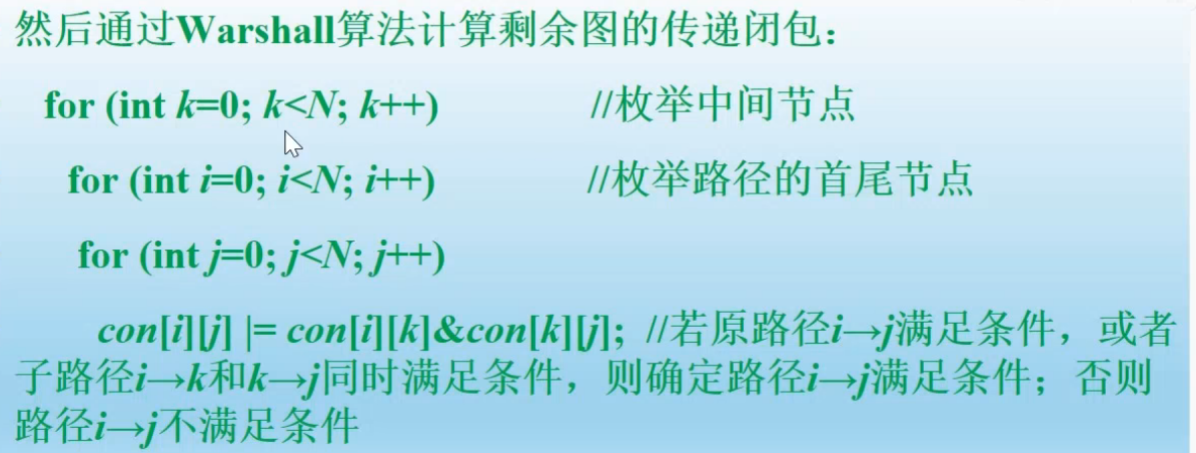
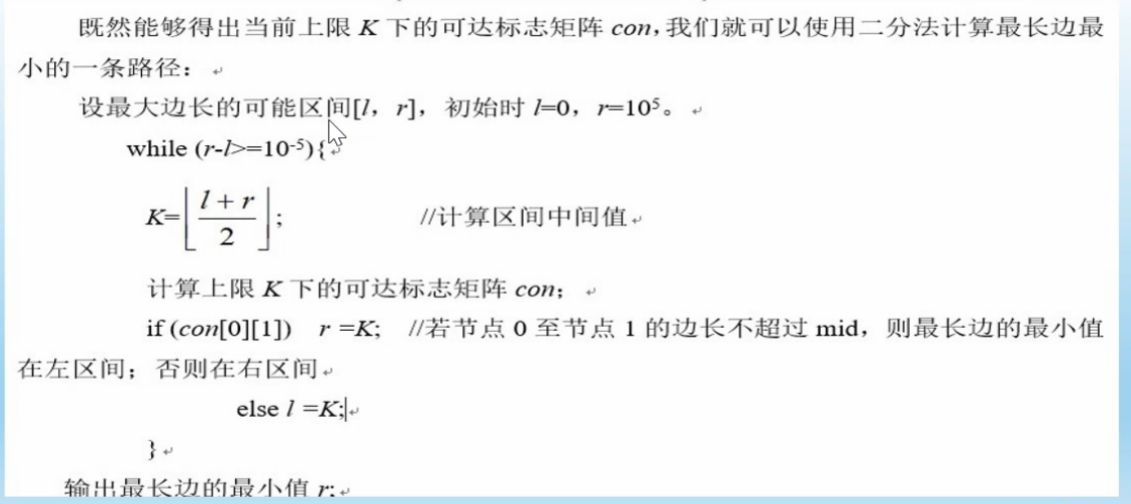
#include <iostream>

#include <cmath>

#include <cstdio>

#include <cstring>

using namespace std;

typedef long long ll;

const int maxn=205;

struct node{

    int x,y;

}N[maxn];

int con[maxn][maxn],n;

double G[maxn][maxn];

void floyed()       //枚举所有边进行松弛;

{

    for(int k=0;k<n;k++)

        for(int i=0;i<n;i++)

            for(int j=0;j<n;j++)    //松弛为最大边的最小值;

            G[i][j]=min(G[i][j],max(G[i][k],G[k][j]));

}

int main()

{

    int kase=0;

    while(~scanf("%d",&n),n)

    {

        for(int i=0;i<n;i++)

            scanf("%d%d",&N[i].x,&N[i].y);

        for(int i=0;i<n;i++)        //这样对称的邻接矩阵只须计算一半

            for(int j=i+1;j<n;j++)

                G[i][j]=G[j][i]=(double)sqrt(double(N[i].x-N[j].x)*(N[i].x-N[j].x)+double(N[i].y-N[j].y)*(N[i].y-N[j].y));

        floyed();

        printf("Scenario #%d\n",++kase);

        printf("Frog Distance = %.3lf\n\n",G[0][1]);

    }

    return 0;

}
二、Dijkstra算法



#include <iostream>

#include <cstdio>

#include <cmath>

#include <algorithm>

using namespace std;

const int maxn=1005;

const int inf=0x3f3f3f3f;

int n;

struct node{

    int x,y;

}N[maxn];

bool vis[maxn];

double G[maxn][maxn],d[maxn];       //邻接矩阵

void Dijkstra()

{

    fill(vis,vis+n,false);

    fill(d,d+n,inf);

    d[0]=0;

    while(true)

    {

        int v=-1;

        for(int i=0;i<n;i++)

            if(!vis[i]&&(v==-1||d[i]<d[v]))     //从尚未使用过的顶点中选取一个最小值;

                v=i;

        if(v==-1)

            break;

        vis[v]=true;

        for(int i=0;i<n;i++)

            d[i]=min(d[i],max(d[v],G[v][i]));   //源点到各点的最长边的最小值;

    }

}

int main()

{

    int kase=0;

    while(~scanf("%d",&n),n)

    {

        for(int i=0;i<n;i++)

            scanf("%d%d",&N[i].x,&N[i].y);

        for(int i=0;i<n;i++)        //这样对称的邻接矩阵只须计算一半

            for(int j=i+1;j<n;j++)

                G[i][j]=G[j][i]=(double)sqrt(double(N[i].x-N[j].x)*(N[i].x-N[j].x)+double(N[i].y-N[j].y)*(N[i].y-N[j].y));

        Dijkstra();

        printf("Scenario #%d\n",++kase);

        printf("Frog Distance = %.3f\n\n",d[1]);

    }

    return 0;

}
三、Bellman-Ford算法
四、SPFA算法(Shortest Path Faster Algorithm)
队列优化的bellman-ford;
例:POJ1874 畅通工程续
现在,已知起点和终点,请你计算出要从起点到终点,最短需要行走多少距离。
每组数据第一行包含两个正整数N和M(0<N<200,0<M<1000),分别代表现有城镇的数目和已修建的道路的数目。城镇分别以0~N-1编号。
接下来是M行道路信息。每一行有三个整数A,B,X(0<=A,B<N,A!=B,0<X<10000),表示城镇A和城镇B之间有一条长度为X的双向道路。
再接下一行有两个整数S,T(0<=S,T<N),分别代表起点和终点。
0 1 1
0 2 3
1 2 1
0 2
3 1
0 1 1
1 2
-1
#include <iostream>

#include <queue>

#include <cstdio>

#include <vector>

using namespace std;

const int maxn=205;

const int inf=0x3f3f3f3f;

typedef pair<int,int> p;

vector<p>E[maxn];//邻接表;

int n,m,d[maxn],inq[maxn];      //d[maxn]到源点的最短距离,inq[maxn]在队列里的元素;

void init()

{

    for(int i=0;i<n;i++)E[i].clear();

    for(int i=0;i<n;i++)inq[i]=0;

    for(int i=0;i<n;i++)d[i]=inf;

}

void spfa(int x)

{

    queue<int> que;

    que.push(x),d[x]=0,inq[x]=1;

    while(!que.empty())

    {

        int now=que.front();

        que.pop();

        inq[now]=0;

        for(int i=0;i<E[now].size();i++)

        {

            int v=E[now][i].first;

            if(d[v]>d[now]+E[now][i].second)

            {

                d[v]=d[now]+E[now][i].second;

                if(inq[v]==0){

                    inq[v]=1;

                    que.push(v);

                }

            }

        }

    }

}

int main()

{

    while(~scanf("%d%d",&n,&m))

    {

        init();

        int a,b,c;

        for(int i=0;i<m;i++)

        {

            scanf("%d%d%d",&a,&b,&c);

            E[a].push_back(p(b,c));

            E[b].push_back(p(a,c));

        }

        scanf("%d%d",&a,&b);

        spfa(a);

        if(d[b]==inf)

            cout << -1 << endl;

        else

            cout << d[b] << endl;

    }

    return 0;

}
#include <iostream>

#include <cstdio>

#include <algorithm>

using namespace std;

const int maxn=205;

const int inf=0x3f3f3f3f;

int n,m,maze[maxn][maxn];

void floyed()

{

    for(int k=0;k<n;k++)

        for(int i=0;i<n;i++)

            for(int j=0;j<n;j++)

            if(i!=j&&j!=k&&k!=i)

            maze[i][j]=min(maze[i][j],maze[i][k]+maze[k][j]);

}

int main()

{

    while(~scanf("%d%d",&n,&m))

    {

        int a,b,c;

        for(int i=0;i<n;i++)

            for(int j=0;j<n;j++)

            {

                if(i!=j)

                maze[i][j]=inf;

            }

        for(int i=0;i<m;i++)

        {

            scanf("%d%d%d",&a,&b,&c);

            maze[a][b]=min(c,maze[a][b]);//处理解决重边问题;

            maze[b][a]=min(c,maze[b][a]);

        }

        scanf("%d%d",&a,&b);

        floyed();

        if(maze[a][b]==inf)

            cout << -1 << endl;

        else

            cout << maze[a][b] <<endl;

    }

    return 0;

}
//自我整理:最短路径的这三个算法,就像BFS一样;
//spfa:每次把发生更新的点作为当前到该点的最短路径,都入队列视为下一次遍历开始的源点;
//dijkstra:每次只取所有发生更新的点,即所有当前最短路径中里离源点最近的点作为下一次开始的源点,前面的值都视为已确定的最短路径
最短路(Floyed、Dijkstra、Bellman-Ford、SPFA)的更多相关文章
- HDOJ 2544 最短路(最短路径 dijkstra算法,SPFA邻接表实现,floyd算法)
最短路 Time Limit: 5000/1000 MS (Java/Others) Memory Limit: 32768/32768 K (Java/Others) Total Submis ...
- 蓝桥杯 algo_5 最短路 (bellman,SPFA)
问题描述 给定一个n个顶点,m条边的有向图(其中某些边权可能为负,但保证没有负环).请你计算从1号点到其他点的最短路(顶点从1到n编号). 输入格式 第一行两个整数n, m. 接下来的m行,每行有三个 ...
- Til the Cows Come Home 最短路Dijkstra+bellman(普通+优化)
Til the Cows Come Home 最短路Dijkstra+bellman(普通+优化) 贝西在田里,想在农夫约翰叫醒她早上挤奶之前回到谷仓尽可能多地睡一觉.贝西需要她的美梦,所以她想尽快回 ...
- hdoj 2544 最短路【dijkstra or spfa】
最短路 Time Limit: 5000/1000 MS (Java/Others) Memory Limit: 32768/32768 K (Java/Others) Total Submis ...
- 【最短路算法】Dijkstra+heap和SPFA的区别
单源最短路问题(SSSP)常用的算法有Dijkstra,Bellman-Ford,这两个算法进行优化,就有了Dijkstra+heap.SPFA(Shortest Path Faster Algori ...
- ACM/ICPC 之 最短路径-Bellman Ford范例(POJ1556-POJ2240)
两道Bellman Ford解最短路的范例,Bellman Ford只是一种最短路的方法,两道都可以用dijkstra, SPFA做. Bellman Ford解法是将每条边遍历一次,遍历一次所有边可 ...
- poj1860 bellman—ford队列优化 Currency Exchange
Currency Exchange Time Limit: 1000MS Memory Limit: 30000K Total Submissions: 22123 Accepted: 799 ...
- Bellman - Ford 算法解决最短路径问题
Bellman - Ford 算法: 一:基本算法 对于单源最短路径问题,上一篇文章中介绍了 Dijkstra 算法,但是由于 Dijkstra 算法局限于解决非负权的最短路径问题,对于带负权的图就力 ...
- uva 558 - Wormholes(Bellman Ford判断负环)
题目链接:558 - Wormholes 题目大意:给出n和m,表示有n个点,然后给出m条边,然后判断给出的有向图中是否存在负环. 解题思路:利用Bellman Ford算法,若进行第n次松弛时,还能 ...
- 最短路计数——Dijkstra
题目: 给出一个N个顶点M条边的无向无权图,顶点编号为1−N.问从顶点1开始,到其他每个点的最短路有几条. ——传送门 受到题解的启发,用 Dijkstra A掉(手工代码) 思路: 1.无向无权图, ...
随机推荐
- Unity检测鼠标是否与UI交互
在Unity项目中,假设在鼠标按键时会触发游戏内的操作,但是在鼠标与UI进行交互时我们希望停止游戏中的操作,这是需要使用EventSystem中的方法来检测鼠标是否正在与UI交互 private bo ...
- vue几种插槽的使用方法
参考文档:https://blog.csdn.net/weixin_49217200/article/details/118496525 参考文档:https://blog.csdn.net/ct52 ...
- EF6 Code First Migrations
参考地址:https://learn.microsoft.com/en-us/ef/ef6/modeling/code-first/migrations/ 1.启动Migrations Enable- ...
- ssh基于主机名访问
登录一台服务器我们可以用ssh user@IP这种方式 还有一种快捷的方式,就是基于主机名访问,这需要先配置 /etc/hosts文件 假如我们又两台主机 192.168.75.131/165 分别为 ...
- springboot--配置格式文件
修改端口号的三种方法 1.server.port = 80 2.新建application.yml文件. 3.新建application.yaml文件. 配置文件加载顺序: 当三个文件都存在时prop ...
- 《操作系统导论》读书笔记1——CPU虚拟化,进程
系列文章目录和关于我 一丶CPU的虚拟化 一个桃子,我们称之为物理(physical)桃子.但有很多想吃这个桃子的 人,我们希望向每个想吃的人提供一个属于他的桃子,这样才能皆大欢喜.我们把给每个 人的 ...
- Spring Bean 的生命周期(详细解读)
Spring Bean 的生命周期简单易懂.在一个 bean 实例被初始化时,需要执行一系列的初始化操作以达到可用的状态.同样的,当一个 bean 不再被调用时需要进行相关的析构操作,并从 bean ...
- 在Vue3+TypeScript 前端项目中使用事件总线Mitt
事件总线Mitt使用非常简单,本篇随笔介绍在Vue3+TypeScript 前端项目中使用的一些场景和思路.我们在Vue 的项目中,经常会通过emits 触发事件来通知组件或者页面进行相应的处理,不过 ...
- 论文解读(CosFace)《CosFace: Large Margin Cosine Loss for Deep Face Recognition》
论文信息 论文标题:CosFace: Large Margin Cosine Loss for Deep Face Recognition论文作者:H. Wang, Yitong Wang, Zhen ...
- MYSQL DQL语句(基础)
MySQL引入 数据库的好处 持久化数据到本地 可以实现结构化查询,方便管理 数据库的相关概念 DB:数据库(database):存储数据的"仓库",它保存了一系列有组织的数据. ...