
Retain NULL values vs Keep NULLs in SSIS Dataflows - Which To Use? (转载)
There is some confusion as to what the various NULL settings all do in SSIS. In fact in one team where I worked we had created 15 packages before realising the full implications of the various default settings. Anyway, hopefully this article will help to clarify a bit......
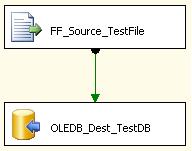
Suppose you are doing a bog-standard import of a text file like the one below. We have a data flow task with a flat-file source going to a OLEDB destination. The flat file contains 3 columns: MyDate, MyInt and MyText. In the file there are 2 rows - one containing normal values and the other one just containing blank column values. So, what happens in the case of a blank value?
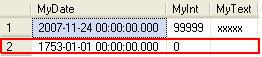
By default, what will happen is shown in the first dataset below (2nd row). A blank date will become "1st Jan 1753", an integer will become "0" and text will become "". Is this what you want? Usually not - especially if "0" is also a legitimate explicit numerical value in the text file!
So, we can designate that the null values from the flat file (really an absence of a value) will become a null in the resulting OLEDB destination. There is a little checkbox on the flat file source which controls this:

The imported dataset will now look like this:

So far so good.
However there is another similar setting available here. This is a checkbox on the OLEDB destination labelled as "Keep NULLs" - what is that for?
Basically this controls what happens when you have defaults on the destination table. If there is a default constraint on each column –
eg
the date should be today's date,
the number should be -1
the text "n/a"
- do we want these default values to be overwritten by NULL values or to simply apply their specified defaults?
The relevant option is shown below. In this particluar case the defaults won't get applied and will be overwritten by NULLs from the source file.

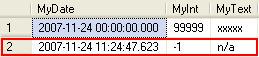
If it was unchecked, and the defaults mentioned above existed, we would arrive at the values below.
Hopefully this makes these 2 setting and the various permutations s a little clearer
Retain NULL values vs Keep NULLs in SSIS Dataflows - Which To Use? (转载)的更多相关文章
- MySQL :: MySQL 8.0 Reference Manual :: B.6.4.3 Problems with NULL Values https://dev.mysql.com/doc/refman/8.0/en/problems-with-null.html
MySQL :: MySQL 8.0 Reference Manual :: B.6.4.3 Problems with NULL Values https://dev.mysql.com/doc/r ...
- You can add an index on a column that can have NULL values if you are using the MyISAM, InnoDB, or MEMORY storage engine.
w https://dev.mysql.com/doc/refman/5.7/en/create-index.html MySQL :: MySQL 5.7 Reference Manual :: B ...
- SQL NULL Values
NULL代表缺失的.未知的数据.表的列值默认是NULL.如果某个表的某个列不是NOT NULL的,那么当我们插入新纪录.更新已存在的记录时,可以不用为此列赋值,这意味着那个列保存为NULL值. NUL ...
- NOT IN clause and NULL values
https://stackoverflow.com/questions/129077/not-in-clause-and-null-values This issue came up when I g ...
- Elasticsearch的null values
很多时候,我们需要面临null值的烦扰,查询es时传入null值是要查询出null的数据还是不查这个field呢,稍有不慎就会引发新的bug,这的确是个问题! null_value 意味着无法索引或搜 ...
- 微软BI 之SSIS 系列 - 对于平面文件中 NULL 值处理过程中容易极易混淆的几个细节
开篇介绍 最近有人问我有关文件处理中空值处理的相关问题: OLE DB Destination 中的 Keep Nulls 如何控制 NULL 值的显示? 为什么选中了 Keep Nulls 但是数据 ...
- 微软BI SSIS 2012 ETL 控件与案例精讲面试 200 问(SSIS 面试题,ETL 面试题)
开篇介绍 本自测与面试题出自 微软BI SSIS 2012 ETL 控件与案例精讲 (http://www.hellobi.com/course/21) 课程,对于学完本课程的每一课时和阅读完相关辅助 ...
- 微软BI SSIS 2012 ETL 控件与案例精讲课程学习方式与面试准备详解
开篇介绍 微软BI SSIS 2012 ETL 控件与案例精讲 (http://www.hellobi.com/course/21) 课程从2014年9月开始准备,到2014年12月在 天善BI学院 ...
- SSIS 自测题-文件操作类
说明:以下是自己的理解答案,不是标准的答案,如有不妥烦请指出. 有些题目暂时没有答案,有知道的请留言,互相学习,一起进步. 1.什么是控制流,什么是数据流,控制流和数据流之间的关系是什 ...
随机推荐
- 使用openssl在命令行加密
对于需要在应用软件中进行加密编程的开发者,通过命令行把基本的加密操作做一遍是很有意义的.openssl支持在命令行进行各种基本加密算法的操作.这些操作过程无需编程,其命令参数与程序函数调用加密的参数有 ...
- 微信token验证源码分享(c#版)
在开发时遇到一个问题: 上线后提交申请微信提示"您的服务器没有正确响应token验证...",我查看日志发现根本就没有接收到来自微信的参数. 后来我又记录了微信请求方式和请求的字符 ...
- LI居中
在用UL-LI时,有适合需要将Li里面的内容居中显示:方法有两种:(推荐)1.设置LI的display为inline(规定应该从父元素继承 display 属性的值),为LI设置长度,设置text-a ...
- H5新特性-----type=file文件上传
1.语法 单文件上传:<input type="file" id="file1"/> 多文件上传:<input type="file ...
- iframe中插入代码并执行
最近有需求通过iframe插入代码.有蛮多方法,如下: 1 var iframe = document.getElementById('previewUrl'); 2 iframe.src = 'ab ...
- attention机制的实现
本文转自,http://www.jeyzhang.com/understand-attention-in-rnn.html,感谢分享! LSTM 中实现attention:https://distil ...
- 视频监控——从其他浏览器打开低版本IE方案
1. 方案背景 由于低版本IE浏览器并不支持很多新的页面技术,导致部分页面效果难以实现;另一方面IE浏览器版本与操作系统绑定,难以统一,不同版本IE间的不兼容导致多种兼容性问题,因此本项目暂定采用Ch ...
- Informatica 9.1.0 Domain地址变化修改
由于公司机房的变动,infa所连数据库的IP地址变化,致使INFA不能启动.经过查找资料终于解决,现分享给大家,解决方法如下: 1.查看日志路径: Informatica/9.1.0/tomcat/l ...
- C#实现Stream与byte[]之间的转换实例教程
一.二进制转换成图片 MemoryStream ms = new MemoryStream(bytes); ms.Position = ; Image img = Image.FromStream(m ...
- 常用的shell语句 【awk】去重,排列
目的:从日志access.log中,筛选出IP来,并统计每个IP出现的次数,然后显示出来. 因为:awk = 扒IP shot = 排序 uniq = 去重 所以:awk '{print $1} ...