
Caffe源码解析7:Pooling_Layer
转载请注明出处,楼燚(yì)航的blog,http://home.cnblogs.com/louyihang-loves-baiyan/
Pooling 层一般在网络中是跟在Conv卷积层之后,做采样操作,其实是为了进一步缩小feature map,同时也能增大神经元的视野。在Caffe中,pooling层属于vision_layer的一部分,其相关的定义也在vision_layer.hpp的头文件中。Pooling层的相关操作比较少,在Caffe的自带模式下只有Max pooling和Average poooling两种
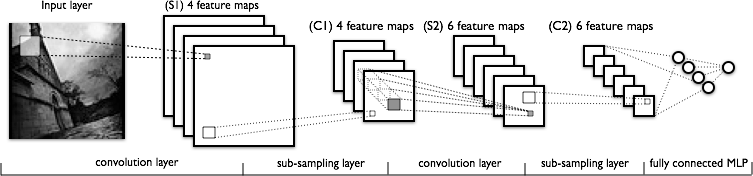
下图是一个LeNet的网络结构图,全连接之前主要有2个卷基层,2个池化层,其中sub_sampling layer就是pooling的操作。pooling的范围是给定的一个region。
PoolingLayer
caffe中Pooling的操作相对比较少,结构也简单,首先看它的Forward_cpu函数,在forward的时候根据相应的Pooling_method选择相应的pooling方法
forward_cpu
void PoolingLayer<Dtype>::Forward_cpu(const vector<Blob<Dtype>*>& bottom,

      const vector<Blob<Dtype>*>& top) {

  const Dtype* bottom_data = bottom[0]->cpu_data();

  Dtype* top_data = top[0]->mutable_cpu_data();

  const int top_count = top[0]->count();

  //将mask信息输出到top[1],如果top大于1

  const bool use_top_mask = top.size() > 1;

  int* mask = NULL;  // suppress warnings about uninitalized variables

  Dtype* top_mask = NULL;

  switch (this->layer_param_.pooling_param().pool()) {

  case PoolingParameter_PoolMethod_MAX://这里的case主要是实现max pooling的方法

    // Initialize

    if (use_top_mask) {

      top_mask = top[1]->mutable_cpu_data();

      caffe_set(top_count, Dtype(-1), top_mask);

    } else {

      mask = max_idx_.mutable_cpu_data();

      caffe_set(top_count, -1, mask);

    }

    caffe_set(top_count, Dtype(-FLT_MAX), top_data);

    // The main loop

    for (int n = 0; n < bottom[0]->num(); ++n) {

      for (int c = 0; c < channels_; ++c) {

        for (int ph = 0; ph < pooled_height_; ++ph) {

          for (int pw = 0; pw < pooled_width_; ++pw) {

            int hstart = ph * stride_h_ - pad_h_;//这里的hstart,wstart,hend,wend指的是pooling窗口在特征图中的坐标,对应左上右下即x1 y1 x2 y2

            int wstart = pw * stride_w_ - pad_w_;

            int hend = min(hstart + kernel_h_, height_);

            int wend = min(wstart + kernel_w_, width_);

            hstart = max(hstart, 0);

            wstart = max(wstart, 0);

            const int pool_index = ph * pooled_width_ + pw;

            for (int h = hstart; h < hend; ++h) {

              for (int w = wstart; w < wend; ++w) {

                const int index = h * width_ + w;//记录index偏差

                if (bottom_data[index] > top_data[pool_index]) {//不停迭代

                  top_data[pool_index] = bottom_data[index];

                  if (use_top_mask) {

                    top_mask[pool_index] = static_cast<Dtype>(index);//记录当前最大值的的坐标索引

                  } else {

                    mask[pool_index] = index;

                  }

                }

              }

            }

          }

        }

        // 计算偏移量,进入下一张图的index起始地址

        bottom_data += bottom[0]->offset(0, 1);

        top_data += top[0]->offset(0, 1);

        if (use_top_mask) {

          top_mask += top[0]->offset(0, 1);

        } else {

          mask += top[0]->offset(0, 1);

        }

      }

    }

    break;

 case PoolingParameter_PoolMethod_AVE://average_pooling

    for (int i = 0; i < top_count; ++i) {

      top_data[i] = 0;

    }

    // The main loop

    for (int n = 0; n < bottom[0]->num(); ++n) {//同样是主循环

      for (int c = 0; c < channels_; ++c) {

        for (int ph = 0; ph < pooled_height_; ++ph) {

          for (int pw = 0; pw < pooled_width_; ++pw) {

            int hstart = ph * stride_h_ - pad_h_;

            int wstart = pw * stride_w_ - pad_w_;

            int hend = min(hstart + kernel_h_, height_ + pad_h_);

            int wend = min(wstart + kernel_w_, width_ + pad_w_);

            int pool_size = (hend - hstart) * (wend - wstart);

            hstart = max(hstart, 0);

            wstart = max(wstart, 0);

            hend = min(hend, height_);

            wend = min(wend, width_);

            for (int h = hstart; h < hend; ++h) {

              for (int w = wstart; w < wend; ++w) {

                top_data[ph * pooled_width_ + pw] +=

                    bottom_data[h * width_ + w];

              }

            }

            top_data[ph * pooled_width_ + pw] /= pool_size;//获得相应的平均值

          }

        }

        // compute offset同理计算下一个图的起始地址

        bottom_data += bottom[0]->offset(0, 1);

        top_data += top[0]->offset(0, 1);

      }

    }

    break;

  case PoolingParameter_PoolMethod_STOCHASTIC:

    NOT_IMPLEMENTED;

    break;

  default:

    LOG(FATAL) << "Unknown pooling method.";

  }
backward_cpu
对于误差的反向传导
对于pooling层的误差传到,根据下式
\]
这里的Upsample具体可以根据相应的pooling方法来进行上采样,upsample的基本思想也是将误差进行的平摊到各个采样的对应点上。在这里pooling因为是线性的所以h这一项其实是可以省略的。
具体的计算推导过程请结合http://www.cnblogs.com/tornadomeet/p/3468450.html有详细的推导过程,结合代码中主循环中的最里项会更清晰的明白
template <typename Dtype>

void PoolingLayer<Dtype>::Backward_cpu(const vector<Blob<Dtype>*>& top,

      const vector<bool>& propagate_down, const vector<Blob<Dtype>*>& bottom) {

  if (!propagate_down[0]) {

    return;

  }

  const Dtype* top_diff = top[0]->cpu_diff();//首先获得上层top_blob的diff

  Dtype* bottom_diff = bottom[0]->mutable_cpu_diff();

  caffe_set(bottom[0]->count(), Dtype(0), bottom_diff);

  // We'll output the mask to top[1] if it's of size >1.

  const bool use_top_mask = top.size() > 1;

  const int* mask = NULL;  // suppress warnings about uninitialized variables

  const Dtype* top_mask = NULL;

  switch (this->layer_param_.pooling_param().pool()) {

  case PoolingParameter_PoolMethod_MAX:

    // The main loop

    if (use_top_mask) {

      top_mask = top[1]->cpu_data();

    } else {

      mask = max_idx_.cpu_data();

    }

    for (int n = 0; n < top[0]->num(); ++n) {

      for (int c = 0; c < channels_; ++c) {

        for (int ph = 0; ph < pooled_height_; ++ph) {

          for (int pw = 0; pw < pooled_width_; ++pw) {

            const int index = ph * pooled_width_ + pw;

            const int bottom_index =

                use_top_mask ? top_mask[index] : mask[index];//根据max pooling记录的mask位置,进行误差反转

            bottom_diff[bottom_index] += top_diff[index];

          }

        }

        bottom_diff += bottom[0]->offset(0, 1);

        top_diff += top[0]->offset(0, 1);

        if (use_top_mask) {

          top_mask += top[0]->offset(0, 1);

        } else {

          mask += top[0]->offset(0, 1);

        }

      }

    }

    break;

  case PoolingParameter_PoolMethod_AVE:

    // The main loop

    for (int n = 0; n < top[0]->num(); ++n) {

      for (int c = 0; c < channels_; ++c) {

        for (int ph = 0; ph < pooled_height_; ++ph) {

          for (int pw = 0; pw < pooled_width_; ++pw) {

            int hstart = ph * stride_h_ - pad_h_;

            int wstart = pw * stride_w_ - pad_w_;

            int hend = min(hstart + kernel_h_, height_ + pad_h_);

            int wend = min(wstart + kernel_w_, width_ + pad_w_);

            int pool_size = (hend - hstart) * (wend - wstart);

            hstart = max(hstart, 0);

            wstart = max(wstart, 0);

            hend = min(hend, height_);

            wend = min(wend, width_);

            for (int h = hstart; h < hend; ++h) {

              for (int w = wstart; w < wend; ++w) {

                bottom_diff[h * width_ + w] +=

                  top_diff[ph * pooled_width_ + pw] / pool_size;//mean_pooling中,bottom的误差值按pooling窗口中的大小计算,从上一层进行填充后,再除窗口大小

              }

            }

          }

        }

        // offset

        bottom_diff += bottom[0]->offset(0, 1);

        top_diff += top[0]->offset(0, 1);

      }

    }

    break;

  case PoolingParameter_PoolMethod_STOCHASTIC:

    NOT_IMPLEMENTED;

    break;

  default:

    LOG(FATAL) << "Unknown pooling method.";

  }

}
Caffe源码解析7:Pooling_Layer的更多相关文章
- Caffe源码解析6:Neuron_Layer
转载请注明出处,楼燚(yì)航的blog,http://home.cnblogs.com/louyihang-loves-baiyan/ NeuronLayer,顾名思义这里就是神经元,激活函数的相应 ...
- Caffe源码解析5:Conv_Layer
转载请注明出处,楼燚(yì)航的blog,http://home.cnblogs.com/louyihang-loves-baiyan/ Vision_layer里面主要是包括了一些关于一些视觉上的操 ...
- Caffe源码解析4: Data_layer
转载请注明出处,楼燚(yì)航的blog,http://home.cnblogs.com/louyihang-loves-baiyan/ data_layer应该是网络的最底层,主要是将数据送给blo ...
- Caffe源码解析3:Layer
转载请注明出处,楼燚(yì)航的blog,http://home.cnblogs.com/louyihang-loves-baiyan/ layer这个类可以说是里面最终的一个基本类了,深度网络呢就是 ...
- Caffe源码解析2:SycedMem
转载请注明出处,楼燚(yì)航的blog,http://www.cnblogs.com/louyihang loves baiyan/ 看到SyncedMem就知道,这是在做内存同步的操作.这类个类的 ...
- Caffe源码解析1:Blob
转载请注明出处,楼燚(yì)航的blog,http://www.cnblogs.com/louyihang-loves-baiyan/ 首先看到的是Blob这个类,Blob是作为Caffe中数据流通的 ...
- caffe源码解析
http://blog.csdn.net/lanxuecc/article/details/53186613
- caffe源码阅读
参考网址:https://www.cnblogs.com/louyihang-loves-baiyan/p/5149628.html 1.caffe代码层次熟悉blob,layer,net,solve ...
- 【Caffe】源码解析----caffe.proto (转载)
分析caffe源码,看首先看caffe.proto,是明智的选择.好吧,我不是创造者,只是搬运工. 原文地址:http://blog.csdn.net/qq_16055159/article/deta ...
随机推荐
- Lind.DDD.Manager里的3,7,15,31,63,127,255,511,1023,2047
回到目录 进制 我是一个程序猿,我喜欢简单的数字,十进制如何,数字太多,有10种数字组成,但由于它广为人知,所有使用最为广泛,人们的惯性思维培养了十进制,并说它是最容易被计算的数字,事实上,在计算机里 ...
- [翻译]Java HashMap工作原理
大部分Java开发者都在使用Map,特别是HashMap.HashMap是一种简单但强大的方式去存储和获取数据.但有多少开发者知道HashMap内部如何工作呢?几天前,我阅读了java.util.Ha ...
- Ext.NET MVC 配置问题总结
随着VS版本和.NET MVC版本.EF的版本的不断更新,虽然很多功能随着版本的提升而更完善,但对于旧版本开发的软件就有点悲催了,或许很多开发者都遇到类似的问题! 最近有一个项目是用.NET MVC3 ...
- 阻止默认事件event.preventDefault();
阻止浏览器默认事件.什么是默认事件,例如浏览器默认右键菜单.a标签默认连接跳转...,如何阻止呢? Firefox中,event必须作为参数传入. IE中,event是window对象的属性. ev ...
- How To Restart timer service on all servers in farm
[array]$servers= Get-SPServer | ? {$_.Role -eq "Application"} $farm = Get-SPFarm foreach ( ...
- Android+PHP+MYSQL把数据库中的数据显示在Android界面上
俗话说,好记性不如烂笔头.今天终于体会其中的道理了.昨天写好的代码不知道为何找不到了.所以今天我一定得抽出一点时间把我的代码保存起来,以防我的代码再没有了. 还是先上图片. 这个界面是用ListVie ...
- iOS所有常见证书,appID,Provisioning Profiles配置说明及制作图文教程
转自holydancer的CSDN专栏,原文地址:http://blog.csdn.net/holydancer/article/details/9219333 概述: 苹果的证书繁锁复杂,制作管理相 ...
- html5快速入门(一)—— html简介
前言: 1.HTML5的发展非常迅速,可以说已经是前端开发人员的标配,在电商类型的APP中更是运用广泛,这个系列的文章是本人自己整理,尽量将开发中不常用到的剔除,将经常使用的拿出来,使需要的朋友能够真 ...
- javascript深入浅出(imooc)
第一章 数据类型 1,六种数据类型:原始类型(number,string,boolean,null,undefined) + object对象(Function Array Date) 2,隐式转换: ...
- 基于显卡的光栅化渲染器Gaius计划
决定实现一个基于显卡的光栅化渲染器,能将一些基于显卡的新算法融入其中.