
POJ1523 SPF
| Time Limit: 1000MS | Memory Limit: 10000K | |
| Total Submissions: 8254 | Accepted: 3772 |
Description
Node 3 is therefore a Single Point of Failure (SPF) for this network. Strictly, an SPF will be defined as any node that, if unavailable, would prevent at least one pair of available nodes from being able to communicate on what was previously a fully connected network. Note that the network on the right has no such node; there is no SPF in the network. At least two machines must fail before there are any pairs of available nodes which cannot communicate. 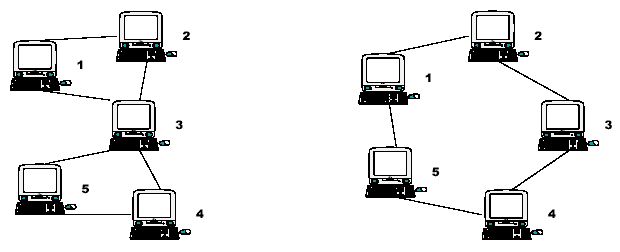
Input
Output
The first network in the file should be identified as "Network #1", the second as "Network #2", etc. For each SPF node, output a line, formatted as shown in the examples below, that identifies the node and the number of fully connected subnets that remain when that node fails. If the network has no SPF nodes, simply output the text "No SPF nodes" instead of a list of SPF nodes.
Sample Input
1 2

5 4

3 1

3 2

3 4

3 5

0

1 2

2 3

3 4

4 5

5 1

0

1 2

2 3

3 4

4 6

6 3

2 5

5 1

0

0
Sample Output
Network #1

  SPF node 3 leaves 2 subnets

Network #2

  No SPF nodes

Network #3

  SPF node 2 leaves 2 subnets

  SPF node 3 leaves 2 subnets
Source
点双连通分量模板题
 /*by SilverN*/

 #include<algorithm>

 #include<iostream>

 #include<cstring>

 #include<cstdio>

 #include<cmath>

 #include<vector>

 using namespace std;

 const int mxn=;

 struct edge{

     int v,nxt;

 }e[mxn<<];

 int hd[mxn],mct=;

 void add_edge(int u,int v){

     e[++mct].v=v;e[mct].nxt=hd[u];hd[u]=mct;

     return;

 }

 int n;

 int low[mxn],dfn[mxn],dtime=;

 int num[mxn];

 int st[mxn],top=;

 bool cut[mxn];

 void DFS(int u,int fa){

     low[u]=dfn[u]=++dtime;

     st[++top]=u;

     int i,j;

     for(i=hd[u];i;i=e[i].nxt){

         int v=e[i].v;

         if(v==fa)continue;

         if(!dfn[v]){

             DFS(v,u);

             if(low[v]>=dfn[u]){

                 cut[u]=;

                 int s=;

                 do{

                     s=st[top--];

                     ++num[s];

                 }while(u!=s);

                 top++;

             }

 //            num[u]++;

             low[u]=min(low[u],low[v]);

         }

         else low[u]=min(dfn[v],low[u]);

     }

     return;

 }

 bool have[mxn];

 int main(){

     int cas=;

     while(){

         memset(hd,,sizeof hd);

         memset(cut,,sizeof cut);

         memset(low,,sizeof low);

         memset(dfn,,sizeof dfn);

         memset(have,,sizeof have);

         memset(num,,sizeof num);

         mct=dtime=top=;

         int i,j,u,v;

         bool flag=;

         while(scanf("%d",&u) && u){

             scanf("%d",&v);

             have[u]=have[v]=;

             add_edge(u,v);

             add_edge(v,u);

             flag=;

         }

         if(!flag)break;

         for(i=;i<=;i++)

             if(have[i] && !dfn[i])DFS(i,);

         printf("Network #%d\n",++cas);

         flag=;

         for(i=;i<=;i++){

             if(num[i]>=){

                 flag=;

                 printf("  SPF node %d leaves %d subnets\n",i,num[i]);

             }

         }

         if(!flag)printf("  No SPF nodes\n");

         printf("\n");

     }

     return ;

 }
POJ1523 SPF的更多相关文章
- POJ1523 SPF[无向图割点]
SPF Time Limit: 1000MS Memory Limit: 10000K Total Submissions: 8139 Accepted: 3723 Description C ...
- POJ1523 SPF 单点故障
POJ1523 题意很简单,求删除割点后原先割点所在的无向连通图被分成了几个连通部分(原题说prevent at least one pair of available nodes from bein ...
- POJ1523 SPF(割点模板)
题目求一个无向图的所有割点,并输出删除这些割点后形成几个连通分量.用Tarjan算法: 一遍DFS,构造出一颗深度优先生成树,在原无向图中边分成了两种:树边(生成树上的边)和反祖边(非生成树上的边). ...
- POJ1523:SPF(无向连通图求割点)
题目:http://poj.org/problem?id=1523 题目解析: 注意题目输入输入,防止PE,题目就是求割点,并问割点将这个连通图分成了几个子图,算是模版题吧. #include < ...
- poj图论解题报告索引
最短路径: poj1125 - Stockbroker Grapevine(多源最短路径,floyd) poj1502 - MPI Maelstrom(单源最短路径,dijkstra,bellman- ...
- Tarjan求割点和桥
by szTom 前置知识 邻接表存储及遍历图 tarjan求强连通分量 割点 割点的定义 在一个无向图中,如果有一个顶点集合,删除这个顶点集合以及这个集合中所有顶点相关联的边以后,图的连通分量增多, ...
- POJ1523:SPF——题解
http://poj.org/problem?id=1523 这题明显就是求割点然后求割完之后的强连通分量的个数. 割点都会求,怎么求割完的分量个数呢? 我们可以通过万能的并查集啊!(具体做法看代码吧 ...
- POJ 1523 SPF(求割点)
题目链接 题意 : 找出图中所有的割点,然后输出删掉他们之后还剩多少个连通分量. 思路 : v与u邻接,要么v是u的孩子,要么u是v的祖先,(u,v)构成一条回边. //poj1523 #includ ...
- POJ 1523 SPF 割点与桥的推断算法-Tarjan
题目链接: POJ1523 题意: 问一个连通的网络中有多少个关节点,这些关节点分别能把网络分成几部分 题解: Tarjan 算法模板题 顺序遍历整个图,能够得到一棵生成树: 树边:可理解为在DFS过 ...
随机推荐
- Linux下安装使用NMON监控、分析系统性能
背景:今天在LoadRunner11.0中使用rstat监控linux过程中,始终提示如下错: Monitor name :UNIX Resources. Cannot initialize the ...
- Spring 中注入 properties 中的值
<bean id="ckcPlaceholderProperties" class="org.springframework.beans.factory.confi ...
- 转:CentOS设置时区
from: http://os.51cto.com/art/201004/192805.htm 建议直接使用: 1. session 临时修改查看: tzselect. 然后数字键入,回车 2. 永久 ...
- 023医疗项目-模块二:药品目录的导入导出-从数据库中查出数据用XSSF导出excel并存放在虚拟目录最后下载(包括调试)
我们要实现的效果: 进入到这个页面后,输入要查询的条件,查询出药品表的数据,然后按下导出按钮 ,就会在服务器的一个目录下生成一个药品表的excel表格. 点击"导出"之后 ...
- Elasticsearch 相关名词理解
Cluster包含多个node,Indices不应该理解成动词索引,Indices可理解成关系数据库中的databases,Indices可包含多个Index,Index对应关系数据库中的databa ...
- [Bug]redis问题解决(MISCONF Redis is configured to save RDB snapshots)
redis问题解决(MISCONF Redis is configured to save RDB snapshots) (error) MISCONF Redis is configured t ...
- [应用层]mail邮件协议
转:http://***/chapter-14/ 以前老记不住这smtp和pop3谁收谁发. 简单邮件传输协议(SMTP),用来发送或中转发出的电子邮件,占用tcp 25端口. 第三版邮局协议(POP ...
- 利用ViewHolder优化自定义Adapter的典型写法
1 public class MarkerItemAdapter extends BaseAdapter { private Context mContext = null; private List ...
- Oracle11G 卸载步骤
(之前因为不知道偶电脑是因为安装了oracle后,才导致的长达两周的开机速度要足足10分钟,以前只有一分钟不到!可以想象oracle的服务启动的强大,知道后,偶果断立即卸载掉!) 一.在oracle1 ...
- Page Security
参见开发文档 Overview This document describes how to build applications that grant selected access to indi ...