
python之路3:
 class set(object):

     """

     set() -> new empty set object

     set(iterable) -> new set object

     Build an unordered collection of unique elements.

     """

     wjh=set(['','',''])

     wjh.add('')

     wjh.add('')

     print(wjh)

     {'', '', '', ''} set中元素是唯一的

     def add(self, *args, **kwargs): # real signature unknown

         """ 添加 """

         """

         Add an element to a set.

         This has no effect if the element is already present.

         """

         pass

         wjh.add('')

     def clear(self, *args, **kwargs): # real signature unknown

         """ Remove all elements from this set. """

         pass

         wjh.clear()清除set所有数据

     def copy(self, *args, **kwargs): # real signature unknown

         """ Return a shallow copy of a set. """

         pass

         浅拷贝

     def difference(self, *args, **kwargs): # real signature unknown

         """

         Return the difference of two or more sets as a new set.

         (i.e. all elements that are in this set but not the others.)

         """

         pass

         取两个set合集差异,取单集合

         old = old_dict.keys()

         new = new_dict.keys()

         old_set=set(old)

         new_set=set(new)

         delete_set=old_set.difference(new_set)

         print(delete_set)

         {'#2'} 只取了old_set中的差异

     def difference_update(self, *args, **kwargs): # real signature unknown

         """ 删除当前set中的所有包含在 new set 里的元素 """

         """ Remove all elements of another set from this set. """

         pass

         old = old_dict.keys()

         new = new_dict.keys()

         old_set=set(old)

         new_set=set(new)

         delete_update_set=old_set.difference_update(new_set)

         print(old_set)

         {'#2'} 删除old_set中与new相重叠的元素

     def discard(self, *args, **kwargs): # real signature unknown

         """ 移除元素 """

         """

         Remove an element from a set if it is a member.

         If the element is not a member, do nothing.

         """

         pass

         new = new_dict.keys()

         new_set=set(new)

         delt=new_set.discard('#3')

         print(new_set)

         {'#1', '#4'}移除特定元素

     def intersection(self, *args, **kwargs): # real signature unknown

         """ 取交集,新创建一个set """

         """

         Return the intersection of two or more sets as a new set.

         (i.e. elements that are common to all of the sets.)

         """

         pass

         old = old_dict.keys()

         new = new_dict.keys()

         old_set=set(old)

         new_set=set(new)

         new_jiaoji_set=new_set.intersection(old_set)

         print(new_jiaoji_set)

         {'#3', '#1'}

     def intersection_update(self, *args, **kwargs): # real signature unknown

         """ 取交集,修改原来set """

         """ Update a set with the intersection of itself and another. """

         pass

         old = old_dict.keys()

         new = new_dict.keys()

         old_set=set(old)

         new_set=set(new)

         new_jiaoji_set=new_set.intersection_update(old_set)

         print(new_set)

         {'#1', '#3'}

     def isdisjoint(self, *args, **kwargs): # real signature unknown

         """ 如果没有交集,返回true  """

         """ Return True if two sets have a null intersection. """

         pass

         old = old_dict.keys()

         new = new_dict.keys()

         old_set=set(old)

         new_set=set(new)

         jieguo=new_set.isdisjoint(old_set)

         print(jieguo)

         False

     def issubset(self, *args, **kwargs): # real signature unknown

         """ 是否是子集 """

         """ Report whether another set contains this set. """

         pass

     def issuperset(self, *args, **kwargs): # real signature unknown

         """ 是否是父集 """

         """ Report whether this set contains another set. """

         pass

     def pop(self, *args, **kwargs): # real signature unknown

         """ 移除 """

         """

         Remove and return an arbitrary set element.

         Raises KeyError if the set is empty.

         """

         pass

             old = old_dict.keys()

             new = new_dict.keys()

             old_set=set(old)

             new_set=set(new)

             pp=old_set.pop()

             print(pp)

             print(old_set)

             #

             {'#1', '#3'}

             随机移除一个元素

     def remove(self, *args, **kwargs): # real signature unknown

         """ 移除 """

         """

         Remove an element from a set; it must be a member.

         If the element is not a member, raise a KeyError.

         """

         pass

         old = old_dict.keys()

         new = new_dict.keys()

         old_set=set(old)

         new_set=set(new)

         #print(old_set)

         pp=old_set.remove('#3')

         print(pp)

         print(old_set)

         {'#1', '#2'} 移除一个指定元素

     def symmetric_difference(self, *args, **kwargs): # real signature unknown

         """ 差集,创建新对象"""

         """

         Return the symmetric difference of two sets as a new set.

         (i.e. all elements that are in exactly one of the sets.)

         """

         pass

         old = old_dict.keys()

         new = new_dict.keys()

         old_set=set(old)

         new_set=set(new)

         cha=old_set.symmetric_difference(new_set)

         print(cha)

         {'#4', '#2'}

     def symmetric_difference_update(self, *args, **kwargs): # real signature unknown

         """ 差集,改变原来 """

         """ Update a set with the symmetric difference of itself and another. """

         pass

     def union(self, *args, **kwargs): # real signature unknown

         """ 并集 """

         """

         Return the union of sets as a new set.

         (i.e. all elements that are in either set.)

         """

         pass

         old = old_dict.keys()

         new = new_dict.keys()

         old_set=set(old)

         new_set=set(new)

         unic=old_set.union(new_set)

         print(unic)

         {'#3', '#1', '#4', '#2'} 合并

     def update(self, *args, **kwargs): # real signature unknown

         """ 更新 """

         """ Update a set with the union of itself and others. """

         pass

         old = old_dict.keys()

         new = new_dict.keys()

         old_set=set(old)

         new_set=set(new)

         update=old_set.update(new_set)

         print(old_set)

         {'#1', '#2', '#4', '#3'} 更新

     def __and__(self, y): # real signature unknown; restored from __doc__

         """ x.__and__(y) <==> x&y """

         pass

     def __cmp__(self, y): # real signature unknown; restored from __doc__

         """ x.__cmp__(y) <==> cmp(x,y) """

         pass

     def __contains__(self, y): # real signature unknown; restored from __doc__

         """ x.__contains__(y) <==> y in x. """

         pass

     def __eq__(self, y): # real signature unknown; restored from __doc__

         """ x.__eq__(y) <==> x==y """

         pass

     def __getattribute__(self, name): # real signature unknown; restored from __doc__

         """ x.__getattribute__('name') <==> x.name """

         pass

     def __ge__(self, y): # real signature unknown; restored from __doc__

         """ x.__ge__(y) <==> x>=y """

         pass

     def __gt__(self, y): # real signature unknown; restored from __doc__

         """ x.__gt__(y) <==> x>y """

         pass

     def __iand__(self, y): # real signature unknown; restored from __doc__

         """ x.__iand__(y) <==> x&=y """

         pass

     def __init__(self, seq=()): # known special case of set.__init__

         """

         set() -> new empty set object

         set(iterable) -> new set object

         Build an unordered collection of unique elements.

         # (copied from class doc)

         """

         pass

     def __ior__(self, y): # real signature unknown; restored from __doc__

         """ x.__ior__(y) <==> x|=y """

         pass

     def __isub__(self, y): # real signature unknown; restored from __doc__

         """ x.__isub__(y) <==> x-=y """

         pass

     def __iter__(self): # real signature unknown; restored from __doc__

         """ x.__iter__() <==> iter(x) """

         pass

     def __ixor__(self, y): # real signature unknown; restored from __doc__

         """ x.__ixor__(y) <==> x^=y """

         pass

     def __len__(self): # real signature unknown; restored from __doc__

         """ x.__len__() <==> len(x) """

         pass

     def __le__(self, y): # real signature unknown; restored from __doc__

         """ x.__le__(y) <==> x<=y """

         pass

     def __lt__(self, y): # real signature unknown; restored from __doc__

         """ x.__lt__(y) <==> x<y """

         pass

     @staticmethod # known case of __new__

     def __new__(S, *more): # real signature unknown; restored from __doc__

         """ T.__new__(S, ...) -> a new object with type S, a subtype of T """

         pass

     def __ne__(self, y): # real signature unknown; restored from __doc__

         """ x.__ne__(y) <==> x!=y """

         pass

     def __or__(self, y): # real signature unknown; restored from __doc__

         """ x.__or__(y) <==> x|y """

         pass

     def __rand__(self, y): # real signature unknown; restored from __doc__

         """ x.__rand__(y) <==> y&x """

         pass

     def __reduce__(self, *args, **kwargs): # real signature unknown

         """ Return state information for pickling. """

         pass

     def __repr__(self): # real signature unknown; restored from __doc__

         """ x.__repr__() <==> repr(x) """

         pass

     def __ror__(self, y): # real signature unknown; restored from __doc__

         """ x.__ror__(y) <==> y|x """

         pass

     def __rsub__(self, y): # real signature unknown; restored from __doc__

         """ x.__rsub__(y) <==> y-x """

         pass

     def __rxor__(self, y): # real signature unknown; restored from __doc__

         """ x.__rxor__(y) <==> y^x """

         pass

     def __sizeof__(self): # real signature unknown; restored from __doc__

         """ S.__sizeof__() -> size of S in memory, in bytes """

         pass

     def __sub__(self, y): # real signature unknown; restored from __doc__

         """ x.__sub__(y) <==> x-y """

         pass

     def __xor__(self, y): # real signature unknown; restored from __doc__

         """ x.__xor__(y) <==> x^y """

         pass

     __hash__ = None
set集合
set集合
set是一个无序且不重复的元素集合

练习:寻找差异

1

2

3

4

5

6

7

8

9

10

11

12

13

14

15

16

17

# 数据库中原有

old_dict = {

    "#1":{ 'hostname':c1, 'cpu_count': 2, 'mem_capicity': 80 },

    "#2":{ 'hostname':c1, 'cpu_count': 2, 'mem_capicity': 80 }

    "#3":{ 'hostname':c1, 'cpu_count': 2, 'mem_capicity': 80 }

}

# cmdb 新汇报的数据

new_dict = {

    "#1":{ 'hostname':c1, 'cpu_count': 2, 'mem_capicity': 800 },

    "#3":{ 'hostname':c1, 'cpu_count': 2, 'mem_capicity': 80 }

    "#4":{ 'hostname':c2, 'cpu_count': 2, 'mem_capicity': 80 }

}

需要删除:?

需要新建:?

需要更新:? 注意:无需考虑内部元素是否改变,只要原来存在,新汇报也存在,就是需要更新
copy(深浅拷贝)
import copy

字符串,整数,浮点,列表,元组(深浅拷贝都一样)

'''

a1 = 1223444

a2 = a1

print(id(a1))

print(id(a2))

'''

a1 = 123444

'''

a2 = copy.copy(a1)

print(id(a1))

print(id(a2))

'''

'''

a2=copy.deepcopy(a1)

print(id(a1))

print(id(a2))

'''

当出现下面这种情况,包涵多个子值时,浅拷贝只会拷贝第一层的内存地址,而深拷贝则会拷贝除最后一层外所有。

n1 = {'k1':'v1','k2':'v2','k3':['wjh',223,]}

'''

print(id(n1))

n2 = n1

print(id(n2))

'''

监控模板调用例子:

#n2 = copy.copy(n1)

n2 = copy.deepcopy(n1)

#print(id(n1['k3']))

#print(id(n2['k3']))

dic = {

    'cpu':[80,],

    'mem':[80,],

    'disk':[80,],

}

#print(dic)

new_dic=copy.deepcopy(dic)

#print(new_dic)

new_dic['cpu'][0] = 50

print(dic)

print(new_dic)
python之函数详解
返回值:

import smtplib

from email.mime.text import MIMEText

from email.utils import formataddr

def mail(user):

    ret = True

    try:

        msg = MIMEText('邮件内容', 'plain', 'utf-8')

        msg['From'] = formataddr(["武沛齐",'wptawy@126.com'])

        msg['To'] = formataddr(["走人",'133130355@qq.com'])

        msg['Subject'] = "主题"

        server = smtplib.SMTP("smtp.126.com", 25)

        server.login("wptawy@126.com", "WW.3945.59")

        server.sendmail('wptawy@126.com', [user,], msg.as_string())

        server.quit()

    except Exception:

        ret = False

    return ret

ret = mail('hdwangjianhui@163.com')

if ret:

    print('success')

else:

    print('shibai')

无参数:

import smtplib

from email.mime.text import MIMEText

from email.utils import formataddr

def mail():

    msg = MIMEText('邮件内容', 'plain', 'utf-8')

    msg['From'] = formataddr(["武沛齐",'wptawy@126.com'])

    msg['To'] = formataddr(["走人",'424662508@qq.com'])

    msg['Subject'] = "主题"

    server = smtplib.SMTP("smtp.126.com", 25)

    server.login("wptawy@126.com", "邮箱密码")

    server.sendmail('wptawy@126.com', ['133130355@qq.com',], msg.as_string())

    server.quit()

mail()

普通参数:

import smtplib

from email.mime.text import MIMEText

from email.utils import formataddr

def mail(user):

    msg = MIMEText('邮件内容', 'plain', 'utf-8')

    msg['From'] = formataddr(["武沛齐",'wptawy@126.com'])

    msg['To'] = formataddr(["走人",'424662508@qq.com'])

    msg['Subject'] = "主题"

    server = smtplib.SMTP("smtp.126.com", 25)

    server.login("wptawy@126.com", "邮箱密码")

    server.sendmail('wptawy@126.com', [user,], msg.as_string())

    server.quit()

mail('133130355@qq.com')

默认参数:

def func(name, age = 18):

    print ("%s:%s" %(name,age))

# 指定参数

func('wupeiqi', 19)

# 使用默认参数

func('alex')

动态参数:

*

def pr(*args):

    print(args)

wjh=['1','2']

pr(wjh)

*可以传递元组,字符,列表

**

def pr(**args):

    print(args)

pr(wjh={'wjh':'123',})

**可以传递字典

def pr(*args,**kwargs):

    print(args)

    print(kwargs)

pr([1,2,3,4],wjh={'wjh':'123',})

当两个参数都存在时一定要先写*的
双向队列:
可以将值从左右提取插入。

import collections

d = collections.deque()

d.append('1')

d.appendleft('10')

d.appendleft('1')

print(d)

print(d.count('1'))

d.extend(['y','yy','n'])#扩展

d.extendleft(['t','1'])

d.rotate(1) #将最后一个值放到第一个

单向队列:

只能将值从左到右传入,取出,(类似子弹夹原理)

import queue

#qsize:查看队列元素个数

#empty:清除

#full:是否填满

#put:插入数据

#get:取数据

q = queue.Queue()

q.put('123')

q.put('456')

print(q.qsize())

print (q.get())
字典(扩展)
有序字典:

import collections

dic = collections.OrderedDict()

dic['a'] = 'a1'

dic['b'] = 'b1'

dic['c'] = 'c1'

print(dic)

通过列表去像字典传输元素,以达到有顺序。

默认字典:

dic = collections.defaultdict(list)定义默认字典的元素为list。

#dic={}

a = [11,22,33,44,55,66,77,88,99]

for i in a:

    if i >66:

        dic['k1'].append(i)

    else:

        dic['v2'].append(i)

可命名元组:

print(dic)name_tuple=collections.namedtuple('name_tuple',['x','y','z'])

tuple1=name_tuple(11,22,33)

print(tuple1.x)

print(tuple1.y)
内置函数
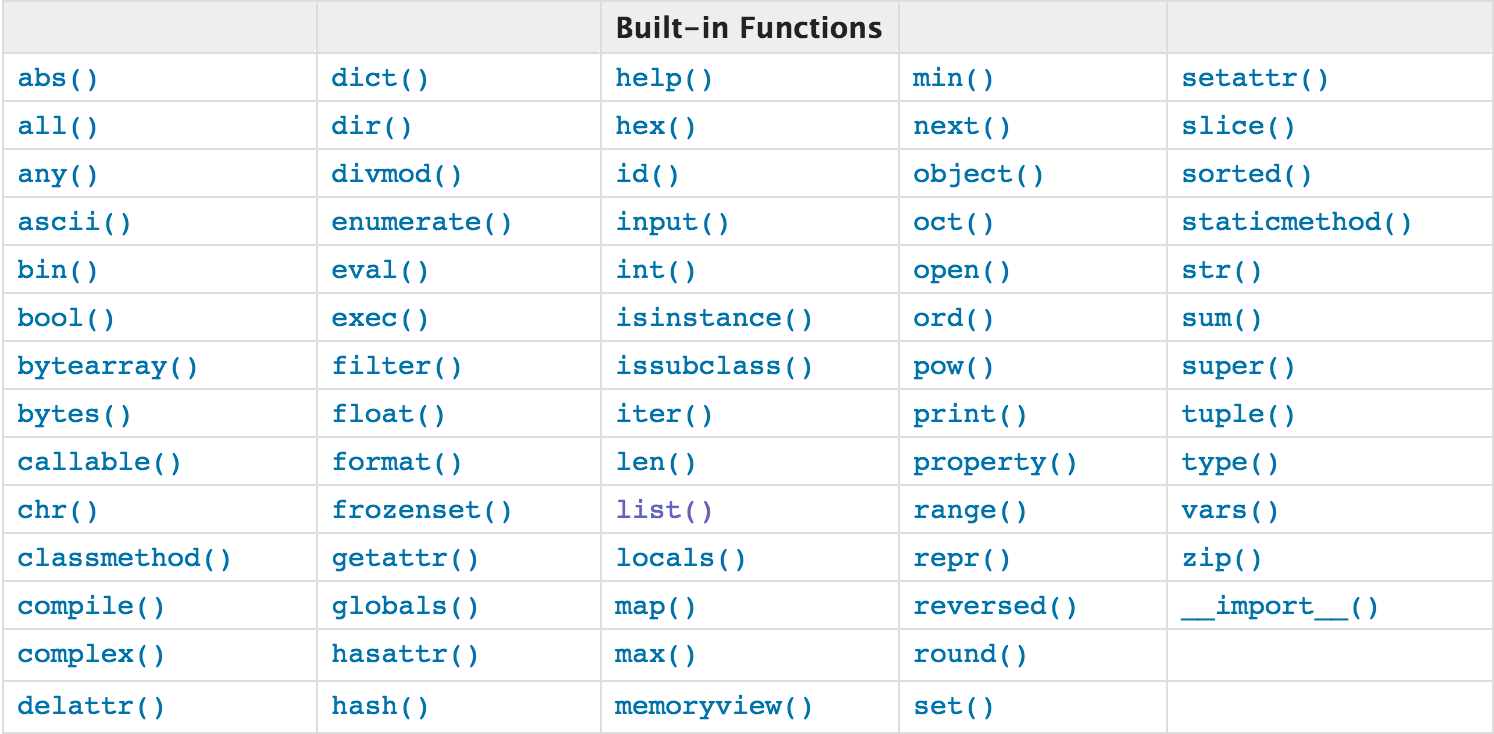
查看详细:https://docs.python.org/3/library/functions.html#next
abs()绝对值

all()当所有值为真才为真:None,Flase,空,都为假

a=all(['1',])

print(a) True

any()当其中值任意一个为真就为真。

bin()查看整数二进制

bool()查看布尔类型:Ture/Flase

chr()将整数转换为计算机识别的字符:

a = chr(81)

print(a)  Q 可用于验证码

ord()将字符转换为数字:

a = ord('A')

print(a) 65

random:生成随机数。

import random

print(random.randint(1,99))

dict():生成字典。

dir():查看对象可以使用的操作。

a = dir(111)

print(a)

['__abs__', '__add__', '__and__', '__bool__', '__ceil__', '__class__', '__delattr__', '__dir__', '__divmod__', '__doc__', '__eq__', '__float__', '__floor__', '__floordiv__', '__format__', '__ge__', '__getattribute__', '__getnewargs__', '__gt__', '__hash__', '__index__', '__init__', '__int__', '__invert__', '__le__', '__lshift__', '__lt__', '__mod__', '__mul__', '__ne__', '__neg__', '__new__', '__or__', '__pos__', '__pow__', '__radd__', '__rand__', '__rdivmod__', '__reduce__', '__reduce_ex__', '__repr__', '__rfloordiv__', '__rlshift__', '__rmod__', '__rmul__', '__ror__', '__round__', '__rpow__', '__rrshift__', '__rshift__', '__rsub__', '__rtruediv__', '__rxor__', '__setattr__', '__sizeof__', '__str__', '__sub__', '__subclasshook__', '__truediv__', '__trunc__', '__xor__', 'bit_length', 'conjugate', 'denominator', 'from_bytes', 'imag', 'numerator', 'real', 'to_bytes']

divmod:整除并且返回余数。

enumerate:将目标加上序号。

wjh={

    'wjh1':'11',

    'wjh2':'22',

}

for i,v in enumerate(wjh,2):

    print(i,v)

2 wjh2

3 wjh1

eval():函数将字符串str当成有效Python表达式来求值,并返回计算结果。

r = 1

print eval()

r =1

print (eval('r + 1'))

float():浮点数。

help():帮助。

id():查看内存地址。

input():插入。

int():整数。

hex():16进制转换。

len():长度。

list():列表

min():最小值

max():最大值

oct():八进制

open():打开文件

print():打印

pow():次方

import math

a = pow(2,2)

print(a)

range():定义数量

reversed():反转

set():定义唯一集合

round():大约,约等于

sorted():排序

str():字符串

sum():求和

tuple():元组

type():类型

vars():查看内置方法

class a:

    foo=100

b = vars(a)

print(b)

zip():将数组进行组合成列表。

map():map函数会根据提供的函数对指定序列做映射。

lil=[22,23,24,]

new_li=map(lambda x:x + 100,lil)

li = list(new_li)

print(li)

filter():过滤

li1=[11,22,33,44]

def fuc(x):

    if x>22:

        return True

    else:

        return False

new_li=filter(fuc,li1)

print(list(new_li))
lambda表达式
学习条件运算时,对于简单的 if else 语句,可以使用三元运算来表示,即:
# 普通条件语句

if 1 == 1:

    name = 'wupeiqi'

else:

    name = 'alex'

# 三元运算

name = 'wupeiqi' if 1 == 1 else 'alex'

对于简单的函数,也存在一种简便的表示方式,即:lambda表达式

# ###################### 普通函数 ######################

# 定义函数(普通方式)

def func(arg):

    return arg + 1

# 执行函数

result = func(123)

# ###################### lambda ######################

# 定义函数(lambda表达式)

my_lambda = lambda arg : arg + 1

# 执行函数

result = my_lambda(123)

lambda存在意义就是对简单函数的简洁表示
文件操作
open函数,该函数用于文件处理
操作文件时,一般需要经历如下步骤:
- 打开文件
- 操作文件
一、打开文件
|
1
|
文件句柄 = open('文件路径', '模式') |
打开文件时,需要指定文件路径和以何等方式打开文件,打开后,即可获取该文件句柄,日后通过此文件句柄对该文件操作。
打开文件的模式有:
- r,只读模式(默认)。
- w,只写模式。【不可读;不存在则创建;存在则删除内容;】
- a,追加模式。【可读; 不存在则创建;存在则只追加内容;】
"+" 表示可以同时读写某个文件
- r+,可读写文件。【可读;可写;可追加】
- w+,写读
- a+,同a
"U"表示在读取时,可以将 \r \n \r\n自动转换成 \n (与 r 或 r+ 模式同使用)
- rU
- r+U
"b"表示处理二进制文件(如:FTP发送上传ISO镜像文件,linux可忽略,windows处理二进制文件时需标注)
- rb
- wb
- ab
- 二、操作
     复制代码

     class TextIOWrapper(_TextIOBase):

         """

         Character and line based layer over a BufferedIOBase object, buffer.

         encoding gives the name of the encoding that the stream will be

         decoded or encoded with. It defaults to locale.getpreferredencoding(False).

         errors determines the strictness of encoding and decoding (see

         help(codecs.Codec) or the documentation for codecs.register) and

         defaults to "strict".

         newline controls how line endings are handled. It can be None, '',

         '\n', '\r', and '\r\n'.  It works as follows:

         * On input, if newline is None, universal newlines mode is

           enabled. Lines in the input can end in '\n', '\r', or '\r\n', and

           these are translated into '\n' before being returned to the

           caller. If it is '', universal newline mode is enabled, but line

           endings are returned to the caller untranslated. If it has any of

           the other legal values, input lines are only terminated by the given

           string, and the line ending is returned to the caller untranslated.

         * On output, if newline is None, any '\n' characters written are

           translated to the system default line separator, os.linesep. If

           newline is '' or '\n', no translation takes place. If newline is any

           of the other legal values, any '\n' characters written are translated

           to the given string.

         If line_buffering is True, a call to flush is implied when a call to

         write contains a newline character.

         """

         def close(self, *args, **kwargs): # real signature unknown

             关闭文件

             pass

         def fileno(self, *args, **kwargs): # real signature unknown

             文件描述符

             pass

         def flush(self, *args, **kwargs): # real signature unknown

             刷新文件内部缓冲区

             pass

         def isatty(self, *args, **kwargs): # real signature unknown

             判断文件是否是同意tty设备

             pass

         def read(self, *args, **kwargs): # real signature unknown

             读取指定字节数据

             pass

         def readable(self, *args, **kwargs): # real signature unknown

             是否可读

             pass

         def readline(self, *args, **kwargs): # real signature unknown

             仅读取一行数据

             pass

         def seek(self, *args, **kwargs): # real signature unknown

             指定文件中指针位置

             pass

         def seekable(self, *args, **kwargs): # real signature unknown

             指针是否可操作

             pass

         def tell(self, *args, **kwargs): # real signature unknown

             获取指针位置

             pass

         def truncate(self, *args, **kwargs): # real signature unknown

             截断数据,仅保留指定之前数据

             pass

         def writable(self, *args, **kwargs): # real signature unknown

             是否可写

             pass

         def write(self, *args, **kwargs): # real signature unknown

             写内容

             pass

         def __getstate__(self, *args, **kwargs): # real signature unknown

             pass

         def __init__(self, *args, **kwargs): # real signature unknown

             pass

         @staticmethod # known case of __new__

         def __new__(*args, **kwargs): # real signature unknown

             """ Create and return a new object.  See help(type) for accurate signature. """

             pass

         def __next__(self, *args, **kwargs): # real signature unknown

             """ Implement next(self). """

             pass

         def __repr__(self, *args, **kwargs): # real signature unknown

             """ Return repr(self). """

             pass

         buffer = property(lambda self: object(), lambda self, v: None, lambda self: None)  # default

         closed = property(lambda self: object(), lambda self, v: None, lambda self: None)  # default

         encoding = property(lambda self: object(), lambda self, v: None, lambda self: None)  # default

         errors = property(lambda self: object(), lambda self, v: None, lambda self: None)  # default

         line_buffering = property(lambda self: object(), lambda self, v: None, lambda self: None)  # default

         name = property(lambda self: object(), lambda self, v: None, lambda self: None)  # default

         newlines = property(lambda self: object(), lambda self, v: None, lambda self: None)  # default

         _CHUNK_SIZE = property(lambda self: object(), lambda self, v: None, lambda self: None)  # default

         _finalizing = property(lambda self: object(), lambda self, v: None, lambda self: None)  # default

 好文要顶 关注我 收藏该文
python之路3:的更多相关文章
- Python之路【第一篇】python基础
一.python开发 1.开发: 1)高级语言:python .Java .PHP. C# Go ruby c++ ===>字节码 2)低级语言:c .汇编 2.语言之间的对比: 1)py ...
- Python之路
Python学习之路 第一天 Python之路,Day1 - Python基础1介绍.基本语法.流程控制 第一天作业第二天 Python之路,Day2 - Pytho ...
- python之路 目录
目录 python python_基础总结1 python由来 字符编码 注释 pyc文件 python变量 导入模块 获取用户输入 流程控制if while python 基础2 编码转换 pych ...
- Python之路【第十九篇】:爬虫
Python之路[第十九篇]:爬虫 网络爬虫(又被称为网页蜘蛛,网络机器人,在FOAF社区中间,更经常的称为网页追逐者),是一种按照一定的规则,自动地抓取万维网信息的程序或者脚本.另外一些不常使用 ...
- Python之路【第十八篇】:Web框架们
Python之路[第十八篇]:Web框架们 Python的WEB框架 Bottle Bottle是一个快速.简洁.轻量级的基于WSIG的微型Web框架,此框架只由一个 .py 文件,除了Pytho ...
- Python之路【第十七篇】:Django【进阶篇 】
Python之路[第十七篇]:Django[进阶篇 ] Model 到目前为止,当我们的程序涉及到数据库相关操作时,我们一般都会这么搞: 创建数据库,设计表结构和字段 使用 MySQLdb 来连接 ...
- Python之路【第十六篇】:Django【基础篇】
Python之路[第十六篇]:Django[基础篇] Python的WEB框架有Django.Tornado.Flask 等多种,Django相较与其他WEB框架其优势为:大而全,框架本身集成了O ...
- Python之路【第十五篇】:Web框架
Python之路[第十五篇]:Web框架 Web框架本质 众所周知,对于所有的Web应用,本质上其实就是一个socket服务端,用户的浏览器其实就是一个socket客户端. 1 2 3 4 5 6 ...
- Python之路【第九篇】:Python操作 RabbitMQ、Redis、Memcache、SQLAlchemy
Python之路[第九篇]:Python操作 RabbitMQ.Redis.Memcache.SQLAlchemy Memcached Memcached 是一个高性能的分布式内存对象缓存系统,用 ...
- Python之路【第八篇】:堡垒机实例以及数据库操作
Python之路[第八篇]:堡垒机实例以及数据库操作 堡垒机前戏 开发堡垒机之前,先来学习Python的paramiko模块,该模块机遇SSH用于连接远程服务器并执行相关操作 SSHClient ...
随机推荐
- 使用Photoshop不改变图片尺寸,保存图片到30K以下的解决办法
- C#正则表达式判断输入日期格式是否正确
/// <summary> /// 是否为日期型字符串 /// </summary> /// <param name=&qu ...
- Linux操作系统备份之三:通过二进制拷贝(dd)方式实现Linux操作系统数据的备份
前面有两篇文章,<Linux操作系统备份之一:使用LVM快照实现Linux操作系统数据的在线备份>和<Linux操作系统备份之二:通过tar拷贝分区实现Linux操作数据的在线备份& ...
- Asp.net MVC5引用ExtJS6
摘要:VisualStuio2015 asp.net mvc如何引用ExtJS6,使用BundleConfig. 首先下载ExtJS6.0 gpl版.ExtJS有自己的程序框架,但我们需要asp.ne ...
- Android Monkey测试(转载)
Monkey是一款通过命令行来对我们APP进行测试的工具,可以运行在模拟器里或真机上.它向系统发送伪随机的用户事件流,实现对正应用程序进行压力测试. 官方介绍 :https://developer.a ...
- [SQL入门级] 接上篇,继续查询
距离上一篇时间隔得蛮久了,这篇继续查询,简单总结一下聚合函数.分组的知识. 一.聚合函数(组函数/多行函数) 何谓多行函数,顾名思义就是函数作用于多行数据得出一个输出结果,什么意思呢?看图: 那么常用 ...
- 在eclipse上跑hadoop的helloworld
关于hadoop的用处什么我就不说了,在这里记录下在eclipse上第一次跑hadoop遇到的问题吧~ hadoop的安装我就不说啦,网上教程一大堆~我直接用的公司的Linux上的hadoop. ec ...
- HttpEntity转换Inputstream(红色)加XmlPull解析
package com.bawei.xml; import java.io.IOException; import java.io.InputStream; import java.util.Arra ...
- C# 将数字时间转化为特定格式字符串
在工作中,经常遇到,将距离某点的时间段转化为"HH:MM:SS"格式时间的情况. 经过总结,用C#实现了一个特别好的办法: DateTime _dTNow = DateTime. ...
- myeclipse快捷键
转: 当时我看到struts2讲解视频的时候,讲解员居然能一下子注释掉好几行代码,而且注释的很整齐,然我大吃一惊,上网搜了下Myeclipse的快捷键还真多选择你要注释的那一行或多行代码,按Ctrl+ ...