
poj2553 强连通缩点
| Time Limit: 3000MS | Memory Limit: 65536K | |
| Total Submissions: 10114 | Accepted: 4184 |
Description
Let n be a positive integer, and let p=(e1,...,en) be a sequence of length n of edges ei∈E such that ei=(vi,vi+1) for a sequence of vertices (v1,...,vn+1). Then p is called a path from vertex v1 to vertex vn+1 in Gand we say that vn+1 is reachable from v1, writing (v1→vn+1).
Here are some new definitions. A node v in a graph G=(V,E) is called a sink, if for every node w in G that is reachable from v, v is also reachable from w. The bottom of a graph is the subset of all nodes that are sinks, i.e., bottom(G)={v∈V|∀w∈V:(v→w)⇒(w→v)}. You have to calculate the bottom of certain graphs.
Input
Output
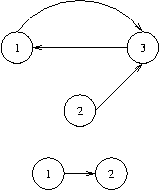
Sample Input
3 3

1 3 2 3 3 1

2 1

1 2

0
Sample Output
1 3

2
题意:
n个点,m条边,并且是单向边。求有多少个顶点,满足它能到的点也能够到达它。
思路:
对于强连通中的点,肯定能够互相到达,所以可以强连通缩点,此时只要找到出度为0的点,其连通分量连所有的点就是答案。因为
如果该点的出度不为0,那么肯定有新的该点能够到达的点,由于已经缩点了,不可能出现有强连通的情况,所以出度不为0的点不满足要求。
/*

 * Author:  sweat123

 * Created Time:  2016/6/25 14:32:24

 * File Name: main.cpp

 */

#include<set>

#include<map>

#include<queue>

#include<stack>

#include<cmath>

#include<string>

#include<vector>

#include<cstdio>

#include<time.h>

#include<cstring>

#include<iostream>

#include<algorithm>

#define INF 1<<30

#define MOD 1000000007

#define ll long long

#define lson l,m,rt<<1

#define rson m+1,r,rt<<1|1

#define pi acos(-1.0)

using namespace std;

const int MAXN = ;

struct node{

    int from;

    int to;

    int next;

}edge[MAXN*];

int pre[MAXN],vis[MAXN],dfn[MAXN],low[MAXN],n,m,ind;

int f[MAXN],siz[MAXN],num,dep,out[MAXN],in[MAXN];

stack<int>s;

vector<int>p[MAXN];

void add(int x,int y){

    edge[ind].from = x;

    edge[ind].to = y;

    edge[ind].next = pre[x];

    pre[x] = ind ++;

}

void dfs(int rt){

    dfn[rt] = low[rt] = ++dep;

    vis[rt] = ;

    s.push(rt);

    for(int i = pre[rt]; i != -; i = edge[i].next){

        int t = edge[i].to;

        if(!dfn[t]){

            dfs(t);

            low[rt] = min(low[rt],low[t]);

        } else if(vis[t]){

            low[rt] = min(low[rt],dfn[t]);

        }

    }

    if(low[rt] == dfn[rt]){

        ++num;

        while(!s.empty()){

            int  tp = s.top();

            s.pop();

            vis[tp] = ;

            f[tp] = num;

            siz[num] ++;

            p[num].push_back(tp);

            if(tp == rt)break;

        }

    }

}

void setcc(){

    num = ;

    dep = ;

    memset(in,,sizeof(in));

    memset(out,,sizeof(out));

    memset(dfn,,sizeof(dfn));

    memset(low,,sizeof(low));

    for(int i = ; i <= n; i++){

        if(!dfn[i]){

            dfs(i);

        }

    }

    memset(pre,-,sizeof(pre));

    int ret = ind;

    for(int i = ; i < ret; i++){

        int x = f[edge[i].from];

        int y = f[edge[i].to];

        if(x == y)continue;

        add(x,y);

        out[x] ++;

        in[y] ++;

    }

    vector<int>ans;

    for(int i = ; i <= num; i++){

        if(!out[i]){

            for(int j = ; j < p[i].size(); j++){

                ans.push_back(p[i][j]);

            }

        }

    }

    sort(ans.begin(),ans.end());

    for(int i = ; i < ans.size(); i++){

        if(i == )printf("%d",ans[i]);

        else printf(" %d",ans[i]);

    }

    printf("\n");

}

int main(){

    while(~scanf("%d",&n)){

        if(n == )break;

        scanf("%d",&m);

        if(n == ){

            printf("1\n");

            continue;

        }

        ind = ;

        for(int i = ; i <= n; i++){

            p[i].clear();

        }

        memset(pre,-,sizeof(pre));

        while(!s.empty())s.pop();

        memset(f,-,sizeof(f));

        memset(siz,,sizeof(siz));

        for(int i = ; i <= m; i++){

            int x,y;

            scanf("%d%d",&x,&y);

            add(x,y);

        }

        setcc();

    }

    return ;

}
| Time Limit: 3000MS | Memory Limit: 65536K | |
| Total Submissions: 10114 | Accepted: 4184 |
Description
Let n be a positive integer, and let p=(e1,...,en) be a sequence of length n of edges ei∈E such that ei=(vi,vi+1) for a sequence of vertices (v1,...,vn+1). Then p is called a path from vertex v1 to vertex vn+1 in Gand we say that vn+1 is reachable from v1, writing (v1→vn+1).
Here are some new definitions. A node v in a graph G=(V,E) is called a sink, if for every node w in G that is reachable from v, v is also reachable from w. The bottom of a graph is the subset of all nodes that are sinks, i.e., bottom(G)={v∈V|∀w∈V:(v→w)⇒(w→v)}. You have to calculate the bottom of certain graphs.
Input
Output
Sample Input
3 3

1 3 2 3 3 1

2 1

1 2

0
Sample Output
1 3

2
poj2553 强连通缩点的更多相关文章
- hdu 4635 Strongly connected 强连通缩点
题目链接:http://acm.hdu.edu.cn/showproblem.php?pid=4635 题意:给你一个n个点m条边的图,问在图不是强连通图的情况下,最多可以向图中添多少条边,若图为原来 ...
- BZOJ 1051: [HAOI2006]受欢迎的牛 强连通缩点
题目链接: http://www.lydsy.com/JudgeOnline/problem.php?id=1051 题解: 强连通缩点得到DAG图,将图转置一下,对入度为零的点跑dfs看看能不能访问 ...
- hdu 2767 Proving Equivalences 强连通缩点
给出n个命题,m个推导,问最少添加多少条推导,能够使全部命题都能等价(两两都能互推) 既给出有向图,最少加多少边,使得原图变成强连通. 首先强连通缩点,对于新图,每一个点都至少要有一条出去的边和一条进 ...
- UVA - 11324 The Largest Clique 强连通缩点+记忆化dp
题目要求一个最大的弱联通图. 首先对于原图进行强连通缩点,得到新图,这个新图呈链状,类似树结构. 对新图进行记忆化dp,求一条权值最长的链,每一个点的权值就是当前强连通分量点的个数. /* Tarja ...
- poj-1904(强连通缩点)
题意:有n个王子,每个王子都有k个喜欢的女生,王子挑选喜欢的女生匹配,然后再给你n个王子最开始就定好的匹配,每个王子输出能够结合且不影响其他王子的女生匹配 解题思路:强连通缩点,每个王子与其喜欢的女生 ...
- NOIP2017提高组Day1T3 逛公园 洛谷P3953 Tarjan 强连通缩点 SPFA 动态规划 最短路 拓扑序
原文链接https://www.cnblogs.com/zhouzhendong/p/9258043.html 题目传送门 - 洛谷P3953 题目传送门 - Vijos P2030 题意 给定一个有 ...
- BZOJ1179 [Apio2009]Atm Tarjan 强连通缩点 动态规划
欢迎访问~原文出处——博客园-zhouzhendong 去博客园看该题解 题目传送门 - BZOJ1179 题意概括 有一个有向图,每一个节点有一个权值,其中有一些结束点. 现在,你要从S出发,到达任 ...
- BZOJ1051 [HAOI2006]受欢迎的牛 Tarjan 强连通缩点
欢迎访问~原文出处——博客园-zhouzhendong 去博客园看该题解 题目传送门 - BZOJ1051 题意概括 有n只牛,有m个羡慕关系. 羡慕关系具有传递性. 如果A羡慕B,B羡慕C,那么我们 ...
- 强连通缩点— HDU1827
强连通缩点以后最终形成的是一棵树 我们可以根据树的性质来看缩点以后的强连通分量图,就很好理解了 /* gyt Live up to every day */ #include<cstdio> ...
随机推荐
- IT菜鸟的第2天(输入输出,数据类型,运算符的使用)
1:输入输出 另一种读写方法: 注释:Console.Write(Line{自动换行})是输入,string xxx = Console.ReadLine();是输出. string :字符串类型 ...
- java 28 - 2 设计模式之 模版设计模式
模版设计模式 模版设计模式概述 模版方法模式就是定义一个算法的骨架,而将具体的算法延迟到子类中来实现 优点 使用模版方法模式,在定义算法骨架的同时,可以很灵活的实现具体的算法,满足用户灵活多变的需求 ...
- java 25 - 4 网络编程之 UDP协议传输的代码优化
UDP协议的输出端: /* UDP发送数据: A:创建Socket发送端对象 B:创建数据报包(把数据打包) C:调用Socket对象发送数据报包 D:释放资源(底层是IO流) */ public c ...
- 我的WafBypass之道
0x00 前言 去年到现在就一直有人希望我出一篇关于waf绕过的文章,我觉得这种老生常谈的话题也没什么可写的.很多人一遇到waf就发懵,不知如何是好,能搜到的各种姿势也是然并卵.但是积累姿势的过程也 ...
- js关闭当前页面(窗口)的几种方式总结(转)
js关闭当前页面(窗口)的几种方式总结 1. 不带任何提示关闭窗口的js代码 代码如下 <a href="javascript:window.opener=null;windo ...
- HTML 学习笔记 CSS样式(边框)
元素的边框(border)是围绕元素内容和内边距的一条或多条线 CSS border 属性允许你规定边框的样式 宽度和颜色 CSS 边框 在 HTML 中,我们使用表格来创建文本周围的边框,但是通过使 ...
- js的client详解
clientWidth:可视区宽 说明:样式宽+padding clientHeight:可视区高 说明:样式高+padding elem.clientWidth //获取元素 ...
- 使用 JavaScript File API 实现文件上传
概述 以往对于基于浏览器的应用而言,访问本地文件都是一件头疼的事情.虽然伴随着 Web 2.0 应用技术的不断发展,JavaScript 正在扮演越来越重要的角色,但是出于安全性的考虑,JavaScr ...
- android 混淆文件proguard.cfg详解
-optimizationpasses 5 [代码压缩级别]-dontusemixedcaseclassnames [混淆时不会产生形形色色的类名 ]-dontskipnonpubliclibrar ...
- iOS APNS配置(转)
Introduction To send Push notification to an application/device couple you need an unique device tok ...