
[Kotlin Tutorials 21] 协程的取消
协程的取消
本文讨论协程的取消, 以及实现时可能会碰到的几个问题.
本文属于合辑: https://github.com/mengdd/KotlinTutorials
协程的取消
取消的意义: 避免资源浪费, 以及多余操作带来的问题.
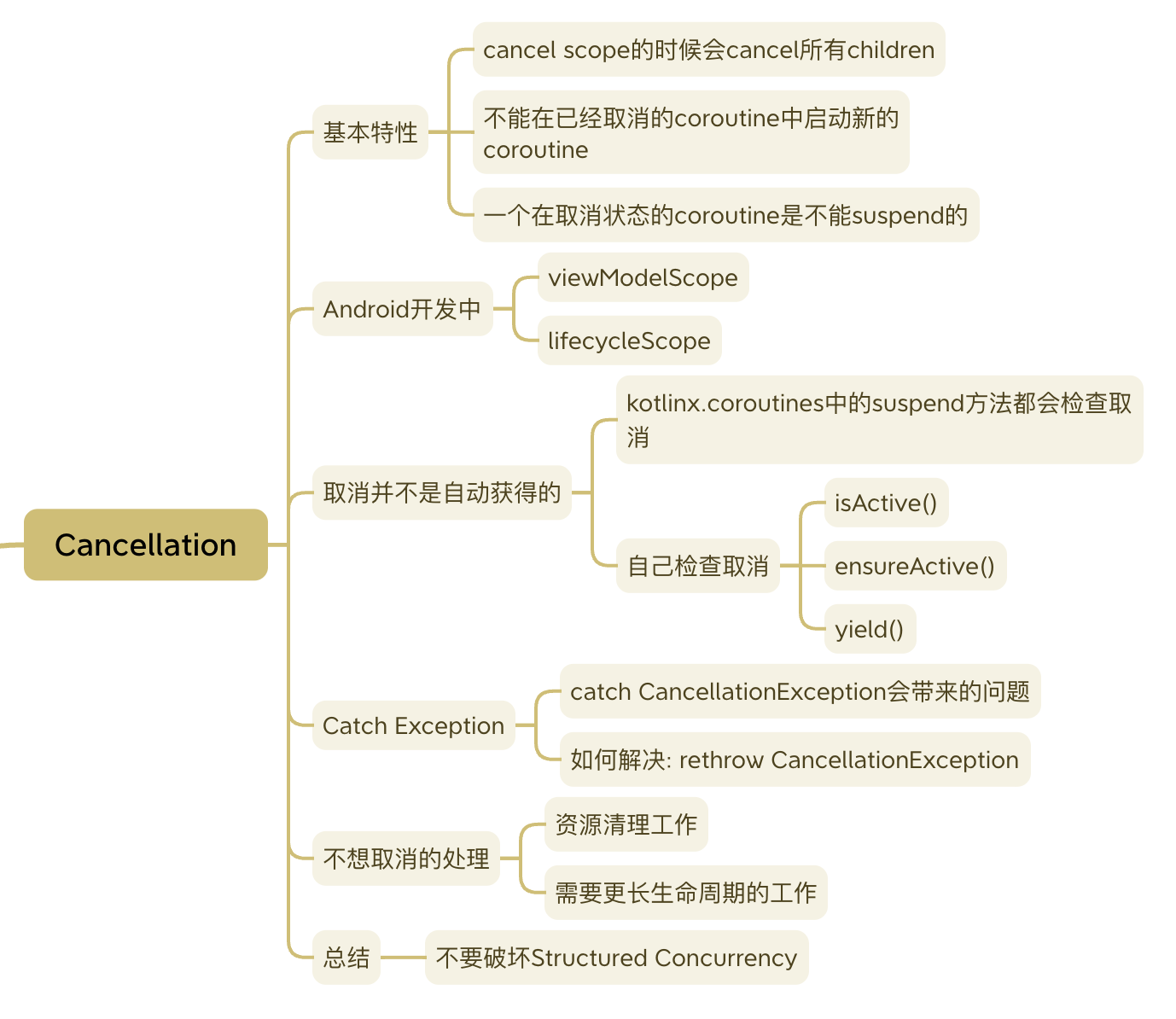
基本特性:
- cancel scope的时候会cancel其中的所有child coroutines.
- 一旦取消一个scope, 你将不能再在其中launch新的coroutine.
- 一个在取消状态的coroutine是不能suspend的.
如果一个coroutine抛出了异常, 它将会把这个exception向上抛给它的parent, 它的parent会做以下三件事情:
- 取消其他所有的children.
- 取消自己.
- 把exception继续向上传递.
Android开发中的取消
在Android开发中, 比较常见的情形是由于View生命周期的终止, 我们需要取消一些操作.
通常我们不需要手动调用cancel()方法, 那是因为我们利用了一些更高级的包装方法, 比如:
viewModelScope: 会在ViewModel onClear的时候cancel.lifecycleScope: 会在作为Lifecycle Owner的View对象: Activity, Fragment到达DESTROYED状态时cancel.
取消并不是自动获得的
all suspend functions from kotlinx.coroutines are cancellable, but not yours.
kotlin官方提供的suspend方法都会有cancel的处理, 但是我们自己写的suspend方法就需要自己留意.
尤其是耗时或者带循环的地方, 通常需要自己加入检查, 否则即便调用了cancel, 代码也继续在执行.
有这么几种方法:
isActive()ensureActive()yield(): 除了ensureActive以外, 会出让资源, 比如其他工作不需要再往线程池里加线程.
一个在循环中检查coroutine是否依然活跃的例子:
fun main() = runBlocking {

    val startTime = currentTimeMillis()

    val job = launch(Dispatchers.Default) {

        var nextPrintTime = startTime

        var i = 0

        while (isActive) { // cancellable computation loop

            // print a message twice a second

            if (currentTimeMillis() >= nextPrintTime) {

                println("job: I'm sleeping ${i++} ...")

                nextPrintTime += 500L

            }

        }

    }

    delay(1300L) // delay a bit

    println("main: I'm tired of waiting!")

    job.cancelAndJoin() // cancels the job and waits for its completion

    println("main: Now I can quit.")

}
输出:
job: I'm sleeping 0 ...

job: I'm sleeping 1 ...

job: I'm sleeping 2 ...

main: I'm tired of waiting!

main: Now I can quit.
catch Exception和runCatching
众所周知catch一个很general的Exception类型可能不是一个好做法.
因为你以为捕获了A, B, C异常, 结果实际上还有D, E, F.
捕获具体的异常类型, 在开发阶段的快速失败会帮助我们更早定位和解决问题.
协程还推出了一个"方便"的runCatching方法, catchThrowable.
让我们写出了看似更"保险", 但却更容易破坏取消机制的代码.
如果我们catch了CancellationException, 会破坏Structured Concurrency.
看这个例子:
fun main() = runBlocking {

    val job = launch(Dispatchers.Default) {

        println("my long time function start")

        myLongTimeFunction()

        println("my other operations ==== ") // this line should not be printed when cancelled

    }

    delay(1300L) // delay a bit

    println("main: I'm tired of waiting!")

    job.cancelAndJoin() // cancels the job and waits for its completion

    println("main: Now I can quit.")

}

private suspend fun myLongTimeFunction() = runCatching {

    var i = 0

    while (i < 10) {

        // print a message twice a second

        println("job: I'm sleeping ${i++} ...")

        delay(500)

    }

}
输出:
my long time function start

job: I'm sleeping 0 ...

job: I'm sleeping 1 ...

job: I'm sleeping 2 ...

main: I'm tired of waiting!

my other operations ====

main: Now I can quit.
当job cancel了以后后续的工作不应该继续进行, 然而我们可以看到log仍然被打印出来, 这是因为runCatching把异常全都catch了.
这里有个open issue讨论这个问题: https://github.com/Kotlin/kotlinx.coroutines/issues/1814
CancellationException的特殊处理
如何解决上面的问题呢? 基本方案是把CancellationException再throw出来.
比如对于runCatching的改造, NowInAndroid里有这么一个方法suspendRunCatching:
private suspend fun <T> suspendRunCatching(block: suspend () -> T): Result<T> = try {

    Result.success(block())

} catch (cancellationException: CancellationException) {

    throw cancellationException

} catch (exception: Exception) {

    Log.i(

        "suspendRunCatching",

        "Failed to evaluate a suspendRunCatchingBlock. Returning failure Result",

        exception

    )

    Result.failure(exception)

}
上面的例子改为用这个suspendRunCatching方法替代runCatching就修好了.
上面例子的输出变为:
my long time function start

job: I'm sleeping 0 ...

job: I'm sleeping 1 ...

job: I'm sleeping 2 ...

main: I'm tired of waiting!

main: Now I can quit.
不想取消的处理
可能还有一些工作我们不想随着job的取消而完全取消.
资源清理工作
finally通常用于try block之后的的资源清理, 如果其中没有suspend方法那么没有问题.
如果finally中的代码是suspend的, 如前所述, 一个在取消状态的coroutine是不能suspend的.
那么需要用一个withContext(NonCancellable).
例子:
fun main() = runBlocking {

    val job = launch {

        try {

            repeat(1000) { i ->

                println("job: I'm sleeping $i ...")

                delay(500L)

            }

        } finally {

            withContext(NonCancellable) {

                println("job: I'm running finally")

                delay(1000L)

                println("job: And I've just delayed for 1 sec because I'm non-cancellable")

            }

        }

    }

    delay(1300L) // delay a bit

    println("main: I'm tired of waiting!")

    job.cancelAndJoin() // cancels the job and waits for its completion

    println("main: Now I can quit.")

}
注意这个方法一般用于会suspend的资源清理, 不建议在各个场合到处使用, 因为它破坏了对coroutine执行取消的控制.
需要更长生命周期的工作
如果有一些工作需要比View/ViewModel更长的生命周期, 可以把它放在更下层, 用一个生命周期更长的scope.
可以根据不同的场景设计, 比如可以用一个application生命周期的scope:
class MyApplication : Application() {

  // No need to cancel this scope as it'll be torn down with the process

  val applicationScope = CoroutineScope(SupervisorJob() + otherConfig)

}
再把这个scope注入到repository中去.
如果需要做的工作比application的生命周期更长, 那么可以考虑用WorkManager.
总结: 不要破坏Structured Concurrency
Structure Concurrency为开发者提供了方便管理多个coroutines的有效方法.
基本上破坏Structure Concurrency特性的行为(比如用GlobalScope, 用NonCancellable, catch CancellationException等)都是反模式, 要小心使用.
还要注意不要随便传递job.
CoroutineContext有一个元素是job, 但是这并不意味着我们可以像切Dispatcher一样随便传一个job参数进去.
文章: Structured Concurrency Anniversary
看这里: https://github.com/Kotlin/kotlinx.coroutines/issues/1001
References & Further Reading
Kotlin官方文档的网页版和markdown版本:
Android官方文档上链接的博客和视频:
- Cancellation in coroutines
- KotlinConf 2019: Coroutines! Gotta catch 'em all! by Florina Muntenescu & Manuel Vivo
其他:
- Coroutines: first things first
- Kotlin Coroutines and Flow - Use Cases on Android
- Structured Concurrency Anniversary
- Exceptions in coroutines
- Coroutines & Patterns for work that shouldn’t be cancelled
[Kotlin Tutorials 21] 协程的取消的更多相关文章
- kotlin学习-Coroutines(协程)
协程(又名纤程),轻量级线程(建立在线程基础上,属于用户态调用),非阻塞式编程(像同步编写一样),在用户态内进行任务调度,避免与内核态过多交互问题,提高程序快速响应.协程使用挂起当前上下文替代阻塞,被 ...
- Kotlin Coroutine(协程): 二、初识协程
@ 目录 前言 一.初识协程 1.runBlocking: 阻塞协程 2.launch: 创建协程 3.Job 4.coroutineScope 5.协程取消 6.协程超时 7.async 并行任务 ...
- Kotlin Coroutine(协程): 三、了解协程
@ 目录 前言 一.协程上下文 1.调度器 2.给协程起名 3.局部变量 二.启动模式 CoroutineStart 三.异常处理 1.异常测试 2.CoroutineExceptionHandler ...
- Kotlin 协程一 —— 全面了解 Kotlin 协程
一.协程的一些前置知识 1.1 进程和线程 1.1.1基本定义 1.1.2为什么要有线程 1.1.3 进程与线程的区别 1.2 协作式与抢占式 1.2.1 协作式 1.2.2 抢占式 1.3 协程 二 ...
- Kotlin协程解析系列(上):协程调度与挂起
vivo 互联网客户端团队- Ruan Wen 本文是Kotlin协程解析系列文章的开篇,主要介绍Kotlin协程的创建.协程调度与协程挂起相关的内容 一.协程引入 Kotlin 中引入 Corout ...
- Kotlin协程第一个示例剖析及Kotlin线程使用技巧
Kotlin协程第一个示例剖析: 上一次https://www.cnblogs.com/webor2006/p/11712521.html已经对Kotlin中的协程有了理论化的了解了,这次则用代码来直 ...
- Kotlin协程入门
开发环境 IntelliJ IDEA 2021.2.2 (Community Edition) Kotlin: 212-1.5.10-release-IJ5284.40 介绍Kotlin中的协程.用一 ...
- Android中的Coroutine协程原理详解
前言 协程是一个并发方案.也是一种思想. 传统意义上的协程是单线程的,面对io密集型任务他的内存消耗更少,进而效率高.但是面对计算密集型的任务不如多线程并行运算效率高. 不同的语言对于协程都有不同的实 ...
- Unity协程Coroutine使用总结和一些坑
原文摘自 Unity协程Coroutine使用总结和一些坑 MonoBehavior关于协程提供了下面几个接口: 可以使用函数或者函数名字符串来启动一个协程,同时可以用函数,函数名字符串,和Corou ...
- 第二章 - Java与协程
Java与协程 内核线程的局限 通过一个具体场景来解释目前Java线程面临的困境.今天对Web应用的服务要求,不论是在请求数量上还是在复杂度上,与十多年前相比已不可同日而语,这一方面是源于业务量的增长 ...
随机推荐
- CAS 单点登录系统
一.什么是单点登录 单点登录(Sign Sion On),简称为 SSO,是目前比较流行的企业业务整合的解决方案之一.SSO 的定义是在多个应用系统中,用户只需要登录一次就可以访问所有相互信任的应用系 ...
- SpringBoot 启动类的原理
SpringBoot启动类上使用 @SpringBootApplication注解,该注解是一个组合注解,包含多个其它注解.和类定义(SpringApplication.run)要揭开 SpringB ...
- Vue+ElementUI动态显示el-table某列(值和颜色)的方法
方法一:结合 template scope组件和 v-if 语法判断 例1:值 <el-table-column prop="status" label="车辆状态 ...
- 实现一个CRDT工具库——VClock 时钟向量类
这段代码实现了一个VClock类,它是基于GCounter实现的.VClock是一种向量时钟,它可以用于在分布式系统中对事件发生的顺序进行排序.VClock的实现方式是将每个节点的计数器值存储在一个字 ...
- [ACM]Uva572-Oil Deposits-DFS应用
#include<iostream> #include<cstdio> #include<cstdlib> #include<cstring> usin ...
- Git Commit Message 应该怎么写?
原文链接: Git Commit Message 应该怎么写? 最近被同事吐槽了,说我代码提交说明写的太差.其实都不用他吐槽,我自己心里也非常清楚.毕竟很多时候犯懒,都是直接一个 -m "f ...
- Django笔记二十一之使用原生SQL查询数据库
本文首发于公众号:Hunter后端 原文链接:Django笔记二十一之使用原生SQL查询数据库 Django 提供了两种方式来执行原生 SQL 代码. 一种是使用 raw() 函数,一种是 使用 co ...
- Java设计模式 —— 观察者模式
16 观察者模式 16.1 观察者模式概述 Observer Pattern: 定义对象之间的依赖关系(一对多),当一个对象的状态发生改变时,其关联的依赖对象均收到通知并自动更新. 观察者模式又称:发 ...
- 巧用Nginx配置解决跨域问题
页面nginx配置 1,前端页面放在域名根目录,比如,http://www.xuecheng.com/ ,对应的nginx配置: #门户 location / { alias D:/Z_lhy/Spr ...
- 关于取消DevTools listening on ws://127.0.0.1…提示的方法
Python代码写好之后,通过任务计划程序定期执行.py文件,但总会有命令窗口,虽然不影响程序执行,但每次需要手动叉掉比较烦.于是我网上搜索了一些方法. 网上的方法并没有直接解决我的问题,但我借助搜索 ...