
Java IO学习笔记二:DirectByteBuffer与HeapByteBuffer
作者:Grey
原文地址:Java IO学习笔记二:DirectByteBuffer与HeapByteBuffer
ByteBuffer.allocate()与ByteBuffer.allocateDirect()的基本使用
这两个API封装了一个统一的ByteBuffer返回值,在使用上是无差别的。
import java.nio.ByteBuffer;

public class TestByteBuffer {

    public static void main(String[] args) {

        ByteBuffer buffer = ByteBuffer.allocateDirect(1024);

        System.out.println("position: " + buffer.position());

        System.out.println("limit: " + buffer.limit());

        System.out.println("capacity: " + buffer.capacity());

        System.out.println("mark: " + buffer);

        buffer.put("123".getBytes());

        System.out.println("-------------put:123......");

        System.out.println("mark: " + buffer);

        buffer.flip();

        System.out.println("-------------flip......");

        System.out.println("mark: " + buffer);

        buffer.get();

        System.out.println("-------------get......");

        System.out.println("mark: " + buffer);

        buffer.compact();

        System.out.println("-------------compact......");

        System.out.println("mark: " + buffer);

        buffer.clear();

        System.out.println("-------------clear......");

        System.out.println("mark: " + buffer);

    }

}
输出结果是:
mark: java.nio.DirectByteBuffer[pos=0 lim=1024 cap=1024]

-------------put:123......

mark: java.nio.DirectByteBuffer[pos=3 lim=1024 cap=1024]

-------------flip......

mark: java.nio.DirectByteBuffer[pos=0 lim=3 cap=1024]

-------------get......

mark: java.nio.DirectByteBuffer[pos=1 lim=3 cap=1024]

-------------compact......

mark: java.nio.DirectByteBuffer[pos=2 lim=1024 cap=1024]

-------------clear......

mark: java.nio.DirectByteBuffer[pos=0 lim=1024 cap=1024]
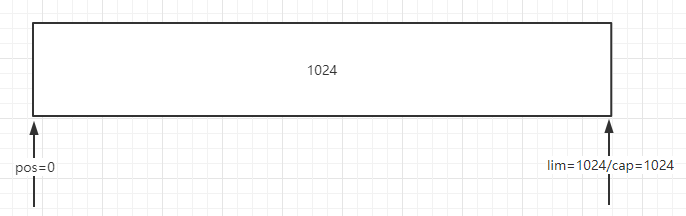
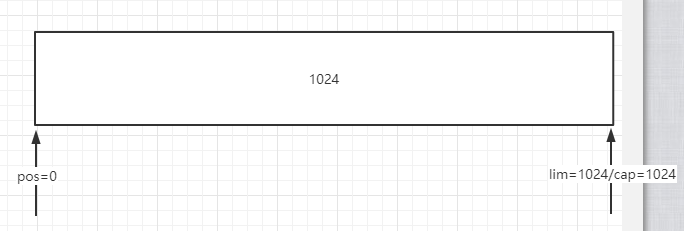
当分配好1024空间后,未对ByteBuffer做任何操作的时候,position最初就是0位置,limit和capcity都是1024位置,如图:
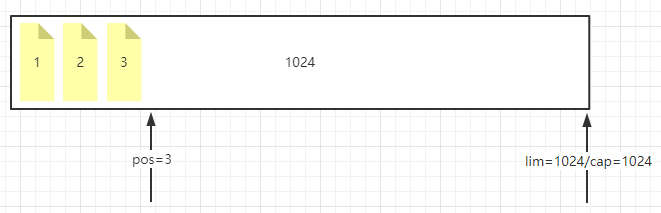
当put进去123三个字符以后:
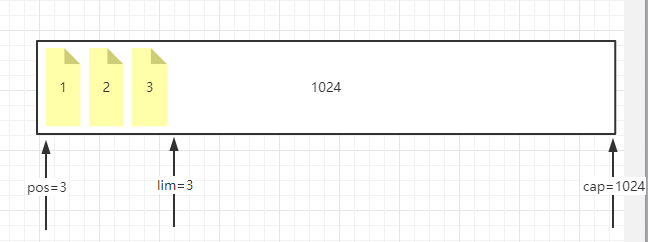
执行flip后,pos会回到原点,lim会到目前写入的位置,这个方法主要用于读取数据:
调用get方法,拿出一个byte,如下图:
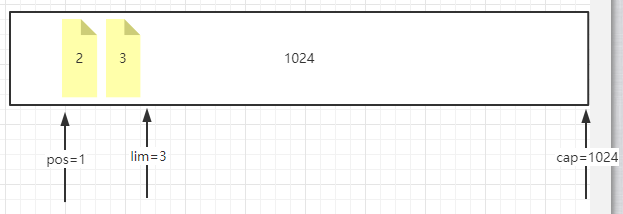
调用compact,会把前面拿掉的1个Byte位置填充:
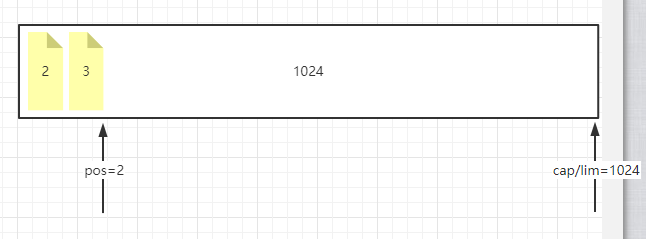
调用clear会让整个内存回到初始分配状态:
ByteBuffer.allocate()与ByteBuffer.allocateDirect()方法的区别
可以参考:
Ron Hitches in his excellent book Java NIO seems to offer what I thought could be a good answer to your question:
Operating systems perform I/O operations on memory areas. These memory areas, as far as the operating system is concerned, are contiguous sequences of bytes. It's no surprise then that only byte buffers are eligible to participate in I/O operations. Also recall that the operating system will directly access the address space of the process, in this case the JVM process, to transfer the data. This means that memory areas that are targets of I/O perations must be contiguous sequences of bytes. In the JVM, an array of bytes may not be stored contiguously in memory, or the Garbage Collector could move it at any time. Arrays are objects in Java, and the way data is stored inside that object could vary from one JVM implementation to another.
For this reason, the notion of a direct buffer was introduced. Direct buffers are intended for interaction with channels and native I/O routines. They make a best effort to store the byte elements in a memory area that a channel can use for direct, or raw, access by using native code to tell the operating system to drain or fill the memory area directly.
Direct byte buffers are usually the best choice for I/O operations. By design, they support the most efficient I/O mechanism available to the JVM. Nondirect byte buffers can be passed to channels, but doing so may incur a performance penalty. It's usually not possible for a nondirect buffer to be the target of a native I/O operation. If you pass a nondirect ByteBuffer object to a channel for write, the channel may implicitly do the following on each call:
Create a temporary direct ByteBuffer object.
Copy the content of the nondirect buffer to the temporary buffer.
Perform the low-level I/O operation using the temporary buffer.
The temporary buffer object goes out of scope and is eventually garbage collected.
This can potentially result in buffer copying and object churn on every I/O, which are exactly the sorts of things we'd like to avoid. However, depending on the implementation, things may not be this bad. The runtime will likely cache and reuse direct buffers or perform other clever tricks to boost throughput. If you're simply creating a buffer for one-time use, the difference is not significant. On the other hand, if you will be using the buffer repeatedly in a high-performance scenario, you're better off allocating direct buffers and reusing them.
Direct buffers are optimal for I/O, but they may be more expensive to create than nondirect byte buffers. The memory used by direct buffers is allocated by calling through to native, operating system-specific code, bypassing the standard JVM heap. Setting up and tearing down direct buffers could be significantly more expensive than heap-resident buffers, depending on the host operating system and JVM implementation. The memory-storage areas of direct buffers are not subject to garbage collection because they are outside the standard JVM heap.
The performance tradeoffs of using direct versus nondirect buffers can vary widely by JVM, operating system, and code design. By allocating memory outside the heap, you may subject your application to additional forces of which the JVM is unaware. When bringing additional moving parts into play, make sure that you're achieving the desired effect. I recommend the old software maxim: first make it work, then make it fast. Don't worry too much about optimization up front; concentrate first on correctness. The JVM implementation may be able to perform buffer caching or other optimizations that will give you the performance you need without a lot of unnecessary effort on your part.
allocate分配方式产生的内存开销是在JVM中的,allocateDirect分配方式产生的开销在JVM之外,以就是系统级的内存分配。系统级别内存的分配比JVM内存的分配要耗时多。所以并非不论什么时候 allocateDirect的操作效率都是很高的。
那什么时候使用堆内存,什么时候使用直接内存?
参考:NIO ByteBuffer 的 allocate 和 allocateDirect 的区别
什么情况下使用DirectByteBuffer(ByteBuffer.allocateDirect(int))?
1、频繁的native IO,即缓冲区 中转 从操作系统获取的文件数据、或者使用缓冲区中转网络数据等
2、不需要经常创建和销毁DirectByteBuffer对象
3、经常复用DirectByteBuffer对象,即经常写入数据到DirectByteBuffer中,然后flip,再读取出来,最后clear。。反复使用该DirectByteBuffer对象。
而且,DirectByteBuffer不会占用堆内存。。也就是不会受到堆大小限制,只在DirectByteBuffer对象被回收后才会释放该缓冲区。
什么情况下使用HeapByteBuffer(ByteBuffer.allocate(int))?
1、同一个HeapByteBuffer对象很少被复用,并且该对象经常是用一次就不用了,此时可以使用HeapByteBuffer,因为创建HeapByteBuffer开销比DirectByteBuffer低。
(但是!!创建所消耗时间差距只是一倍以下的差距,一般一次只会创建一个DirectByteBuffer对象反复使用,而不会创建几百个DirectByteBuffer,
所以在创建一个对象的情况下,HeapByteBuffer并没有什么优势,所以,开发中要使用ByteBuffer时,直接用DirectByteBuffer就行了)
源码
Java IO学习笔记二:DirectByteBuffer与HeapByteBuffer的更多相关文章
- Java IO学习笔记二
Java IO学习笔记二 流的概念 在程序中所有的数据都是以流的方式进行传输或保存的,程序需要数据的时候要使用输入流读取数据,而当程序需要将一些数据保存起来的时候,就要使用输出流完成. 程序中的输入输 ...
- Java IO学习笔记:概念与原理
Java IO学习笔记:概念与原理 一.概念 Java中对文件的操作是以流的方式进行的.流是Java内存中的一组有序数据序列.Java将数据从源(文件.内存.键盘.网络)读入到内存 中,形成了 ...
- Java IO学习笔记总结
Java IO学习笔记总结 前言 前面的八篇文章详细的讲述了Java IO的操作方法,文章列表如下 基本的文件操作 字符流和字节流的操作 InputStreamReader和OutputStreamW ...
- Java IO学习笔记三
Java IO学习笔记三 在整个IO包中,实际上就是分为字节流和字符流,但是除了这两个流之外,还存在了一组字节流-字符流的转换类. OutputStreamWriter:是Writer的子类,将输出的 ...
- Java IO学习笔记一
Java IO学习笔记一 File File是文件和目录路径名的抽象表示形式,总的来说就是java创建删除文件目录的一个类库,但是作用不仅仅于此,详细见官方文档 构造函数 File(File pare ...
- Java IO学习笔记一:为什么带Buffer的比不带Buffer的快
作者:Grey 原文地址:Java IO学习笔记一:为什么带Buffer的比不带Buffer的快 Java中为什么BufferedReader,BufferedWriter要比FileReader 和 ...
- Java IO学习笔记三:MMAP与RandomAccessFile
作者:Grey 原文地址:Java IO学习笔记三:MMAP与RandomAccessFile 关于RandomAccessFile 相较于前面提到的BufferedReader/Writer和Fil ...
- Java IO学习笔记四:Socket基础
作者:Grey 原文地址:Java IO学习笔记四:Socket基础 准备两个Linux实例(安装好jdk1.8),我准备的两个实例的ip地址分别为: io1实例:192.168.205.138 io ...
- Java IO学习笔记六:NIO到多路复用
作者:Grey 原文地址:Java IO学习笔记六:NIO到多路复用 虽然NIO性能上比BIO要好,参考:Java IO学习笔记五:BIO到NIO 但是NIO也有问题,NIO服务端的示例代码中往往会包 ...
随机推荐
- Python爬虫之-动态网页数据抓取
什么是AJAX: AJAX(Asynchronouse JavaScript And XML)异步JavaScript和XML.过在后台与服务器进行少量数据交换,Ajax 可以使网页实现异步更新.这意 ...
- 【python】Leetcode每日一题-存在重复元素3
[python]Leetcode每日一题-存在重复元素3 [题目描述] 给你一个整数数组 nums 和两个整数 k 和 t .请你判断是否存在 两个不同下标 i 和 j,使得 abs(nums[i] ...
- MyBatis Plus 实现多表分页模糊查询
项目中使用springboot+mybatis-plus来实现. 但是之前处理的时候都是一个功能,比如分页查询,条件查询,模糊查询. 这次将这个几个功能合起来就有点头疼,写下这边博客来记录自己碰到的问 ...
- Spark大数据处理框架入门(单机版)
导读 引言 环境准备 安装步骤 1.下载地址 2.开始下载 3.解压spark 4.配置环境变量 5.配置 spark-env.sh 6.启动spark服务 7.测试spark stay hungry ...
- 2021年主流CRM系统盘点
面对市面上五花八门的CRM系统,相信您在选择的时候肯定是一头雾水.哪个CRM系统功能最强大?哪个CRM系统性价比最高?哪个CRM系统最适合企业使用?本篇文章小编将选出几家有代表性的CRM系统,并进行对 ...
- 【转载】Python 代码调试技巧
https://www.ibm.com/developerworks/cn/linux/l-cn-pythondebugger/ Python 代码调试技巧 张 颖2012 年 5 月 03 日发布 ...
- Linux 系统定时任务:crontab,anacron
Linux 系统定时任务:crontab,anacron 一.Cron 服务 1. 启动服务 service cron start 2. 关闭服务 service cron stop 3. 重启服务 ...
- 开机自动挂载本地yum源-20200402-V0.1
开机自动挂载本地yum源-20200402-V0.1 已下载本地iso /home/Kylin-Server-10-mips64-Release-Build04.08-lic-20200313.iso ...
- mysql不停库恢复
环境搭建:yum -y install mysql-co*servervim /etc/my.cnf############server-id=1log-bin=binbinlog-format=RO ...
- 利用S3fs在Amazon EC2 Linux实例上挂载S3存储桶
一.准备!!! 1.使用拥有足够权限的IAM账号登录AWS控制台 2.创建S3存储桶,给存储桶命名如"my-bucket"(如果使用已有存储桶,本步骤可略过) 3.有该S3存储桶访 ...