
Shredding Company(dfs)
| Time Limit: 1000MS | Memory Limit: 10000K | |
| Total Submissions: 3519 | Accepted: 2009 |
Description
1.The shredder takes as input a target number and a sheet of paper with a number written on it.
2.It shreds (or cuts) the sheet into pieces each of which has one or more digits on it.
3.The sum of the numbers written on each piece is the closest possible number to the target number, without going over it.
For example, suppose that the target number is 50, and the sheet of paper has the number 12346. The shredder would cut the sheet into four pieces, where one piece has 1, another has 2, the third has 34, and the fourth has 6. This is because their sum 43 (= 1 + 2 + 34 + 6) is closest to the target number 50 of all possible combinations without going over 50. For example, a combination where the pieces are 1, 23, 4, and 6 is not valid, because the sum of this combination 34 (= 1 + 23 + 4 + 6) is less than the above combination's 43. The combination of 12, 34, and 6 is not valid either, because the sum 52 (= 12 + 34 + 6) is greater than the target number of 50. 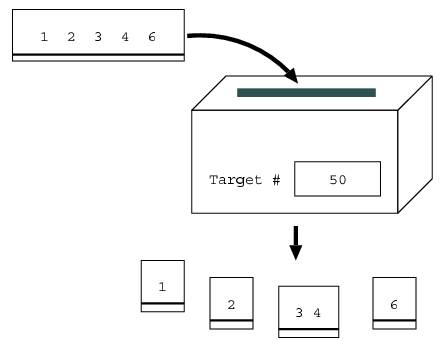
Figure 1. Shredding a sheet of paper having the number 12346 when the target number is 50
There are also three special rules :
1.If the target number is the same as the number on the sheet of paper, then the paper is not cut.
For example, if the target number is 100 and the number on the sheet of paper is also 100, then
the paper is not cut.
2.If it is not possible to make any combination whose sum is less than or equal to the target number, then error is printed on a display. For example, if the target number is 1 and the number on the sheet of paper is 123, it is not possible to make any valid combination, as the combination with the smallest possible sum is 1, 2, 3. The sum for this combination is 6, which is greater than the target number, and thus error is printed.
3.If there is more than one possible combination where the sum is closest to the target number without going over it, then rejected is printed on a display. For example, if the target number is 15, and the number on the sheet of paper is 111, then there are two possible combinations with the highest possible sum of 12: (a) 1 and 11 and (b) 11 and 1; thus rejected is printed. In order to develop such a shredder, you have decided to first make a simple program that would simulate the above characteristics and rules. Given two numbers, where the first is the target number and the second is the number on the sheet of paper to be shredded, you need to figure out how the shredder should "cut up" the second number.
Input
tl num1
t2 num2
...
tn numn
0 0
Each test case consists of the following two positive integers, which are separated by one space : (1) the first integer (ti above) is the target number, (2) the second integer (numi above) is the number that is on the paper to be shredded.
Neither integers may have a 0 as the first digit, e.g., 123 is allowed but 0123 is not. You may assume that both integers are at most 6 digits in length. A line consisting of two zeros signals the end of the input.
Output
sum part1 part2 ...
rejected
error
In the first type, partj and sum have the following meaning :
1.Each partj is a number on one piece of shredded paper. The order of partj corresponds to the order of the original digits on the sheet of paper.
2.sum is the sum of the numbers after being shredded, i.e., sum = part1 + part2 +...
Each number should be separated by one space.
The message error is printed if it is not possible to make any combination, and rejected if there is
more than one possible combination.
No extra characters including spaces are allowed at the beginning of each line, nor at the end of each line.
Sample Input
50 12346

376 144139

927438 927438

18 3312

9 3142

25 1299

111 33333

103 862150

6 1104

0 0
Sample Output
43 1 2 34 6

283 144 139

927438 927438

18 3 3 12

error

21 1 2 9 9

rejected

103 86 2 15 0

rejected
我想说一句又是一道难搞(对本人而言)的dfs,dfs,我该拿你肿么办??

题意:给定一个数和一个字符串,你可以将字符串拆成若干个十进制数,求出这几个十进制数和它们的和,使得这些数的和是小于t的最大的数;

思路:看完题意后一片迷茫,下面转述BU同学的讲解;可以把这个大的过程分成若干个相同的小步骤:每次拿出一个字符串,对这个串只切一次,可以枚举切第一个数、前两个数、前三个数、、、直到一次取完整个串;
     假设此次去了前x个数,把切下来的十进制数保存下来(传到字符串中),那么从第x+1个到结束又是一个新串,再对这个新串做相同操作,当取完所有串后就得到若干个数的和了,最后比较得到一个小于t并且最      接近t的数;
 #include<stdio.h>

 #include<string.h>

 int n,ans;

 char path[],ans_path[];

 int ok;

 void dfs(int sum, char s[])

 {

     int i,j;

     if(sum > n)

         return;

     if(s[] == '\0')//没有剩余的串可以切了,

     {

         if(sum == ans)

             ok = ;

         else if(sum > ans && sum <= n)

         {

             ok = ;

             ans = sum;

             strcpy(ans_path,path);

         }

         return;

     }

     //还有串可以切

     int len = strlen(s);

     for(i = ; i <= len; i++)//枚举切前一个数,前两个数,前三个数、、、

     {

         int x = s[]-'';

         for(j = ; j < i; j++)

             x = x* + s[j]-'';

         char tmp[];

         int  pathlen = strlen(path);

         sprintf(tmp," %d",x);//将新得到的数存入字符串以便输出

         strcat(path,tmp);

         dfs(sum+x,&s[i]);//继续切剩余的串

         path[pathlen] = '\0';

     }

 }

 int main()

 {

     char s[];

     while(scanf("%d %s",&n,s) != EOF)

     {

         if(n ==  && s[] == '')

             break;

         int len = strlen(s);

         ans = -;

         ok = ;

         path[] = '\0';

         for(int i = ; i <= len; i++)

         {

             int x = s[]-'';

             for(int j = ; j < i; j++)

                 x = x*+s[j]-'';

             sprintf(path,"%d",x);

             dfs(x,&s[i]);

         }

         if(ans == -)

             printf("error");

         else if(ok)

             printf("rejected");

         else printf("%d %s",ans,ans_path);

         printf("\n");

     }

     return ;

 }
Shredding Company(dfs)的更多相关文章
- LeetCode Subsets II (DFS)
题意: 给一个集合,有n个可能相同的元素,求出所有的子集(包括空集,但是不能重复). 思路: 看这个就差不多了.LEETCODE SUBSETS (DFS) class Solution { publ ...
- LeetCode Subsets (DFS)
题意: 给一个集合,有n个互不相同的元素,求出所有的子集(包括空集,但是不能重复). 思路: DFS方法:由于集合中的元素是不可能出现相同的,所以不用解决相同的元素而导致重复统计. class Sol ...
- HDU 2553 N皇后问题(dfs)
N皇后问题 Time Limit:1000MS Memory Limit:32768KB 64bit IO Format:%I64d & %I64u Description 在 ...
- 深搜(DFS)广搜(BFS)详解
图的深搜与广搜 一.介绍: p { margin-bottom: 0.25cm; direction: ltr; line-height: 120%; text-align: justify; orp ...
- 【算法导论】图的深度优先搜索遍历(DFS)
关于图的存储在上一篇文章中已经讲述,在这里不在赘述.下面我们介绍图的深度优先搜索遍历(DFS). 深度优先搜索遍历实在访问了顶点vi后,访问vi的一个邻接点vj:访问vj之后,又访问vj的一个邻接点, ...
- 深度优先搜索(DFS)与广度优先搜索(BFS)的Java实现
1.基础部分 在图中实现最基本的操作之一就是搜索从一个指定顶点可以到达哪些顶点,比如从武汉出发的高铁可以到达哪些城市,一些城市可以直达,一些城市不能直达.现在有一份全国高铁模拟图,要从某个城市(顶点) ...
- 深度优先搜索(DFS)和广度优先搜索(BFS)
深度优先搜索(DFS) 广度优先搜索(BFS) 1.介绍 广度优先搜索(BFS)是图的另一种遍历方式,与DFS相对,是以广度优先进行搜索.简言之就是先访问图的顶点,然后广度优先访问其邻接点,然后再依次 ...
- 图的 储存 深度优先(DFS)广度优先(BFS)遍历
图遍历的概念: 从图中某顶点出发访遍图中每个顶点,且每个顶点仅访问一次,此过程称为图的遍历(Traversing Graph).图的遍历算法是求解图的连通性问题.拓扑排序和求关键路径等算法的基础.图的 ...
- 搜索——深度优先搜索(DFS)
设想我们现在身处一个巨大的迷宫中,我们只能自己想办法走出去,下面是一种看上去很盲目但实际上会很有效的方法. 以当前所在位置为起点,沿着一条路向前走,当碰到岔道口时,选择其中一个岔路前进.如果选择的这个 ...
随机推荐
- gamit10.6问题汇总
1.在处理精密星历时,提示:old version of file not supported (name svnav.dat) 解决办法:在gamit10.5中不会出现这个问题,10.6中的官方文档 ...
- weex-toolkit打包
需要2.15.1及以上的npm支持 运行终端,查看版本 npm --version 如果版本低于2.15.1,需要更新 sudo npm install -g npm 安装weex-toolkit n ...
- instanceof的用法①
public class typeof1{ private String a="zzw"; public void instance(){ if(a instanceof Stri ...
- 玩javaweb的web.xml编译路径
有时候能够碰到这样的情况 缓存就是 清不掉 那就可以去寻找编译路径了 <Context docBase="E:\java-workspace\eigyo_com405" pa ...
- WPF Binding值转换器ValueConverter使用简介(二)-IMultiValueConverter
注: 需要继承IMultiValueConverter接口,接口使用和IValueConverter逻辑相同. 一.MultiBinding+Converter 多值绑定及多值转换实例 当纵向流量大于 ...
- PropertyPlaceholderConfigurer的用法(使用spring提供的类读取数据库配置信息.properties)
http://www.cnblogs.com/wanggd/archive/2013/07/04/3172042.html(写的很好)
- Notification和KVO有什么不同
Notification是推送通知,我们可以建立一个通知中心,存放创建多个通知,在不同的地方在需要的时候push调用和KVO不同的是,KVO是键值观察,只能观察一个值,这就是区别
- jQuery 效果- 动画
jQuery animate() 方法允许您创建自定义的动画. jQuery 动画实例 jQuery jQuery 动画 - animate() 方法 jQuery animate() 方法用于创建自 ...
- wpf 自定义RadioButton控件样式
实现的效果为: 我感觉来自定义RadioButton样式和定义button空间的样式差不多,只是类型不同而已. 接下来分析一下样式代码: <!--自定义单选按钮样式--> & ...
- IO流基础
IO流,也称为数据流,用于处理设备之间的数据传输. JAVA对数据的操作就是通过流的方式,而流分为两种:字符流,字节流 字符流: 可以内部制定码表,处理文字很方便,字符流里的基类是Reader,Wri ...