
杨其菊201771010134《面向对象程序设计(java)》第四周学习总结
《面向对象程序设计(java)》 第四周学习总结
第一部分:理论知识
1.类与对象
a.类(class)是构造对象的模板或蓝图。由类构造对象的过程称为创建类的实例;
java中类声明的格式如下:
[类修饰符] class 类名 [extends 父类名称] [implements 接口名称列表]
{
变量定义及初始化;
方法定义及方法体;
}
public:类的访问控制符。Java类具有两种访问访问修饰符:public和default。public允许类具有完全开放的可见性,所有其他类都可以访问它,省略public,则为default,即只有位于同一个包(本质上就是文件夹)中的类可以访问该类。
abstract指明该类为一个抽象类,说明该类是一个定义不完全的类,需要被继承,才能实例化创建对象。
b.对象:即数据,对象有三个特性——1.行为 2.状态 3.标识。
c、方法,变量.
d.类是对象,事物的描述和抽象,是具有相同属性和行为的对象集合。对象则是该类事物的实例。
2.预定义类 、API
Math类、String类、math类、Scanner类、LocalDate类
3.自定义类
4.静态域和静态方法 绝大多数面向对象程序设计语言中,静态域被称为类域。如果将域定义为static,每个类中只有一个这样的域。而每个对象对于所有的实例域却都有自己的一份拷贝。
构造器、更改器方法、访问器方法,静态方法
5.方法参数
6.包
7.文档注释技术
第二部分:实验部分
1、实验目的与要求
(1) 理解用户自定义类的定义;
(2) 掌握对象的声明;
(3) 学会使用构造函数初始化对象;
(4) 使用类属性与方法的使用掌握使用;
(5) 掌握package和import语句的用途。
2、实验内容和步骤
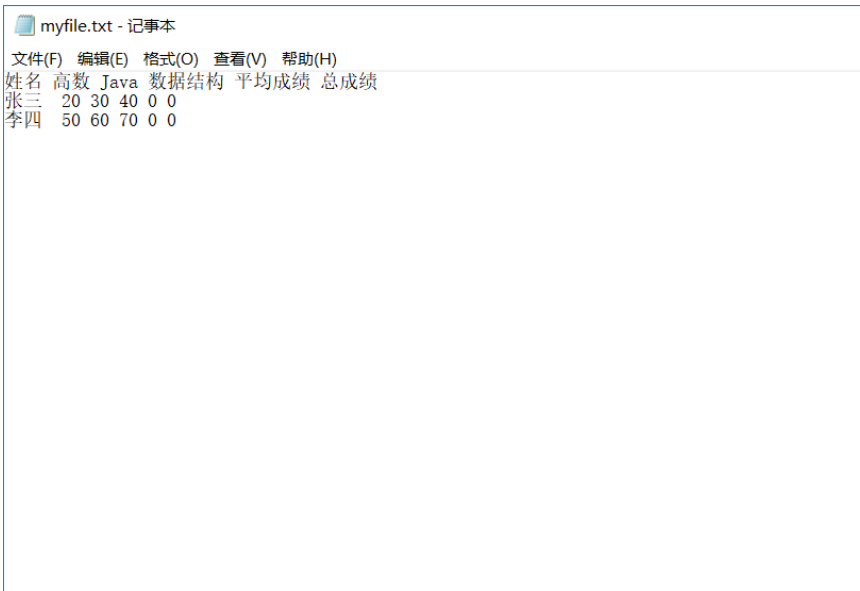
实验1 测试以下程序,掌握文件输入输出程序设计技术(文件输入输出,教材61-62).
 import java.io.*;

 import java.util.*;

 public class FileWriteReadTest {

     public static void main(String[] args) throws IOException{

         //写入文件演示

         PrintWriter out = new PrintWriter("myfile.txt");

         out.println("姓名 高数 Java 数据结构 平均成绩 总成绩");

         out.println("张三 20 30 40 0 0");

         out.println("李四 50 60 70 0 0");

         out.close();//输出完毕,需要close

         //读入文件演示

         Scanner in = new Scanner(new File("myfile.txt"));//为myfile.txt这个File创建一个扫描器in

         int number = 1;//行号

         System.out.println(in.nextLine());

         while(in.hasNextLine()){//判断扫描器是否还有下一行未读取,该循环把文件的每一行都读出

             String line = in.nextLine();//读出myfile.txt的下一行

             System.out.print("第"+(++number)+"行的内容: ");

             Scanner linescanner = new Scanner(line);//行内容建立扫描器

             linescanner.useDelimiter(" ");//使用空格作为分隔符

             String name = linescanner.next();

             String math = linescanner.next();

             String java = linescanner.next();

             String ds = linescanner.next();

             String avg = linescanner.next();

             String total = linescanner.next();

             System.out.println("name="+name+"  math="+math+"  java="+java+"  ds="+ds+"  avg"+avg+"  total="+total);

         }

         in.close();//读入完毕,最后需要对其进行close。

     }

 }
测试结果截图如下:
实验2 导入第4章示例程序并测试。
测试程序1:
l 编辑、编译、调试运行程序4-2(教材104页);
l 结合程序运行结果,掌握类的定义与类对象的用法,并在程序代码中添加类与对象知识应用的注释;
l 尝试在项目中编辑两个类文件(Employee.java、 EmployeeTest.java ),编译并运行程序。
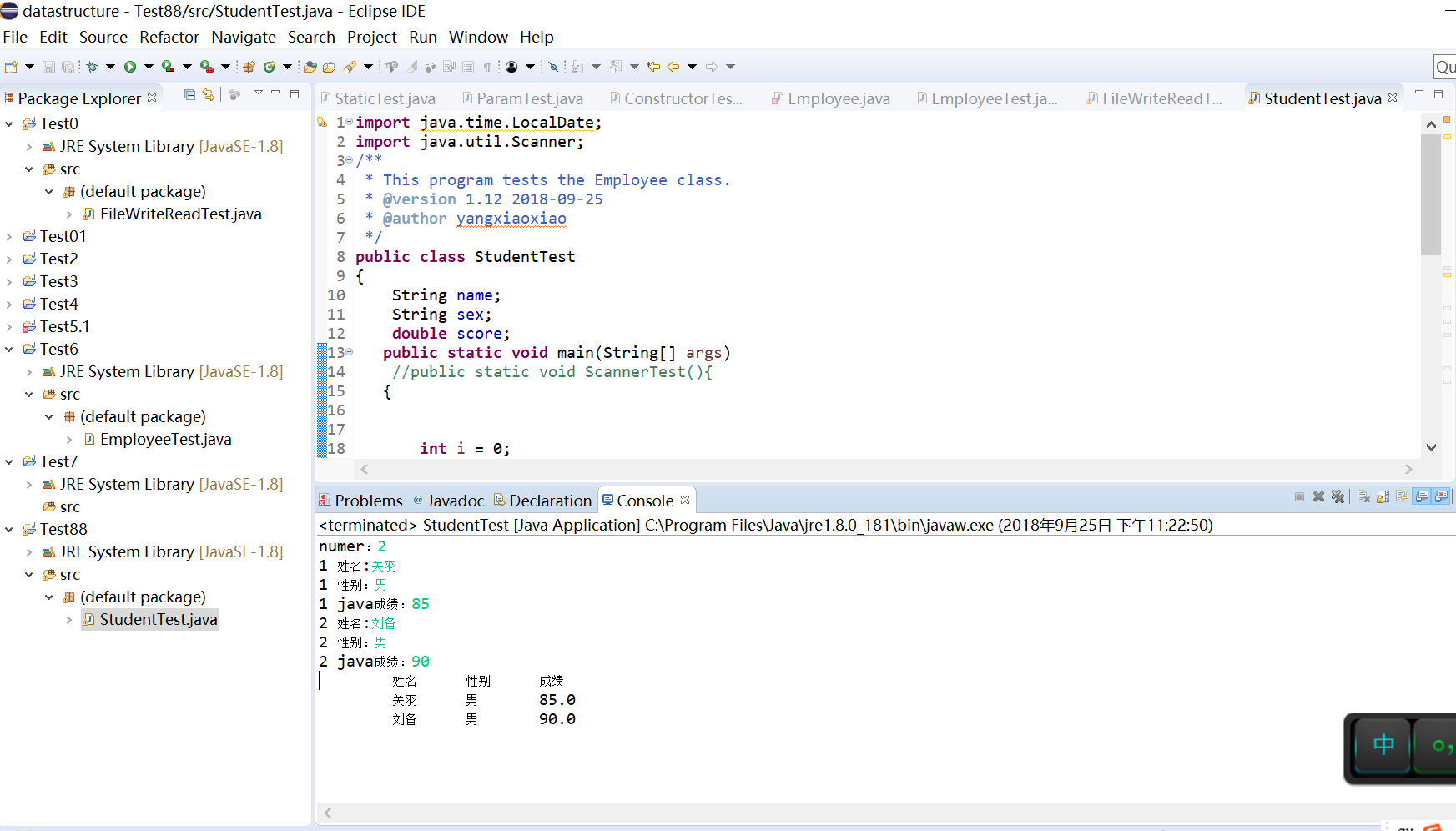
l 参考教材104页EmployeeTest.java,设计StudentTest.java,定义Student类,包含name(姓名)、sex(性别)、javascore(java成绩)三个字段,编写程序,从键盘输入学生人数,输入学生信息,并按以下表头输出学生信息表:
姓名 性别 java成绩
(1)源代码:
(2)Employee.java、 EmployeeTest.java 运行结果截图:
 import java.time.*;

 /**

  * This program tests the Employee class.

  * @version 1.12 2015-05-08

  * @author Cay Horstmann

  */

 public class EmployeeTest

 {

    public static void main(String[] args)

    {

       // fill the staff array with three Employee objects

       Employee[] staff = new Employee[3];

       staff[0] = new Employee("Carl Cracker", 75000, 1987, 12, 15);

       staff[1] = new Employee("Harry Hacker", 50000, 1989, 10, 1);

       staff[2] = new Employee("Tony Tester", 40000, 1990, 3, 15);

       // raise everyone's salary by 5%

       for (Employee e : staff)

          e.raiseSalary(5);

       // print out information about all Employee objects

       for (Employee e : staff)

          System.out.println("name=" + e.getName() + ",salary=" + e.getSalary() + ",hireDay="

                + e.getHireDay());

    }

 }

 class Employee

 {

    private String name;

    private double salary;

    private LocalDate hireDay;

    public Employee(String n, double s, int year, int month, int day)

    {

       name = n;

       salary = s;

       hireDay = LocalDate.of(year, month, day);

    }

    public String getName()

    {

       return name;

    }

    public double getSalary()

    {

       return salary;

    }

    public LocalDate getHireDay()

    {

       return hireDay;

    }

    public void raiseSalary(double byPercent)

    {

       double raise = salary * byPercent / 100;

       salary += raise;

    }

 }

(3)EmployeeTest.java源代码及运行结果截图如下
 import java.time.LocalDate;

 import java.util.Scanner;

 /**

  * This program tests the Employee class.

  * @version 1.12 2018-09-25

  * @author yangxiaoxiao

  */

 public class StudentTest

 {

     String name;

     String sex;

     double score;

    public static void main(String[] args)

     //public static void ScannerTest(){

    {

        int i = 0;

         System.out.print("numer:");

         Scanner sc= new Scanner(System.in);

        int number = sc.nextInt();

        StudentTest Stu[] = new StudentTest[number];

         for (i = 0; i < Stu.length; i++) {

             Stu[i] = new StudentTest();

             System.out.print( (i + 1)+" "+"姓名:" );

             Stu[i].name = sc.next();

             System.out.print( (i + 1)+" " +"性别:");

             Stu[i].sex = sc.next();

             System.out.print( (i + 1)+" " +"java成绩:");

             Stu[i].score = sc.nextDouble();

         }

       System.out.println("\t姓名\t性别\t成绩");

         for (StudentTest StudentTest : Stu) {

             System.out.println("\t" + StudentTest.name+ "\t" + StudentTest.sex + "\t" + StudentTest.score);

         }

    }

 }
测试程序2:
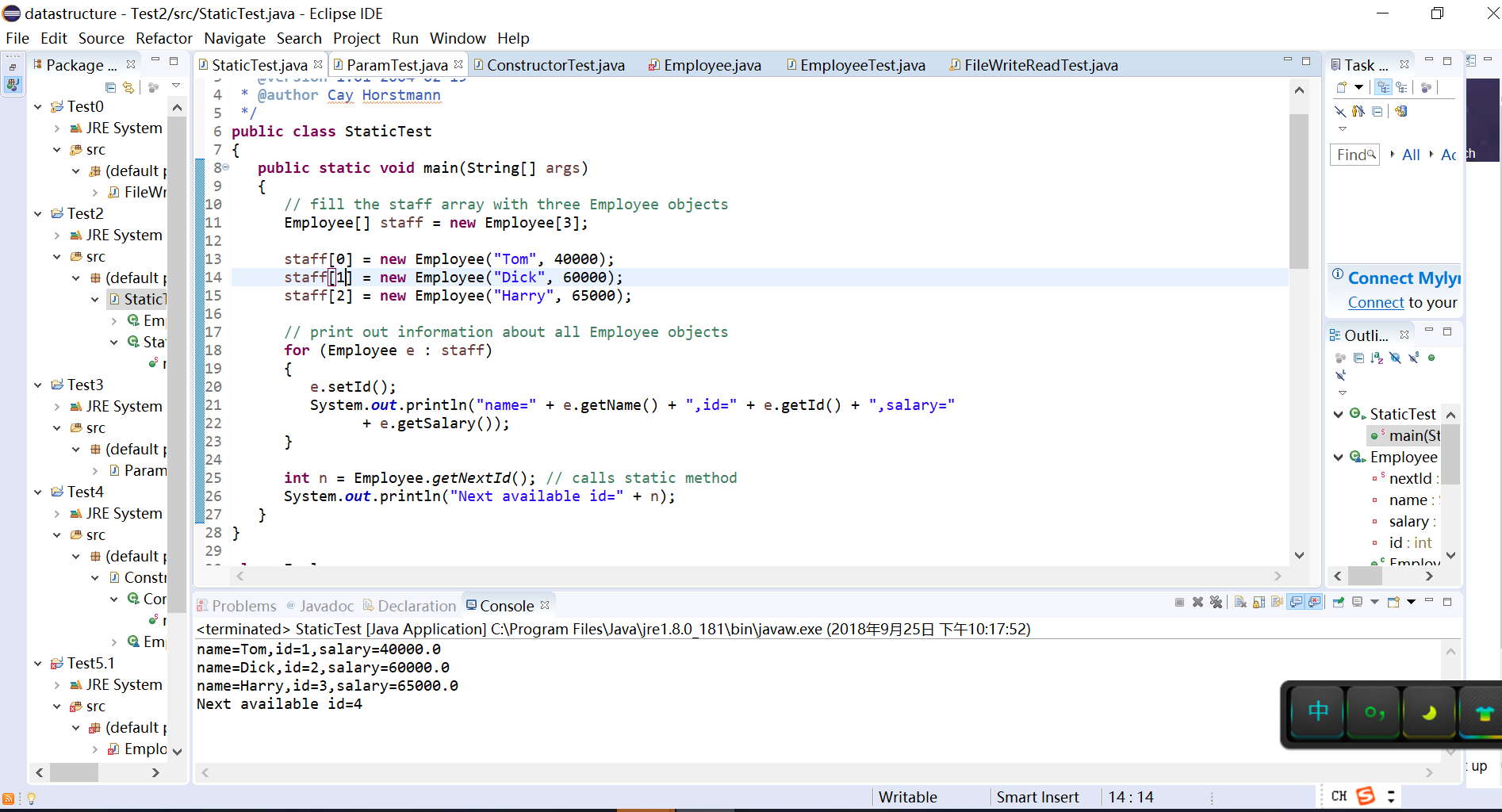
l 编辑、编译、调试运行程序4-3(教材116);
l 结合程序运行结果,理解程序代码,掌握静态域(netxtId)与静态方法(getNextId)的用法,在相关代码后添加注释;
理解Java单元(类)测试的技巧。
 /**

  * This program demonstrates static methods.

  * @version 1.01 2004-02-19

  * @author Cay Horstmann

  */

 public class StaticTest

 {

    public static void main(String[] args)

    {

       // fill the staff array with three Employee objects

       Employee[] staff = new Employee[3];

       staff[0] = new Employee("Tom", 40000);

       staff[1] = new Employee("Dick", 60000);

       staff[2] = new Employee("Harry", 65000);

       // print out information about all Employee objects

       for (Employee e : staff)

       {

          e.setId();

          System.out.println("name=" + e.getName() + ",id=" + e.getId() + ",salary="

                + e.getSalary());

       }

       int n = Employee.getNextId(); // calls static method

       System.out.println("Next available id=" + n);

    }

 }

 class Employee

 {

    private static int nextId = 1;

    private String name;

    private double salary;

    private int id;

    public Employee(String n, double s)

    {

       name = n;

       salary = s;

       id = 0;

    }

    public String getName()

    {

       return name;

    }

    public double getSalary()

    {

       return salary;

    }

    public int getId()

    {

       return id;

    }

    public void setId()

    {

       id = nextId; // set id to next available id

       nextId++;

    }

    public static int getNextId()

    {

       return nextId; // returns static field

    }

    public static void main(String[] args) // unit test

    {

       Employee e = new Employee("Harry", 50000);

       System.out.println(e.getName() + " " + e.getSalary());

    }

 }
测试程序
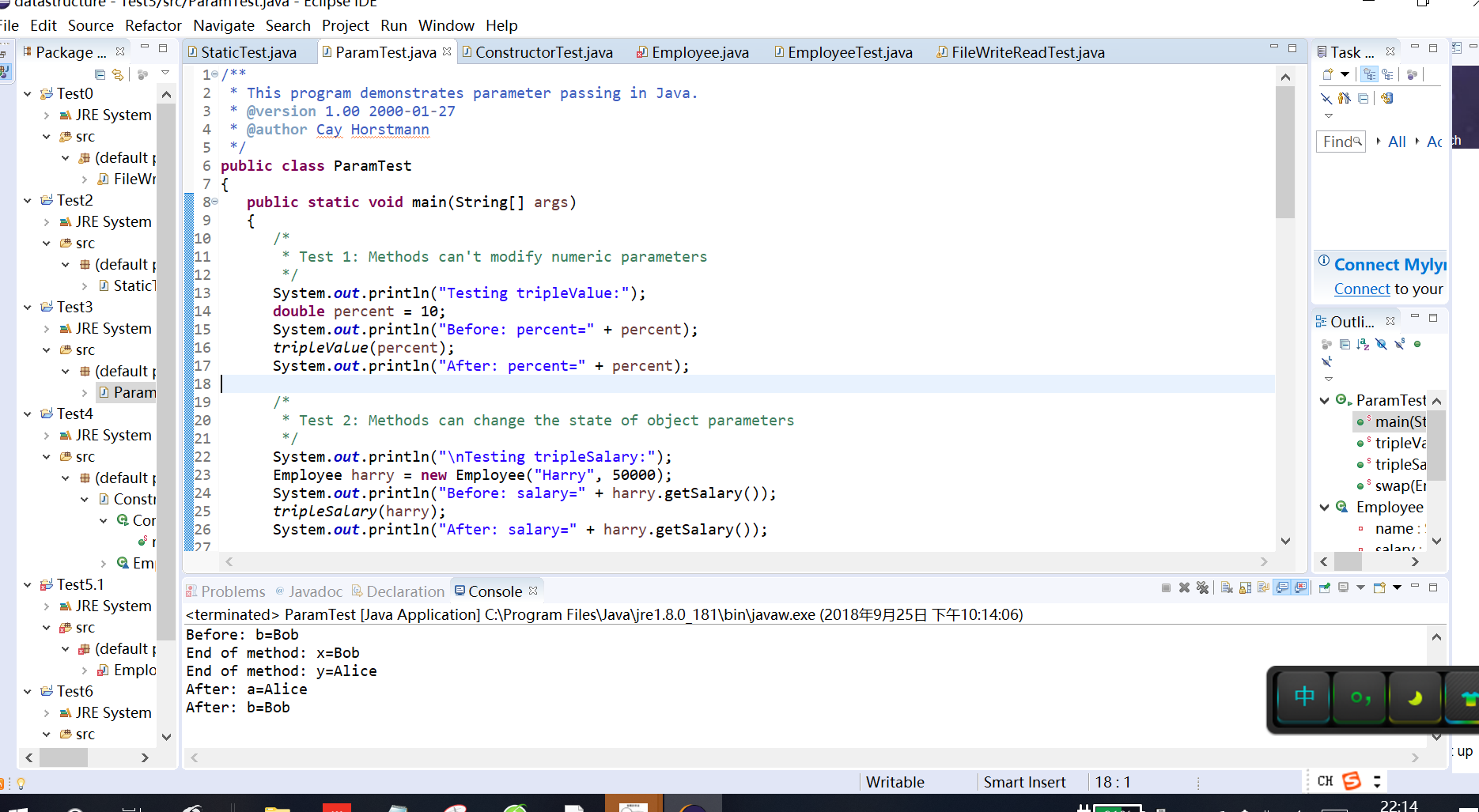
l 编辑、编译、调试运行程序4-4(教材121);
l 结合程序运行结果,理解程序代码,掌握掌握Java方法参数的用法,在相关代码后添加注释;
 /**

  * This program demonstrates parameter passing in Java.

  * @version 1.00 2000-01-27

  * @author Cay Horstmann

  */

 public class ParamTest

 {

    public static void main(String[] args)

    {

       /*

        * Test 1: Methods can't modify numeric parameters

        */

       System.out.println("Testing tripleValue:");

       double percent = 10;

       System.out.println("Before: percent=" + percent);

       tripleValue(percent);

       System.out.println("After: percent=" + percent);

       /*

        * Test 2: Methods can change the state of object parameters

        */

       System.out.println("\nTesting tripleSalary:");

       Employee harry = new Employee("Harry", 50000);

       System.out.println("Before: salary=" + harry.getSalary());

       tripleSalary(harry);

       System.out.println("After: salary=" + harry.getSalary());

       /*

        * Test 3: Methods can't attach new objects to object parameters

        */

       System.out.println("\nTesting swap:");

       Employee a = new Employee("Alice", 70000);

       Employee b = new Employee("Bob", 60000);

       System.out.println("Before: a=" + a.getName());

       System.out.println("Before: b=" + b.getName());

       swap(a, b);

       System.out.println("After: a=" + a.getName());

       System.out.println("After: b=" + b.getName());

    }

    public static void tripleValue(double x) // doesn't work

    {

       x = 3 * x;

       System.out.println("End of method: x=" + x);

    }

    public static void tripleSalary(Employee x) // works

    {

       x.raiseSalary(200);

       System.out.println("End of method: salary=" + x.getSalary());

    }

    public static void swap(Employee x, Employee y)

    {

       Employee temp = x;

       x = y;

       y = temp;

       System.out.println("End of method: x=" + x.getName());

       System.out.println("End of method: y=" + y.getName());

    }

 }

 class Employee // simplified Employee class

 {

    private String name;

    private double salary;

    public Employee(String n, double s)

    {

       name = n;

       salary = s;

    }

    public String getName()

    {

       return name;

    }

    public double getSalary()

    {

       return salary;

    }

    public void raiseSalary(double byPercent)

    {

       double raise = salary * byPercent / 100;

       salary += raise;

    }

 }
测试程序
l 编辑、编译、调试运行程序4-5(教材129);
l 结合程序运行结果,理解程序代码,掌握Java用户自定义类的用法,掌握对象构造方法及对象使用方法,在相关代码后添加注释。
 import java.util.*;

 /**

 * This program demonstrates object construction.

 * @version 1.01 2004-02-19

 * @author Cay Horstmann

 */

 public class ConstructorTest

 {

 public static void main(String[] args)

 {

 // fill the staff array with three Employee objects

 Employee[] staff = new Employee[3];

 staff[0] = new Employee("Harry", 40000);

 staff[1] = new Employee(60000);

 staff[2] = new Employee();

 // print out information about all Employee objects

 for (Employee e : staff)

 System.out.println("name=" + e.getName() + ",id=" + e.getId() + ",salary="

 + e.getSalary());

 }

 }

 class Employee

 {

 private static int nextId;

 private int id;

 private String name = ""; // instance field initialization

 private double salary;

 // static initialization block

 static

 {

 Random generator = new Random();

 // set nextId to a random number between 0 and 9999

 nextId = generator.nextInt(10000);

 }

 // object initialization block

 {

 id = nextId;

 nextId++;

 }

 // three overloaded constructors

 public Employee(String n, double s)

 {

 name = n;

 salary = s;

 }

 public Employee(double s)

 {

 // calls the Employee(String, double) constructor

 this("Employee #" + nextId, s);

 }

 // the default constructor

 public Employee()

 {

 // name initialized to ""--see above

 // salary not explicitly set--initialized to 0

 // id initialized in initialization block

 }

 public String getName()

 {

 return name;

 }

 public double getSalary()

 {

 return salary;

 }

 public int getId()

 {

 return id;

 }

 }
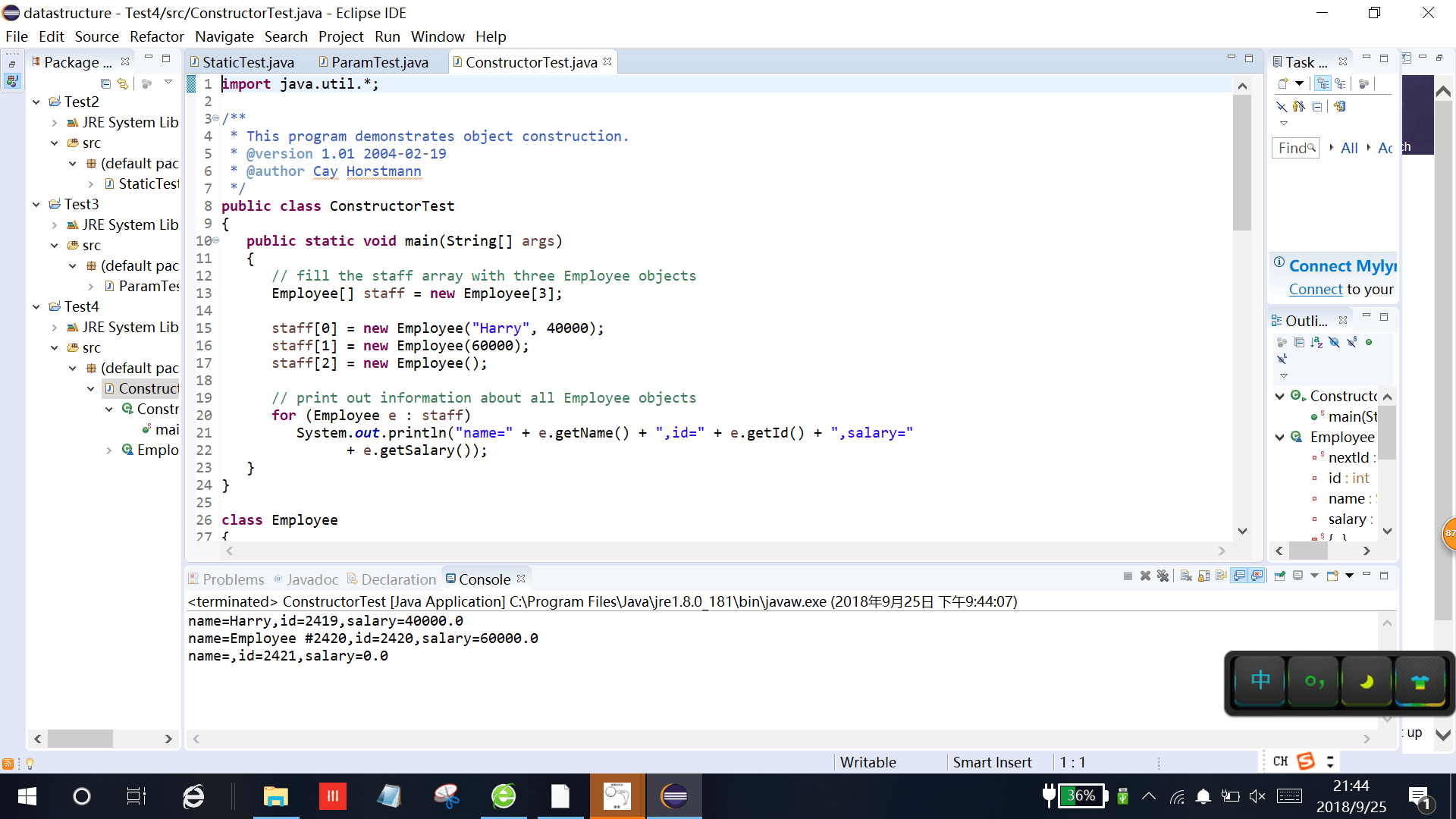
测试程序5:
l 编辑、编译、调试运行程序4-6、4-7(教材135);
结合程序运行结果,理解程序代码,掌握Java包的定义及用法,在相关代码后添加注释;
4-6
 import com.horstmann.corejava.*;

 // the Employee class is defined in that package

 import static java.lang.System.*;

 /**

  * This program demonstrates the use of packages.

  * @version 1.11 2004-02-19

  * @author Cay Horstmann

  */

 public class PackageTest

 {

    public static void main(String[] args)

    {

       // because of the import statement, we don't have to use

       // com.horstmann.corejava.Employee here

       Employee harry = new Employee("Harry Hacker", 50000, 1989, 10, 1);

       harry.raiseSalary(5);

       // because of the static import statement, we don't have to use System.out here

       out.println("name=" + harry.getName() + ",salary=" + harry.getSalary());

    }

 }
4-7
 package com.horstmann.corejava;

 // the classes in this file are part of this package

 import java.time.*;

 // import statements come after the package statement

 /**

  * @version 1.11 2015-05-08

  * @author Cay Horstmann

  */

 public class Employee

 {

    private String name;

    private double salary;

    private LocalDate hireDay;

    public Employee(String name, double salary, int year, int month, int day)

    {

       this.name = name;

       this.salary = salary;

       hireDay = LocalDate.of(year, month, day);

    }

    public String getName()

    {

       return name;

    }

    public double getSalary()

    {

       return salary;

    }

    public LocalDate getHireDay()

    {

       return hireDay;

    }

    public void raiseSalary(double byPercent)

    {

       double raise = salary * byPercent / 100;

       salary += raise;

    }

 }
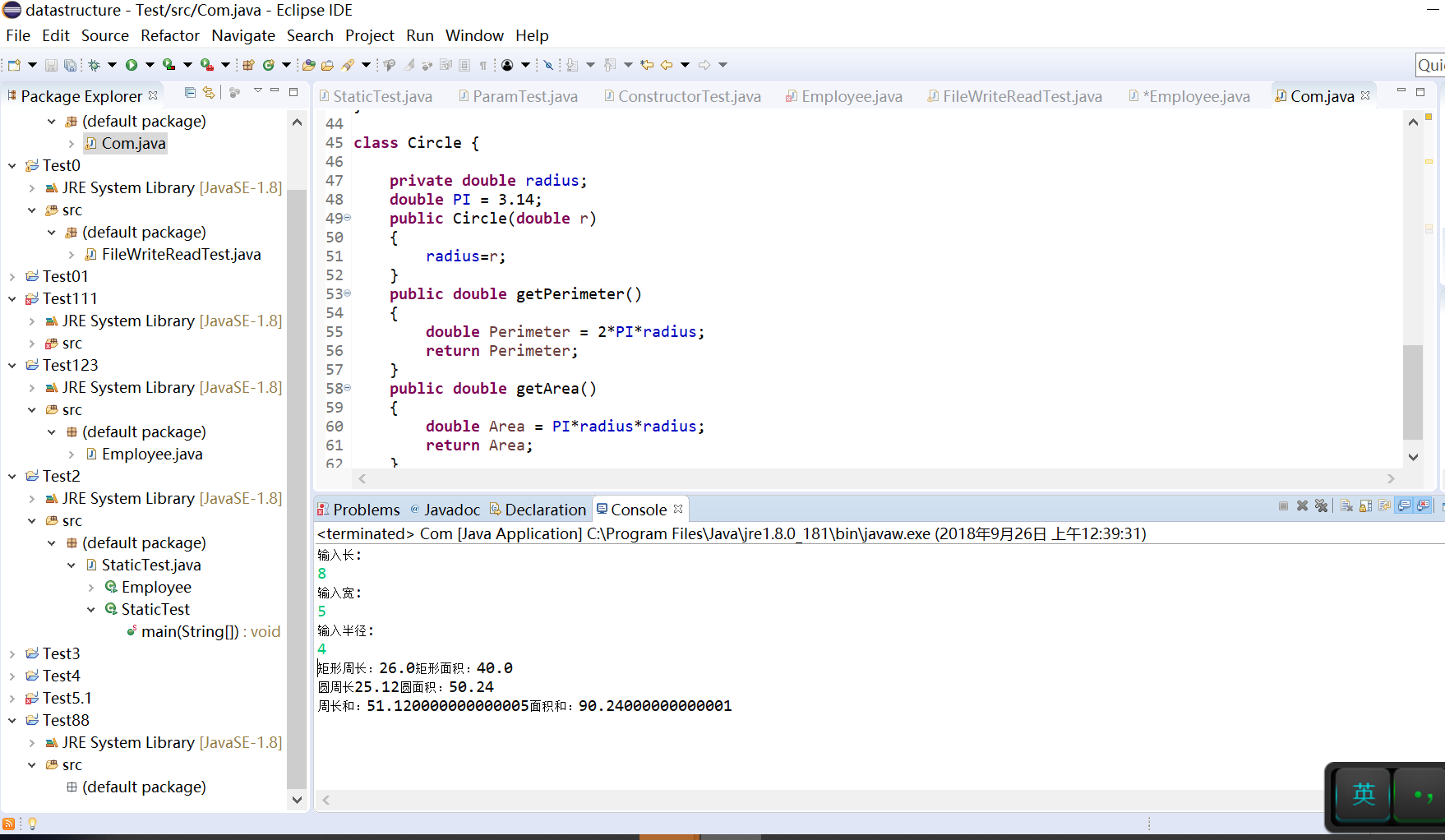
实验3 编写长方形类Rectangle与圆形类Circle,其中Rectangle类设置私有属性:width,length;Circle类设置私有属性radius。编写Rectangle类的带参构造函数Rectangle(int width,int length), Circle类的带参构造函数Circle(int radius),编写两个类的toString方法(Eclipse可自动生成)。上述2个类均定义以下方法:
求周长的方法public int getPerimeter()
求面积的方法public int getArea()
在main方法中完成以下任务:
(1) 输入1行长与宽,创建一个Rectangle对象;
(2) 输入1行半径,创建一个Circle对象;
(3) 将两个对象的周长加总输出,将两个对象的面积加总输出。
 import java.util.*;

 public class Com {

     public static void main(String[] args) {

         Scanner in = new Scanner(System.in);

         System.out.println("输入长:");

         double  length = in.nextDouble();

         System.out.println("输入宽:");

         double  width = in.nextDouble();

         System.out.println("输入半径:");

         double  radius = in.nextDouble();

         Rectangle a=new Rectangle(length,width);

         Circle    b=new Circle(radius);

         System.out.println("矩形周长:"+a.getPerimeter()+"矩形面积:"+a.getArea());

         System.out.println("圆周长"+b.getPerimeter()+"圆面积:"+b.getArea());

         double x = a.getPerimeter()+b.getPerimeter();

         double  y = a.getArea()+b.getArea();

         System.out.println("周长和:"+x+"面积和:"+y);

     }

 }

 class Rectangle {

     private double width;

     private double length;

     public Rectangle(double w,double l)

     {

         width=w;

         length=l;

     }

     public double getPerimeter()

     {

         double Perimeter = (width+length)*2;

         return Perimeter;

     }

     public double getArea()

     {

         double Area = width*length;

         return Area;

     }

 }

 class Circle {

     private double radius;

     double PI = 3.14;

     public Circle(double r)

     {

         radius=r;

     }

     public double getPerimeter()

     {

         double Perimeter = 2*PI*radius;

         return Perimeter;

     }

     public double getArea()

     {

         double Area = PI*radius*radius;

         return Area;

     }

 }
第三部分:实验总结
通过这个周的学习,学习了面向对象程序设计的一些基础知识,类、对象、对象的三个特征(行为、状态和标识),明确了创建类、构造和初始化对象的格式、以及熟悉预定义类API的使用。学学习了一些常用的类:Math类、String类、Scanner类、LocalDate类等。在课上课下的阅读程序中,以及编写程序时,有些疑惑,不清楚代码语句的作用和和如何去编写代码,看懂不等于会!
杨其菊201771010134《面向对象程序设计(java)》第四周学习总结的更多相关文章
- 201771010134杨其菊《面向对象程序设计java》第十周学习总结
第8章泛型程序设计学习总结 第一部分:理论知识 主要内容: 什么是泛型程序设计 泛型类的声明及实例化的方法 泛型方法的定义 ...
- 201771010134杨其菊《面向对象程序设计java》第九周学习总结
第九周学习总结 第一部分:理论知识 异常.断言和调试.日志 1.捕获 ...
- 201771010134杨其菊《面向对象程序设计java》第八周学习总结
第八周学习总结 第一部分:理论知识 一.接口.lambda和内部类: Comparator与comparable接口: 1.comparable接口的方法是compareTo,只有一个参数:comp ...
- 201771010134杨其菊《面向对象程序设计java》第十二周学习总结
第十二周学习总结 第一部分:理论知识 内容概要: AWT与Swing简介:框架的创建:图形程序设计: 显示图像: 1.AWT组件: 2.Swing 组件层次关系 3 .AWT与Swing的关系:大部分 ...
- 201771010134杨其菊《面向对象程序设计java》第七周学习总结
第七周学习总结 第一部分:理论知识 1.继承是面向对象程序设计(Object Oriented Programming-OOP)中软件重用的关键技术.继承机制使用已经定义的类作为基础建立新的类定义,新 ...
- 201771010134杨其菊《面向对象程序设计(java)》第十六周学习总结
第十六周学习总结 第一部分:理论知识 1. 程序是一段静态的代码,它是应用程序执行的蓝本.进程是程序的一次动态执行,它对应了从代码加载.执行至执行完毕的一个完整过程.操作系统为每个进程分配一段独立的内 ...
- 201771010134杨其菊《面向对象程序设计(java)》第十七周学习总结
第十七周学习总结 1. 程序是一段静态的代码,它是应用程序执行的蓝本.进程是程序的一次动态执行,它对应了从代码加载.执行至执行完毕的一个完整过程.操作系统为每个进程分配一段独立的内存空间和系统资源,包 ...
- 201771010134杨其菊《面向对象程序设计(java)》第十五周学习
第十五周学习总结 第一部分:理论知识 JAR文件: 应用程序首选项存储: Java Web Start JAR文件: 1.Java程序的打包:程序编译完成后,程序员将.class文件压缩打包为.jar ...
- 201771010134杨其菊《面向对象程序设计(java)》第十三周学习总结
第十三周学习总结 第一部分:理论知识 第11章 事件处理(事件处理基础; 动作; 鼠标事件;AWT事件继承层次) 1. 事件源(event source):能够产生事件的对象都可 以成为事件源,如文本 ...
- 杨其菊201771010134《面向对象程序设计(java)》第六周学习总结
<面向对象程序设计(java)>第六周学习总结 第一部分:理论知识 1)类.超类和子类2)Object:所有类的超类 3)泛型数组列表4)对象包装器和自动打包 5)参数数量可变的方法 6) ...
随机推荐
- 如何在myeclipse中安装spket插件
在web开发中,经常会遇到自动提示,比如jquery.extjs等,在myeclipse写这些代码时需要自动提示,就需要安装spket插件,具体方法见下面 工具/原料 myeclipse spke ...
- 第六届蓝桥杯省赛 java三羊献瑞
将文字看作一个个变量.根据一开始确定的文字的值进行暴力循环. 三羊献瑞 观察下面的加法算式: 祥 瑞 生 辉 + 三 羊 献 瑞------------------- 三 羊 生 瑞 气 (如果有对齐 ...
- sequelize的get/post方法例子
定义两个model,一个给get的,一个给post的 var Sequelize = require('sequelize'); const DeviceNos = sequelize.define( ...
- 变式配置简介 VARIANT CONFIGURATION
变式物料类型KMAT; ITEM CATEGORY GROUP: main item 0002 sub item 0004 strategy group:25 requirement type: ke ...
- asp.net web api 权限验证的方法
思路:客户端使用header或者form讲验证信息传入api,在权限验证过滤中进行处理,代码示例: 定义过滤器 public class ApiFilter1 : System.Web.Http.Au ...
- Problem B: 取石子
转换成一个数在(0,X + Y)的加减问题 考虑一种使用线段树处理的方法, 维护前缀最大值, 前缀最小值, 前缀和, 然后查询的时候先询问右区间是否会同时碰到上下界, 会的话左区间无用直接递归右区间, ...
- js获取浏览器内核判断终端(是QQ打开还是QQ浏览器打开)
var browser ={ versions: function() { var u = navigator.userAgent, var ua = navigator.userAgent.toLo ...
- windows清空电脑的DNS缓存
清空电脑的DNS缓存 按"Win+R"系统热键打开"运行"窗口,进入terminal终端 输入"ipconfig /flushdns"命令后 ...
- CentOS 7 实现ssh无密码登录
cd ~ 进入根目录. (使用ls -a或者 ls -la 能够看到当前文件夹下的所有文件包含隐藏文件夹等) 我们首先使用ls -la 发现并没有.ssh的文件夹存在. 在终端输入 ssh lo ...
- python class的创建
def f(): class a(): a=5 def f2(): pass Disassembly of f: 14 0 LOAD_CONST 1 ('a') 3 LOAD_CONST 3 (()) ...